
Why Getting Lawn Installation Right in Boston MA Matters From Day One
Lawn installation in Boston MA is one of the most impactful investments you can make in your property — but only if it’s done right from the start.
Quick Answer: How to Plan Professional Lawn Installation in Boston MA
| Step | What to Do |
|---|---|
| 1. Choose your method | Sod (instant results), hydroseeding (large areas), or traditional seeding (budget-friendly) |
| 2. Test your soil | Use UMass Soil Lab to check pH (target 6.5–7.0) and organic matter |
| 3. Prepare the site | Grade for drainage, amend soil, clear debris |
| 4. Pick the right timing | Late spring (mid-May to June) or early fall (late August to mid-September) |
| 5. Install and water | New lawns need watering 2–3 times daily for the first 2–4 weeks |
| 6. Plan for upkeep | Mow, fertilize, and monitor for pests once established |
Boston’s climate and soil are genuinely challenging. The region sits in USDA Climate Zone 6b, which means cold winters, unpredictable springs, and increasingly hot summers. Add in the glacial till and marine clay soils found across neighborhoods like Brookline and Newton, and you have a situation where what happens before the grass goes down matters more than the grass itself.
Most homeowners don’t realize this until a patchy, uneven lawn shows up in year two — long after the crew has left.
Whether you’re starting from bare soil after a renovation, replacing a lawn that never took hold, or exploring low-maintenance alternatives like synthetic turf, this guide walks you through every step with the detail Boston properties actually require.
I’m Steve Schumacher, owner-operator of Boston Landscape Co. since 1991, with over three decades of hands-on lawn installation in Boston MA — from Brookline and Newton to Lexington and Concord. You can reach our team at +781-438-6690 to discuss your landscaping needs. I’ll share what I’ve learned so you can avoid the most costly mistakes and end up with a lawn that genuinely lasts.
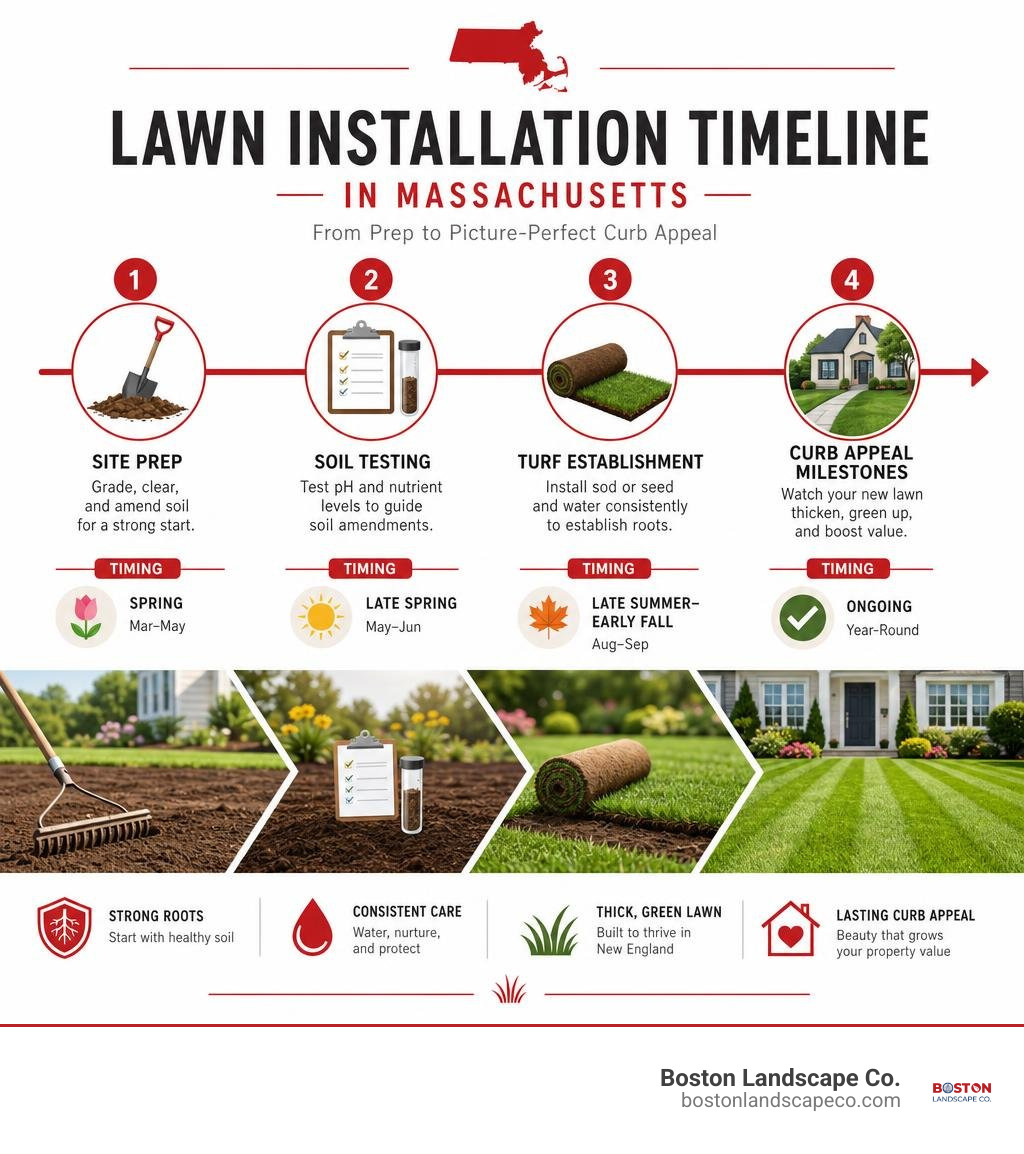
Key Lawn installation Boston MA vocabulary:
Selecting the Best Lawn Installation Boston MA Methods
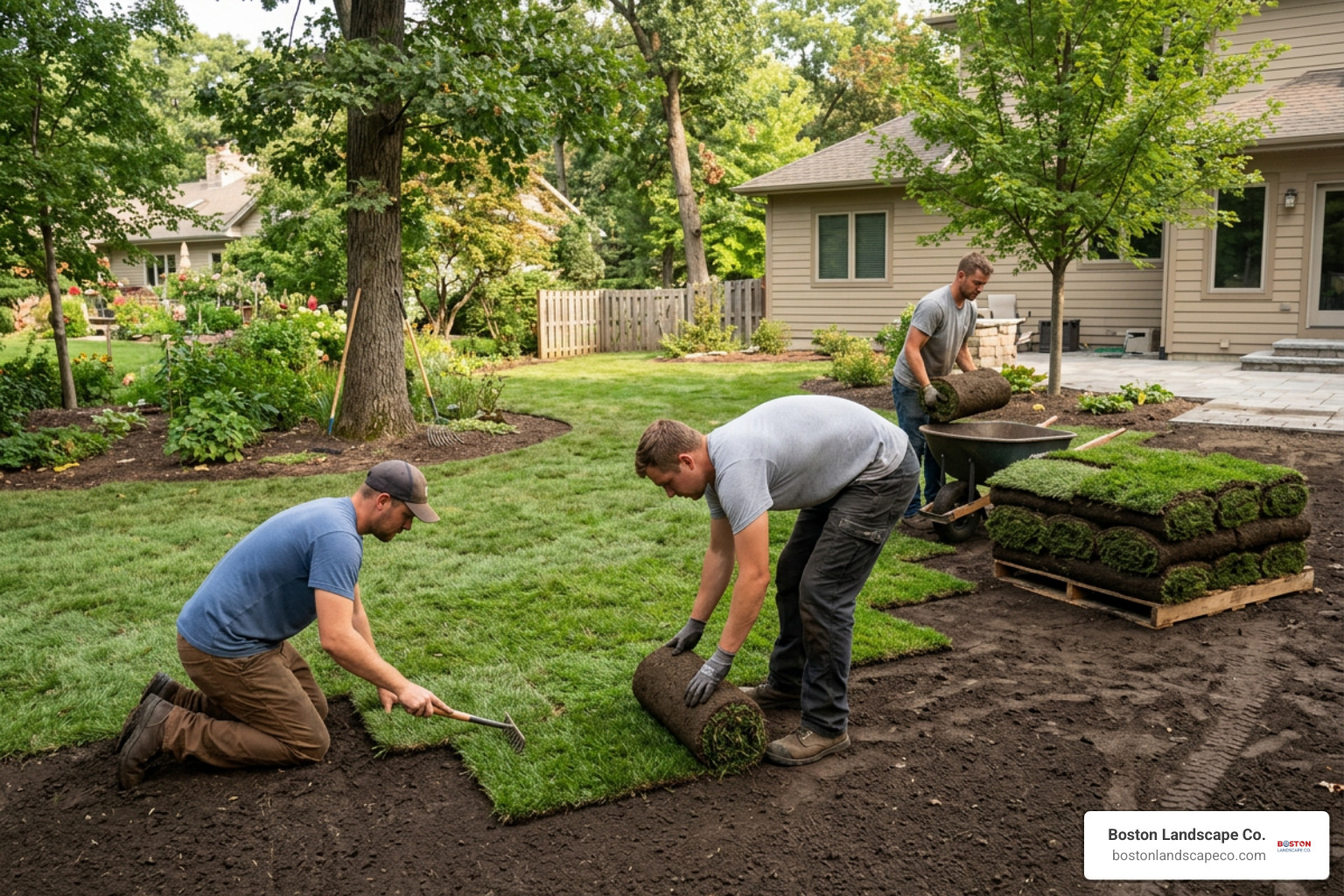
Choosing how to establish your new lawn is the first major decision you will face. Each method has its place depending on your budget, timeline, and the specific layout of your property. Whether we are managing projects in Lexington, Concord, or Billerica, we evaluate the microclimate, terrain, and soil structure before recommending a path forward.
We always emphasize that proper installation requires specialized heavy machinery and precise agricultural knowledge. While DIY guides make it look simple, achieving a level, self-sustaining turf is a complex task best left to professional teams.
To explore all options, you can read our comprehensive Buyer’s Guide: Best Lawn Installation Services for 2026.
Sod Installation for Instant Curb Appeal
If you want an immediate transformation, sodding is the undisputed gold standard. Sod consists of pre-grown, mature turf rolls harvested from local farms and laid directly onto prepared topsoil.
The primary advantage of sod is instant gratification and immediate erosion control. It is particularly effective for sloped yards in areas like Lexington where heavy rains can easily wash away loose seed. However, sod requires perfect soil contact to root successfully. If there are air pockets or if the base soil is too compacted, the roots will fail to penetrate, and the turf will die in patches.
To ensure a successful establishment, professional soil preparation and grading are essential before any sod is laid.
Hydroseeding and Traditional Seeding for Large Properties
For expansive estates, such as those found in Concord, traditional seeding or hydroseeding is often the most practical choice.
Traditional seeding involves broadcasting high-quality seed mixes over prepared soil. While it is highly cost-effective, it requires meticulous care and is highly vulnerable to birds, wind, and heavy downpours.
Hydroseeding, on the other hand, is a highly effective alternative. We spray a pressurized slurry of seed, water, fertilizer, and green wood-fiber mulch directly onto the ground. This slurry binds to the soil, locking in moisture and accelerating seed germination while preventing erosion on steep grades.
To understand how this process works on larger properties, check out our guide on Residential Hydroseeding to learn more about establishing a healthy lawn.
Crucial Site Preparation and Soil Engineering Steps

The secret to a lifetime of green grass is buried beneath the surface. You can purchase the most expensive seed or sod in New England, but if you lay it over poorly engineered soil, it will fail. Most long-term lawn failures in year two or three trace back to shortcuts taken during the excavation and grading phases.
To avoid these pitfalls, read our detailed report on 5 Common Lawn Installation Mistakes You Can’t Afford to Make.
Soil Testing and Amendments for Boston’s Glacial Till
Eastern Massachusetts is famous for its rocky glacial till and dense, acidic clay. This is especially true for Lexington soil profiles, which frequently suffer from compaction and low nutrient availability.
Before we spread a single seed or lay a roll of sod, we perform a comprehensive soil assessment. We send soil samples to the UMass Soil and Plant Nutrient Testing Laboratory to analyze pH, nutrient levels, and organic matter content.
Most local soils require significant pH adjustment; we typically apply agricultural lime to bring acidic soils closer to the ideal 6.5 to 7.0 range. We also rototill 2 to 4 inches of rich organic compost into the existing clay-heavy soils to break up compaction and improve aeration.
Grading and Drainage Solutions to Prevent Water Pooling
Poor drainage is a lawn’s worst enemy. Standing water drowns grass roots, encourages fungal diseases, and turns your yard into a muddy swamp. During our site preparation, we grade the entire area to ensure a gentle 1% to 2% slope away from your home’s foundation and outdoor living spaces.
For properties dealing with severe Billerica drainage challenges, simple grading may not be enough. In these cases, we install subsurface drainage solutions, such as French drains or dry wells, to capture and redirect excess runoff before it can saturate the root zone.
For professional assistance with site preparation, consult a licensed landscaping professional to ensure your property is graded correctly.
Artificial Grass vs. Natural Turf in Eastern Massachusetts
For some homeowners, maintaining natural turf is simply too time-consuming or chemically intensive. In recent years, synthetic turf has emerged as a durable, low-maintenance alternative. Here is how the two options compare:
| Feature | Natural Turf | Artificial Grass |
|---|---|---|
| Initial Cost | Moderate | High |
| Maintenance Need | High (Mowing, watering, weeding) | Low (Occasional brushing, rinsing) |
| Lifespan | Indefinite (with proper care) | 15 to 20+ Years |
| Water Usage | High | Extremely Low |
| Environmental Impact | Supports local ecosystems, cools air | Reduces water use, eliminates chemicals |
| Best For | Traditional aesthetics, active gardens | High-traffic pet zones, roof decks, putting greens |
To explore our natural turf options further, visit our Lawn Installations Boston MA service page.
Choosing Synthetic Turf for High-Traffic and Pet Areas
Traditional grass often struggles to survive the constant wear and tear of active dogs and children. This is why many Burlington residential properties are turning to advanced synthetic turf.
Modern artificial grass is highly sophisticated. Premium products feature advanced molecular technologies like antimicrobial protection to eliminate pet odors, heat-reflective designs to keep the surface cool, and anti-static features. These systems provide a clean, mud-free environment that drains rapidly, making them perfect for playgrounds and heavy-use pet runs.
To see how local property owners manage their lawns, professional maintenance and proper installation are key to keeping synthetic turf looking pristine.
Eco-Friendly and Recyclable Artificial Grass Options
Environmental concerns used to keep homeowners from choosing synthetic grass, but the industry has evolved. Today, we install eco-friendly, 100% recyclable artificial grass systems.
These modern systems replace traditional petroleum-based backings with biobased polymers derived from renewable resources like soybeans. By choosing these sustainable products, Concord homeowners can dramatically reduce their residential water consumption, eliminate the need for chemical fertilizers or pesticides, and ensure that the turf can be fully recycled at the end of its lifespan.
For more information on high-quality synthetic options throughout the region, consulting with a professional installer can help you select the right eco-friendly turf for your property.
Understanding the Cost and Timeline of Professional Lawn Installation
A successful lawn installation requires careful budgeting and seasonal planning. Because every property has unique grading, access, and soil challenges, costs can vary significantly.
Average Cost Breakdown for Lawn Installation Boston MA
When planning your landscaping budget, it is important to look at realistic project costs. Please note that all prices mentioned below are average costs sourced from publicly available internet data and are not the actual prices or rates of Boston Landscape Co.
According to general industry averages, while a basic lawn installation might average around $5,000, a comprehensive professional lawn installation in our region can range widely depending on the square footage, grading difficulty, and the chosen method. To account for industry variability, the low end of a professional project typically starts around $10,000 (two times the basic average), while high-end installations for large estates or extensive soil remediation can reach $25,000 or more (at least five times the basic average).
The final price is heavily influenced by site preparation, old lawn disposal, topsoil delivery, and drainage installation. For example, Burlington lawn projects that require heavy excavation and retaining walls will naturally fall on the higher end of the spectrum.
Typical Project Timelines and Seasonal Windows
Most residential installations are completed within 1 to 3 days on-site, though the preparation work begins weeks in advance.
Timing is everything in New England. The optimal windows for lawn installation in Boston MA are late spring (mid-May to early June) and early fall (late August to mid-September). During these periods, moderate temperatures and consistent rainfall provide the perfect environment for root establishment. Installing grass in the scorching heat of July or the freezing temperatures of November will almost certainly guarantee poor results.
If you are planning a project and need professional mowing support during the transition, working with a dedicated local maintenance team can ensure your property remains neat and tidy.
Post-Installation Care and Long-Term Maintenance
Once your new turf is in place, the critical work of establishment begins. The first month is a make-or-break period that requires strict adherence to professional watering and maintenance protocols.
For ongoing support, you can access our professional Lawn Maintenance Boston MA programs.
Critical Watering Protocols for New Lawn Installation Boston MA
Water is the lifeblood of your new lawn. For the first 10 to 14 days, you must keep the root zone consistently moist. This means watering light and frequently — typically 2 to 3 times daily.
If you installed sod, check that the moisture is penetrating through the sod block and into the underlying topsoil. For seeded or hydroseeded lawns, dry soil will halt germination instantly. We highly recommend installing an automated irrigation system to manage this delicate schedule.
For detailed tips, read our guide on New Lawn Installations Tips for a Lush and Healthy Yard.
First Mowing and Fertilization Schedules
Knowing when to mow your new lawn for the first time is crucial. For sod, wait until the roots have firmly anchored into the soil (test this by gently tugging on a corner of the sod; if it resists, it is ready). This usually takes 10 to 14 days. For seeded lawns, wait until the grass reaches 3 to 4 inches in height. Set your mower deck high, cutting no more than the top 1/3 of the grass blade.
When it comes to fertilization, timing and legality matter. In Massachusetts, all commercial fertilizer and pesticide applicators must be licensed by the state. We coordinate carefully timed applications of slow-release granular starter fertilizers to feed the young roots without burning the tender new blades, keeping your Billerica lawn care schedules on track.
To ensure your lawn receives the best possible care, partner with a licensed and experienced local landscaping company that understands the unique needs of Massachusetts turf.
Frequently Asked Questions About Lawn Installation
How long does it take for a new sod lawn to fully establish?
Under ideal weather conditions and with diligent watering, a new sod lawn will fully establish its root system within 2 to 4 weeks. You should limit heavy foot traffic and keep pets off the lawn during this critical window to prevent shifting and soil compaction.
Can artificial grass increase property value in Boston neighborhoods?
Yes. Modern, high-quality synthetic turf dramatically boosts curb appeal by maintaining a flawless, vibrant green appearance year-round. Homeowners appreciate the elimination of ongoing maintenance costs, mud, and water bills, making it an attractive selling point in premium local real estate markets.
What permits or regulations apply to lawn installations near wetlands?
In Massachusetts, any landscaping work within 100 feet of a wetland, pond, river, or conservation zone is strictly regulated under the Wetlands Protection Act. You must file a Request for Determination of Applicability (RDA) or a Notice of Intent (NOI) with your town’s local Conservation Commission before starting any excavation or grading to ensure proper runoff management and prevent environmental damage.
Conclusion
A beautiful, healthy lawn is the foundation of your property’s outdoor aesthetic. Whether you choose the instant gratification of premium sod, the cost-effective coverage of hydroseeding, or the low-maintenance ease of advanced synthetic turf, the key to success lies in professional site preparation and expert execution.
At Boston Landscape Co., we have spent over 35 years perfecting the art of New England lawn establishment. From initial soil testing and advanced grading to professional installation and automated irrigation systems, our experienced in-house crews handle every single detail. We specialize in residential and commercial landscaping, premium hardscaping features, and comprehensive property maintenance designed to make your yard thrive.
Stop struggling with patchy turf and poor drainage. Let our team deliver the lush, vibrant lawn your property deserves.
Ready to transform your outdoor space?
- Get a Free Estimate: Fill out our quick Online Quote Request Form to schedule an on-site consultation.
- Explore Our Services: Learn more about how we can help by visiting our Professional Lawn Installation Services page.
