
Why Choosing the Right Mulch Companies Matters for Your Garden
Mulch companies vary widely in product quality, delivery options, and local expertise — so knowing what separates a great supplier from an average one can save you time, money, and frustration.
Here’s a quick overview of what to look for:
- Product range — Do they offer hardwood, bark, cedar, colored, and playground mulch?
- Delivery options — Can they deliver bulk mulch directly to your driveway with reasonable minimums?
- Local knowledge — Do they understand regional soil and climate conditions?
- Pricing transparency — Are costs clearly listed, with no hidden delivery fees?
- Quality standards — Is playground mulch IPEMA certified? Is organic mulch free of diseased wood or yard waste?
The U.S. mulch market is worth around $3.5 billion and growing — and for good reason. Property owners who mulch regularly report up to 25% less water usage in their landscapes. With hardwood mulch alone making up nearly 60% of all mulch sold in the country, demand for reliable suppliers has never been higher.
For property owners in areas like Lexington or Concord, finding a supplier who understands Massachusetts soil conditions and seasonal needs makes a real difference in results.
I’m Steve Schumacher, owner of Boston Landscape Co. since 1991, and over more than three decades of working with mulch companies across the Greater Boston area, I’ve developed a clear picture of what quality suppliers look like and which products perform best in our local climate. In this guide, I’ll walk you through everything you need to evaluate your options confidently. If you have any questions or would like to discuss your landscaping needs, contact our team at +781-438-6690.
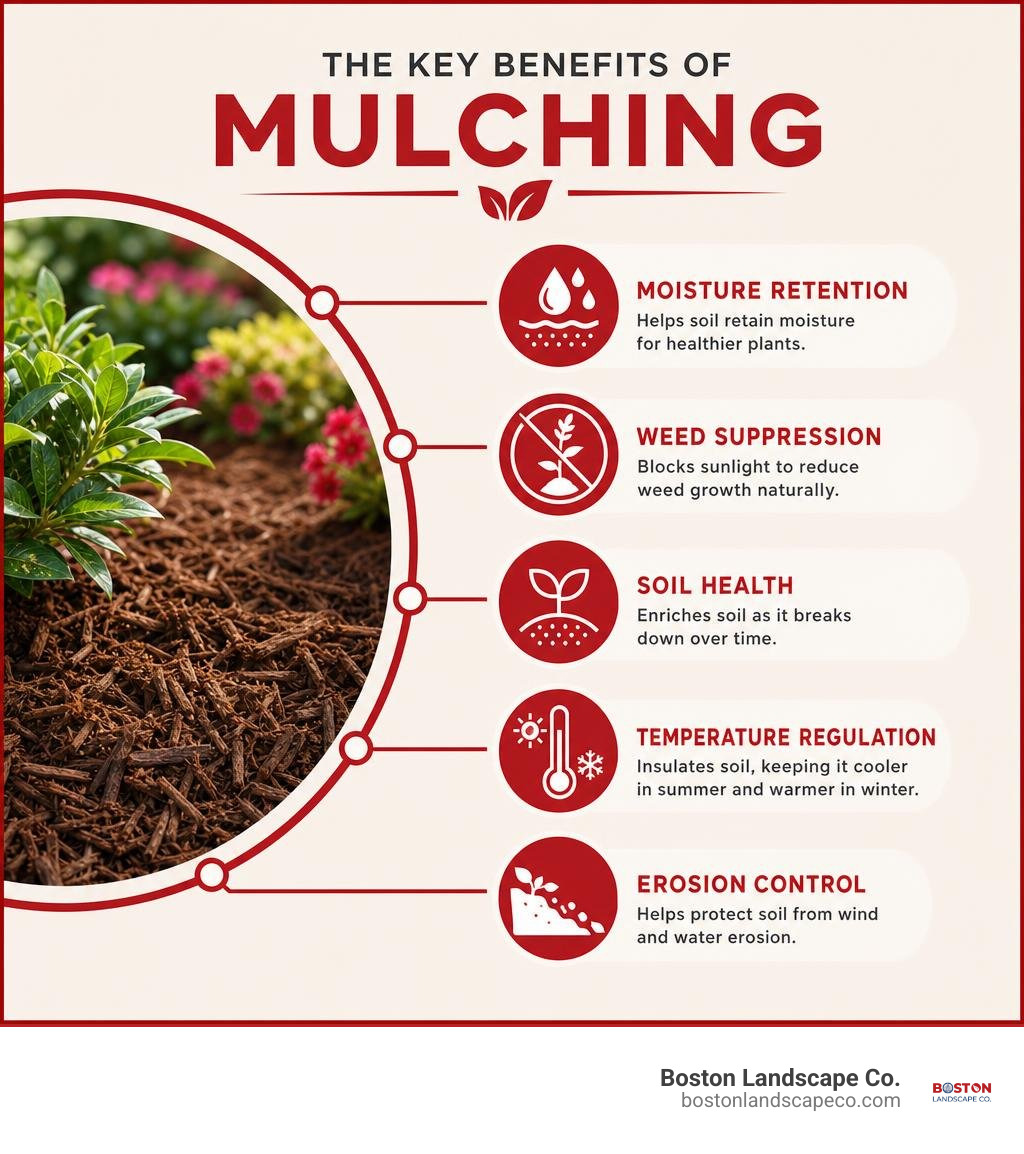
Basic mulch companies terms:
What to Look For in Professional Mulch Companies
When you begin evaluating local mulch companies, it is easy to assume that all wood chips are created equal. However, the sourcing, processing, and customer service standards of your supplier will directly impact the health of your soil and the longevity of your landscape beds.
First and foremost, look at how the supplier sources their raw materials. High-quality mulch companies prioritize virgin wood fibers sourced directly from sustainable lumber mills or verified land-clearing projects. Lower-tier suppliers often rely on municipal yard waste or recycled construction debris. While recycling is generally positive, municipal waste can introduce invasive weed seeds, plant pathogens, and pesticide residues directly into your pristine garden beds.
Additionally, customer service and operational transparency are crucial. Reliable suppliers should offer:
- Clear delivery timelines and flexible drop-off options.
- Easy-to-use digital tools such as online volume calculators.
- Knowledgeable staff who can recommend the right material for your specific plantings.
- Certifications for specialized products, such as playground-safe wood chips.
To ensure your landscape is fully prepared for a fresh layer of material, it is highly recommended to perform a thorough cleanup first. Reviewing our Ultimate Landscape Cleanup Guide can help you coordinate weed removal, edging, and pruning before your delivery arrives. For those who prefer to leave the preparation and heavy lifting to the experts, our professional Yard Maintenance Services ensure your property is in pristine condition to receive its seasonal dressing.
Working with established, professional suppliers ensures you receive high-quality materials that meet rigorous standards for your commercial or residential landscape.
Types of Mulch Offered by Local Suppliers

The best mulch companies offer a diverse catalog of products designed to meet different aesthetic tastes and ecological needs. In Eastern Massachusetts, our climate demands products that can handle wet, freezing winters and hot, humid summers.
- Hardwood Mulch: Sourced from shredded deciduous trees, hardwood mulch is the workhorse of the industry. It knits together tightly on slopes, making it excellent for erosion control. It decomposes relatively quickly, returning valuable organic matter to the soil.
- Bark Mulch: Made from the outer bark of softwood trees like pine, hemlock, and spruce, bark mulch is highly prized for its rich, natural color and slow decomposition rate. It is highly resistant to fading and adds a premium look to estate gardens.
- Cedar Mulch: Known for its longevity and pleasant aroma, cedar contains natural oils that repel insects like termites and ants. It is an excellent choice for beds surrounding home foundations.
For property owners in Lexington or Concord, choosing a species-appropriate mulch is key to maintaining soil acidity levels. For instance, acid-loving plants like rhododendrons and azaleas thrive under a blanket of pine or hemlock bark. You can explore these material choices in depth through our comprehensive Yard Maintenance Services page.
Selecting regional varieties tailored to our local plant palette ensures your landscape beds remain healthy and vibrant throughout the changing seasons.
Organic vs. Inorganic Options from Mulch Companies
When selecting a ground cover, you must weigh the benefits of organic materials against inorganic alternatives.
Organic mulches (wood chips, bark, pine needles, and straw) decompose over time. This decomposition is highly beneficial because it feeds soil microorganisms, improves soil structure, suppresses weeds, and maintains consistent root temperatures. If you are looking for a lightweight, agricultural option for vegetable gardens or newly seeded lawns, you might consider the benefits outlined in our guide on Clean Straw Mulch.
Inorganic mulches (rubber mulch, stone, and gravel) do not decompose.
- Rubber mulch, often made from recycled tires, is highly durable and does not attract insects. It is popular for high-traffic play areas.
- Stone and gravel provide a permanent, clean look and are excellent for drainage pathways.
While inorganic options require less frequent replacement, they do not enrich the soil. For active garden beds in areas like Lexington, organic wood or bark mulch remains the superior choice for long-term plant health.
Specialty and Certified Playground Mulch
For schools, daycare centers, and recreational play structures, standard landscaping mulch is not suitable. Specialized mulch companies supply certified playground mulch, often sold under the name engineered wood fiber (EWF).
This material must hold an IPEMA (International Play Equipment Manufacturers Association) certification. Unlike standard mulch, certified playground chips are:
- Sliver-Free: Processed to eliminate sharp edges and large splinters.
- Impact-Absorbing: Engineered to cushion falls from play equipment.
- Chemical-Free: Manufactured from virgin wood without the use of toxic dyes, chemical treatments, or recycled pallet wood containing nails.
When choosing a playground material, always verify that the supplier has up-to-date safety certifications to protect the children using the space.
Bulk vs. Bagged Delivery Options in Massachusetts
One of the most important decisions you will make when ordering is whether to purchase bulk material or bagged products.
| Feature | Bulk Mulch | Bagged Mulch |
|---|---|---|
| Cost Per Yard | Significantly lower; highly cost-effective for large projects | Higher unit cost due to packaging and handling retail fees |
| Labor & Handling | Requires shoveling and wheelbarrowing from a central pile | Easy to carry, place, and open exactly where needed |
| Storage & Mess | Left in a large pile on your driveway; can leave temporary stains | Neatly stacked on a pallet; can be stored long-term in bags |
| Ideal Project Size | Best for properties requiring 3+ cubic yards of material | Best for small touch-ups, containers, or hard-to-reach beds |
For property owners in Billerica or Burlington, bulk delivery is almost always the most economical route for seasonal refreshing. To understand how to coordinate these logistics smoothly, read our helpful tips on The Easiest Ways to Get Garden Mulch Delivered This Spring.
Utilizing a professional bulk delivery service ensures that large volumes of material are transported and placed efficiently on your property.
Delivery Logistics and Minimum Orders for Mulch Companies
Before scheduling a drop-off with bulk mulch companies, it is vital to understand their delivery policies and logistics requirements.
Most bulk suppliers have a minimum order size for delivery, typically ranging from 3 to 5 cubic yards. If your project falls below this threshold, you may need to pick up the material yourself using a truck or opt for bagged products.
When preparing for a driveway delivery, keep these best practices in mind:
- Clear the Area: Ensure your driveway is clear of vehicles, basketball hoops, and trash cans.
- Mark the Spot: Place a tarp down to protect your driveway from oil residues or temporary dye stains, and mark the exact drop-off spot with a cone or chalk.
- Check for Overhead Obstacles: Ensure there are no low-hanging tree branches or power lines that could obstruct the dump truck’s raised bed.
If you are coordinating a larger landscape renovation in Burlington or Billerica, professional suppliers often offer combined delivery of other essential materials, such as crushed stone, gravel, and clean loam, to streamline your project logistics.
For a hands-off experience where the material is delivered and professionally applied to your beds, consider our guide on how to Spread the Love Not the Labor with Professional Mulch Services.
Average Costs and Pricing of Mulch Services

Note: All prices mentioned below are average costs sourced from publicly available internet data and do not represent the actual pricing or service rates of Boston Landscape Co.
When budgeting for your landscaping project, it is helpful to understand the wide range of pricing in the industry. Because of variations in wood species, dye quality, processing methods, and regional delivery fees, prices fluctuate significantly.
Based on general online data, while the average cost of bulk mulch is approximately $30 per cubic yard, actual market prices vary widely. To account for this industry variability across the state, bulk mulch prices typically range from $60 to $300 per cubic yard delivered.
- Natural Double-Shredded Hardwood: Typically sits on the lower end of the pricing spectrum.
- Premium Bark Mulches (such as Hemlock or Cedar): Sit on the higher end of the spectrum due to their specialized sourcing and natural pest-resistant properties.
- Dye-Enhanced Mulches (Black, Brown, Red): Usually command a slight premium over standard natural hardwood.
If you are hiring a professional team to handle both the delivery and the labor of spreading the material, you will also need to factor in professional installation costs. This is often bundled into comprehensive seasonal cleanup services. To understand how these costs are calculated, you can read our detailed breakdowns on How Much Does a Spring Clean Up Cost? and the Average Cost of Spring Yard Clean Up.
Frequently Asked Questions about Mulch Delivery
How do I calculate how much mulch I need?
Calculating your material needs is a straightforward mathematical formula based on your total square footage and your desired depth. For standard landscape beds, a 3-inch depth is the industry gold standard for weed suppression and moisture retention.
To calculate:
- Measure the length and width of your garden beds in feet.
- Multiply length by width to get the square footage of each bed, then add them together for your total square footage.
- Multiply your total square footage by your desired depth in inches (e.g., 3 inches).
- Divide that number by 324 to find the total cubic yards needed (since 1 cubic yard covers 324 square feet at 1 inch deep, or 108 square feet at 3 inches deep).
Example: If you have 600 square feet of beds and want a 3-inch depth:600 / 108 = 5.5 cubic yards (round up to 6 yards for safety).
Is it better to buy bulk or bagged mulch?
For small projects under 2 cubic yards, bagged mulch is highly convenient. It is easy to transport and can be placed exactly where needed without creating a temporary storage pile.
However, for larger projects, bulk is vastly superior. It is significantly cheaper per cubic yard, reduces plastic waste, and is typically of higher quality than bagged wood chips, which can sit in plastic bags for months developing sour, anaerobic odors.
Can I apply new mulch over old mulch?
Yes, you can apply new material over an existing layer, but you must take a few precautions to protect your plants.
First, ensure the total depth of the old and new material does not exceed 3 to 4 inches. If the mulch becomes too thick, it can prevent oxygen and water from reaching the soil, effectively suffocating your plants’ root systems.
Second, check the condition of the old layer. If it has compacted into a hard, crusty mat, use a rake to break it up and aerate it before adding a fresh layer. If you have weed growth or accumulated winter debris, it is highly recommended to perform a thorough cleanup first. You can learn more about scheduling these essential prep steps through our Spring Yard Clean Up Services page.
Conclusion
Investing in high-quality materials from reputable mulch companies is one of the most effective ways to protect your plants, enrich your soil, and elevate your property’s curb appeal. Whether you are managing a residential estate or a commercial property, choosing the right material and delivery method makes all the difference.
At Boston Landscape Co., we provide comprehensive, professional landscaping and hardscaping services tailored to the unique climate of Eastern Massachusetts. From seasonal cleanups to professional mulch installation, our team is proud to serve residential and commercial properties in Billerica and the surrounding towns.
Let us handle the heavy lifting and ensure your beds are perfectly prepped, edged, and mulched for the season.
Ready to transform your landscape?
- Request an estimate online: Get a Free Quote
- Learn more about our local services: Get Professional Mulch Services in Billerica
Like us on Facebook!
