
The Lawn Installation Mistakes That Cost Massachusetts Property Owners the Most
Lawn installation services done right can increase property value and curb appeal — but done wrong, they can lead to costly repairs, restarts, drainage corrections, and wasted materials.
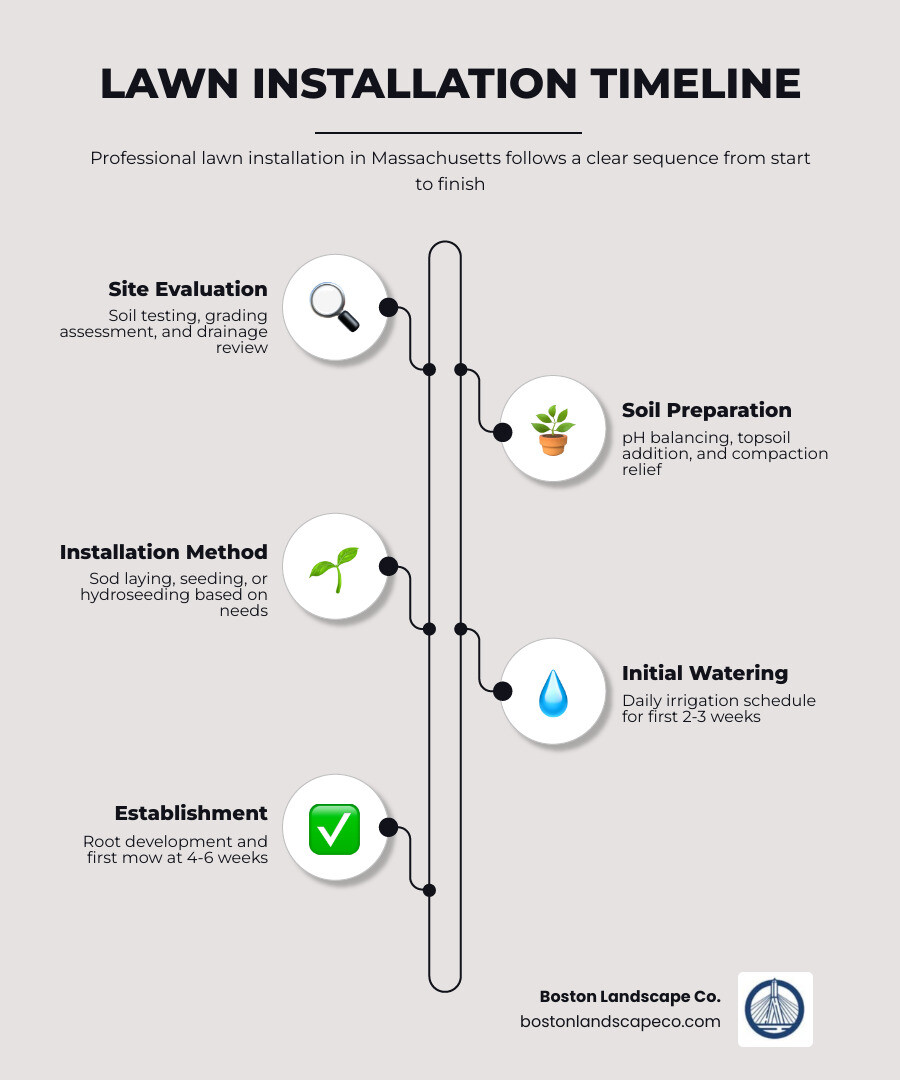
Here’s a quick overview of what professional lawn installation involves and what to watch out for:
What lawn installation services typically include:
- Site evaluation and soil testing
- Grading and drainage correction
- Soil conditioning and topsoil addition
- Sod laying, grass seeding, or hydroseeding
- Post-installation watering guidance and care instructions
The 5 most common mistakes property owners make:
- Choosing the wrong installation method (sod vs. seed vs. hydroseeding)
- Skipping soil preparation and proper grading
- Installing at the wrong time of year
- Underestimating the true cost of the project
- Neglecting watering and care after installation
A new lawn is one of the highest-impact investments you can make in a property. But the difference between a lawn that thrives and one that fails within a season almost always comes down to how it was installed — not just what was planted.
Whether you’re developing a site after new construction or replacing worn-out turf in Burlington, Bedford, Billerica, or Lexington, the process matters far more than most property owners expect.
I’m Steve Schumacher, owner of Boston Landscape Co. since 1991, and over more than three decades of delivering lawn installation services across the Greater Boston area, I’ve seen the same avoidable mistakes come up time and again. In this guide, I’ll walk you through each one so you can make smarter decisions for your property from the start.
For related outdoor upgrades, explore our Lawn improvement services, Lawn sprinkler installation, and artificial grass installation near me services.
Call +781-438-6690 or request a quote here: https://bostonlandscapeco.com/request-estimate/
Mistake 1: Choosing the Wrong Method for Your Property’s Needs
When it comes to establishing a new lawn, there is no one-size-fits-all solution. Homeowners often choose an installation method based solely on the upfront price tag, without considering their property’s unique terrain, shade profile, or usage needs.
The three primary methods of lawn establishment are traditional seeding, hydroseeding, and sod installation. Selecting the wrong one can lead to severe erosion, weed infestations, or a lawn that simply fails to thrive.
For instance, if your property has sloped areas, traditional grass seed is highly susceptible to washing away during the first heavy Massachusetts rainstorm. In these cases, opting for Lawn Replacement Services that utilize sod or advanced Hydroseeding Services is critical to lock the soil in place and prevent erosion.
Sod provides instant dense coverage, which naturally discourages weed growth right from day one. Traditional seeding, on the other hand, leaves bare soil exposed to airborne weed seeds for weeks, requiring extensive weed management later on. When we consult with homeowners seeking professional lawn installation services in Bedford, MA, we evaluate these environmental factors to recommend the most sustainable and successful approach for their specific land.
Sod vs. Seed: Key Differences in Lawn Installation Services
Understanding the biological and practical differences between sod and seed is essential for making an informed investment. Sod is mature, living turf grown locally on specialized farms, harvested with a thin layer of soil, and laid down like a puzzle. Seed requires patience, precise moisture levels, and ideal weather conditions to germinate.
Germination rates and establishment times vary dramatically between these methods. While traditional grass seed can take anywhere from 7 to 21 days just to begin germinating, sod offers an instant green space that can handle light foot traffic in as little as two to three weeks. If you are considering hydroseeding—a process where a slurry of seed, mulch, fertilizer, and water is sprayed onto the soil—you might wonder, How Long Does It Take for Hydroseed to Grow?. Generally, hydroseed sprouts within 10 to 14 days, offering a middle ground between traditional seed and instant sod.
To help you compare your options, here is a breakdown of how these three primary methods perform across key categories:
| Feature / Benefit | Sod Installation | Traditional Grass Seed | Hydroseeding |
|---|---|---|---|
| Upfront Cost | Higher initial investment | Lowest initial cost | Moderate cost |
| Establishment Time | Instant lawn; usable in 2–3 weeks | 6–12 months for full density | 3–5 weeks for initial coverage |
| Erosion Control | Excellent (immediate stabilization) | Poor (highly prone to washout) | Good (mulch slurry binds to soil) |
| Weed Resistance | High (dense turf crowds out weeds) | Low (bare soil invites weed growth) | Moderate (rapid germination helps) |
| Water Requirement | High initial watering (4+ times/day) | Moderate, consistent moisture | Moderate, moisture-retaining mulch |
| Best Use Case | Slopes, high-traffic yards, instant curb appeal | Large flat acres, budget-friendly projects | Slopes, large residential lots, rapid seeding |
Choosing the right method requires balancing your budget, timeline, and physical property constraints. For premium results, partnering with experienced local professionals ensures that the method matches your soil type and yard layout.
Mistake 2: Neglecting Soil Preparation and Grading
The most common reason new lawns fail has nothing to do with the grass itself—it has to do with the soil beneath it. Many low-cost installations skip the labor-intensive work of soil preparation and grading, opting to spread seed or lay sod directly over compacted, nutrient-poor ground. This is a recipe for failure.
Before any turf or seed is laid down, a comprehensive site assessment and professional soil testing are highly recommended. Massachusetts soils can vary widely. For example, when addressing clay soil and grading in Billerica, MA, we often encounter heavy, compacted glacial till that drains poorly. Without proper soil conditioning, grass roots cannot penetrate the hard dirt, leading to a shallow root system that declines during the first dry spell.
Proper grading is equally critical. Grading ensures that the site is level and sloped away from building foundations. Poor grading leads to low spots where water pools, drowning grass roots and creating muddy areas, while also increasing the risk of drainage issues around structures. According to the University of Massachusetts Amherst Extension, understanding local soil composition and proper site preparation are foundational to successful turf establishment in New England.
Why Soil Conditioning Matters for Professional Lawn Installation Services
Soil conditioning is the process of physically and chemically modifying the soil to create the right environment for root development. Compacted soil lacks the pore space necessary for oxygen, water, and nutrients to reach the grass roots.
To fix this, professional lawn installation services involve roto-tilling the existing dirt, clearing out rocks and debris, and incorporating 2 to 5 inches of high-quality organic topsoil. We aim for an organic matter content of 3% to 5% and adjust the soil pH to an optimal range of 6.3 to 6.8 using lime or sulfur based on soil test results.

Using professional-grade equipment, such as excavators and hydraulic Harley rakes, allows us to pulverize compacted soil, blend in soil conditioners, and create a smooth, level seedbed. This level of preparation is difficult to achieve without commercial equipment, which is why professional site preparation is the foundation of every successful lawn installation in Bedford, Burlington, and Billerica.
Mistake 3: Poor Timing and Seasonal Planning
Timing is everything when installing a new lawn in Massachusetts. Trying to establish grass during the peak of summer heat or too close to the winter freeze is one of the fastest ways to waste your investment.
In Massachusetts, our climate dictates that we primarily grow cool-season grasses, such as Kentucky Bluegrass, Tall Fescue, and Fine Fescue. These grass varieties thrive in moderate temperatures and consistent rainfall. Therefore, the absolute best times of year for lawn installation are early spring (late April to May) and early fall (late August to September).
- Spring Installation: The soil is warming up, and natural rainfall is often abundant. However, spring installations must be timed carefully to avoid the last hard frost and to ensure the grass is strong enough to handle summer stress.
- Fall Installation: This is widely considered the ideal window. The soil is warm from the summer, temperatures are cool, and weed competition is minimal. This gives the grass roots several months to establish before winter dormancy.
If you schedule installation in the middle of July, the extreme heat will stress the young grass, requiring an unsustainable amount of watering to keep it alive. Conversely, planting too late in the fall means the roots may not have time to anchor before the ground freezes, leading to winterkill.
When planning turf projects in Bedford, Burlington, Chelmsford, and Lexington, we carefully coordinate timing around local site conditions and seasonal biology so installations occur during the best window for root establishment and long-term success.
Mistake 4: Underestimating the True Cost of Lawn Installation Services
A successful lawn installation is an investment, and like any exterior improvement project, cutting corners to save money upfront often leads to much higher costs later. Property owners frequently underestimate the total cost of a professional installation because they only look at the retail price of grass seed or sod rolls, overlooking labor, equipment, site prep, grading, and soil amendments.
To help with budgeting, it is useful to look at general industry pricing.
Note: All prices mentioned below are average costs sourced from publicly available internet data and are not the actual prices of Boston Landscape Co.
According to general industry averages and online data, the installed cost for new sod can vary dramatically based on project size, access, drainage conditions, soil preparation, and regional labor. To reflect that variability, broad market ranges may run from $4.00 to $20.00 per square foot installed.
For larger properties, understanding The Cost of Sod Per Acre is essential, as bulk materials and heavy machinery are required to manage the volume of land. If the existing turf is dead, thin, or weed-heavy, you may also need to account for the Average Cost to Resod a Lawn, which includes old turf removal, disposal, and regrading.
Several factors influence the final price of your project:
- Site Accessibility: Can heavy machinery easily access the work area, or does material have to be moved by hand?
- Prep Work Needed: Does the site require tree and rock removal, or major drainage and grading corrections?
- Soil Quality: How many yards of premium topsoil and compost need to be brought in to condition the ground?
- Irrigation Setup: Is there an existing sprinkler system, or will one need to be installed to support the new turf?
Investing in proper site preparation up front helps avoid tearing out and replacing a failed lawn later.
Mistake 5: Inadequate Post-Installation Care and Irrigation
You can install high-quality sod or a premium seed blend, but if it is not watered correctly, it will fail. Inadequate watering is one of the leading causes of post-installation lawn failure.
New lawns have delicate, shallow root systems. For the first few weeks, they have limited ability to search deep into the soil for moisture. If the top inch of soil dries out, young grass plants can decline quickly.
If you are searching for professional Lawn Installation Near Me for a project in Burlington, Bedford, Billerica, or Lexington, make sure there is a clear irrigation and aftercare plan in place from day one. Post-installation watering schedules across Massachusetts require close attention:
- Sod Watering Schedule: New sod typically needs watering 4+ times a day for the first 10 to 14 days. The goal is to keep the sod rolls and the top inch of soil beneath them consistently moist, without creating muddy conditions, so the roots can knit into the ground.
- Seeded Lawn Watering Schedule: Seeded areas require light, frequent watering (2 to 3 times daily) to keep the seedbed damp. If the seeds dry out after germination begins, establishment can fail.

Along with watering, early care also matters. Limit foot traffic on new lawns for at least 3 to 4 weeks. When the grass reaches about 3.5 to 4 inches tall, it is ready for its first mow—but ensure mower blades are sharp, and never remove more than the top third of the blade height.
For properties that need irrigation support, see our Lawn sprinkler installation service.
Frequently Asked Questions About Lawn Installation
How long does it take for a newly installed lawn to establish and be ready for use?
The timeline depends heavily on the method used. For seeded lawns, germination typically begins within 7 to 21 days. However, it often takes a full cool-season growing cycle (6 to 12 months) for a seeded lawn to become fully dense and mature.
For sod, root establishment begins within the first 10 to 14 days. You can test this by gently pulling up on a corner of a sod roll; if you feel resistance, the roots are taking hold. While sod looks complete immediately, it is best to wait at least 3 to 4 weeks before allowing heavy foot traffic or regular use.
What are the benefits of hiring a professional lawn installation service versus DIY?
Installing a new lawn is labor-intensive and requires specialized knowledge, careful timing, and commercial machinery. For that reason, most projects are best handled by a professional service rather than as a DIY installation.
Hiring a professional service offers several key advantages:
- Specialized Equipment: Professionals use commercial sod cutters, rototillers, tractors, and hydraulic grading rakes that help create a properly prepared surface.
- Sourcing Premium Materials: Professionals have access to fresh, locally grown, weed-free sod and high-germination seed blends tailored to Massachusetts conditions.
- Guaranteed Prep Work: Experienced crews know how to test soil, correct drainage issues, and apply the soil amendments needed for long-term performance.
- Warranty and Support: Many professional installations include service support and aftercare guidance.
What local regulations or environmental factors should be considered in Massachusetts?
In Massachusetts, environmental compliance matters. Property owners must follow local yard waste disposal regulations, and vegetative debris removed during preparation must be disposed of properly through approved facilities.
Additionally, many towns in Middlesex County enforce seasonal water restrictions during dry summer months. It is important to plan installation during spring or fall when rainfall is more supportive, or to confirm watering rules with the local water department before work begins. If a property is near protected wetlands in towns such as Concord or Billerica, grading and fertilizer applications may also need to comply with local Conservation Commission guidelines.
Conclusion
Installing a new lawn is a major project that can transform curb appeal, improve site usability, and enhance property value. Avoiding common problems like poor soil prep, improper timing, and the wrong installation method is the best way to protect that investment.
At Boston Landscape Co., we have been helping residential and commercial property owners across Massachusetts design, install, and maintain high-quality outdoor spaces since 1991. Whether you need premium sod, hydroseeding, artificial grass installation near me, Lawn improvement services, or Lawn sprinkler installation, we bring the local expertise, professional equipment, and dependable service needed to get the job done right.
We proudly serve clients throughout Middlesex County, including Burlington, Bedford, Billerica, and Lexington, with professional lawn installation services tailored to Massachusetts conditions.
Ready to upgrade your property with a healthy, professionally installed lawn? Request your free on-site consultation and estimate below.
