
Hardscaping Sloped Yard: Top 5 Ultimate Solutions!
Your Sloped Yard is an Opportunity, Not an Obstacle
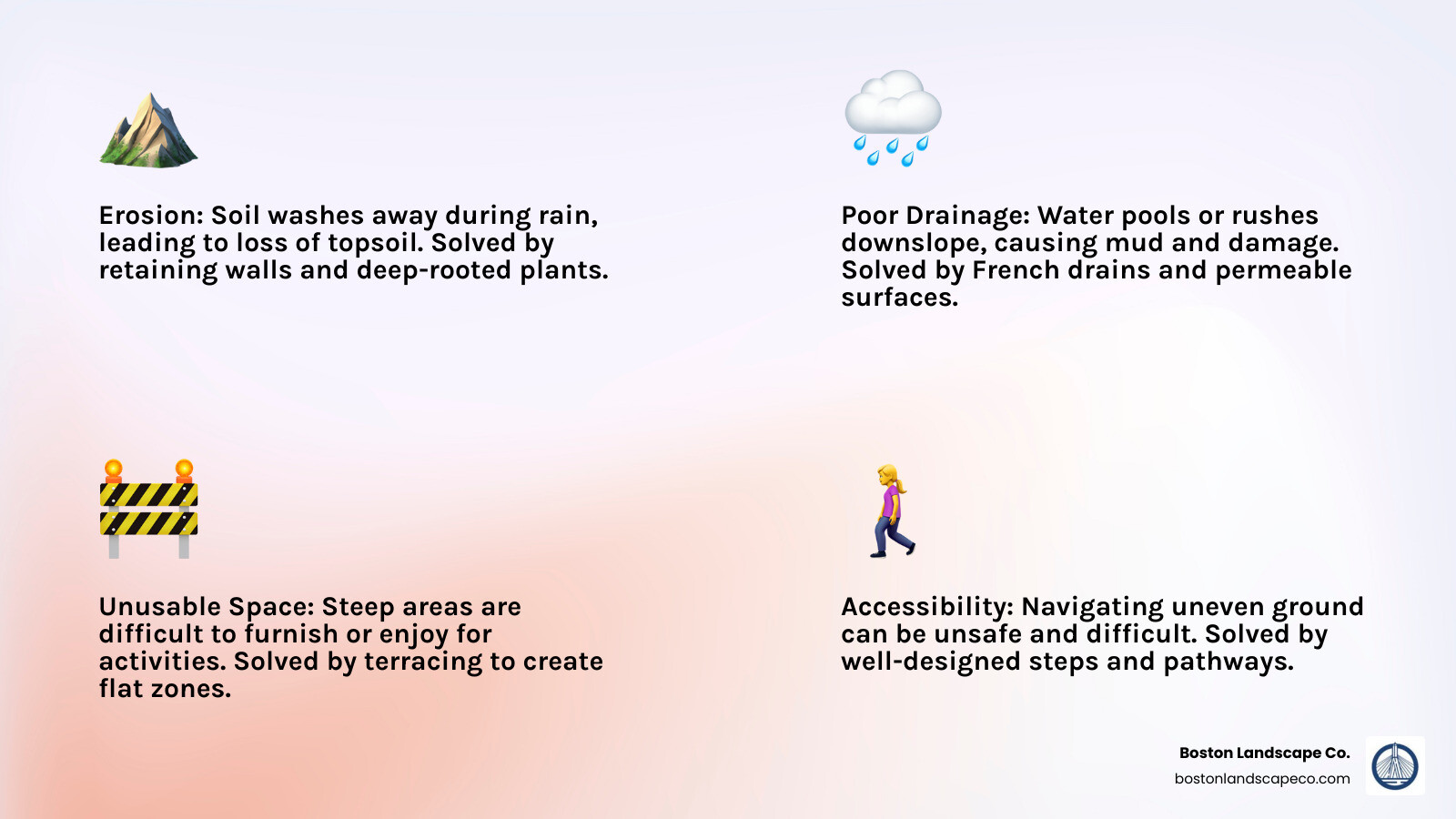
Hardscaping sloped yard challenges can be transformed into stunning outdoor spaces with the right approach. As the New England weather warms up, you might see a challenge, but we see potential. A sloped yard offers a unique canvas for a dynamic, multi-level outdoor living space that flat yards can’t match.
Homeowners on sloped properties often face erosion, poor drainage, and unusable space. With proper hardscaping, these problems become opportunities. Terraced gardens can showcase spring bulbs, stone steps can wind through emerging perennials, and a sunken patio can provide a sheltered spot for the first outdoor meals of the season.
This guide will walk you through the best hardscaping solutions to make your slope work for you. Key solutions include:
- Retaining Walls: Create level areas and prevent erosion.
- Terracing: Build multiple flat zones for patios, gardens, and play areas.
- Steps & Pathways: Ensure safe access between levels.
- Drainage Systems: Manage water with French drains and permeable surfaces.
- Strategic Planting: Stabilize soil with deep-rooted plants.
I’m Steve Schumacher, owner-operator of Boston Landscape Co. since 1991. For over three decades, my team has helped Greater Boston homeowners solve their sloped yard challenges by turning New England’s hilly terrain into functional, beautiful outdoor spaces.
Learn more about hardscaping sloped yard:
Understanding the Basics of Hardscaping a Sloped Yard
Before starting, careful preparation is key to ensuring your investment lasts for decades. Hardscaping a sloped yard requires a thorough understanding of your property’s unique conditions.
First, we evaluate the slope’s grade, which determines which solutions are safe and practical. Next, soil analysis is crucial; sandy soils erode easily, while clay can become waterlogged, creating immense pressure behind walls. Understanding your soil helps in choosing the right materials and techniques. We also consider accessibility and safety to ensure the final space is enjoyable and easy to steer. Finally, we focus on creating functional zones and maximizing views, turning a single unusable hillside into distinct outdoor rooms with privacy and architectural interest.
Preliminary Design Considerations
A successful project begins with a site analysis to understand sun exposure, existing vegetation, and natural water flow. From there, we develop a master plan that aligns your wishlist with a buildable blueprint, considering budget and phasing. Choosing a style that integrates with your home’s architecture is also key. A naturalistic look with boulders suits traditional New England homes, while modern designs may call for cleaner lines and segmented blocks.
Need some inspiration? These 11 Design Solutions for Sloping Backyards showcase creative approaches. For local ideas, our Backyard Hardscape Design portfolio shows what’s possible with New England terrain.
The Importance of Drainage and Erosion Control
Proper drainage is the unsung hero of sloped yard hardscaping. Water is the number one enemy, creating hydrostatic pressure that can topple walls. This is especially true in Massachusetts, where freeze-thaw cycles turn small drainage issues into major structural failures by spring.
Effective solutions include:
- French Drains: Subsurface trenches that intercept and redirect water away from structures.
- Weep Holes: Openings in retaining walls that allow trapped water to escape.
- Permeable Pavers: Surfaces that let rainwater soak through, reducing runoff and erosion.
- Swales and Dry Creek Beds: Landscaped channels that slow and direct heavy water flow during storms.
- Deep-Rooted Plants: A living erosion control system that anchors soil and absorbs water.
Proper drainage is critical for all sloped projects, including specialized ones like an In Ground Trampoline Drainage system, where pooling water can cause significant damage.
Top 5 Hardscaping Solutions for Sloped Yards
Now that we’ve covered the basics, let’s dive into the core solutions for your hardscaping sloped yard challenges. These five approaches, used individually or in combination, can transform your challenging slope into a stunning, usable landscape.
Think of these as building blocks. A successful project often combines retaining walls with terracing, adds safe pathways, and integrates plantings to soften the edges. As spring arrives, understanding these solutions will help you envision what’s possible, whether you’re dreaming of a terraced garden, a stone patio, or simply safe access to your yard.
1. Retaining Walls: The Foundation of Slope Management

Retaining walls are the backbone of hardscaping sloped yard projects. They are structural powerhouses that prevent soil erosion and manage water runoff, turning an unusable hillside into level, functional spaces. By creating terraced levels, a steep slope can become a series of flat zones perfect for a patio, garden, or play area. For specialized projects, like an in-ground trampoline on a slope, a properly engineered In Ground Trampoline Retaining Wall is essential for safety.
Material choice affects both the look and longevity of your wall:
- Segmented Concrete Blocks: Affordable, durable, and engineered to interlock for strength. Many modern varieties mimic the look of natural stone.
- Natural Stone & Boulders: Offer timeless beauty and can last for over 100 years. Fieldstone provides a rustic New England look, while cut stone is more formal.
- Timber: A budget-friendly option with a warm, natural look, ideal for garden beds. Expect a lifespan of 15-20 years in our humid climate.
- Corten Steel: Provides a modern, industrial elegance with a protective rust-colored patina that contrasts beautifully with plantings.
Properly installed walls maintain their integrity for decades. Learn more about our quality construction methods on our Retaining Wall Construction page.
2. Terracing: Creating Functional Outdoor Rooms
Terracing transforms a continuous slope into a series of flat, usable plateaus, creating multiple “outdoor rooms” stacked vertically. Each level becomes its own destination, making your yard feel exponentially larger and more functional.
You might design an upper dining patio to catch the evening sun, with a cozy fire pit area nestled a few steps down for shelter on cool spring nights. Another level could hold a sun-lounging space or a flat play area for children, providing a secure space to run around.
For gardeners, terraced garden beds are a game-changer. They prevent soil erosion, improve drainage, and bring plants to a comfortable, accessible height. You can even tuck plants into wall crevices to create living walls that soften the hardscape.
Our team at Boston Landscape Co. designs these multi-level spaces to flow naturally, connected by safe pathways. This approach to hardscaping sloped yard challenges turns unusable terrain into the most interesting part of your property. See examples of our Boston Outdoor Patios and learn about our work as Backyard Hardscape Contractors.
3. Steps and Pathways: Ensuring Safe and Neat Access
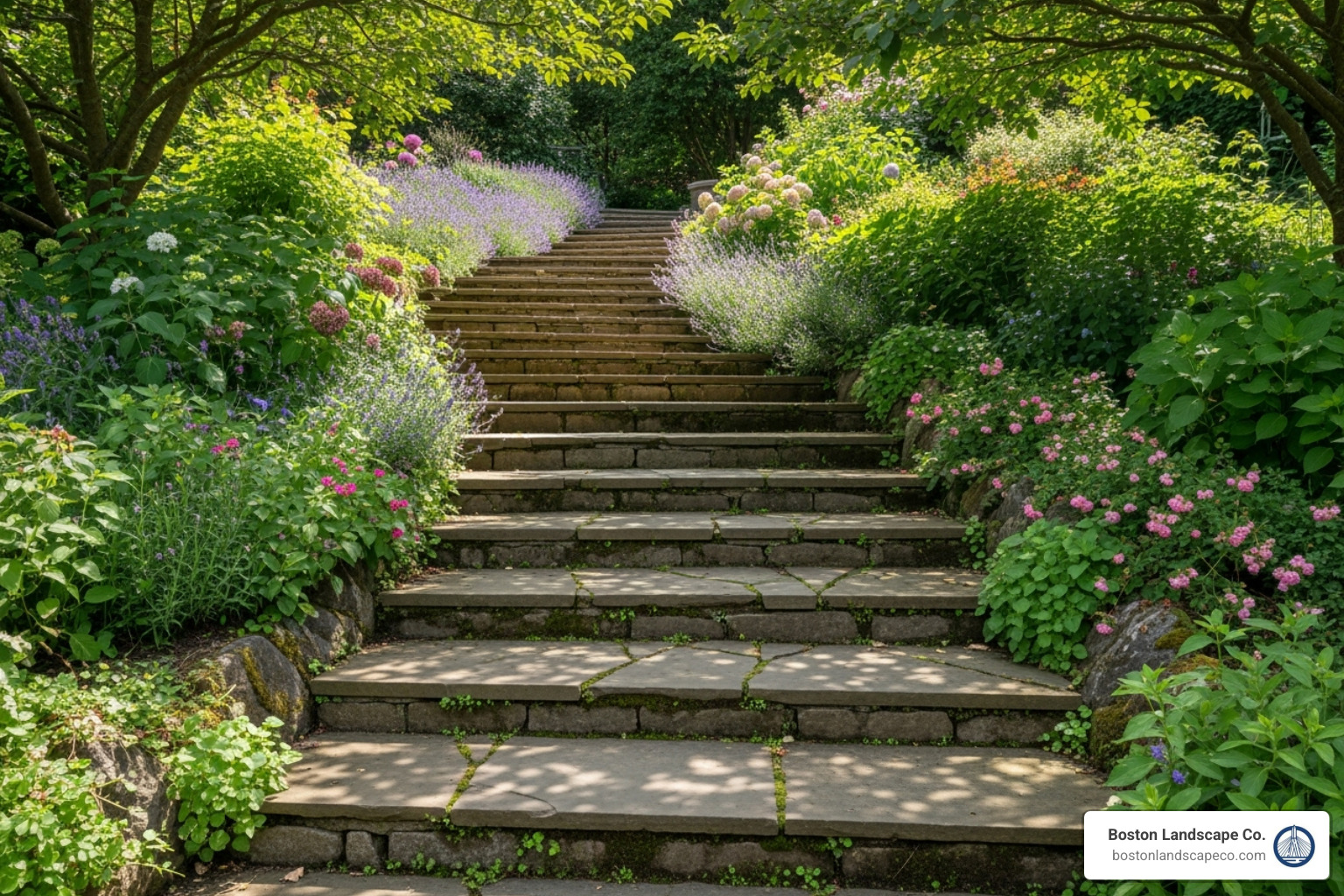
Once you have terraced levels, you need a safe, attractive way to move between them. Thoughtfully designed steps and pathways are not just practical; they are design elements that guide visitors through your landscape. This is especially important in spring, when dew and rain can make slopes slippery.
When it comes to hardscaping sloped yard access, material choice is key:
- Stone Slabs: Offer best durability and a timeless, natural look with excellent traction.
- Pavers: Provide design flexibility with uniform surfaces and countless pattern options.
- Brick: Brings classic New England charm, especially if matching your home’s architecture.
- Gravel: A softer, more naturalistic approach, though it requires more maintenance on slopes.
The design is just as important. On steep slopes, wide, meandering steps are safer and more comfortable than a direct ascent. They also create opportunities for planting pockets along the path. Straight pathways work well on gentler slopes for a more formal look. We recommend a width of at least 36 inches for primary routes to allow for comfortable passage.
Our team has decades of experience in Stone Steps Installation Boston, ensuring every step is properly graded for New England’s freeze-thaw cycles. Our Stone Walkway Design services create cohesive routes that tie your whole outdoor space together.
4. Patios and Decks: Your Lifted Outdoor Living Space
On a sloped yard, a flat, comfortable patio or deck is achievable by either building up or digging down. The best choice depends on your slope’s severity and your vision.
For steep slopes, a lifted, multi-level deck is often the most practical solution. It can seem to float above the hillside, providing flat areas for dining and lounging while offering spectacular views. The space underneath can also serve as covered storage or a sheltered play area.
On gentler slopes, a sunken patio is a great option. By excavating into the hillside and using retaining walls, we create an intimate, sheltered space. Surrounded by terraced plantings, a sunken patio offers a sense of privacy and a natural windbreak, making it comfortable even on cool spring evenings.
These outdoor living spaces become true destinations in your hardscaping sloped yard design. They are perfect for hosting a cookout, enjoying morning coffee, or gathering around a fire pit. We’ve designed countless such spaces, from cozy Custom Outdoor Fireplaces to expansive patios built by our Concrete Patio Specialists, all custom-fitted to work with challenging terrain.
5. Integrated Planting and Water Features
While hardscaping provides the bones of your hardscaping sloped yard project, living elements bring it to life. The marriage between structures and thoughtful plantings creates a landscape that is both functional and beautiful.
Softening the hard lines of a retaining wall with cascading plants like creeping phlox turns it into a living part of the garden. We often plant in wall crevices to create a “living wall” where hardscape and softscape become one. For erosion control between hardscaped areas, groundcover plants with deep root systems are your best friends. Choose plants appropriate for your USDA plant hardiness zone to ensure they thrive in New England.
Slopes are also perfect for water features. A flat yard needs pumps to create a waterfall, but a slope offers natural elevation changes. We can design a cascading waterfall or a meandering stream that follows the contour of your land, turning water management into a dramatic focal point. The sound of tumbling water on a spring evening is an incomparable way to draw you outdoors.
Even in a Hardscape for Small Backyard with a slope, strategic planting and a small water feature can maximize visual impact. The key is to balance structure and nature to create a cohesive, inviting space.
Planning Your Project: Budget and Professional Help
Hardscaping sloped yard projects are significant investments in time, money, and expertise. It’s important to understand what’s involved to make smart decisions.
DIY vs. Hiring a Professional for Hardscaping a Sloped Yard
While the DIY spirit is admirable, sloped yards are deceptively complex. What looks like “stacking blocks” involves understanding soil mechanics, water flow, and structural engineering. A retaining wall built incorrectly can fail catastrophically.
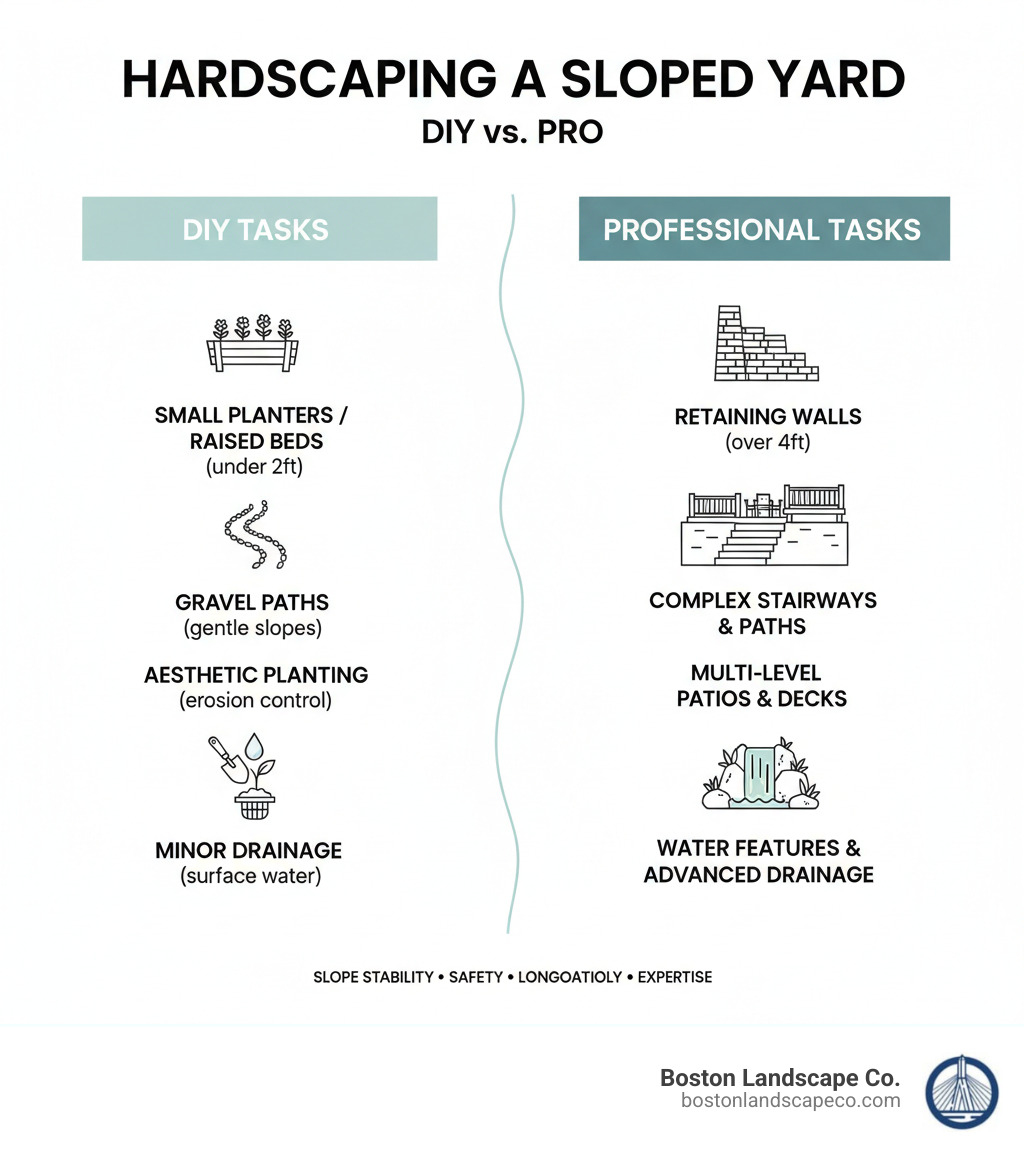
Good DIY Projects:
- Installing small raised garden beds on a gentle slope.
- Laying a simple gravel path on a minimal grade.
- Planting groundcover for erosion control.
When to Hire a Professional:
- Any retaining wall over 3-4 feet high. These require engineering and deep footings to handle New England’s frost heave.
- Major excavation and grading on a steep slope.
- Complex drainage systems like French drains.
- Projects requiring permits. Many Massachusetts towns require permits for walls over 4 feet. A professional Hardscape Installation Company will handle the permitting process, ensuring compliance with local codes.
Understanding the Costs of Hardscaping a Sloped Yard
The cost of hardscaping a slope varies wildly. Key factors include:
- Slope Severity: Steeper slopes require more engineering and labor, driving up costs.
- Materials: Segmented blocks are more affordable than natural stone. Timber is budget-friendly initially but has a shorter lifespan.
- Labor & Accessibility: Slope work is more labor-intensive. Poor site access for machinery will also increase labor hours.
- Drainage & Reinforcement: These are non-negotiable expenses to protect your investment.
Disclaimer: The following are average costs based on national internet data and are not actual costs for Boston Landscape Co. Real-world prices depend on your specific property. A project on a gentle slope might range from $25-$75 per square foot, while a steep, complex site can easily exceed $40-$100+ per square foot. A small project might start around $400, while a comprehensive renovation could exceed $60,000.
Think of this as an investment that increases property value, creates usable space, and prevents erosion damage. If budget is a concern, we can phase the project. Our Affordable Hardscaping Near Me approach focuses on creating a plan that fits your budget while delivering lasting quality.
Frequently Asked Questions about Hardscaping Sloped Yards
What is the cheapest way to retain a slope?
The most affordable solutions often involve less structural hardscaping. Deep-rooted groundcover plants and grasses are highly cost-effective for preventing erosion. For creating simple garden beds on gentle slopes, low terraces built with landscape timbers are a budget-friendly option, though they have a shorter lifespan (15-20 years) than stone or concrete. For pathways, gravel is significantly cheaper than pavers or stone. These options work best for gentle slopes; steeper inclines require a more significant investment in proper retaining walls for long-term stability.
How do you make a sloped backyard usable?
The key is to create level areas. This is most effectively done through terracing with retaining walls. By holding back the earth, we can carve out flat plateaus for patios, lawns, garden beds, or play areas. Connecting these terraces with well-designed steps and pathways makes the entire yard accessible and inviting. This approach transforms a frustrating incline into a functional, multi-level outdoor living space with far more character than a flat yard.
Do I need a permit to build a retaining wall in Massachusetts?
It depends, but for any substantial wall, the answer is likely yes. In most Massachusetts towns, a building permit is required for retaining walls over 4 feet in height (measured from the footing to the top). However, local rules can be stricter. Walls near property lines, supporting a driveway, or in conservation areas may require a permit regardless of height. Towns like Lexington MA and Concord MA have their own specific regulations. We always recommend checking with your local building department before starting. As experienced professionals, we handle permit applications regularly as part of our hardscaping sloped yard services.
Transform Your New England Slope into a Masterpiece
Your sloped yard isn’t a problem; it’s an opportunity to create a captivating outdoor space. Here in New England, rolling terrain is part of the landscape, and with the right approach, it can become the best feature of your property.
By using solutions like retaining walls, terracing, and thoughtful pathways, you can conquer the challenges of erosion and accessibility. A steep bank can become a dramatic stone wall with cascading plantings, and an unusable hillside can be converted into tiered patios where your family will gather for years to come.
Spring is the perfect time to start planning. Imagine what your slope could become: terraced gardens bursting with color, stone steps winding to a new patio, and a functional, stunning outdoor space that your family will enjoy through every New England season. The investment you make now will pay dividends in usability, beauty, and property value.
If you’re ready to transform your sloped yard in the Boston area, the team at Boston Landscape Co. is here to help. Since 1991, we’ve been turning New England’s challenging terrain into outdoor masterpieces. We understand our climate, our soil, and how to build solutions that last.
Contact us today to discuss your hardscaping project! Let’s turn your slope into something spectacular.
