
Why a Commercial Plowing Contract Is Your Winter Safety Net
A commercial plowing contract is a legally binding agreement between a property owner or manager and a snow removal company that defines the scope of services, pricing, response times, and liability protections for winter snow and ice management. At its core, this contract is your business’s lifeline during New England’s harsh winters, ensuring your property remains safe, accessible, and operational—no matter how much snow falls.
Without a clear, detailed contract, you’re not just gambling with accessibility; you’re exposing your business to significant financial and legal risks. A single slip-and-fall incident can lead to costly lawsuits, while an impassable parking lot can mean a full day of lost revenue and frustrated tenants or customers. A proactive approach is essential.
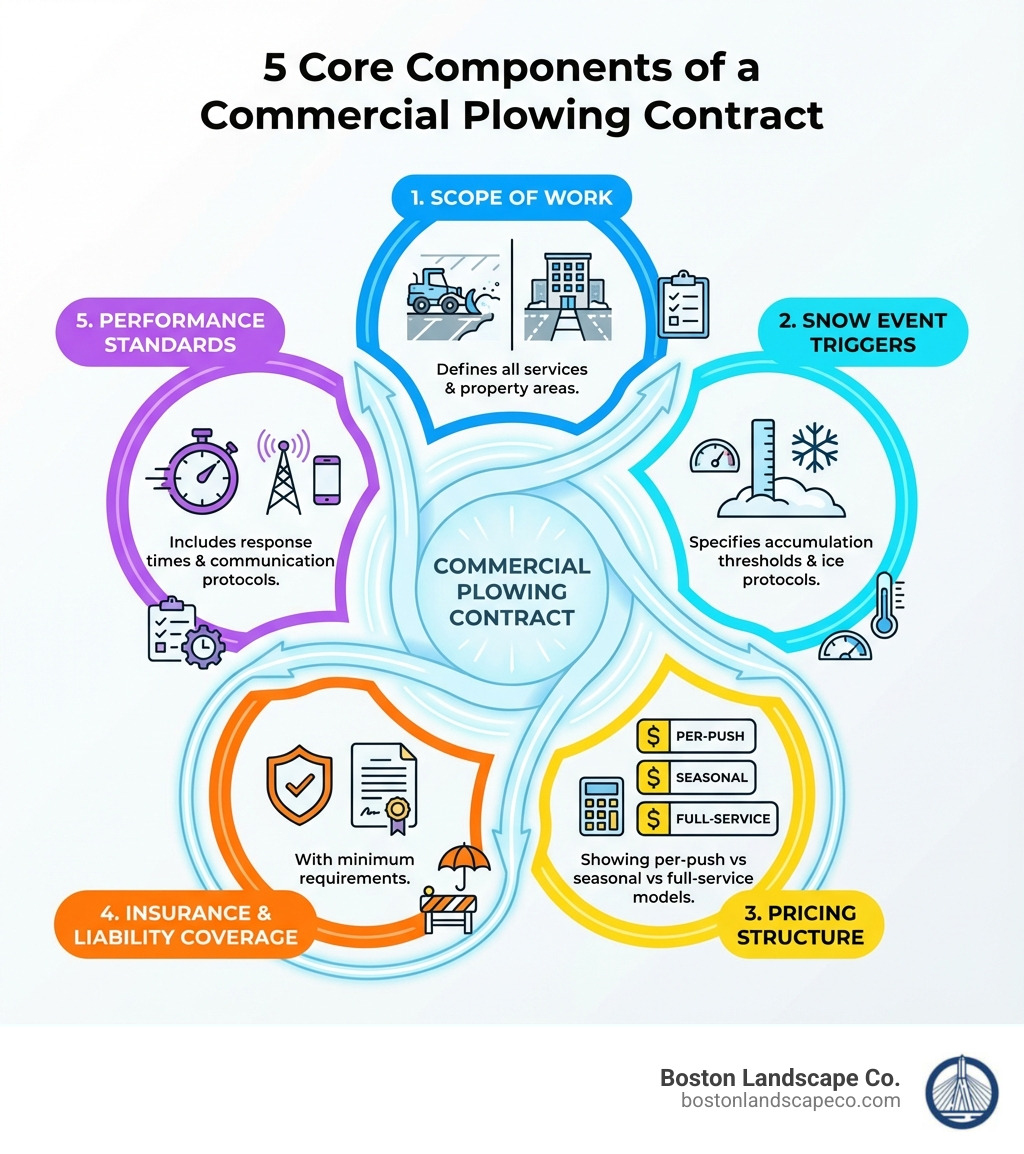
Key Components of a Commercial Plowing Contract:
- Scope of Services – What gets plowed, shoveled, salted, and when? This should include detailed site maps marking priority areas, snow pile locations, and any obstacles.
- Snow Event Triggers – The specific accumulation threshold (e.g., 1 or 2 inches) that automatically initiates service, including separate protocols for ice.
- Pricing Model – How you’ll be billed. This could be a per-push rate, a seasonal flat fee, or a comprehensive all-inclusive model.
- Response Times – A clear timeline for when your parking lot, walkways, and entrances will be cleared after a snow event begins.
- Insurance and Liability – A critical section that outlines who is responsible for what, backed by proper insurance certificates.
- Contract Duration – Typically spanning the entire snow season (e.g., October through April), often with options for multi-year renewals.
According to industry data, commercial snow removal agreements often require 24/7 operations and rapid response times, unlike residential contracts. They also involve heavier equipment, larger service areas, and more complex logistics—from coordinating with building managers to ensuring emergency vehicle access during active storms. A hospital parking lot buried in snow isn’t just an inconvenience—it’s a safety hazard and a liability nightmare. The same goes for retail centers, office complexes, and any property where employees, customers, or tenants need safe access during winter weather.
I’m Steve Schumacher, owner-operator of Boston Landscape Co. since 1991. Over three decades, I’ve steered countless commercial plowing contracts for clients across Greater Boston, from office parks to retail centers, and I’ve learned that a well-structured agreement is the foundation of safe, reliable winter operations.
Commercial plowing contract terms made easy:
Decoding the Anatomy of a Commercial Plowing Contract
A well-crafted commercial plowing contract is more than just a piece of paper; it’s a comprehensive roadmap for winter operations. It protects both the property owner and the snow removal provider by clearly outlining expectations, responsibilities, and contingencies. If you’re about to sign a commercial snow removal contract that’s just a page or so long, hold off on that signature — something’s wrong. A robust agreement should be packed with details, leaving no room for ambiguity when a blizzard hits.

When we draft a commercial plowing contract, we ensure it covers all the critical elements to prevent misunderstandings and ensure smooth, efficient service. Here’s what you should look for.
Defining the ‘Snow Event’ and Service Triggers
One of the most crucial elements in any commercial plowing contract is the clear definition of a “snow event” and its corresponding service triggers. This is the agreed-upon condition that activates our obligation to begin snow removal services.
- Accumulation Triggers: This is the specific depth of snow that must fall before plows are dispatched. While some properties might opt for a 2- or 3-inch threshold to manage costs, a busy retail center or medical facility in the Greater Boston area might require service at just 1 inch of accumulation to maintain constant, safe access. The key is to align the trigger with your operational needs and risk tolerance. We can also set up tiered pricing for different snow depths (e.g., 1-3 inches, 3-5 inches, etc.).
- Ice Storm Protocols: It’s not just about snow. Ice storms are often more dangerous and require a different response. A professional contract will specify clear ice storm triggers (e.g., any freezing rain or sleet) and de-icing protocols. This ensures we respond promptly to treat surfaces, not just wait for snow to accumulate.
- Pre-treatment Applications: For many properties, especially those prioritizing a ‘zero-tolerance’ approach to ice, pre-treatment with liquid de-icers before a storm hits is a key component of the contract. This proactive measure, often using a salt brine, prevents ice from bonding to pavement and walkways, making subsequent removal faster, more effective, and reducing the overall amount of salt needed.
- Continuous Storm Service Requirements: During a long-duration blizzard, a single “push” at the end of the storm is not enough. Your contract should include provisions for continuous or multi-visit plowing during major storms to ensure emergency vehicle access and maintain safe conditions. This is vital for high-traffic properties like hospitals, distribution centers, and large residential communities.
Key Services to Specify in Your Agreement
The scope of services in your commercial plowing contract should be carefully detailed. It’s not just about “plowing snow”; it’s about defining what, where, and how services will be performed, often with a site map as a visual guide. The Snow & Ice Management Association (SIMA) recommends documenting every service area to avoid disputes and ensure comprehensive coverage.
- Plowing Parking Lots and Access Roads: This is the core service, but it needs specifics. The contract should clearly identify all paved parking areas, driveways, loading docks, fire lanes, and access roads to be cleared.
- Shoveling Walkways and Entrances: Beyond vehicle areas, pedestrian safety is paramount. The contract must detail which sidewalks, stairways, building entrances, handicap-accessible ramps, and emergency exits will be hand-shoveled or cleared with specialized equipment.
- De-icing Services: This includes the application of various de-icing agents to prevent ice formation and improve traction. We specify whether we’ll use traditional rock salt (sodium chloride), a treated salt blend, or more environmentally friendly options like magnesium chloride or calcium chloride, which are effective at lower temperatures and can be safer for concrete and landscaping. This is a key consideration for properties in environmentally-conscious communities like Concord or Lexington.
- More info about our snow and ice management services
- Snow Hauling vs. Snow Stacking (Banking): This is a critical distinction that impacts both safety and cost. Snow stacking involves pushing snow to designated, pre-approved areas on your property. However, in tight urban lots or after several major storms, these piles can become enormous, reducing parking capacity and creating dangerous blind spots. Snow hauling involves loading the snow into trucks and removing it from your property entirely. This service incurs an additional charge but is often necessary for businesses in dense areas like Somerville or for properties that cannot sacrifice parking spaces.
Choosing the Right Contract Type for Your Property
The type of commercial plowing contract you choose significantly impacts your budget predictability and the level of service you receive. Each option has its unique advantages and disadvantages, depending on your property’s needs, your tolerance for risk, and the typical winter weather in the Greater Boston area.
| Contract Type | Cost Structure | Budget Predictability | Ideal Property Type |
|---|---|---|---|
| Per-Push / Per-Event | Pay for each service visit (plow, salt application, etc.). | Low (costs fluctuate with the weather). | Properties with low traffic, flexible hours, or large snow storage areas. Can be cost-effective in mild winters. |
| Seasonal (Fixed-Fee) | One flat fee for the entire winter season. | High (fixed cost, easy to budget). | Most commercial properties: office parks, retail centers, apartment complexes, industrial facilities. |
| Full-Service / All-Inclusive | A premium seasonal fee covering all possible winter events. | Highest (all-inclusive, no surprise charges). | Hospitals, 24/7 logistics centers, high-end retail, properties with zero tolerance for snow or ice. |
Per-Push / Per-Event Contracts
This is a pay-as-you-go model where you are billed for each individual service rendered, whether it’s plowing, salting, or sidewalk clearing. It can seem attractive due to the potential for lower costs during a mild winter with infrequent snowfall. This model can work for properties with low foot traffic and ample space for snow storage, where a slight delay in service won’t critically impact operations. However, the major drawback is budget unpredictability. A harsh, snow-heavy winter can lead to costs that far exceed a seasonal contract. Furthermore, during a major blizzard, contractors typically prioritize their seasonal clients, which could mean longer wait times for per-push customers.
Seasonal (Fixed-Fee) Contracts
This is the most popular and balanced option for the majority of commercial properties. You pay a single, predetermined price that covers all snow and ice management services for the entire winter season, typically from November through April. The primary benefit is budget certainty; you know exactly what your winter maintenance will cost, regardless of whether it snows five times or twenty-five times. This model ensures you are a priority client, guaranteeing timely service.
Many contracts, especially multi-year agreements, offer better pricing and ensure you have a dedicated partner year after year. It’s crucial to understand if the contract includes a ‘snowfall cap’—a limit on the total inches of snow covered by the fee. If snowfall exceeds this cap, additional charges may apply. This is an ideal solution for office parks, apartment complexes, and retail centers from Boston to Billerica.
Full-Service / All-Inclusive Contracts
This is the premium, ‘zero-tolerance’ option designed for properties where safety, liability, and accessibility are the absolute top priorities, 24/7. A full-service contract is a comprehensive partnership. It covers everything: proactive pre-storm anti-icing treatments, continuous plowing and de-icing during the storm, and post-storm site monitoring for refreezing and melt-off.
It’s a proactive, rather than reactive, approach to winter safety. Hospitals, large retail destinations like those in Burlington, 24-hour distribution centers, and corporate headquarters often opt for this level of service to minimize liability and ensure their operations are never interrupted by winter weather. While it represents the highest upfront investment, it provides the greatest peace of mind and the most robust protection against weather-related disruptions and legal risks.
