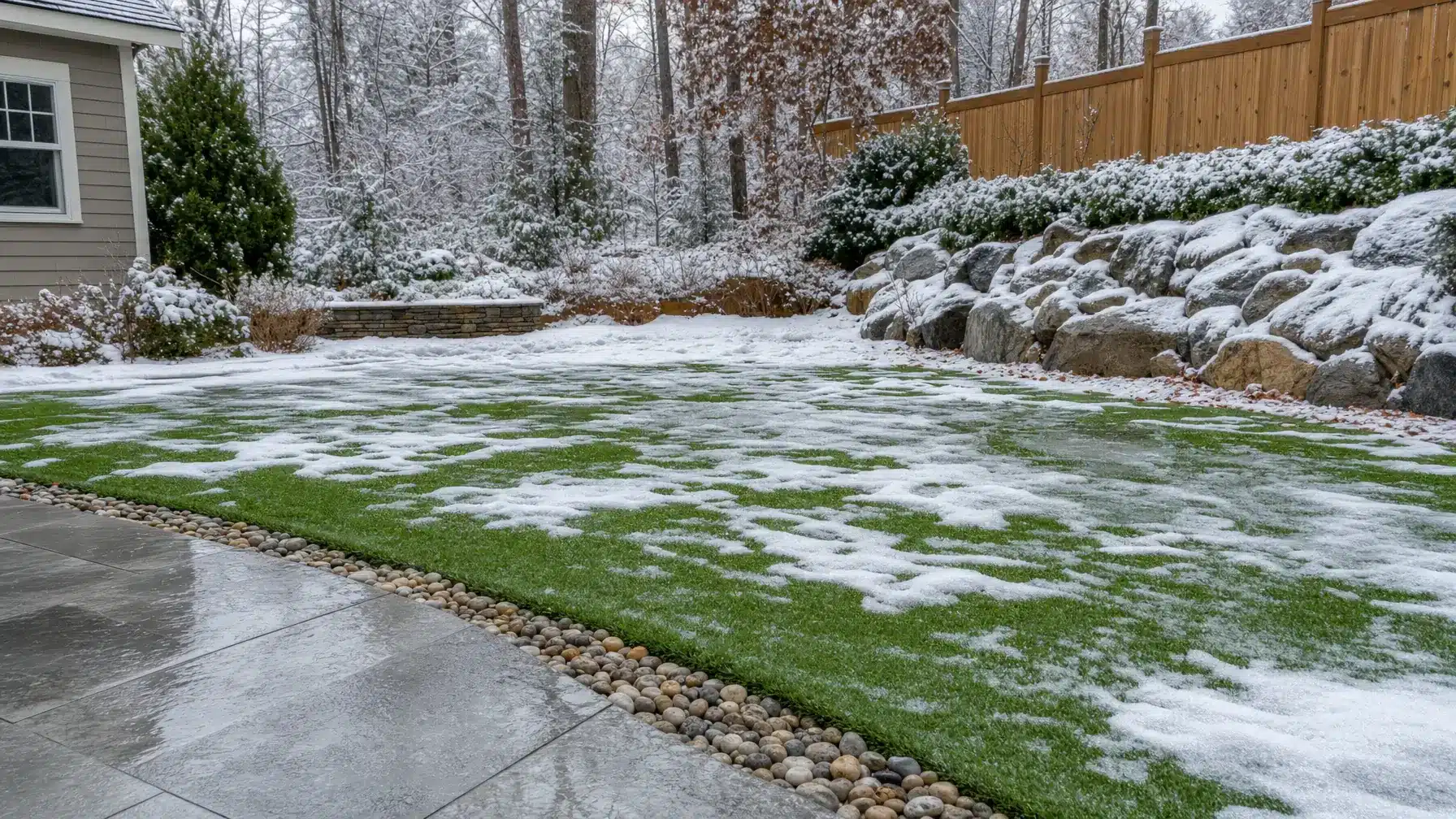
When winter arrives, artificial-grass owners have practical questions: Can you shovel it? What should you do about ice? How should you handle salt tracked in from a walkway? Start with the care instructions for the installed turf rather than applying a general snow-clearing routine.
What should you confirm about snow and frost?
Ask your installer to identify the turf product and provide its applicable winter-care guidance. Do not assume that snow cover is harmless under every condition or that snowmelt will drain exactly as rain does. Have the installer explain what to expect from your turf system, its installation and the ground conditions on your property.
Include questions about frozen-surface use: when to keep people and pets off the area, when grooming can resume and what conditions require an inspection. Until those limits are clear, defer brushing and unnecessary traffic on frozen or icy turf.
Should you shovel snow off artificial grass?
Before clearing a route across the turf, confirm whether snow removal is permitted and which tools and methods the manufacturer allows. Without applicable guidance, do not improvise with shovels, powered equipment or ice-chipping tools.
- Ask whether snow should be left in place or removed for the intended use of the area.
- Confirm any approved tool, required technique and restrictions near seams and borders.
- If winter access is essential, agree on an alternative route before a storm rather than relying on the turf being usable.
Treat surface snow removal and safe access as separate questions. Do not regard a cleared strip as confirmation that an icy route is safe, or rely on sunshine to finish melting it during freezing weather.
Salt, ice melt and plowed snow
Before applying rock salt, another de-icer or traction sand to artificial grass, obtain product-specific approval and cleanup instructions. Do not assume that a material used on the adjacent walkway is suitable for the turf.
Include turf boundaries and proposed snow-pile locations in your discussion with anyone clearing the property. Ask the installer whether those locations are appropriate. If treated snow or residue reaches the turf, record the location and the material used, if known, before asking how to clean it.
What should you ask before winter?
Use a late-fall conversation with your installer to settle the care plan rather than choosing tools or treatments by trial and error.
- Confirm the approved method for removing leaves and other debris.
- Ask whether brushing is needed and which tool and surface conditions are appropriate.
- Photograph visible seam or edge concerns and ask whether they need attention before snow cover.
- Share observations about water collection, downspout discharge and planned snow storage without assuming a cause or remedy.
What to check in spring
After snow recedes, photograph visible flattening, residue, open seams, lifted edges and areas where water collects. Share those observations with the installer rather than diagnosing a base or drainage problem from appearance alone.
Do not brush frozen fibers or rinse residue while the surface is frozen or the added water could refreeze. Wait for suitable thawed conditions and confirm the manufacturer’s cleaning and grooming instructions before proceeding.
Thinking about turf for next year?
Boston Landscape Co. provides artificial lawn installation throughout Greater Boston. When discussing a proposed installation, ask for the product’s winter-care requirements and explain how you need to use the space during snow and freezing weather.