
Is Garden Artificial Grass Installation Right for Your Property?
Garden artificial grass installation transforms tired, high-maintenance lawns into clean, green outdoor spaces that look great year-round — with no mowing, watering, or fertilizing required.
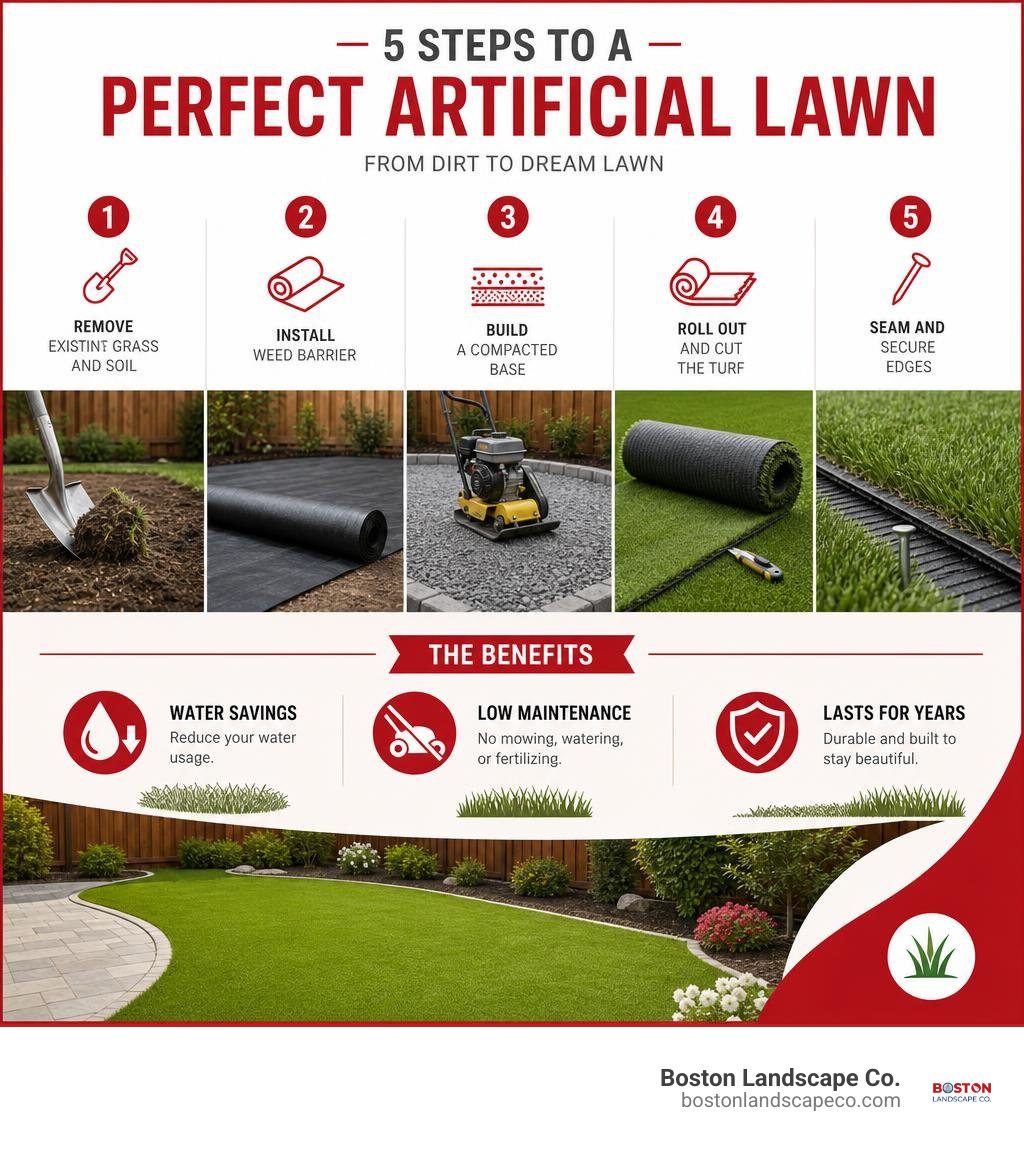
Here’s a quick overview of how it works:
- Remove existing grass and soil — excavate 3–4 inches of topsoil
- Install a weed barrier — lay geotextile membrane to block weed growth
- Build a compacted base — add crushed stone and decomposed granite, compact to 90%
- Roll out and cut the turf — align grain direction, trim to fit
- Seam and secure edges — use seaming tape, adhesive, and landscape spikes
- Apply infill — spread silica sand evenly and brush fibers upright
The result is a durable, low-maintenance lawn that can last 15–25 years and cut residential water usage by up to 55%.
Whether you manage a residential property in the Greater Boston area or oversee a commercial space, the appeal is clear: a lawn that stays pristine through Massachusetts seasons — without the constant upkeep.
But the quality of the final result depends almost entirely on how well the installation is done. Skipped steps in base preparation or poor seaming can lead to uneven surfaces, drainage problems, and premature wear. That’s why understanding the full process matters before committing to any project.
I’m Steve Schumacher, owner-operator of Boston Landscape Co., and over my 30+ years in the landscaping industry I’ve overseen countless garden artificial grass installation projects across Massachusetts — from Bedford residential lawns to Burlington commercial properties. In this guide, I’ll walk you through everything you need to know to get it done right.
Key terms for garden artificial grass installation:
The Commercial and Aesthetic Value of Garden Artificial Grass Installation
For both residential estates and commercial properties, curb appeal is a major driver of property value. Traditional turfgrass in Massachusetts faces harsh realities: freezing winters, muddy spring thaws, and dry, scorching summers. Maintaining a pristine natural lawn under these conditions requires constant care, chemical fertilizers, and thousands of gallons of water.
By opting for a professional garden artificial grass installation, property owners enjoy a vibrant, emerald-green aesthetic that remains entirely unaffected by the weather. Beyond the immediate visual upgrade, the environmental and financial benefits are substantial:
- Water Conservation: According to scientific research on water savings, switching to synthetic turf can reduce residential outdoor water usage by up to 55%. This is a major advantage in Massachusetts towns like Billerica and Chelmsford, where summer water restrictions frequently limit lawn watering.
- Reduced Carbon Emissions: Gas-powered lawn mowers contribute significantly to local air pollution. Synthetic turf completely eliminates the need for mowing, helping residential and commercial properties reduce ongoing landscape maintenance emissions.
- Substantial Cost Savings: Residential and commercial property owners can reduce recurring lawn maintenance expenses, including seed, fertilizer, pesticides, aeration, and commercial mowing services.
- Durability and Longevity: While natural sod in high-traffic areas might only last 5 to 10 years before requiring extensive renovation, professional Artificial Turf for Residential Lawns typically lasts 15 to 25 years with minimal maintenance.
Key Phases of a Professional Synthetic Turf Project
Laying synthetic grass is not as simple as rolling out a carpet over your dirt yard. It is a highly engineered, multi-layered system designed to drain water, resist shifting, and withstand heavy traffic.

Every successful Installation of Artificial Turf relies on a systematic approach. If any phase is rushed—particularly the ground preparation or sub-base compaction—the final surface will inevitably develop dips, wrinkles, and drainage pools.
Ground Preparation for Garden Artificial Grass Installation
The first step in our process is thorough site preparation. We begin by identifying and capping any existing irrigation lines or sprinkler heads. Any organic material left beneath the synthetic turf will eventually decompose, leading to sub-surface failure and uneven settling.
- Excavation: We excavate the existing sod and topsoil to a depth of 3 to 4 inches. This ensures there is plenty of room to build a robust stone aggregate sub-base.
- Grading: We carefully grade the subgrade soil, establishing a subtle 2% slope away from residential foundations or commercial structures to ensure flawless runoff.
- Weed and Pest Mitigation: To prevent resilient weeds from pushing through the drainage holes of the turf, we lay down a heavy-duty geotextile weed barrier. In areas like Billerica and Chelmsford, where subterranean pests can be active, we also install a durable gopher wire mesh directly over the soil to prevent burrowing animals from creating uneven voids beneath the lawn. Learn more about our process for How to Install Synthetic Lawn.
Base Construction and Compaction
Once the excavation is complete and the protective barriers are in place, we construct the drainage foundation. A solid sub-base is critical for preventing shifting during Massachusetts’ winter freeze-thaw cycles.
We build the base using two distinct layers of aggregate:
- The Sub-Base Layer: We spread 2 to 2.5 inches of 3/4-inch crushed stone or drain rock. This layer provides rapid lateral drainage and a stable foundation.
- The Top-Base Layer: We apply 1 to 1.5 inches of class II road base or decomposed granite. This fine material fills the gaps in the coarser stone, allowing us to create an incredibly smooth, flat surface.
We lightly mist the base with water and use a commercial vibrating plate compactor to achieve a compaction rate of 90% or higher.
| Base Material | Recommended Depth | Purpose | Compaction Target |
|---|---|---|---|
| Crushed Stone / Drain Rock (3/4-inch) | 2.0 – 2.5 inches | Structural stability and rapid sub-surface drainage | 90% Compaction |
| Decomposed Granite / Road Base | 1.0 – 1.5 inches | Fine leveling and smooth finish surface | 90% Compaction |
Laying, Seaming, and Securing the Turf
After the base has cured and settled, the artificial grass rolls are ready to be positioned.
- Acclimation: We unroll the turf and let it acclimate in the sun for 1 to 2 hours with the blades facing down. This relaxes the backing and removes any temporary wrinkles from shipping.
- Grain Alignment: We ensure that the grain direction (the direction the grass blades lean) points toward the primary viewing area—such as a residential patio or a commercial storefront—for the most realistic, natural appearance.
- Precision Cutting: We trim the perimeter using heavy-duty utility knives, cutting from the back side of the backing along the stitch rows to avoid damaging the individual grass fibers.
- Seaming: For projects requiring multiple rolls, we align the seams with an exact 1/8-inch gap. We use professional-grade seaming tape and high-strength turf adhesive, securing the seam while it cures.
- Securing the Perimeter: We secure the outer edges using 5- to 6-inch non-corrosive landscape spikes spaced every 3 to 4 inches, ensuring the turf remains taut and wrinkle-free for decades.
Customizing Your Turf: Play Zones, Putting Greens, and Pet Areas
Synthetic turf is highly versatile and can be customized to suit specific residential and commercial landscape needs. Whether you want to design a safe play area, a pet-friendly relief zone, or a personal putting green, the customization lies in the specialized underlayments and infills used.

Specialized Infill and Odor Control for Garden Artificial Grass Installation
Infill is a vital component of any Artificial Grass Backyard project. It sits at the base of the grass blades, keeping them standing upright, protecting the backing from UV damage, and providing ballast to keep the turf weighted down.
- Silica Sand: This is the standard, cost-effective infill option for low-to-medium traffic ornamental lawns.
- Zeolite Infill: For properties with pets, we highly recommend zeolite infill. This natural, porous mineral absorbs and neutralizes ammonia from pet urine, preventing unpleasant odors from building up.
- Drainage Tiles: In dedicated pet areas, we often install specialized drainage tiles beneath the turf to maximize water flow and make washing down the surface easy. Read more about how to Replace Lawn with Artificial Turf to accommodate pets.
Creating Backyard Putting Greens and Play Zones
For property owners looking to practice their short game or build a safe play area, customized installations require a precise touch.
- Backyard Putting Greens: These projects utilize ultra-short, dense texturized nylon fibers designed to mimic a professional PGA-level stimpmeter speed. We carefully grade the sub-base to include subtle breaks and contours for a realistic putting experience.
- Kids’ Play Zones: Safety is our top priority. For play areas under swing sets and slides, we install specialized closed-cell foam shock pads beneath the turf. This padding provides critical fall-height protection, cushioning impacts while maintaining excellent drainage. Learn more about our specialized systems for How to Install Artificial Lawn Turf.
Long-Term Care and Maintenance of Synthetic Lawns
While synthetic turf is incredibly low-maintenance compared to natural grass, it is not entirely “maintenance-free.” To maximize its lifespan and keep it looking pristine, we recommend a simple care routine:
- Debris Removal: Regularly clear leaves, twigs, and organic matter using a leaf blower or a plastic garden rake. Letting organic debris accumulate can lead to weed growth in the infill over time.
- Cross-Brushing: High-traffic areas may experience temporary flattening. Periodically brush the grass fibers against the grain using a synthetic, stiff-bristled broom to restore their upright, natural position. Avoid wire or metal brushes, as they can damage the synthetic fibers.
- Stain Cleaning and Washing: For minor spills or pet waste, scoop up any solids, let the area dry, and rinse it thoroughly with a garden hose. Mild household dish soap and warm water can be used for stubborn spots.
- Algae and Moss Prevention: In humid, shaded areas of your yard, apply a preventative, turf-safe treatment once or twice a year to keep moss and algae at bay.
For a detailed breakdown of long-term care, check out our guide on Synthetic Lawn vs Real Lawn.
Why Professional Installation Outperforms DIY
Artificial turf installation is a labor-intensive landscape construction project that requires proper excavation, engineered base preparation, commercial compaction equipment, precise seaming, and drainage planning. For residential and commercial properties, DIY installation is best limited to very small, temporary applications. Permanent lawn replacement should be handled by a professional crew.
Common problems with non-professional installations include:
- Inadequate Compaction: Without a commercial plate compactor, the sub-base will eventually settle unevenly, creating hazardous tripping zones.
- Visible Seams: Joining multiple rolls of turf seamlessly requires professional experience. Poorly executed seams are highly visible and can easily pull apart.
- Wrinkling and Lifting: Professional installers use specialized carpet stretchers and kickers to ensure the turf is pulled perfectly taut before securing the perimeter.
Average Cost Ranges and Industry Disclaimer
When planning your budget, it is helpful to look at general industry pricing. According to publicly available online data and industry averages, typical professional installations are often cited around $5,000 to $8,000, depending on project size, site access, excavation difficulty, and material selection.
To account for this industry variability, a wide planning range for comprehensive professional installations may run from $10,000 on the lower end to $40,000 or more for complex, highly customized residential or commercial designs. This range is provided for broad planning purposes only and should not be interpreted as Boston Landscape Co. pricing, rates, or guarantees.
Please note that all prices mentioned are average costs sourced from publicly available internet data and are not the actual prices of Boston Landscape Co.
If you are located in Bedford or Burlington, hiring a professional team ensures your project is completed with commercial-grade equipment, premium materials, and experienced craftsmanship that stands the test of time.
Frequently Asked Questions about Synthetic Turf
Can artificial grass be installed over concrete or existing pavers?
Yes, synthetic turf can be installed over hard surfaces like concrete, brick, or pavers. However, you cannot simply lay the grass directly on top without proper preparation. We clean the hardscape surface thoroughly, install a specialized drainage underlayment pad to provide cushioning, and secure the turf using a premium turf binder adhesive. We also ensure there are adequate drainage channels so water does not pool beneath the turf.
Is artificial grass safe for pets and children?
Absolutely. High-quality synthetic turf is manufactured using non-toxic, lead-free materials that are completely safe for children and pets. In fact, because it eliminates the need for chemical fertilizers, weed killers, and pesticides, it creates a much healthier environment for your family. We use antimicrobial infills and sub-surface drainage systems to keep the area clean and hygienic.
How long does a professional artificial grass installation last?
With proper installation and basic maintenance, a high-quality synthetic lawn will last between 15 and 25 years. Premium products feature advanced UV stabilization built directly into the fibers to prevent fading, cracking, and degradation from sun exposure, even during the hottest summer months.
Conclusion
A beautiful, low-maintenance green lawn doesn’t have to be a constant chore. With a professional garden artificial grass installation, you can transform your Massachusetts property into a pristine, year-round landscape that saves time, water, and ongoing maintenance resources.
At Boston Landscape Co., we bring over three decades of local expertise to every project. From residential backyards in Lexington and Wilmington to large-scale commercial properties, our team delivers the highest standard of craftsmanship across the region.
Ready to take the first step toward your dream lawn? Use our quote form button below to schedule a consultation.
- Get an Estimate: Request a Free Estimate Online
- Learn More: Explore our premier Artificial Grass Installation Services.
