
Why Massachusetts Homeowners Are Investing in Hardscapes Landscaping Right Now
Hardscapes landscaping is one of the most impactful upgrades you can make to a property in Massachusetts — and in May 2026, demand for it is stronger than ever.
Quick answer: What is hardscapes landscaping?
| Term | What It Means | Examples |
|---|---|---|
| Hardscaping | Non-living, built structural elements | Patios, walkways, retaining walls, steps, fire pits, outdoor kitchens |
| Softscaping | Living, planted elements | Grass, shrubs, flowers, trees, garden beds |
| Combined benefit | A balanced outdoor space | Up to 20% added home value; patios alone can return up to 80% ROI |
Here’s the reality: most outdoor spaces in the Greater Boston area are underleveraged. A flat lawn or an overgrown slope isn’t doing anything for your property’s value, function, or enjoyment. A well-planned hardscape changes that — permanently.
Hardscaping gives your yard structure. It creates spaces where people actually want to spend time. And unlike plants, it holds up through New England’s brutal freeze-thaw winters when everything else goes dormant.
But getting it right in Massachusetts means more than picking nice pavers. It means understanding clay soil, drainage, proper base construction, and materials that won’t heave after the first hard frost. That’s where professional expertise makes all the difference.
I’m Steve Schumacher, owner of Boston Landscape Co. since 1991, with over three decades of hands-on experience in hardscapes landscaping across the Greater Boston region, including towns like Lexington, Burlington, and beyond. From small walkways to full outdoor living transformations, I’ve seen what works — and what fails — in this climate.
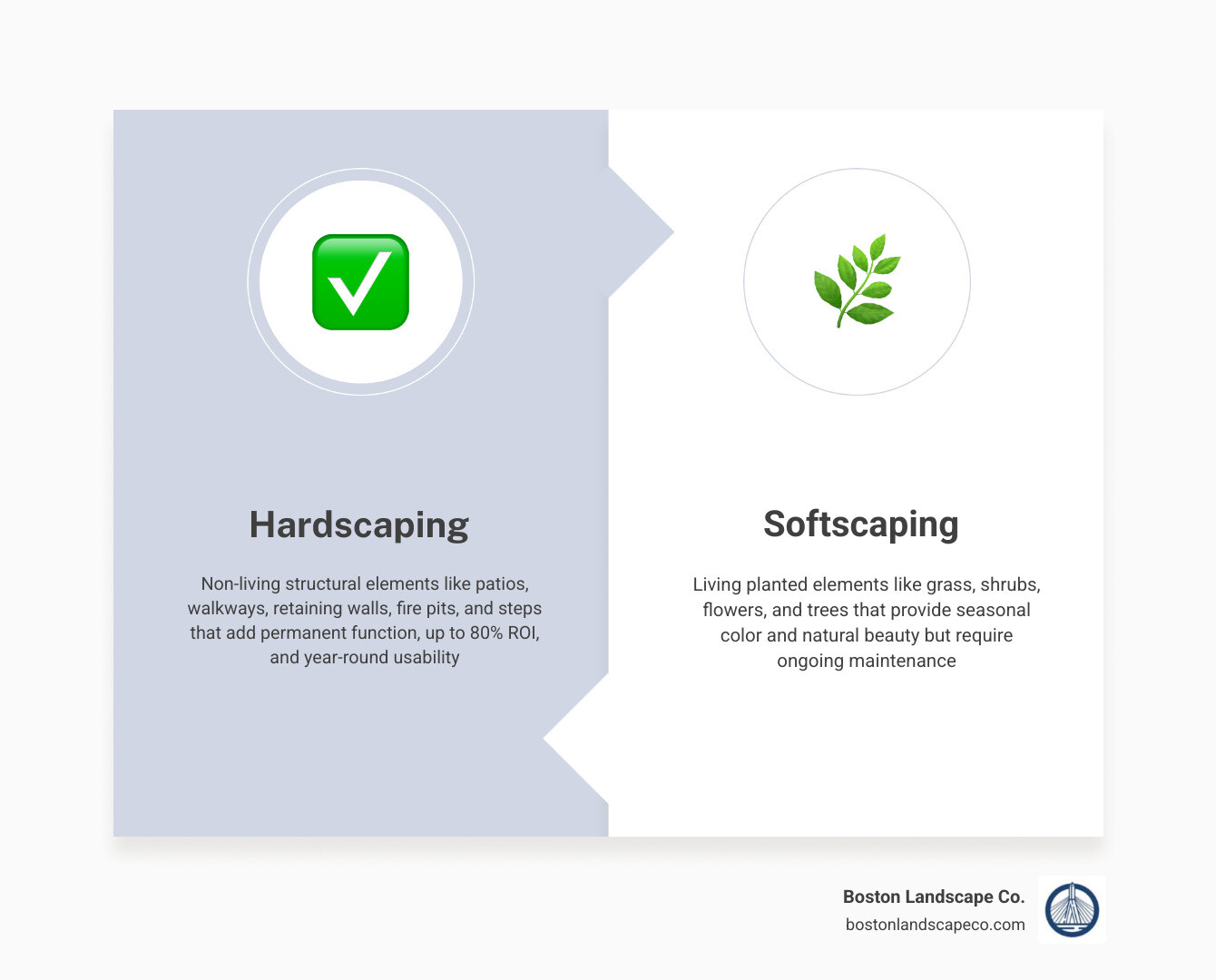
Quick hardscapes landscaping terms:
Understanding Hardscapes Landscaping vs. Softscaping
To build a truly functional yard, we must understand the relationship between the two main pillars of outdoor design: hardscaping and softscaping. Think of hardscaping as the “bones and floors” of your outdoor home, while softscaping represents the “furniture, paint, and decor.”
Without a solid hardscape foundation, your plants, turf, and flowers lack visual context. They can easily look messy or disorganized. Hardscaping provides the clean lines, defined borders, and structural levels that frame your living elements. This balance is critical because while a lush lawn is beautiful, it cannot host a heavy dining set, a fire pit, or an outdoor kitchen without turning into a muddy mess.

When we design a balanced landscape in towns like Burlington and Billerica, we use hard elements to redirect traffic, create usable flat ground, and highlight specific garden features. For instance, a beautifully winding walkway built with concrete pavers or natural flagstone doesn’t just keep your feet dry; it guides visitors through your garden, showcasing your softscaping at its best.
Beyond purely aesthetic benefits, investing in professional hardscaping dramatically boosts your home’s curb appeal and long-term resale value. According to industry data, a well-executed outdoor space that balances hardscape and softscape elements can add up to 20% to a home’s overall value. Features like custom patios offer up to an 80% return on investment (ROI). For homeowners in Massachusetts who want to make smart, lasting investments in their properties, hardscaping is the clear choice.
To explore how these structures can solve layout issues in your yard, read more about Hardscape Installation Services and Why Your Yard Needs Them. If you live in the Billerica area, you can also check out our dedicated regional guide on Hardscaping Billerica MA or view external resources like Affordable Landscaping – Billerica, MA | Hardscapes | Ponds … and Landscape and Hardscape Services in Burlington, MA to see how local properties are being transformed.
Popular Hardscapes Landscaping Features for New England Properties
In New England, our outdoor season is precious. Homeowners are increasingly looking to extend their living spaces outward, creating custom “resort-style” backyards right at home. Modern hardscaping features allow us to treat the backyard as a natural extension of the home’s interior, complete with dedicated zones for cooking, dining, relaxing, and entertaining.
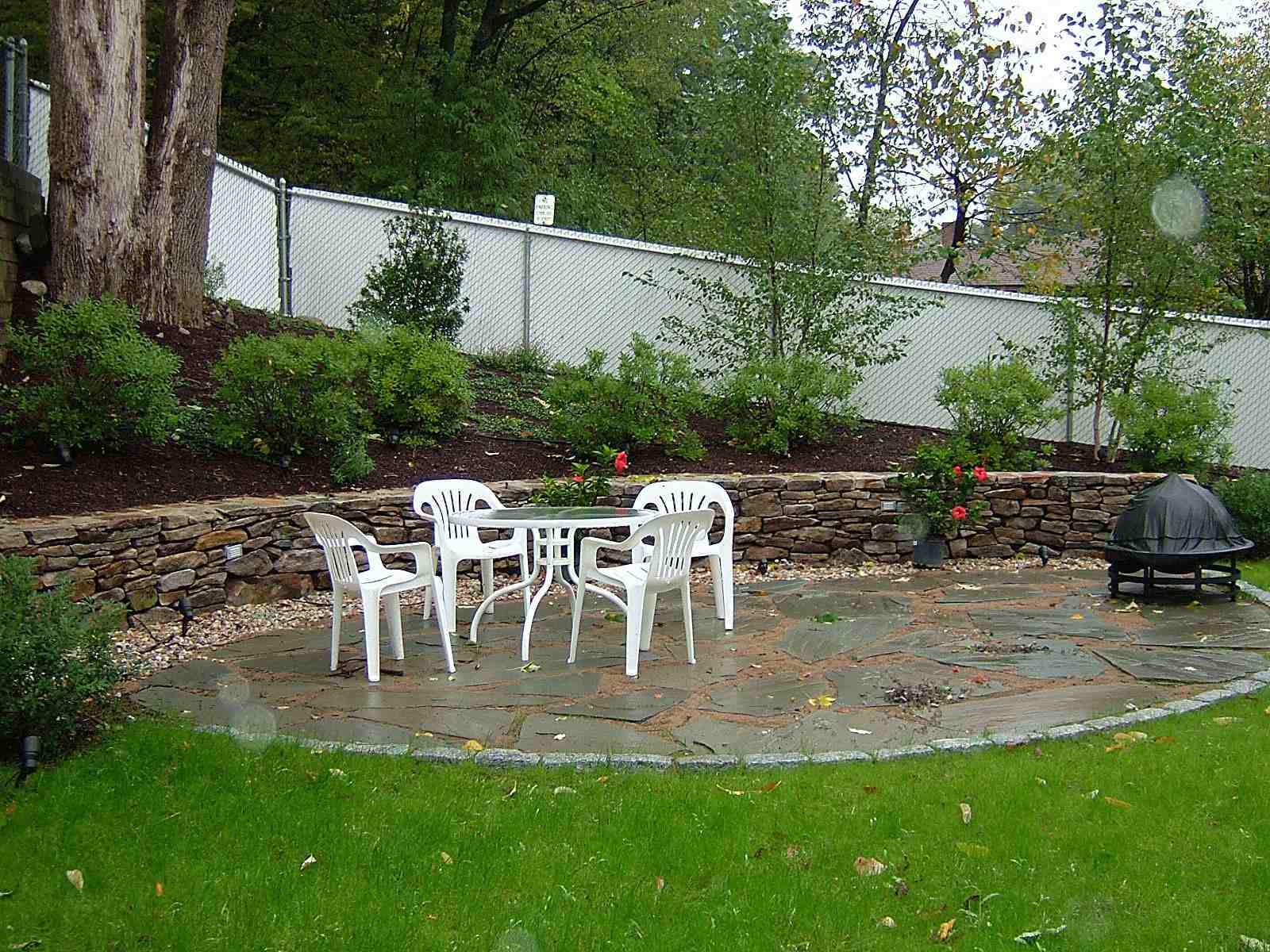
Some of the most popular hardscape features we install include:
- Outdoor Kitchens: No longer just a simple grill station, modern outdoor kitchens feature built-in stone islands, stainless steel appliances, granite countertops, and outdoor-rated refrigerators.
- Fire Pits and Custom Fireplaces: These features act as natural gathering spots, extending the usability of your patio deep into the cool autumn and spring months.
- Water Features: From bubbling rock columns to elegant waterfalls, water features add soothing sound and movement, masking neighborhood noise.
- Integrated Lighting: High-quality low-voltage LED lighting is built directly into steps, retaining walls, and under patio caps, ensuring your outdoor space is safe, functional, and visually stunning after dark.
Patios and Walkways: The Foundation of Hardscapes Landscaping
The patio is the undisputed anchor of any backyard living space. It is the platform upon which your outdoor furniture, dining sets, and social gatherings rest. When choosing materials for your patio or walkway, you generally select from concrete pavers, natural stone (such as bluestone or granite), or brick.
Concrete pavers are an incredibly popular choice in Massachusetts because they are engineered to withstand extreme weather. They come in hundreds of colors, shapes, and textures, allowing us to create custom patterns and inlays that mimic natural stone or historic brick. Natural stone, on the other hand, offers unmatched organic beauty and timeless appeal. Each piece of flagstone or bluestone has unique color variations that add deep character to your yard.
No matter which material you choose, a professional installation is critical to prevent shifting over time. For more information on finding a qualified team, read our guide on choosing a Hardscape Installation Company. If you are planning a project in the Lexington area, check out Hardscaping Lexington MA or review local maintenance tips from Stratford Landscaping | Landscape Maintenance | Lexington MA . For those in the northern suburbs, Land Solutions: Patios, Walkways, Fire Pits – Wilmington, MA offers great local design inspiration.
Retaining Walls and Steps: Managing Slopes with Hardscapes Landscaping
Massachusetts properties are rarely perfectly flat. Slopes, hills, and uneven terrain can make large portions of your yard completely unusable. This is where retaining walls and stone steps become essential.
Retaining walls serve a vital dual purpose: they are structural powerhouses and beautiful design features. By holding back soil, a retaining wall can carve out flat, usable terraces on a sloped property. This allows us to install a patio, a lawn, or a garden bed where there was once only an unusable hill. Additionally, retaining walls are highly effective at controlling soil erosion and managing water runoff.
To connect these different levels seamlessly, we install heavy stone steps. Whether constructed from solid granite blocks or natural flat stone, custom steps provide safe, stable paths through your changing elevations.
To learn more about how to plan these structural features, read our guide on Hardscaping Retaining Wall. If you are located in Chelmsford, explore our regional services at Hardscaping Chelmsford MA. You can also check out external resources like Junior Landscaping – Landscaping Bedford and THE BEST 10 LANDSCAPING NEAR CONCORD, MA 01742 – Yelp to see how regional properties handle sloped terrain.
Engineering for Durability: Base Preparation and Drainage
If there is one thing you must remember about hardscaping, it is this: a hardscape is only as durable as the hidden engineering beneath it. In fact, over 90% of all hardscape failures—such as sinking pavers, cracking walls, and shifting steps—are the direct result of poor base preparation and inadequate drainage.
In Massachusetts, our soils contain a high percentage of clay. Clay holds onto water, and when that water freezes during our cold winters, it expands. This expansion causes the soil to push upward—a phenomenon known as “frost heave.” If your hardscape is built directly on clay soil without a proper base, your beautiful patio will quickly become uneven and cracked.
To prevent this, we follow strict, engineered construction standards:
- Deep Excavation: We excavate the project area down to undisturbed subgrade, typically removing 10 to 14 inches of topsoil and clay for standard pedestrian walkways and patios.
- Geotextile Fabric: We lay down a high-quality woven geotextile fabric over the subgrade. This fabric acts as a barrier, preventing the soft clay soil below from migrating upward into our clean gravel base, which would otherwise compromise the structural integrity.
- Compacted Aggregate Base: We install a 6-to-8-inch base of processed dense-grade aggregate (crushed stone). Crucially, this gravel is compacted in “lifts” of no more than 3 inches at a time to ensure maximum density and eliminate air pockets.
- Bedding Layer: A precise 1-inch layer of clean concrete sand or fine aggregate is swept over the compacted base to provide a perfectly level bedding layer for the pavers.
- Pitch and Drainage: We grade all hardscape surfaces with a minimum 1% slope (approximately 1/8 inch of drop per linear foot) away from your home’s foundation to ensure positive water runoff.
Without these precise steps, water will pool beneath your stone, freeze, and destroy your investment. For a deeper dive into managing complex backyards, refer to our Hardscaping Sloped Yard Guide. If you are located in the Medford area, you can learn more about how we handle these local soil conditions at Hardscaping Medford MA, or check out Landscaping – North Chelmsford, MA – Stony Brook Landscaping Inc … for additional regional insights.
The Professional Installation Process vs. DIY Risks
Because of the heavy equipment, technical engineering, and physical labor required, hardscaping is not a suitable weekend DIY project. While laying down a few stepping stones might seem simple, constructing a level, long-lasting patio or a structural retaining wall requires specialized training and years of experience.
When you hire a professional team, you are paying for expertise that ensures your project complies with all local building codes and industry standards. For example, our installation crews follow strict guidelines set by the Interlocking Concrete Pavement Institute (ICPI). This certification guarantees that every paver is laid with correct spacing, proper edge restraints, and code-compliant step heights.
DIY hardscaping attempts often run into major, expensive roadblocks:
- Lack of Proper Equipment: Excavating tons of soil by hand is exhausting and often leads to shallow, unstable bases. Professionals use heavy excavators and commercial plate compactors to achieve 95% Proctor density compaction.
- Drainage Mistakes: An improperly pitched patio can channel rainwater directly toward your home’s foundation, leading to flooded basements and costly structural damage.
- Permitting and HOA Issues: Many hardscape projects require local municipal permits, especially if they impact wetlands, property lines, or water runoff. Professional contractors handle the entire permitting process for you.
To ensure your outdoor living investment is built to last, it is always best to work with a certified Hardscaping Installer.
Budgeting and Maintenance for Massachusetts Hardscapes
When planning your hardscape project, it is helpful to understand the general cost ranges and lifespans associated with different materials.
Note: The prices listed below represent average industry costs compiled from publicly available online data across the United States. They do not reflect the actual rates or project estimates of Boston Landscape Co. Because every property has unique grading, access, and design requirements, we provide customized quotes after an on-site consultation.
| Material Option | Average Cost Range (Sourced from Public Data) | Estimated Lifespan | Maintenance Level |
|---|---|---|---|
| Poured Concrete | $20 to $50 per sq. ft. | 15–25 Years | Medium (Prone to cracking in freeze-thaw) |
| Concrete Pavers | $35 to $90 per sq. ft. | 30–50+ Years | Low (Easy to replace individual units) |
| Natural Stone (Bluestone/Granite) | $50 to $150+ per sq. ft. | 50–100+ Years | Low (Extremely durable and timeless) |
| Clay Brick | $40 to $100 per sq. ft. | 40–80 Years | Medium (Requires periodic joint sand top-offs) |
To learn more about how material choices impact your overall walkway budget, check out our guide on Hardscaping Brick Walkway Cost.
Maintaining Your Hardscape Over Time
While hardscapes are incredibly durable, they do require some basic maintenance to keep them looking pristine year after year.
First, the joint sand between your pavers must be maintained. We use polymeric sand, which contains special additives that activate with water to bind the sand particles together. This prevents weeds from growing in the joints and stops ants from washing out the sand. Over several years, you may need to top off these joints.
Second, we highly recommend sealing your concrete pavers or natural stone every 3 to 5 years. A high-quality sealer protects the stone from oil spills, leaf stains, and salt damage during the winter, while also enhancing the natural color of the material.
If you are located in Stoneham or the surrounding towns and want to discuss a customized design and maintenance plan for your property, visit our local guide at Hardscaping Stoneham MA.
Frequently Asked Questions About Hardscaping
How long does a typical hardscape installation take?
Most residential hardscape projects, such as a medium-sized paver patio or a retaining wall, take between 2 to 4 weeks to complete. This timeline depends heavily on the project’s complexity, excavation depth, weather conditions, and material availability.
What are the best low-maintenance hardscaping materials?
Interlocking concrete pavers and natural granite are the absolute best low-maintenance choices for Massachusetts. Unlike poured concrete, which can crack during winter freeze-thaw cycles, individual pavers can flex with ground movement and are incredibly easy to replace if one ever becomes stained or damaged.
Do I need a permit for hardscaping in Massachusetts?
In many cases, yes. Permits are often required for retaining walls over 4 feet tall, projects that change the natural flow of water runoff, or any construction close to designated wetlands. A professional contractor will always check local zoning laws and secure the necessary permits before starting work.
Conclusion
Investing in professional hardscapes landscaping is the single best way to maximize the beauty, utility, and value of your Massachusetts home. By creating a harmonious balance between structural stone elements and lush plantings, you can transform your backyard into an outdoor oasis that your family will enjoy for decades.
At Boston Landscape Co., we have been designing and building custom, New-England-tough outdoor spaces since 1991. Whether you are looking to install a sprawling paver patio in Lexington, a structural retaining wall in Burlington, or a welcoming walkway in Billerica, our experienced team has the local knowledge and craftsmanship to bring your vision to life.
Ready to take the first step toward your dream yard?
Request a Free Estimate Online or call us today at +781-438-6690 to speak directly with our design experts. For more details on our complete range of design and installation options, explore our main Hardscaping Services Page.
