
Why Getting Your Garden Mulch Delivered This Spring Makes All the Difference
If you’ve been putting off your spring landscaping prep, getting garden mulch delivered in bulk is one of the fastest ways to refresh your property — whether you manage a commercial site in Burlington or a managed residential property in Lexington.
Here’s what you need to know at a glance:
- Types available: Natural hardwood, dyed black, dyed brown, dyed red, cedar, pine bark, and playground mulch
- Coverage: 1 yard ≈ 27 cubic feet, covers roughly 100–160 sq ft at a 2–3 inch depth
- Minimum orders: Typically 2–5 yards depending on the supplier
- Free delivery: Many providers offer free local delivery on orders of 5+ yards
- Spring savings: Look for seasonal promo codes where available
- Key rule: Once mulch is delivered, it cannot be exchanged — choose carefully before ordering
- Recommended depth: 2–3 inches for most Massachusetts soil types, including clay loam and sandy loam
Mulch does more than make your beds look sharp. It suppresses weeds, locks in soil moisture, and insulates plant roots through temperature swings — all critical benefits heading into a Massachusetts spring.
I’m Steve Schumacher, owner of Boston Landscape Co. since 1991, and over more than three decades of hands-on work across Massachusetts — including Billerica commercial grounds and residential estates — I’ve seen how the right garden mulch delivered on schedule can transform a property’s curb appeal and long-term soil health. Let’s walk through exactly how to order, what to choose, and how to get the most out of your delivery this season.
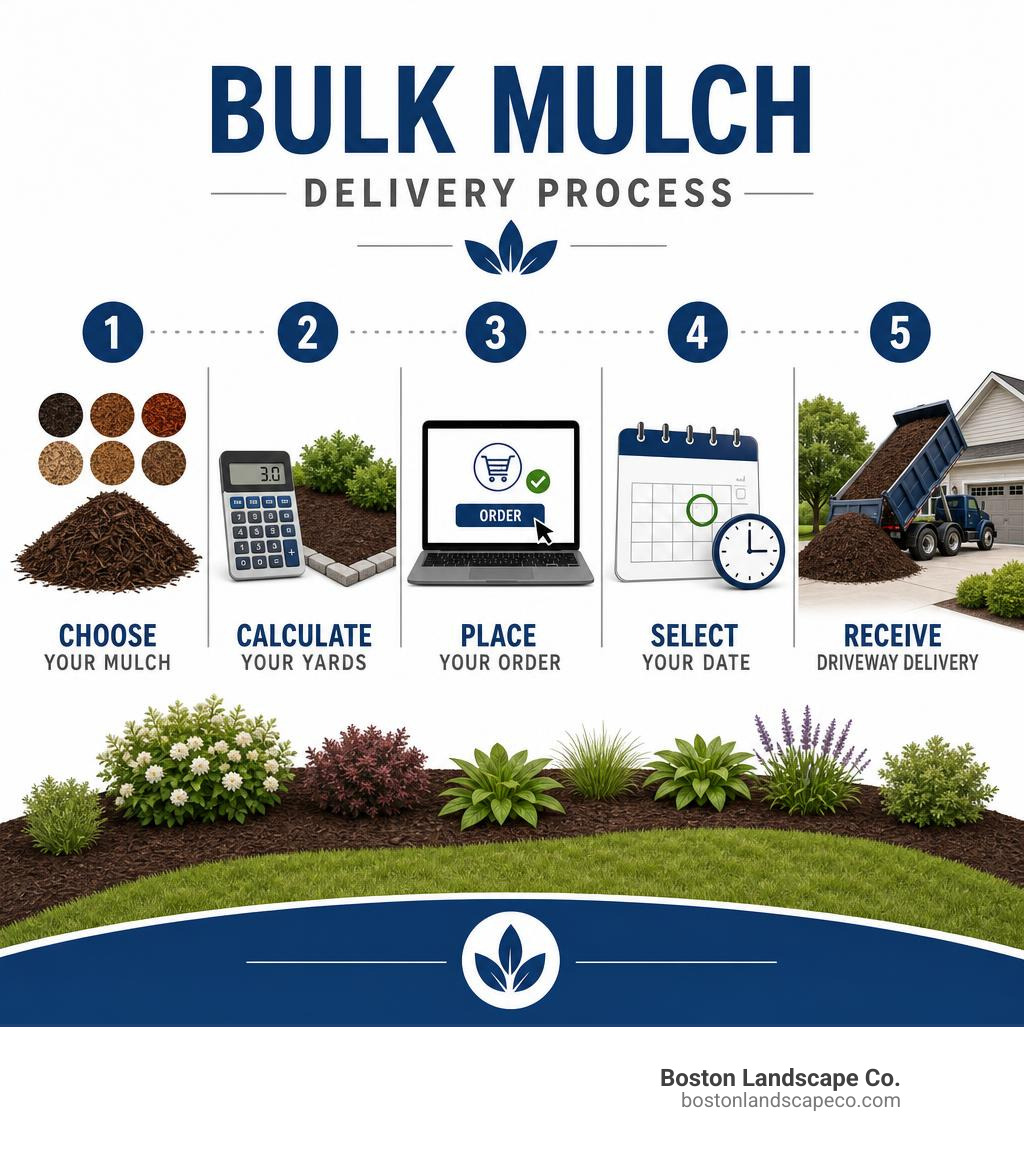
Garden mulch delivered word roundup:
The Benefits of Professional Bulk Mulching for Commercial and Residential Properties
When managing a commercial facility in Burlington or maintaining a premium residential estate in Lexington, mulching is not merely an aesthetic choice. It is a fundamental property maintenance practice that directly protects your softscaping investments. Investing in bulk garden mulch delivered directly to your property provides several key ecological and structural benefits:
- Moisture Retention: Massachusetts summers can bring prolonged dry spells. A thick, uniform layer of mulch acts as a protective barrier, reducing soil surface evaporation by up to 70%. This ensures that your shrubs, trees, and ornamental plantings retain consistent access to moisture, reducing irrigation demands and saving on water costs.
- Weed Suppression: Weeds compete with your prized plantings for essential nutrients, light, and water. A professional application of mulch blocks sunlight from reaching dormant weed seeds, preventing germination. For any remaining aggressive weeds, the loose structure of the mulch makes them significantly easier to remove before they can establish deep root systems.
- Soil Temperature Regulation: Massachusetts spring weather is notoriously unpredictable. Severe temperature swings can shock shallow root systems. Mulch acts as an insulating blanket, keeping soil cooler during scorching summer days and warmer during unexpected late-spring frosts.
- Soil Health and Nutrition: As organic mulch breaks down over the course of the season, it slowly releases valuable organic matter back into the soil. This process improves soil structure, enhances microbial activity, and encourages earthworm populations, which naturally aerate the root zones of your landscapes.
While some property teams attempt to coordinate mulching in-house, the physical labor of hauling, wheelbarrowing, and spreading yards of heavy material often leads to uneven application. Uneven mulch can suffocate plant roots or fail to suppress weeds. Hiring professional mulching contractors near me ensures that the material is applied at the precise depth required for optimal plant health and a consistent commercial-grade finish.

Choosing the Right Material to Have Your Garden Mulch Delivered
Selecting the ideal mulch depends on your property’s specific aesthetic goals, existing plant species, and functional requirements. When you arrange to have your garden mulch delivered, you can choose from several distinct organic materials:
Dyed Mulches (Black, Brown, Red)
These mulches are typically made from double-shredded hardwood utility wood and treated with vegetable-based, non-toxic dyes. They are highly favored for commercial properties in high-traffic areas because they retain their vibrant color much longer than natural alternatives, which tend to fade to gray under UV exposure.
- Best Use Cases: Modern commercial storefronts, entryways, and formal residential beds where high-contrast curb appeal is a priority.
Natural Hardwood Mulch
A triple-shredded or double-shredded natural bark product that is entirely dye-free. It has a rich, deep brown tone that blends seamlessly into wooded landscapes and naturalized beds. It decomposes relatively quickly, making it an excellent soil conditioner.
- Best Use Cases: Native plant gardens, woodland borders, and perennial beds where soil enrichment is the primary goal.
Cedar Mulch
Cedar is a premium, long-lasting wood fiber that naturally resists decay. It contains natural oils that emit a pleasant aroma and act as a natural deterrent to pests like ants, termites, and beetles.
- Best Use Cases: Foundation plantings, managed residential landscapes, and beds adjacent to structures where insect deterrence is beneficial.
Pine Bark and Pine Nuggets
Pine bark is highly acidic and decomposes slowly. It retains its rich, dark reddish-brown color well over time and does not mat down as easily as shredded hardwood, allowing water and air to flow freely to the root systems.
- Best Use Cases: Acid-loving plantings such as azaleas, rhododendrons, and blueberries, as well as large, flat commercial beds.
Aged Hemlock Mulch
Aged Hemlock is naturally aged for a minimum of nine months, resulting in a deep, rich burgundy-brown color without the use of artificial dyes. It is 100% natural, pet-safe, and highly durable.
- Best Use Cases: Premium residential estates and traditional Massachusetts landscapes where an authentic, refined New England aesthetic is required.
Playground Mulch (Fibar-Certified)
This wood fiber is specifically engineered to cushion falls and resist compaction. It is free of twigs, leaves, and chemical additives, making it suitable for high-traffic recreational areas.
- Best Use Cases: School play zones, municipal parks, private recreation areas, and managed walkways.
To help you decide which material is best suited for your upcoming project, review the comparative breakdown below. For large-scale residential or commercial applications, Boston Landscape Co. recommends pairing material selection with a professional site evaluation.
| Mulch Type | Durability | Color Longevity | Nutrient Value | Best Applications |
|---|---|---|---|---|
| Dyed Black / Brown | High (12-18 months) | Excellent (UV Resistant) | Moderate | Commercial entryways, modern landscapes |
| Natural Hardwood | Moderate (10-12 months) | Fades to gray in 4-6 months | High | Organic vegetable gardens, native beds |
| Cedar Mulch | Very High (18-24 months) | Good (Slow weathering) | Low (Slow decay) | Foundation beds, pest-sensitive areas |
| Pine Bark | High (12-18 months) | Moderate | Moderate (Acidic) | Acid-loving plants, large open beds |
| Aged Hemlock | High (12-15 months) | Good (Natural aging) | High | Traditional estates, premium residential |
| Playground Mulch | Very High (Compaction resistant) | N/A | Very Low | Playgrounds, walkways, dog runs |
How to Calculate Your Bulk Mulch Requirements
Underestimating your mulch requirements leads to mid-project delays, while overestimating leaves you with a massive, heavy pile of excess material blocking your driveway. To calculate exactly how much material you need to order, you must determine the total cubic yardage of your beds.
A cubic yard is the standard unit of measurement for bulk landscape materials.
1 Cubic Yard = 27 Cubic Feet
As a general rule of thumb, one cubic yard of mulch will cover approximately 100 to 160 square feet of bed area at a depth of 2 to 3 inches.

When preparing your beds, establishing a clean, crisp edge is essential to hold your newly delivered mulch in place and prevent it from spilling onto your lawn. For detailed guidance on creating these boundaries, refer to The Ultimate Guide to Edging for Bark Chippings. For larger properties, Boston Landscape Co. recommends having a professional crew handle measurement, bed preparation, edging, delivery coordination, and installation.
Estimating Volume for Your Garden Mulch Delivered
To estimate the yardage required for your property, use this high-level three-step formula:
- Measure the Square Footage: Measure the length and width of each planting bed in feet. Multiply these numbers to get the square footage of each bed, then add them together to find your total square footage. Length (ft) × Width (ft) = Square Footage (sq ft)
- Determine Your Target Depth: For most standard landscape applications, a depth of 3 inches is recommended. For refreshing existing beds that still have a partial layer from the previous season, a depth of 2 inches is typically sufficient.
- Calculate Cubic Yards: Multiply your total square footage by your desired depth in feet, then divide the resulting number by 27. (Total Square Footage × Depth in Feet) ÷ 27 = Cubic Yards Needed
For example, if a series of foundation beds in Billerica totals 1,200 square feet and you want to apply a standard 3-inch layer of mulch:
1,200 sq ft × 0.25 ft = 300 cubic feet
300 cubic feet ÷ 27 ≈ 11.1 cubic yards
In this scenario, you would round up and order 11.5 or 12 cubic yards to ensure complete coverage.
Soil Type and Depth Considerations for Garden Mulch Delivered
Your local soil composition plays a significant role in determining the ideal mulch depth and material type. Across Massachusetts properties, soil profiles can vary dramatically:
- Clay Loam: Clay soils naturally retain water but are highly prone to compaction and poor drainage. If you apply mulch too thickly, greater than 3 inches, over clay loam, you risk trapping excess moisture, which can lead to root rot and fungal diseases. For these soils, a lighter, double-shredded natural hardwood or pine bark applied at a strict 2-inch depth is ideal to allow the soil to breathe.
- Sandy Loam: Sandy soils drain incredibly fast and struggle to retain essential nutrients. Here, water evaporates rapidly. To combat this, a heavier 3-inch layer of organic hardwood or aged hemlock is often appropriate. As these materials decompose, they add vital organic matter that improves the water-holding capacity of the sandy loam over time.
- Silty Clay: This soil type is highly susceptible to surface crusting, which prevents water from penetrating the ground. A 2-to-3-inch layer of shredded cedar or natural hardwood protects the soil surface from the impact of heavy rains, preventing crusting and ensuring steady water infiltration.
Logistics, Delivery Fees, and Ordering Policies
Ordering bulk landscape materials requires a clear understanding of delivery logistics to ensure a smooth, hassle-free drop-off. When you arrange to have bulk garden mulch delivered, keep the following industry-standard logistics and policies in mind:
- Delivery Locations: Bulk mulch is delivered using large, heavy dump trucks. The standard drop-off location is on a flat, hard surface, typically your driveway or another approved paved staging area. Drivers cannot drive onto lawns or soft ground, as the weight of the truck will leave deep ruts and potentially damage underground utilities, septic systems, or irrigation system installations.
- Preparation: It is highly recommended to lay down a heavy-duty tarp on your driveway before the truck arrives. This clearly marks the drop-off zone for the driver, protects your asphalt or concrete from temporary staining, especially from dyed black or red mulches, and makes cleanup significantly easier.
- Minimum Orders: Most Massachusetts suppliers require a minimum order of 2 to 3 cubic yards for bulk delivery. For smaller projects requiring less material, a professional landscape team can help determine whether bulk delivery or another material strategy is more appropriate.
- Mixing Policies: Due to the design of standard dump truck beds, different materials such as mulch, topsoil, or compost cannot be mixed in a single load without cross-contamination. If you require both compost and mulch, they must be delivered in separate trips, or transported via specialized split-bed trucks.
- Non-Exchangeable Policy: Once bulk mulch is dumped on your property, it cannot be returned or exchanged. Because the material makes contact with the ground, suppliers cannot reload it onto their trucks due to the risk of contaminating their remaining inventory with soil, weed seeds, or pests. Always double-check your color and material choices before finalizing your order.
For a deeper understanding of how bulk landscape materials are measured and delivered, the United States Environmental Protection Agency’s guide to composting and organic materials provides helpful background on organic mulch sourcing and environmental best practices.
For the most reliable result, coordinate delivery timing, staging, bed preparation, and installation with a professional Massachusetts landscape contractor rather than treating bulk mulch delivery as a stand-alone material drop.
Frequently Asked Questions About Bulk Mulch Delivery
What is the minimum order for bulk mulch delivery?
For most residential and commercial deliveries in Massachusetts, the industry-standard minimum is 3 cubic yards. Ordering in bulk is often more efficient for larger landscapes, commercial properties, and managed residential estates because the material can be staged and installed as part of a coordinated landscape maintenance plan.
Can I mix different types of mulch or compost in one delivery?
Generally, no. Standard dump trucks dump their entire bed at once, meaning different materials will mix and contaminate each other during transport. If you want to combine a soil-enriching layer of compost with a decorative top layer of mulch, you will need to schedule separate deliveries. However, if you are looking for alternative organic ground covers for specific agricultural or garden beds, you can explore our clean straw mulch options.
What is the average cost of bulk garden mulch delivered in Massachusetts?
Note: All prices mentioned below are average costs sourced from publicly available internet data and general industry averages. They do not represent the actual pricing, rates, estimates, or guarantees of Boston Landscape Co.
According to general online data and broad industry averages, the cost of bulk mulch delivery varies widely based on material type, delivery distance, site access, labor requirements, fuel surcharges, and project scale:
- Bulk Mulch (Per Yard): Publicly available online data can vary significantly, so a conservative planning range is approximately $160.00 to $1,250.00 per cubic yard delivered, depending on the material, delivery logistics, and installation requirements.
- Pallet Deliveries (Bagged Mulch): For properties with limited staging space, a broad planning range for a full pallet of bagged mulch is approximately $560.00 to $3,500.00 per pallet delivered, depending on bag count, material type, freight requirements, and site logistics.
For accurate planning, request a professional estimate based on your property size, access conditions, bed preparation needs, and whether you also require landscaping, lawn installation, artificial lawn installation, or hardscaping support.
Conclusion
Getting high-quality garden mulch delivered is the most efficient way to kick off your spring property maintenance. By choosing the right material, accurately calculating your yardage, and preparing your delivery site, you can dramatically improve your property’s soil health, moisture retention, and overall curb appeal.
At Boston Landscape Co., we have spent over 35 years providing elite residential and commercial property maintenance throughout Massachusetts. Beyond premium mulch delivery, our expert teams specialize in comprehensive landscaping services, commercial-grade hardscaping, professional lawn installation, artificial lawn solutions, and seasonal property management.
Let our professional crews handle the heavy lifting, precise edging, and uniform spreading to give your landscape the pristine, professional finish it deserves.
Ready to transform your property this spring?
- Get a Free Estimate: Request a Quote Online
- Explore Billerica Services: Get Premium Mulch Delivered in Billerica MA
