
Why Commercial Artificial Grass Installation Is a Smart Investment for Massachusetts Businesses
Commercial artificial grass installation is one of the fastest-growing landscaping upgrades for business properties across Massachusetts – and for good reason.
Here’s what you need to know at a glance:
| Topic | Quick Answer |
|---|---|
| What it is | Professional-grade synthetic turf engineered for heavy foot traffic and year-round durability |
| Who it’s for | Office parks, retail centers, HOAs, schools, hotels, and more |
| Typical cost (industry avg.) | Ranges widely based on project size and spec – see pricing section below |
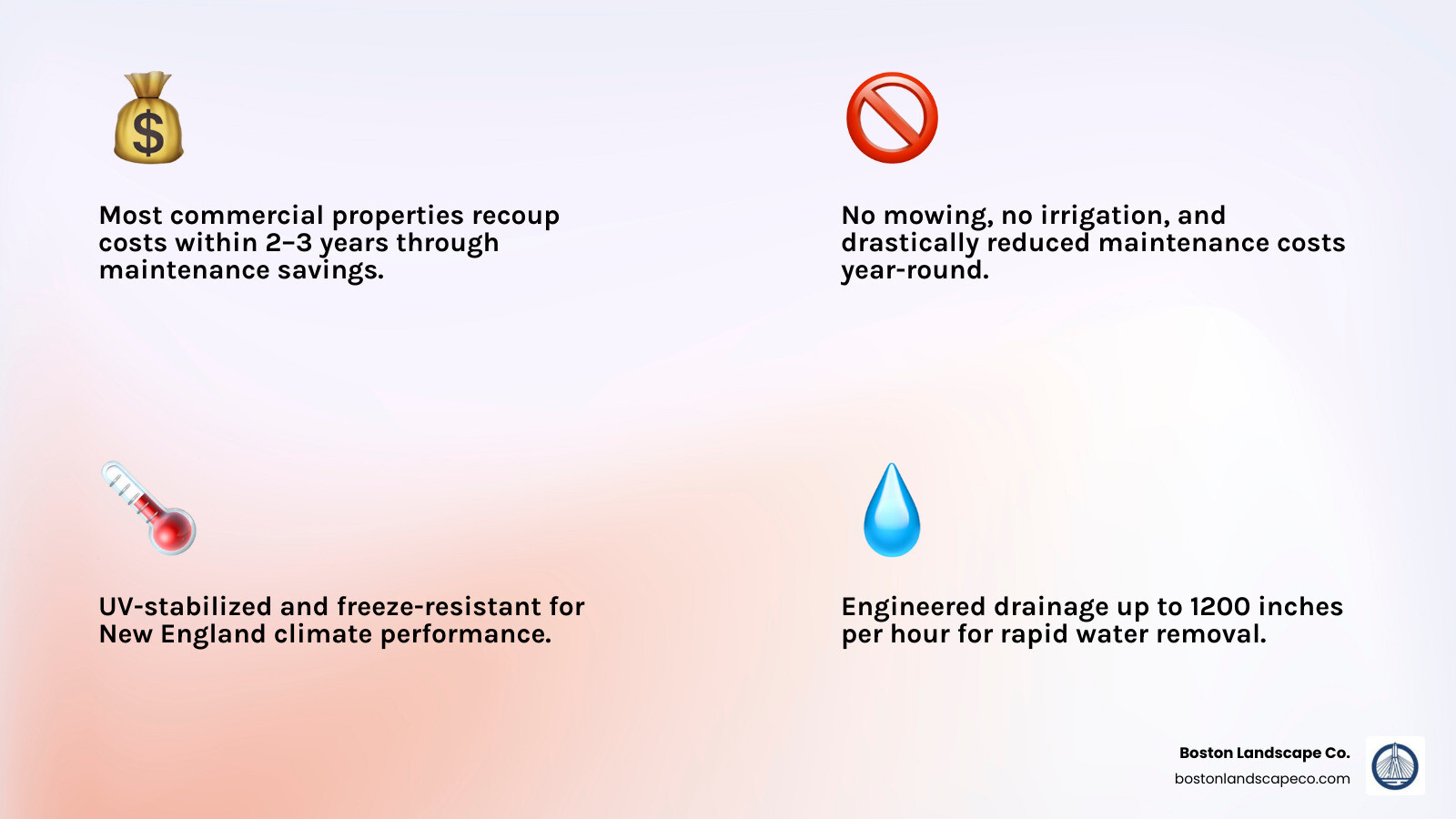
| Key benefits | No mowing, no irrigation, reduced maintenance costs, year-round curb appeal |
| ROI timeline | Many commercial properties may recoup costs over time through maintenance savings, depending on site conditions and usage |
| Climate performance | UV-stabilized, freeze-resistant, and engineered to drain rapidly |
Natural grass is hard to maintain under heavy use. It goes brown in dry summers, gets muddy in wet New England winters, and demands constant watering, mowing, and fertilizing. For commercial properties in towns like Burlington, Lexington, Billerica, and Bedford, that can add up to substantial annual upkeep costs.
Synthetic turf can eliminate much of that ongoing burden.
Modern commercial-grade artificial grass is a far cry from the stiff, plastic-looking surfaces of the past. Today’s systems use advanced fiber technology, permeable backing, and engineered infill to deliver surfaces that look realistic, drain efficiently, and hold up under years of heavy use.
Whether you manage a corporate campus, a retail plaza, or a multi-family residential community, this guide walks you through everything – from how commercial turf differs from residential products, to the full installation process, costs, and maintenance requirements.
I’m Steve Schumacher, owner-operator of Boston Landscape Co. since 1991, and over more than three decades of commercial landscaping work across Massachusetts, I’ve seen how commercial artificial grass installation transforms properties that struggle with high-traffic turf damage and rising maintenance costs. In the sections below, I’ll share what actually matters when planning a commercial synthetic turf project so you can make a confident, informed decision for sites in Billerica, Lexington, Burlington, and Bedford.
Call +781-438-6690 or use our Request an Estimate form to discuss your project. You can also explore related services including commercial landscaping in Boston, artificial grass installation, and lawn sprinkler installation.
Commercial artificial grass installation word guide:
- Commercial sod services
- Lawn sprinkler installation
- Lawn replacement services
- Commercial landscaping in Boston
- Artificial grass installation
What is Commercial Artificial Grass and How Does It Differ from Residential Turf?
When considering a synthetic lawn for a business property, it is vital to understand that commercial-grade turf is entirely different from the products used in residential backyards. While residential turf is designed primarily for aesthetics and soft underfoot comfort, commercial artificial grass is engineered to withstand extreme physical demands.
The primary differences lie in the materials and structural engineering of the turf:
- Fiber Material and Tech: Commercial turf relies heavily on premium polymers like UV-stabilized polypropylene and heavy-duty polyurethane. These fibers are designed to bounce back after being stepped on thousands of times, preventing the “matted down” look that ruins cheap turf.
- Backing Strength: The backing of a commercial turf system is multi-layered and reinforced to prevent tearing, shifting, or bubbling under lateral forces such as heavy carts, frequent pedestrian traffic, or active common-area use.
- Permeability: Commercial backings are designed for maximum water flow-through, ensuring that large-scale surfaces drain efficiently during heavy Massachusetts rainstorms.
If you want to explore the engineering behind these modern systems, you can read more about synthetic artificial lawns to see how modern fiber technology keeps synthetic grass looking lush and natural.
Key Differences in Commercial Artificial Grass Installation Specifications
When we design and execute a commercial layout, we look at several specific metrics that dictate the performance of the lawn:
- Face Weight: Commercial installations typically demand a higher face weight, often 60 oz to 80 oz or more, to ensure there is enough fiber density to handle continuous foot traffic without wearing thin.
- Pile Height: While residential yards might feature taller, softer blades for a plush feel, commercial properties often use a slightly shorter, more resilient pile height, typically 1.25 to 1.75 inches. This structure helps the blades stay upright and makes cleaning debris easier.
- Infill Requirements: Commercial systems require heavier, specialized infill such as acrylic-coated silica sand or antimicrobial infills to help stabilize the turf and support sanitation in pet-friendly or high-traffic zones.
For busy business districts in Billerica, Bedford, Lexington, and Burlington, choosing the right specification is the difference between a surface that performs reliably for years and one that wears prematurely. In our experience, selecting a true commercial-grade specification is essential for a long, low-maintenance life cycle.
The Business Case: ROI and Benefits of Commercial Artificial Grass Installation
For property managers and business owners, landscaping is often viewed as a constant drain on the operating budget. Traditional grass requires continuous mowing, seasonal cleanups, aeration, overseeding, and expensive irrigation.
By transitioning to commercial artificial grass installation, you turn an ongoing operational expense into a long-term property improvement. Many commercial properties see meaningful savings over time through reduced water use, lower landscape labor needs, and fewer inputs such as fertilizers and equipment servicing. Actual return on investment depends on project size, maintenance history, traffic levels, and site conditions.
To help illustrate the long-term financial picture, let’s look at how the costs can stack up over a ten-year period for a typical 5,000-square-foot commercial area using broad industry averages from publicly available online data. These figures are for general planning only and are not the actual prices or estimates of Boston Landscape Co.
Cost Comparison Over 10 Years (5,000 Sq. Ft. Commercial Lawn)
| Expense Category | Natural Grass Lawn | Synthetic Commercial Turf |
|---|---|---|
| Initial Installation | Lower upfront cost | Higher upfront cost |
| Annual Water & Irrigation | $8,000 – $20,000 / year | Typically minimal to none for irrigation |
| Mowing, Edging & Trimming | $6,000 – $15,000 / year | Typically minimal routine grooming only |
| Fertilizers, Pesticides & Aeration | $3,000 – $7,500 / year | Typically not required |
| Periodic Repairs / Resodding | $4,000 – $10,000 every 3-4 years | Occasional grooming or infill adjustment |
| Estimated 10-Year Total Spend | $150,000 – $400,000+ | Initial installation plus periodic maintenance |
All pricing above reflects broad industry averages gathered from publicly available online data and is shown only to demonstrate how commercial landscape costs can vary widely. These figures are not the actual prices, rates, or guarantees of Boston Landscape Co.
As shown, the cumulative cost of maintaining natural grass can quickly exceed the one-time cost of professional turf installation, especially for high-visibility commercial spaces in Burlington, Billerica, Bedford, and Lexington. If you are managing a large office park or retail center, you can discover more about commercial landscaping in Boston and see how integrating low-maintenance turf with your overall landscape plan can support curb appeal while reducing ongoing overhead.
Cost Analysis and Commercial Artificial Grass Installation Pricing in 2026
When budgeting for a commercial synthetic turf project in 2026, it is important to understand that commercial pricing differs significantly from simple residential estimates. Commercial sites often feature complex accessibility challenges, extensive base preparation requirements, and high-performance material specifications.
To help you plan, we have compiled broad industry-wide pricing averages based on publicly available online data:
- Average Commercial Turf Project Range: $30 to $150 per square foot for turnkey installation, depending on site conditions, drainage requirements, access limitations, and product specification.
Disclaimer on Pricing: The price ranges listed above represent broad industry averages sourced from publicly available online data. They do not reflect the actual rates, official pricing, or project estimates of Boston Landscape Co. Every commercial site requires a custom assessment to determine grading, drainage, accessibility, and material specifications.
Why is there such a wide pricing range? A standard, flat landscape perimeter around an office park in Billerica or Bedford may sit on the lower end of the spectrum. By contrast, a highly complex installation such as a multi-level rooftop courtyard in Burlington or an ADA-compliant playground in Lexington with specialized safety underlayment will naturally fall on the higher end.
For the most accurate scope and pricing guidance for your Massachusetts property, call +781-438-6690 or request a custom evaluation through Boston Landscape Co.’s Request an Estimate form.
Step-by-Step Commercial Turf Installation Process
A successful commercial turf project relies almost entirely on the quality of the preparation and the precision of the crew. It is not as simple as rolling out green carpet over dirt.
Here is the professional, step-by-step process we follow to help ensure your commercial lawn remains flat, secure, and visually consistent for years:
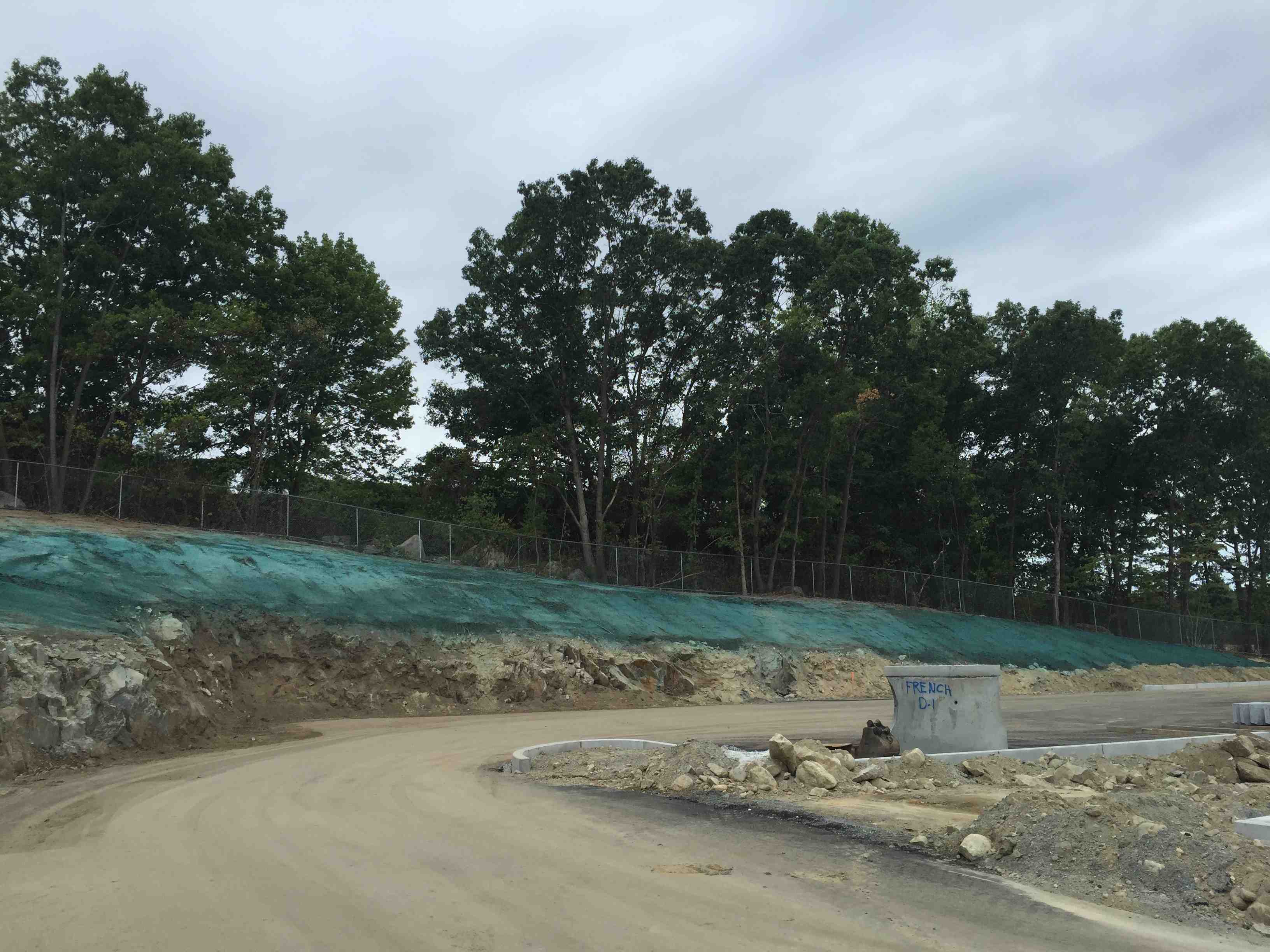
- Site Analysis & Utility Check: Before any excavation begins, we review underground utilities such as irrigation lines or electrical conduits and analyze the natural slope of the land.
- Excavation: We excavate the existing sod and soil down to a depth of roughly 3 to 4 inches to create space for a stable, draining stone sub-base.
- Grading for Drainage: We establish a precise grade, often around a 2% slope when site conditions call for it, to help direct rainwater away from building foundations and toward designated drainage zones.
- Geotextile Weed Barrier: We lay down a commercial-grade, porous geotextile weed fabric to discourage weed growth while allowing water to pass through.
- Aggregate Base Layer: We install a compacted crushed stone base, often topped with a finer leveling layer where appropriate. Proper compaction is essential to reduce settling and surface irregularities.
- Turf Acclimation & Layout: The commercial turf rolls are laid out and allowed to acclimate before final fitting. This helps minimize wrinkling or movement after installation.
- Seaming and Securing: We cut the turf to fit the exact contours of the property. The seams are joined with heavy-duty outdoor adhesive and seaming tape, and the perimeter is secured based on the substrate and project requirements.
- Infill Application & Grooming: We spread appropriate infill across the turf and use power brooms to brush the fibers upright so the infill settles evenly at the base of the blades.
For a deeper look into how these individual steps are executed, read more about fake grass installation to see why professional installation is crucial to avoiding common pitfalls like shifting seams or pooling water.
According to the Synthetic Turf Council, proper base preparation and drainage design are among the most critical factors in determining the long-term performance of any synthetic turf system.
Base Preparation and Drainage Systems
In Massachusetts, the freeze-thaw cycle is a major consideration for any hardscape or landscape installation. If water becomes trapped beneath synthetic turf, freezing and expansion can contribute to surface movement over time.
That is why sub-base design is one of the most important parts of a commercial installation. We use washed crushed stone and other drainage-focused base materials selected for site conditions to help move water efficiently through the system. On well-designed installations, drainage rates can be extremely high, helping the surface perform during spring downpours and winter snowmelt while supporting safer, cleaner walkways in places like Billerica, Bedford, Burlington, and Lexington.
We also prioritize product selections appropriate for commercial use, including fibers designed for UV resistance, durability, and improved surface comfort during warmer weather. For business properties across Massachusetts, professional design, drainage planning, and installation quality are what determine long-term performance.
If you are evaluating options for your site, Boston Landscape Co. can review drainage, grading, and traffic demands as part of a full artificial grass installation consultation.
Frequently Asked Questions about Commercial Synthetic Turf
What commercial properties in Massachusetts benefit most from synthetic turf?
Virtually any business property with outdoor space can benefit from synthetic turf, but we see the highest return on investment in these specific sectors:
- Corporate Office Parks: Keeps main entrances, courtyards, and employee break areas looking immaculate year-round without the noise and disruption of weekly lawn maintenance.
- Retail Plazas & Shopping Centers: High-traffic median strips and green spaces around walkways remain vibrant and green instead of turning into muddy, worn-down dirt paths.
- HOAs & Apartment Complexes: Enhances common areas, pet zones, and pool surrounds while helping keep maintenance budgets more predictable.
- Schools & Daycares: Provides a clean, mud-free surface that may be paired with safety padding where project requirements call for it.
If you are a property manager in Lexington, Bedford, Billerica, or Burlington, you can check out more about commercial landscaping in Lexington MA to learn how synthetic turf integrates into a broader commercial design.
What maintenance is required for commercial artificial grass after installation?
While synthetic turf is incredibly low-maintenance compared to natural grass, it is not entirely maintenance-free. To protect your investment and help maximize its lifespan, we recommend a simple professional maintenance routine:
- Debris Removal: Keep the surface clear of leaves, twigs, and litter using a leaf blower or a plastic rake. Avoid metal rakes, which can damage the fibers.
- Power Brushing: Over time, heavy foot traffic can flatten the grass blades. Brushing the turf periodically helps restore the fibers to a more upright position.
- Infill Refresh: High-traffic areas may experience infill displacement. Periodically topping off and redistributing the infill helps maintain cushioning and stability.
- Sanitization for Pet Zones: In dog-friendly areas, rinsing with water and using a turf-safe deodorizing treatment can help keep the space fresh.
To make things easy for business owners, we offer comprehensive upkeep packages. You can learn more about commercial lawn maintenance services to see how we keep both natural and synthetic landscapes in strong condition throughout the year.
How does commercial turf perform in extreme weather and high-traffic areas?
Commercial synthetic turf is built for extremes. During Massachusetts winters, quality turf fibers are designed to remain flexible in freezing temperatures. Snow can generally be removed using appropriate equipment and methods suited to synthetic surfaces.
In the summer, built-in UV stabilizers help protect color retention under strong sunlight. High-traffic areas in towns like Bedford, Billerica, and Lexington can perform very well when the system includes the right backing, infill, drainage design, and commercial-grade fiber structure.
Conclusion: Partner with Boston Landscape Co. for Your Commercial Turf Needs
Upgrading your commercial property with professional synthetic turf is an investment that can pay dividends for years. It helps reduce the headaches of constant landscaping noise, high water use, and muddy high-traffic dead zones, while supporting a cleaner, more professional image for clients, tenants, and employees.
At Boston Landscape Co., we bring over 35 years of local expertise to every commercial project. Serving communities like Bedford, Billerica, Burlington, Chelmsford, Concord, Lexington, and Wilmington, we handle the entire process from initial site grading and drainage planning to the final precision seaming of your new lawn.
If your property in Billerica, Bedford, Burlington, or Lexington is ready for a lower-maintenance landscape solution, our team can help you evaluate the right system for your needs.
Don’t let high maintenance costs and worn-out grass drain your operating budget. Call +781-438-6690 or click below to request a customized site estimate.
