
Wetland Mitigation: 10 Powerful Benefits in 2025
Understanding Wetland Mitigation: The Basics
When you look at a thriving wetland, you’re witnessing one of nature’s most productive ecosystems. The gentle ripple of water, the chorus of frogs, and the dance of dragonflies all point to something special happening. But these precious habitats are disappearing at an alarming rate.
Wetland mitigation steps in as our response to this crisis. In its simplest form, it’s how we make up for unavoidable impacts to wetlands during development. Think of it as nature’s balance sheet – if we disturb one wetland area, we must create or improve another to maintain ecological equilibrium.
Since the 1850s, we’ve lost staggering amounts of our wetland treasures – about 98% of wet prairies and 67% of emergent marsh habitats across many regions of the United States. Each acre lost means fewer natural flood buffers, reduced water filtration, and diminished wildlife habitat.
| Wetland Mitigation Overview |
|---|
| Definition: The restoration, creation, improvement, or preservation of wetlands to offset unavoidable impacts to existing wetlands |
| Regulatory Framework: Required under Section 404 of the Clean Water Act |
| Mitigation Sequence: 1) Avoid impacts 2) Minimize impacts 3) Compensate for unavoidable impacts |
| Types of Mitigation: Restoration, Creation, Improvement, Preservation |
| Delivery Methods: Permittee-responsible, Mitigation Banking, In-lieu Fee Programs |
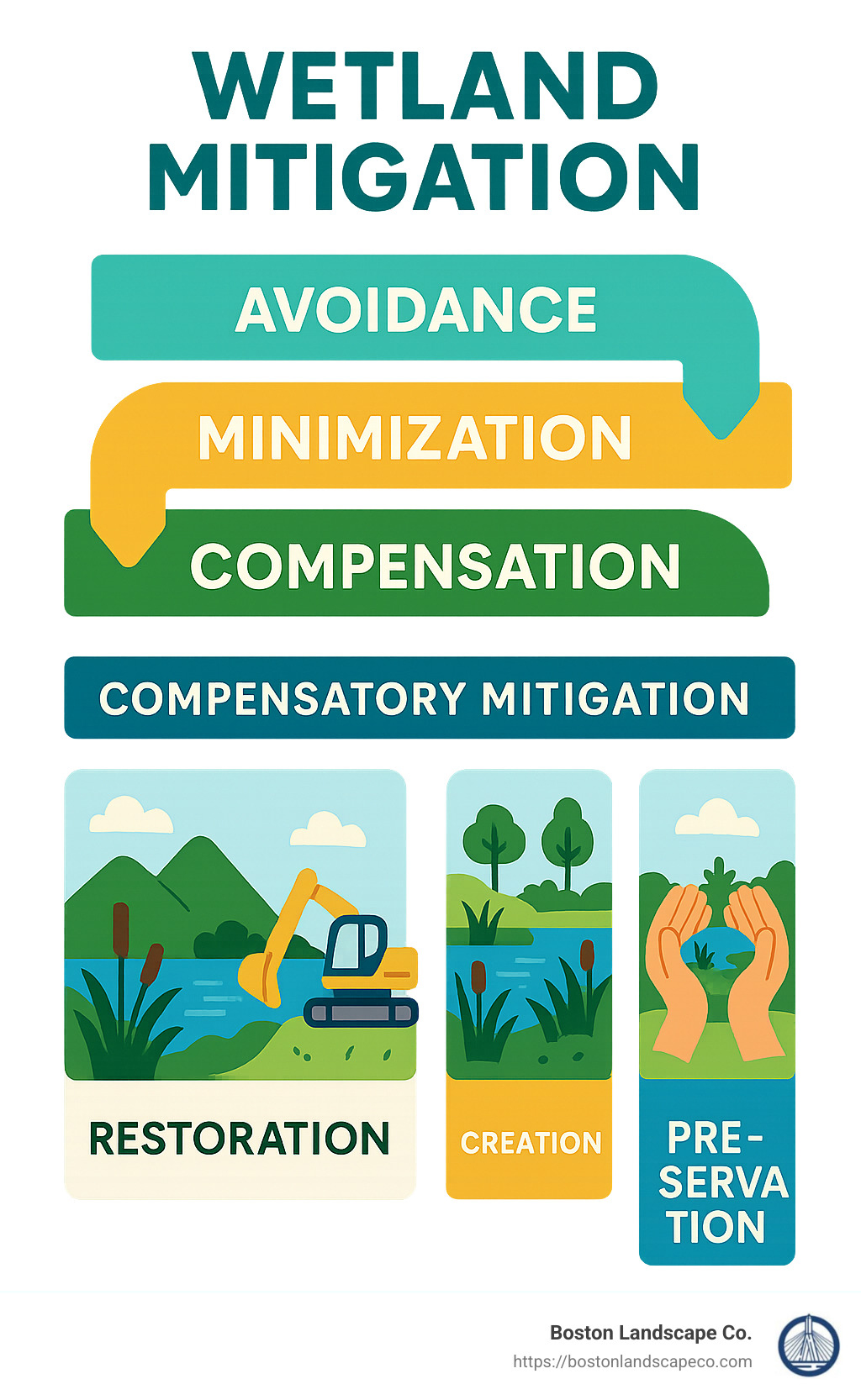
The Clean Water Act established a clear three-step approach that must be followed when development might impact wetlands. First, we must try to avoid disturbing wetlands entirely. If that’s impossible, we must minimize the impacts as much as feasible. Only after these steps can we move to compensating for whatever damage couldn’t be prevented.
This “no net loss” goal means that for every acre of wetland affected, we need to ensure at least an equal amount of wetland function is created or improved elsewhere – preferably more.
When it comes to the actual compensation, wetland mitigation typically follows one of four paths:
Restoration brings life back to wetlands that have been degraded over time. It’s like renovating a historic home – working with what’s there and bringing it back to its former glory.
Creation involves building new wetlands from scratch in areas that weren’t previously wetlands. This is challenging work – like trying to recreate a complex ecosystem from the ground up.
Improvement focuses on enhancing existing wetlands to increase their ecological value. Think of it as upgrading a functional but basic system into something more robust and productive.
Preservation protects high-quality existing wetlands from future threats, ensuring they’ll continue providing environmental benefits for generations to come.
I’m Steve Schumacher, owner of Boston Landscape Co. After three decades in the landscaping industry, I’ve seen how thoughtful wetland mitigation can balance development needs with ecological preservation. These delicate ecosystems provide critical services like flood control, water purification, wildlife habitat, and carbon sequestration – benefits we simply can’t afford to lose.
If you’re navigating the complexities of wetland regulations, you might want to explore our resources on constructed wetlands in the sustainable landscape, wetland protection, and wetland design landscape architecture.
Wetland Mitigation: Definition & Importance
When we talk about wetland mitigation, we’re referring to much more than just regulatory compliance—we’re discussing a vital environmental practice that maintains ecological balance throughout Massachusetts and beyond. At Boston Landscape Co., we’ve seen how wetlands function as nature’s multitaskers in our communities.
Think of wetlands as natural infrastructure. They absorb excess rainwater like giant sponges, significantly reducing downstream flooding during heavy storms. They also act as nature’s water filters, removing pollutants and sediments before water reaches our streams and rivers. What’s more impressive is their ability to store substantial amounts of carbon, helping fight climate change while creating havens for countless plant and animal species that simply can’t survive anywhere else.
The “no net loss” policy established in the late 1980s drives everything we do in wetland mitigation. This national goal recognizes an important truth: while development must continue, we need to balance progress with protecting these irreplaceable natural resources.
What “mitigation” means under the Clean Water Act
Under Section 404 of the Clean Water Act, wetland mitigation follows a three-step sequence that was formalized in the 1990 EPA-Army Memorandum of Agreement:
First, avoid impacts whenever possible through thoughtful project design or relocation. Next, minimize unavoidable impacts to the greatest extent practicable. Only after these steps have been exhausted should you compensate for remaining impacts.
The EPA puts it clearly: “Adverse impacts to aquatic resources are to be avoided and no discharge shall be permitted if there is a practicable alternative with less adverse impact.”
This isn’t just bureaucratic red tape—it’s a practical approach ensuring that wetland mitigation serves as a last resort after we’ve made every reasonable effort to protect existing wetlands. Having guided clients through this process for decades, I can tell you that understanding this sequence is crucial for successful project planning.
Why wetlands matter for people & planet
The benefits of wetlands extend far beyond their ecological functions. For our Massachusetts communities and the greater Boston area, they provide real, tangible value:
When coastal storms threaten, wetlands serve as natural buffers, absorbing storm surges and protecting inland areas from flooding—particularly vital for our New England coastal communities. The natural filtration they provide improves our drinking water quality, while offering wonderful spaces for fishing, bird watching, and connecting with nature.
As climate change brings more extreme weather to Massachusetts, wetland mitigation becomes even more important. Properly functioning wetlands help our communities adapt by reducing flood risks and moderating temperature extremes.
I’ve watched properly maintained wetlands transform neighborhoods from Stoneham to Burlington. They don’t just improve local ecosystems—they improve property values and quality of life for residents. That’s why at Boston Landscape Co., we approach wetland mitigation not just as a requirement, but as an opportunity to create lasting environmental and community benefits.
Whether you’re developing property near sensitive areas or looking to restore wetland functions on your land, understanding the importance of these ecosystems is the first step toward responsible stewardship.
Ecological Functions & Values of Wetlands
When I walk through a wetland with clients in Stoneham or Burlington, I often point out that we’re standing in nature’s Swiss Army knife. Wetlands are true ecological powerhouses, performing a remarkable variety of functions that benefit both wildlife and our communities. Understanding these functions helps us all appreciate why wetland mitigation matters so much.
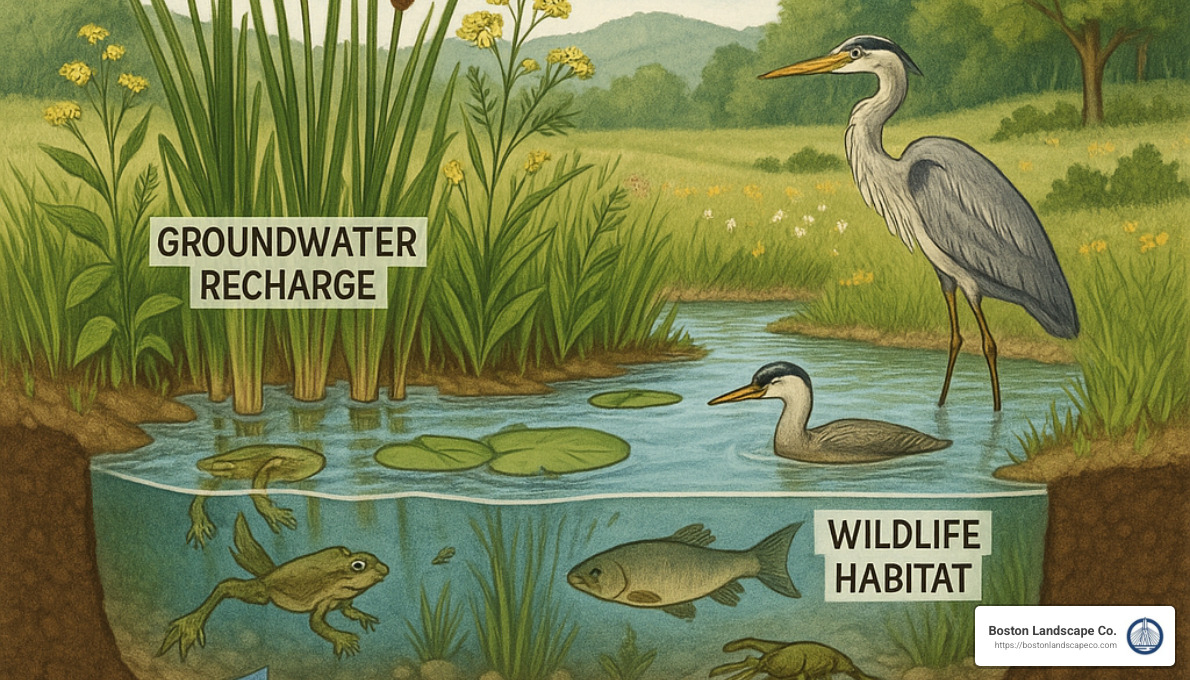
Wetlands are nature’s water managers. They act like giant sponges during heavy rains, temporarily holding water and releasing it slowly to reduce downstream flooding. This same process helps recharge our groundwater supplies and maintains water tables throughout dry periods. Along shorelines, wetland plants’ root systems create natural barriers that prevent erosion and stabilize banks—something we see regularly in our Massachusetts coastal projects.
The chemistry happening in wetlands is nothing short of miraculous. They trap sediments, process excess nutrients, and transform many pollutants into less harmful substances. I’ve seen murky water enter a healthy wetland and emerge dramatically clearer on the other side—nature’s own filtration system at work.
Primary ecological functions of wetlands
When we design and implement wetland mitigation projects across Massachusetts, we’re working to replicate these essential ecological functions:
Nutrient uptake is one of the most valuable services wetlands provide. Wetland plants eagerly absorb excess nitrogen and phosphorus—the same nutrients that, when overabundant in lakes and rivers, cause harmful algal blooms. A single acre of wetland can remove pounds of these nutrients annually.
Groundwater recharge happens as wetlands allow water to slowly seep into underground aquifers. This natural process replenishes drinking water supplies for many communities in our service area, from Billerica to Burlington.
Wetlands also serve as vital wildlife corridors, providing safe passage for animals moving across increasingly fragmented landscapes. I’ve watched deer, foxes, and countless birds use these natural highways to steer between larger habitat patches.
As pollinator refuges, wetlands support native bees, butterflies, and other pollinators that are essential for both agriculture and natural ecosystems. The native wetland plants we incorporate in our restoration projects provide food and shelter for these important creatures throughout their lifecycle.
In places like the Willamette Valley, where only about 2% of historic wet prairies remain, these areas provide irreplaceable habitat for plant and animal species that simply can’t survive elsewhere.
Economic & social benefits you can’t ignore
The dollars-and-cents value of wetlands is substantial, though often overlooked in development decisions:
Property-damage avoidance is perhaps the most dramatic economic benefit. Wetlands dramatically reduce flood damage to homes and businesses—a single acre can store up to 1.5 million gallons of floodwater. After major storms, communities with intact wetlands typically face far lower repair costs.
Public health savings accumulate as wetlands naturally filter water, reducing the cost of drinking water treatment for municipalities. This translates to lower utility costs for residents and businesses alike.
Eco-tourism revenue flows into communities with healthy wetlands. Visitors come to bird watch, fish, kayak, or simply enjoy the natural beauty, supporting local businesses in the process.
Here in Massachusetts communities like Concord and Lexington, where Boston Landscape Co. frequently works, properties near well-maintained wetlands typically command premium prices. Homeowners value both the aesthetic appeal and recreational opportunities these natural features provide.
The science is clear: protecting and restoring wetlands through proper wetland mitigation isn’t just an environmental good—it’s also smart economics and good community planning.
Drivers of Wetland Loss & the Mitigation Sequence
Our wetlands are disappearing at an alarming rate, and the causes might surprise you. As someone who’s worked in Massachusetts landscapes for decades, I’ve witnessed these changes firsthand. Despite their incredible value, wetlands continue to face serious threats from multiple directions:
Agricultural drainage has historically been the biggest culprit, with farmers converting soggy wetlands into productive fields. Urban development follows close behind—as our communities grow, developers often see wetlands as obstacles rather than assets. Rising sea levels are squeezing coastal wetlands between the advancing ocean and developed uplands, while aggressive invasive species like purple loosestrife and phragmites choke out native wetland plants. Perhaps most frustrating are the policy gaps that have allowed inconsistent protection and enforcement.
The statistics tell a sobering story. Since the 1850s, we’ve lost over half of America’s original wetlands. Here in New England, the situation is concerning, but some regions have it even worse—places like Oregon’s Willamette Valley have lost a staggering 98% of their wet prairies and 67% of their emergent marsh habitats.
The Mitigation Sequence in Practice
When a client comes to Boston Landscape Co. with a project that might impact wetlands, we immediately start working through the mitigation sequence:
- Avoidance comes first—always. We help clients explore every possible way to reconfigure their plans to completely avoid wetland impacts. Sometimes this means shifting a building footprint or rerouting a driveway to preserve that vernal pool or marsh area.
- If complete avoidance isn’t possible, we move to minimization. This might involve narrowing a road crossing, using permeable pavers instead of asphalt, or designing sophisticated stormwater management features that protect adjacent wetlands.
- Only after exhausting the first two steps do we consider compensation through wetland mitigation.
I’ve seen how this sequence leads to better outcomes. The EPA’s scientific research on mitigation banking benefits confirms what we’ve observed in practice—projects that faithfully follow this hierarchy result in higher-quality mitigation sites and greater ecological success.
Regulatory framework you must steer
Navigating the wetland mitigation regulatory landscape can feel like trying to cross a wetland itself—without the right guide, you might sink! Here’s what you’re up against:
Clean Water Act §404 forms the backbone of federal wetland protection, requiring permits for any discharge of dredged or fill material into waters of the United States. The 2008 Final Rule established clearer standards for all three mitigation mechanisms: permittee-responsible, mitigation banking, and in-lieu fee programs.
Working in Massachusetts adds another layer of complexity. Our state has additional wetland protection laws that are often more stringent than federal requirements. Many of our clients are surprised to learn they need to satisfy both the federal Clean Water Act and the Massachusetts Wetlands Protection Act—creating a dual permitting process that can be intimidating.
The timeline for these permits varies widely. Nationwide Permits might be processed in 30-45 days, while Individual Permits can take 6-9 months or longer. I’ve seen projects delayed for years when owners didn’t properly plan for wetland permitting.
At Boston Landscape Co., we’ve spent years building relationships with conservation commissions in communities like Stoneham, Billerica, and throughout the Boston area. This experience helps our clients steer these complex regulations without unnecessary delays or costly mistakes. When it comes to wetland mitigation, having a knowledgeable partner can make all the difference.
Four Pathways to Compensatory Wetland Mitigation
When you’ve exhausted all options to avoid or minimize wetland impacts, compensation becomes necessary. At Boston Landscape Co., we work with clients to steer the four main approaches to wetland mitigation:
- Restoration: Bringing a degraded wetland back to life by reestablishing its natural hydrology, soils, and vegetation
- Creation: Building a brand new wetland where none existed before
- Improvement: Enhancing the functions of an existing wetland to increase its ecological value
- Preservation: Permanently protecting high-quality wetlands that might otherwise be at risk
The approach we recommend depends on your specific watershed needs, site conditions, and what the regulations require. Mitigation ratios—how much wetland you need to create or restore compared to what was lost—vary widely. You might need anywhere from 1:1 to 5:1 replacement, depending on the quality of the impacted wetland and the method you choose.
Restoration vs. Creation
If you’re weighing options, know that restoration generally gives you better bang for your buck. There’s wisdom in the saying, “It’s easier to fix something that was once there than to build something from scratch.”
When we handle wetland restoration projects across Massachusetts, we typically focus on three key elements:
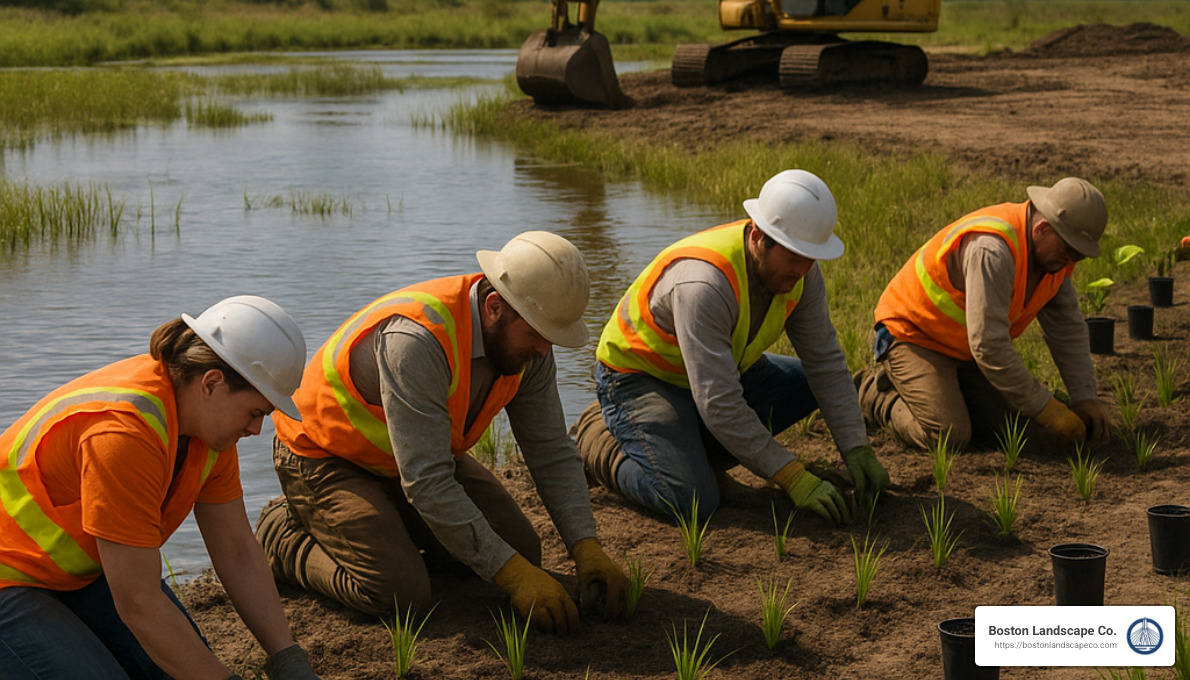
Hydrology re-establishment is often the first step—removing old drainage tiles, filling in ditches, or breaking up compacted soil layers that prevent water movement. In a recent Concord project, simply removing century-old clay drainage tiles allowed the natural water table to return within months.
Soil amendments might be necessary if the soil structure has been altered. Sometimes we need to add organic matter or adjust pH levels to create conditions that support wetland plants.
Native planting completes the picture. We carefully select species that once thrived in the area, creating diverse plant communities that support wildlife. In Lexington, we transformed a former agricultural field into a thriving wet meadow using seeds collected from nearby natural wetlands.
Creation takes a different approach. Rather than restoring what was lost, we’re crafting something new—essentially engineering a wetland from scratch. This involves careful excavation to reach groundwater, installing water control structures, and carefully establishing soil conditions that will support wetland vegetation.
Improvement & Preservation
Sometimes the best approach is enhancing what’s already there. Wetland improvement focuses on boosting specific functions:
Invasive removal is often where we start. Plants like purple loosestrife or phragmites can completely take over, choking out native species. Using targeted removal techniques, we’ve helped restore the natural diversity of wetlands throughout Stoneham and Billerica.
Buffer expansion provides critical protection. A wider buffer zone filters pollutants, reduces erosion, and provides additional wildlife habitat. We often recommend expanding these transition areas with native shrubs and trees.
Conservation easements offer permanent protection for valuable wetlands. These legal agreements restrict future development while allowing current uses to continue. While the paperwork can be complex, the peace of mind is worth it—knowing that the wetland will remain protected for generations.
For clients interested in a more comprehensive approach to integrating wetlands into their landscape, we recommend checking out our detailed guide on Wetland Design & Landscape Architecture. There, you’ll find examples of how we’ve blended ecological function with beautiful design.
Preservation alone typically won’t satisfy your compensatory requirements—regulators want to see new wetland functions created, not just existing ones protected. But preservation often makes sense as part of a larger mitigation package, especially when you can protect rare or threatened wetland types.
Mitigation Banking & Credit Markets
When it comes to wetland mitigation, banking has revolutionized how we approach environmental compensation. Think of mitigation banking as a way to create “ecological savings accounts” that can be drawn upon when development impacts wetlands.
A mitigation bank consists of four essential components: the physical bank site (the actual restored wetland), the bank instrument (legal documentation), the Interagency Review Team providing oversight, and the defined service area where credits can be sold to developers needing to offset impacts.
As the EPA explains, a mitigation bank is “a wetland, stream, or other aquatic resource area that has been restored, established, improved, or preserved for the purpose of providing compensation for unavoidable impacts to aquatic resources permitted under Section 404.” It’s essentially nature’s version of paying it forward.
| Comparison of Mitigation Approaches | Permittee-Responsible | Mitigation Banking |
|---|---|---|
| Timing of implementation | Often after impact occurs | Before credits are sold |
| Success risk | Borne by permittee | Transferred to bank sponsor |
| Ecological scale | Often smaller, isolated | Larger, consolidated sites |
| Long-term management | Varies by permittee | Professional, dedicated |
| Permitting timeline | Longer review process | Faster approval with pre-approved credits |
How wetland mitigation credits are calculated & sold
Mitigation credits are the currency of wetland mitigation banking, representing the ecological value created through restoration efforts. Imagine them as “ecological IOUs” that developers can purchase to fulfill their environmental obligations.
These credits aren’t calculated arbitrarily. They’re determined using sophisticated functional assessment methods that evaluate:
- The wetland’s ability to manage water flow and storage
- How effectively it cycles nutrients and improves water quality
- Its capacity to support diverse plant and animal communities
Different regions across the country use their own assessment methods. Florida relies on the Uniform Mitigation Assessment Method (UMAM), while other areas might use Hydrogeomorphic (HGM) approaches or locally developed systems.
When determining how many credits are needed to offset an impact, regulators typically apply mitigation ratios. These ratios range from 1:1 (one acre restored for every acre impacted) to 3:1 or higher, depending on factors like the quality of the impacted wetland and the likelihood of successful restoration.
Based on internet data, credit prices vary dramatically by location and market conditions. The average costs range from $75,000 to over $300,000 per credit, reflecting the significant ecological value these credits represent. These are market averages and not Boston Landscape Co. pricing.
Advantages & challenges of banking
At Boston Landscape Co., we’ve seen how mitigation banking benefits both developers and the environment. The advantages are substantial:
Economies of scale make banking efficient. Rather than creating many small, isolated wetland patches, banks consolidate resources into larger projects with greater ecological integrity and connectivity.
Faster permits delight developers. Instead of designing and implementing their own mitigation projects, they can purchase pre-approved credits and move forward with development more quickly.
Professional management ensures success. Banks typically employ specialists with deep expertise in wetland restoration, increasing the likelihood of creating fully functioning ecosystems.
Reduced risk appeals to everyone. When developers purchase credits, they also transfer the liability for mitigation success to the bank sponsor – a significant benefit in an uncertain world.
But banking isn’t without challenges:
The upfront capital requirements are substantial, typically exceeding $1 million before the first credit can be sold. This creates a high barrier to entry for potential bank sponsors.
Ecological equivalency debates continue among scientists and regulators. Can a restored wetland in one location truly replace the unique functions of an impacted wetland elsewhere?
Geographic limitations constrain credit use. Typically, credits must be purchased within the same watershed as the impact, which can create supply challenges in some areas.
For landowners curious about the potential of establishing a mitigation bank on their property, more detailed information is available about Wetland Mitigation Bank Credit Potential.
In the Boston area, we’ve seen mitigation banking grow as a practical solution that balances development needs with environmental protection. While it’s not perfect, it represents a significant improvement over historical approaches to wetland mitigation.
Building a Wetland Mitigation Bank: Step-by-Step
Creating a wetland mitigation bank isn’t a weekend project—it’s more like raising a child. It takes years of nurturing, significant resources, and plenty of patience. But for the right landowner, it can be both environmentally meaningful and financially rewarding.
The journey typically follows these six major milestones:
First comes the feasibility study, where you’ll assess if your land has the right ecological potential. This is where we look at soil types, existing hydrology, and surrounding landscape context. We also analyze the local market for mitigation credits—is there enough development activity to create demand?
Next, you’ll develop a detailed prospectus—think of this as your business plan and ecological blueprint rolled into one. This document outlines exactly how you’ll restore the wetland and how the bank will operate.
The Interagency Review Team (IRT) review is where the rubber meets the road. This team of regulatory experts from different agencies will scrutinize your plan, suggest changes, and ultimately decide if your bank gets approved. Be prepared for multiple rounds of questions and revisions.
Once approved, construction and initial restoration begin—breaking ground on the physical work of creating or restoring wetlands. This might involve removing drainage tiles, reshaping the land, and planting thousands of native species.
Then comes the waiting game: monitoring for 7 years (sometimes more) to document that your restoration is actually succeeding. You’ll track water levels, count plant species, and document wildlife use, all to prove you’ve met your performance standards.
Finally, you’ll establish a long-term endowment—a financial trust that generates enough interest to fund the perpetual management of your wetland. This ensures the ecological benefits continue long after you’re gone.
From initial concept to selling your first credit, expect to invest 2-3 years for state approval and up to 7 years for federal approval. This isn’t a get-rich-quick scheme—it’s a long-term commitment to ecological restoration.
Landowner economics & ROI
For landowners considering the wetland mitigation banking path, the financial picture can be attractive, but it requires deep pockets and even deeper patience:
On average, you’ll generate about 1 credit for every 8 acres of restored wetland. So a 160-acre property might yield approximately 20 credits when fully established. These credits don’t all sell at once—they typically move over a 5-10+ year period, depending on regional development activity.
The potential payoff? According to industry data (not Boston Landscape Co. pricing), credits can sell for around $200,000 each in some markets. That hypothetical 160-acre property could potentially generate $4 million in revenue over the bank’s lifetime.
Before you start counting those dollars, consider the significant upfront investment—initial costs often exceed $1 million. You’ll need capital for land acquisition (if you don’t already own it), engineering, construction, planting, and regulatory processes. And there are substantial risks: approval isn’t guaranteed, credit sales depend on regional development patterns, and your management obligations last forever.
At Boston Landscape Co., we help landowners understand if their property might be suitable for mitigation banking and can connect them with the right financial and regulatory partners to explore the possibility.
Success monitoring & adaptive management
The ecological success of a wetland mitigation project isn’t something you can simply eyeball—it requires rigorous, scientific monitoring and responsive management:
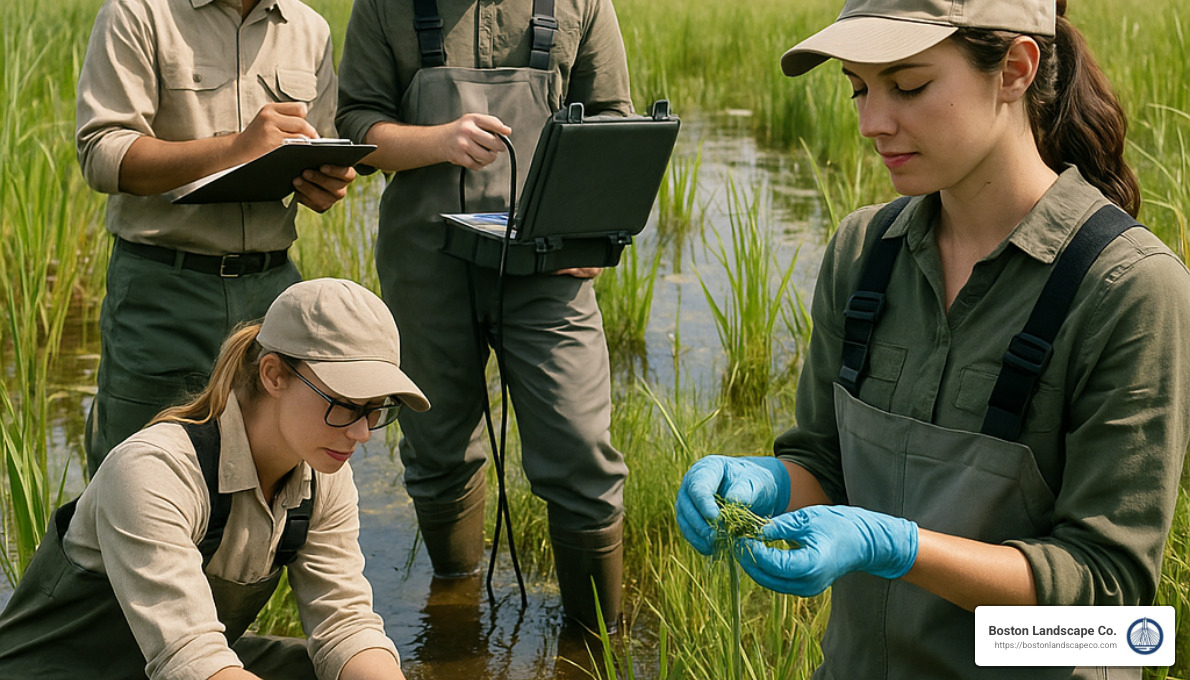
Most regulatory agencies require meeting specific performance standards that might include maintaining minimum water levels throughout the growing season, achieving at least 85% coverage of native wetland plants, keeping invasive species below 5% coverage, and documenting use by target wildlife species.
To track these metrics, you’ll employ various monitoring techniques. Hydrologic gauges record water levels throughout the seasons. Vegetation surveys document which plants are thriving (or not). Soil sampling assesses whether true hydric (wetland) soils are developing. Wildlife surveys count the birds, amphibians, and other creatures making your wetland their home.
When monitoring reveals the site isn’t meeting its targets—and this happens even in the best-planned projects—adaptive management kicks in. Maybe you need to adjust water control structures to hold more water, conduct additional plantings in areas with poor vegetation establishment, or launch an aggressive campaign against invasive species that have gained a foothold.
This cycle of monitoring and adaptation continues throughout the life of the bank, ensuring the wetland mitigation project delivers its promised ecological functions. At Boston Landscape Co., we’ve seen how this commitment to monitoring and adaptive management makes the difference between a struggling wetland and a thriving ecosystem that benefits both wildlife and surrounding communities.
State Spotlights & Future Trends
When it comes to wetland mitigation, there’s no one-size-fits-all approach. Different states have developed unique systems that reflect their ecological challenges and priorities. Let’s take a look at some standout programs across the country.
In Oregon’s Willamette Valley, they’ve tackled an overwhelming 98% loss of wet prairies with determination and creativity. Their comprehensive program doesn’t just replace wetlands—it prioritizes the restoration of these rare prairie habitats. The result? Several thriving wetland prairie banks that preserve this endangered ecosystem while providing mitigation credits.
Florida took a different approach with their Uniform Mitigation Assessment Method (UMAM). If you’ve ever wondered how agencies determine exactly how much mitigation is needed, Florida’s system provides the answer. UMAM offers a standardized way to evaluate wetland function, creating consistency in mitigation requirements throughout the state. This clarity benefits both developers and the environment.
Washington State has pioneered what they call the “watershed approach.” Rather than simply focusing on proximity to impacts, they select mitigation sites based on how they contribute to overall watershed health. This bigger-picture thinking leads to more strategic placement of mitigation projects with greater ecological benefits.
Here in Massachusetts, where Boston Landscape Co. operates, we have our own robust framework through the Wetlands Protection Act. This legislation provides protections that go beyond federal requirements, creating a dual system that ensures thorough review of projects affecting wetlands. Having steerd these regulations for decades, we’ve developed expertise in helping clients meet both state and federal requirements efficiently.
Innovation on the horizon
The world of wetland mitigation keeps evolving, with exciting innovations that promise to make restoration more effective and valuable. These emerging trends point to a future where wetland protection creates even broader benefits.
Blue-carbon banking represents one of the most promising developments. Coastal wetlands are powerhouses of carbon sequestration, and future mitigation banks may generate both wetland and carbon credits. This dual-credit approach could provide additional financial incentives for restoration, making more projects economically viable while fighting climate change.
Another innovation gaining traction is advance mitigation credits. Unlike traditional approaches where mitigation might lag behind impacts, this system allows restoration to be implemented before development occurs. The result? When wetland impacts happen, the replacement functions are already up and running—no waiting period for nature to catch up.
Technology is changing monitoring as well. Remote-sensing audits using drones, satellites, and other advanced technologies make tracking mitigation success more efficient and accurate. These tools allow for more frequent assessment without disturbing sensitive habitats and can detect changes that might be missed by traditional monitoring.
At Boston Landscape Co., we’re excited about these innovations and constantly update our approaches to provide the most effective wetland mitigation solutions. Whether you’re dealing with regulatory requirements or looking to improve the ecological value of your property, our team stays at the forefront of best practices in wetland restoration and creation.
From the wetland prairies of Oregon to the coastal marshes of Massachusetts, wetland mitigation continues to evolve as we better understand these complex ecosystems. The future looks promising, with new approaches that balance development needs with environmental protection more effectively than ever before.
Frequently Asked Questions about Wetland Mitigation
What is the typical mitigation ratio required?
When clients ask me about mitigation ratios, I often explain that it’s not a one-size-fits-all answer. Think of it like a sliding scale that adjusts based on what you’re impacting and how you’re planning to make up for it.
For most wetland mitigation projects, ratios typically start at 1:1 (meaning you restore one acre for every acre impacted) and can go up to 3:1 for more sensitive wetland types. If you’re only preserving existing wetlands, the ratio jumps significantly—sometimes up to 10:1—since you’re not actually creating new wetland area.
Here in Massachusetts, where we work at Boston Landscape Co., the Conservation Commission takes a careful, case-by-case approach. They look at the specific functions of the wetland you’re impacting—things like flood storage capacity, wildlife habitat, and water filtration—and then determine an appropriate ratio based on how well your proposed mitigation will replace those functions.
How long does it take to get mitigation bank approval?
I won’t sugarcoat it—establishing a mitigation bank requires patience. The approval timeline is substantial, with state approval typically taking around 2 years and federal approval stretching up to 7 years in some cases.
The journey follows a fairly predictable path:
- The feasibility study (3-6 months) determines if your site has the right ecological potential
- Developing the prospectus (6-12 months) involves detailed planning and documentation
- Agency review and approval (12-24+ months) includes multiple rounds of feedback and revision
- Construction and initial credit release (6-12 months) happens once you’ve got the green light
If you’re a developer needing mitigation credits quickly, I always recommend purchasing credits from an existing bank instead of trying to establish your own. This approach typically takes just weeks rather than years, allowing your project to move forward without lengthy delays.
Can preservation alone satisfy compensatory requirements?
When clients ask if they can just preserve existing wetlands as their wetland mitigation strategy, I usually have to give them the news that preservation alone typically doesn’t cut it under federal guidelines.
The 2008 Mitigation Rule is pretty clear that preservation by itself isn’t enough in most cases. However, it does carve out some exceptions where preservation can play a larger role:
When the preserved wetlands provide important functions that are rare in the watershed, preservation becomes more valuable. For example, if you’re preserving one of the last intact vernal pools in an area, agencies might give more credit for that.
When the resources face genuine threats of destruction or degradation, preservation makes more sense. Agencies want to know that your preservation is actually preventing likely harm, not just preserving something that wasn’t threatened anyway.
When preservation complements other mitigation efforts like restoration or creation, it becomes part of a comprehensive approach. This is the most common scenario we see in Massachusetts, where preservation typically needs to be paired with active restoration work.
Some states do have different approaches. Florida, for instance, allows preservation to play a larger role in mitigation packages than federal guidelines would suggest. But here in Massachusetts, where Boston Landscape Co. works, the Conservation Commission typically wants to see some active restoration or creation alongside any preservation efforts.
Every situation is unique, and the specific requirements for your project will depend on its location, scale, and impacts. We’re always happy to help steer these complexities for our clients.
Conclusion
Wetland mitigation is truly where environmental stewardship meets practical development needs. Throughout this guide, we’ve seen how these remarkable ecosystems provide irreplaceable services – from flood protection and water purification to wildlife habitat and carbon sequestration.
At Boston Landscape Co., I’ve had the privilege of working on wetland mitigation projects across eastern Massachusetts for over three decades. There’s something deeply satisfying about helping a client steer complex regulations while still achieving their development goals – all while protecting or enhancing our natural environment.
The journey through wetland mitigation can seem daunting at first. The permits, the assessments, the ratios, the monitoring requirements – it’s a lot to take in! But that’s exactly why having an experienced partner makes all the difference. Our team understands both the science behind successful wetland restoration and the nuances of local and federal regulations.
Whether you’re a developer facing mitigation requirements, a property owner with wetlands you want to protect, or a landowner curious about the potential for a mitigation bank, we bring practical solutions custom to your specific situation. We’ve helped clients throughout the greater Boston area transform regulatory obligations into environmental assets that improve property values and ecological resilience.
From our locations in Stoneham and Billerica, we’re proud to serve communities including Boston, Burlington, Lexington, Medford, and beyond. The wetland ecosystems of New England are unique, and our team has spent years learning their intricacies – what plants thrive, how hydrology functions, and which restoration approaches yield the best results.
I believe that successful wetland mitigation isn’t just about checking regulatory boxes – it’s about creating lasting ecological value. When done right, these projects contribute to cleaner water, reduced flooding, improved wildlife habitat, and more beautiful, resilient communities.
For more information about how we can help with your specific wetland mitigation needs, I invite you to visit our wetland services page or reach out to us directly. We’re always happy to share our expertise and discuss your unique situation.
Together, we can ensure that these vital ecosystems continue to benefit our communities and environment for generations to come. After all, when we protect and restore wetlands, we’re not just complying with regulations – we’re investing in our shared environmental future.
