
Tree Hazard Assessment: 7 Essential Tips to Avoid Costly Risks
Why Tree Safety Should Never Be Left to Chance
Tree hazard assessment is a systematic process of evaluating trees for potential dangers to people and property by identifying structural defects, disease, and environmental factors that could cause tree failure.
Quick Reference: Tree Hazard Assessment Basics
– Purpose: Identify trees that pose safety risks before they fail
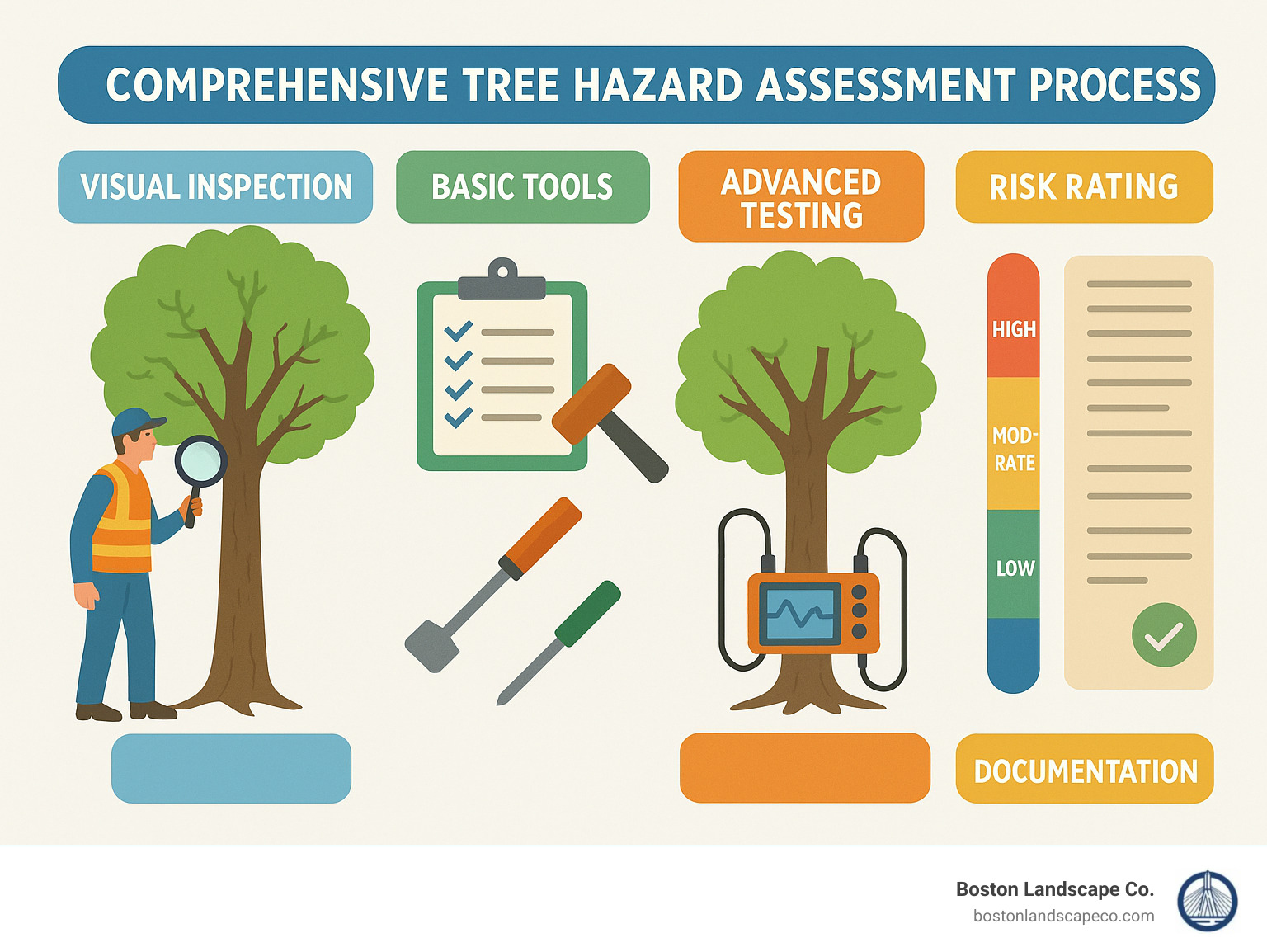
– Assessment Levels: Level 1 (visual), Level 2 (basic tools), Level 3 (advanced testing)
– Key Factors: Tree condition, failure likelihood, and potential targets
– Frequency: Annual for high-use areas, every 2-5 years for low-use areas
– Professional Requirement: Advanced assessments require ISA-certified arborists
Trees provide tremendous benefits – shade, beauty, air quality improvement, and increased property values. But there’s no such thing as a completely safe tree. Even healthy trees can fail under the right conditions, and when they do, the consequences can be devastating.
Research shows that most tree failures occur during wind events, with some species like silver maple suffering extensive damage while others like Norway maple prove more resilient. Trees with codominant trunks fail at just 45% of their normal strength compared to single-trunk trees.
Systematic risk assessment helps property owners balance the many benefits trees provide with necessary safety precautions. By understanding what makes trees hazardous and how to evaluate them properly, you can make informed decisions that protect both people and your valuable tree investments.
As Steve Schumacher with over three decades in the landscaping industry, I’ve seen how proper tree hazard assessment can prevent costly property damage and potential injuries while preserving beautiful trees. Through Boston Landscape Co, we’ve helped countless property owners steer these critical safety decisions since 1991.
Reading Time & Take-Away
Reading Time: 8-10 minutes
Key Takeaways You’ll Learn:
– How to identify potentially dangerous trees before they become hazards
– The three levels of professional tree risk assessment and when each is needed
– Your legal responsibilities as a property owner regarding tree safety
– Practical tools and techniques for evaluating tree health and stability
– When to call professionals versus what you can safely assess yourself
What Is Tree Hazard Assessment & Why It Matters
Tree hazard assessment answers three critical questions: What could fail? How likely is failure? What would be the consequences?
Think of it like a comprehensive health checkup for your trees. Trees might look fine on the outside, but internal problems can develop that aren’t immediately visible. A tree hazard assessment catches problems before they become disasters.
Tree hazard refers to the actual problem within the tree – a cracked trunk, dead branch, or root rot. Tree risk combines how likely that hazard is to cause failure with how severe the consequences would be.
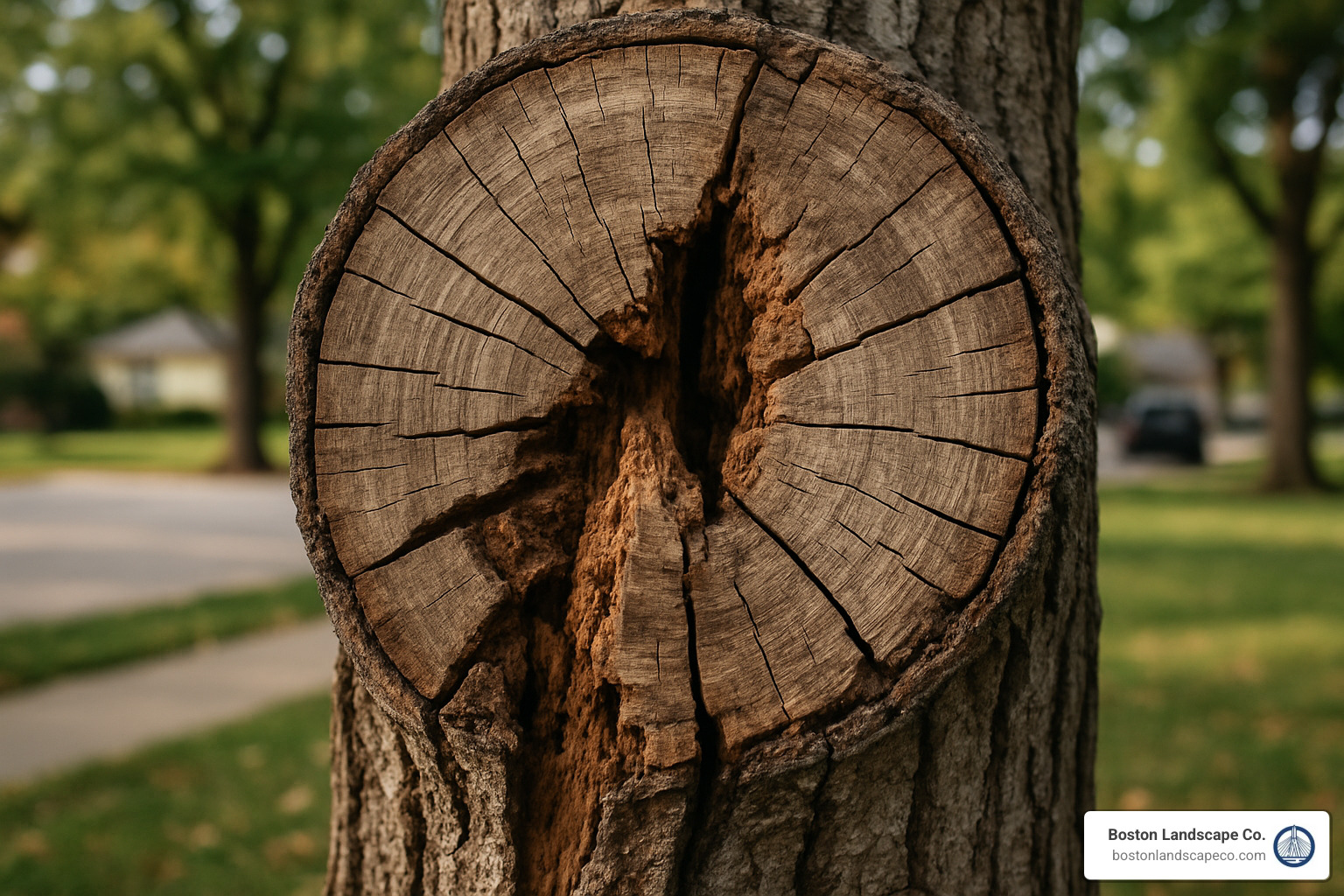
While only a tiny percentage of trees actually cause damage, when failures do occur, they’re often catastrophic. Research shows most tree failures happen during wind events, but some species handle stress much better than others. Silver maples suffer extensive damage in ice storms while other species prove remarkably resilient.
Research on codominant trunk failures reveals particularly concerning data. Trees with V-shaped, codominant stems fail at significantly lower stress levels than single-trunk trees because included bark prevents proper wood formation between stems.
Tree hazard assessment matters for safety – protecting your family, visitors, and neighbors. It’s about property protection, preventing damage that could cost thousands to repair. From a legal liability perspective, proper assessment demonstrates you’re fulfilling your duty of care as a property owner. And tree preservation – identifying problems early often allows for corrective action rather than removal.
Tree Hazard Assessment Levels Explained
The International Society of Arboriculture uses a three-level system that matches inspection intensity to the situation.
Level 1 assessments are basic windshield surveys, looking for obvious problems like hanging branches, dead trees, severe lean, or storm damage. They’re quick, cost-effective, and perfect for screening large areas.
Level 2 assessments involve detailed, 360-degree inspection of individual trees using basic tools. This includes examining crown structure, trunk condition, root zone and soil conditions, and conducting thorough target assessment.
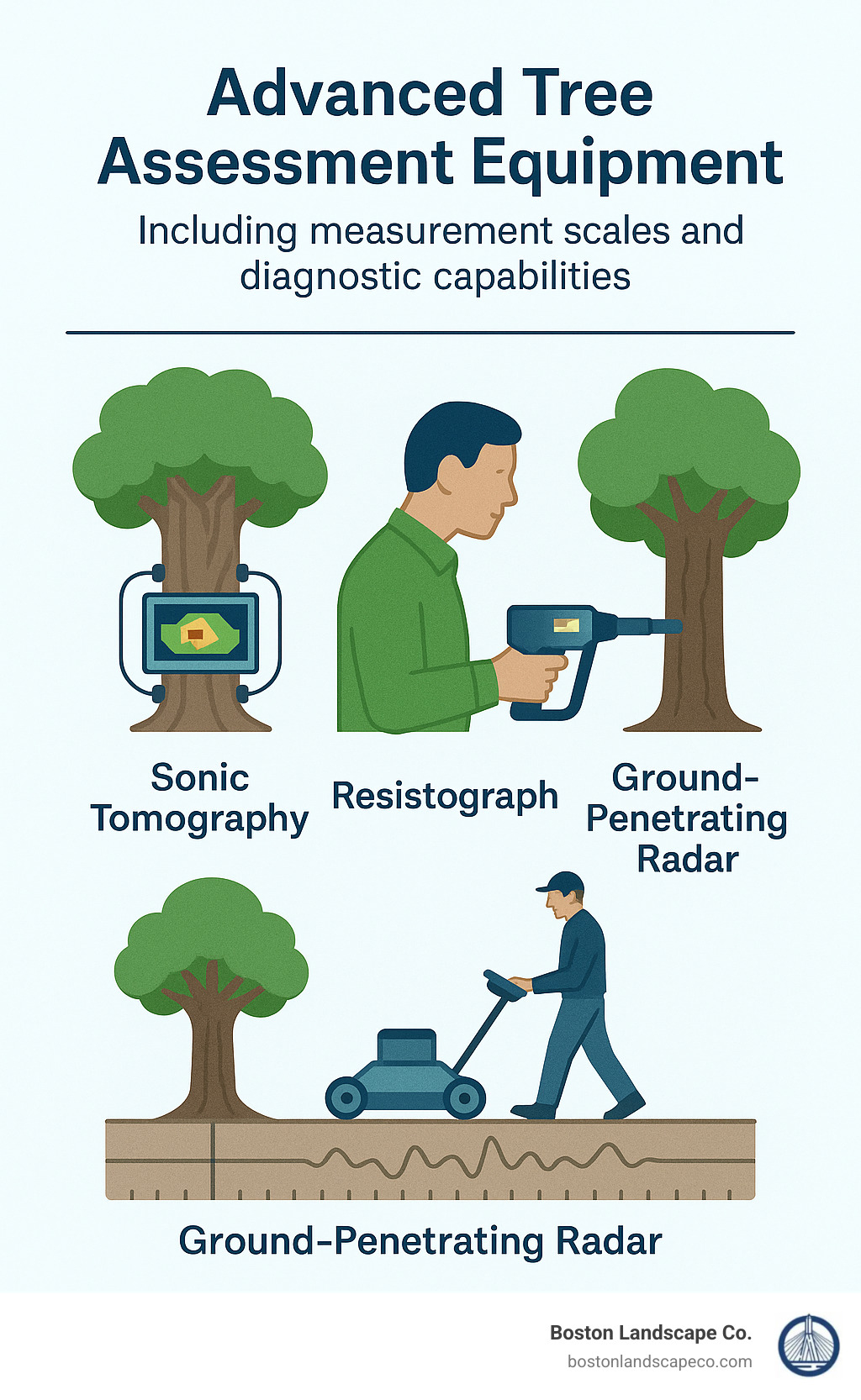
Level 3 assessments use sophisticated diagnostic tools like sonic tomography to map internal decay, resistograph drilling to measure wood density, ground-penetrating radar for root analysis, and static or dynamic load testing.
| Assessment Level | Time Required | Tools Needed | Best Used For | Performed By |
|---|---|---|---|---|
| Level 1 | 5-15 minutes | Visual only | Large area screening | Trained staff |
| Level 2 | 30-60 minutes | Basic tools | Individual tree evaluation | ISA Certified Arborist |
| Level 3 | 2-4 hours | Advanced equipment | High-value/complex cases | ISA TRAQ Qualified |
Tree Hazard Assessment Checklist: Step-by-Step
Start by defining your assessment scope – identify the area, determine the appropriate assessment level, and gather previous inspection records.
Systematic zone inspection divides each tree into six zones because different problems show up in different areas. Zone 1 covers the stem and root zone up to four feet high. Zone 2 examines the main stem above four feet. Zones 3-6 cover primary roots, primary branches, and the remainder of the root system and crown.
Do a 360-degree walk-around examining crown density, branch structure, trunk condition, and root flare visibility. For trees showing decay signs, assess the sound wood shell using the “One-Third Rule” – trees generally don’t fail if they retain at least one-third of their original sound wood.
Documentation includes GPS coordinates, species identification, photographic evidence, risk ratings, and assessment details. Follow-up planning schedules immediate mitigation for high-risk trees and monitoring intervals for moderate-risk trees.
Legal & Ethical Duty of Care for Tree Hazards
As a property owner, you have legal and ethical responsibilities to keep trees from harming people or damaging neighboring properties. The good news? You don’t need to be perfect, just reasonable.

Understanding Your Legal Obligations
The legal concept of “duty of care” means you need to take reasonable steps to prevent foreseeable harm from trees on your property. Courts don’t expect you to guarantee trees will never fail – they expect you to act sensibly.
The Alberta Occupiers’ Liability Act provides a clear example of how courts view tree-related responsibility. Property owners must ensure people on their premises are reasonably safe from tree hazards.
What “Reasonable Care” Actually Means
Courts look for five key elements: Regular inspection, prompt response to identified problems, following professional standards for tree hazard assessment, proper documentation, and due diligence in identifying and addressing hazards.
Different Standards for Different Properties
Municipalities face the highest standard, especially in parks and public spaces. Private property owners have similar but scaled responsibilities – pay attention to trees near homes, walkways, and gathering areas.
Protecting Yourself Through Smart Documentation
Establish regular inspection schedules, document assessments and decisions, act promptly on identified hazards, consult qualified professionals for complex situations, and maintain comprehensive insurance coverage.
Courts expect reasonable care, not perfection. Well-documented tree safety approaches demonstrate you’re taking responsibilities seriously.
How to Conduct a Comprehensive Tree Hazard Assessment
Conducting thorough tree hazard assessments requires systematic methodology, proper tools, and trained eyes. Some species are reliable while others are prone to sudden failures.
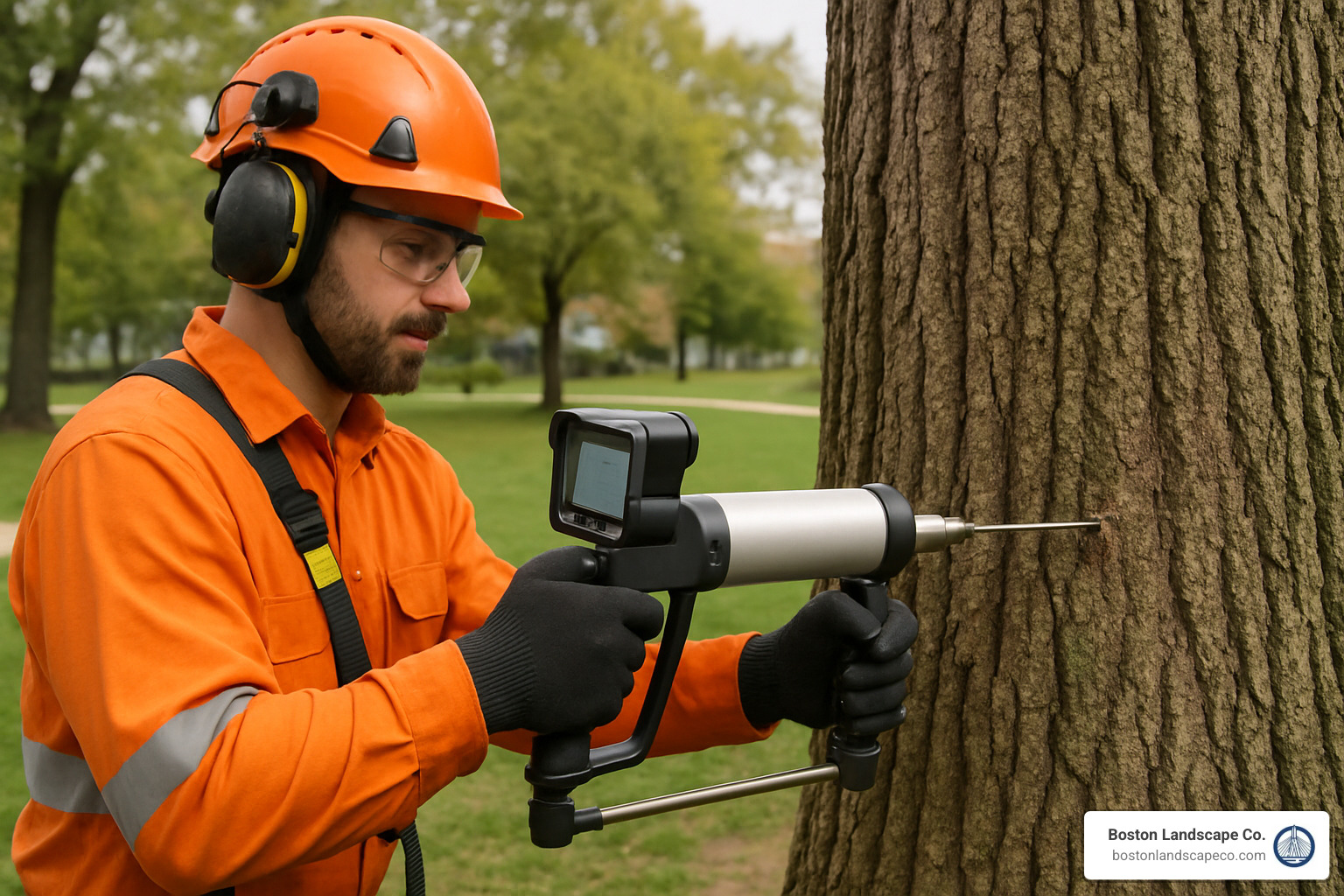
Silver maple and Bradford pear are notorious for sudden failures with brittle wood and weak branch attachments. Sugar maple and white oak are dependable with excellent structural characteristics. Understanding species-specific traits helps focus assessment efforts.
For basic evaluations, binoculars let you inspect crowns safely, rubber mallets detect hollow sounds by tapping trunks, and increment borers sample wood directly. Cameras are crucial for documentation.
Advanced diagnostics use sonic tomography (like ultrasound for trees), resistograph testing (micro-drilling to measure wood density), ground-penetrating radar (root analysis), and static pull testing (measuring actual stability).
The Quantified Tree Risk Assessment (QTRA) approach assigns numerical values to failure probability and consequences, providing objective risk evaluation.
This systematic approach integrates well with our Professional Lawn Care Services – healthy soil and proper maintenance reduce tree stress and improve safety.
Limited Visual Survey (Level 1)
Level 1 assessments are quick health checks for your entire tree population, hunting for obvious problems that could cause immediate harm.
The windshield survey approach covers large areas quickly, looking for hanging limbs, dead trees, or severe lean. They’re perfect for annual monitoring or post-storm damage assessment.
Maintain consistent pace and systematic coverage at 2-3 mph walking speed. Documentation should be quick but accurate – GPS coordinates, basic hazard description, and photos.
Level 1 assessments won’t catch internal defects or early-stage problems, and weather conditions can affect visibility.
Basic Assessment (Level 2)
Level 2 assessments involve detailed, 360-degree inspection of individual trees using basic tools.
Crown evaluation examines branch structure – branches joining trunks at 45 degrees are strongest. Dead, damaged, or diseased limbs lose flexibility and often have missing bark.
Trunk assessment looks for bark condition, cracks, and fungal fruiting bodies that advertise internal decay. Root zone analysis checks for visible root flare and construction damage.
Target evaluation considers what could be hit if the tree fails – a tree next to a busy sidewalk poses much higher risk than one in an open field.
Advanced Assessment (Level 3)
Level 3 assessments use sophisticated diagnostic equipment for high-value specimen trees or trees with significant but unclear defects.
Resistograph testing creates detailed graphs showing exactly where sound wood ends and decay begins. Sonic tomography maps internal structure by measuring sound wave transmission. Root analysis using ground-penetrating radar reveals hidden root problems. Load testing measures actual stability under controlled conditions.
These assessments require ISA TRAQ qualified professionals with specialized training and equipment. At Boston Landscape Co., we coordinate everything from assessment through mitigation as part of our comprehensive Landscape Contractor services.
Mitigation, Monitoring & Record Keeping
Once tree hazard assessment identifies risks, implement appropriate mitigation strategies to reduce risk while preserving tree benefits whenever possible.

Target management often provides the most cost-effective solution. Before major tree work, consider relocating picnic tables, rerouting walkways, or installing protective barriers.
When trees can be preserved, structural correction includes pruning dead or poorly attached limbs, cabling and bracing systems for weak unions, crown reduction to decrease wind loading, and root management to address soil issues.
Sometimes tree removal and replacement becomes necessary for safety.
How Often Should You Monitor?
High-use areas like playgrounds and building entrances need annual attention. Moderate-use areas such as secondary trails can go two years between inspections. Low-use areas including natural areas may only need assessment every 3-5 years.
After major storms, all trees need reassessment regardless of previous schedules.
The Critical Importance of Digital Records
Good record keeping provides essential liability protection. Records should include unique tree identification, GPS coordinates, species and condition data, assessment dates and credentials, risk ratings and actions, and monitoring schedules.
GIS integration transforms record keeping into powerful management tools for analyzing risk patterns and planning efficient inspections.
Understanding the Investment
Based on internet research, assessment costs typically range from $5-$25 per tree for Level 1 surveys, $75-$300 per tree for Level 2 assessments, and $300-$1,200 per tree for Level 3 evaluations.
Mitigation costs vary widely – pruning might run $300-$1,500 per tree, cabling installations $500-$2,000, and tree removal $500-$4,500 per tree.
These are average ranges based on internet research and actual costs may vary significantly based on local conditions, tree size, access difficulty, and specific requirements.
Smart budget planning involves establishing annual assessment budgets and creating reserve funds for emergency work.
For comprehensive property management, we integrate hazard assessment with our Landscape Contractor services to ensure your entire landscape remains both beautiful and safe.
Effective mitigation isn’t about eliminating all risk – it’s about managing risk intelligently while preserving the tremendous benefits that healthy trees provide.
Frequently Asked Questions about Tree Hazard Assessment
How often should trees be assessed?
Timing depends on tree activity levels and environmental factors. Trees needing annual attention include those around playgrounds, parking lots, and building entrances, plus previously identified moderate-risk trees.
Every two years works well for most residential properties with mature trees and low-use trail systems. Every 3-5 years is sufficient for natural areas, young healthy populations, and low-risk areas.
Event-triggered assessments are crucial after severe storms, construction activities, significant drought or flooding, or disease outbreaks. Research shows annual surveys work best in high-use recreation areas, while biennial surveys provide adequate protection for moderate-use areas.
More people around trees equals more frequent checking.
What tools can homeowners safely use?
Basic homeowner toolkit includes binoculars for crown examination, cameras for documentation, rubber mallets for trunk tapping, measuring tape for dimensions, and smartphone apps for tree identification.
Safe inspection routine: Use binoculars to inspect for dead branches or cracks, walk completely around each tree from ground level, check the base for root damage or fungal growth, document concerns with photos.
Know when to call pros – trees touching power lines, large trees over buildings, signs of disease or pest problems, after storm damage, or when unsure about observations.
Safety first: Never climb trees or use ladders for assessment. Avoid walking under trees during windy conditions or after storms.
When is removal the only option?
Immediate removal situations include trees with extreme hazard ratings, structural failures like cracked trunks or root plate failure, extensive decay reducing sound wood below 33% of trunk radius, or dead/dying large specimens over high-value targets.
Sometimes economics favor removal – when mitigation costs exceed 50% of replacement value, maintenance requirements become excessive, or species are inappropriate for the location.
The One-Third Rule provides clear guidance – trees generally don’t fail if they retain at least one-third of their original sound wood. Below this threshold, removal typically becomes safest.
Removal should be the last resort. Many concerning trees can be managed through pruning, support systems, or target modification. But when safety is at stake, removal becomes the responsible choice.
Conclusion
After more than three decades in the landscaping industry, I’ve learned that tree hazard assessment is really about finding that sweet spot between safety and preservation. It’s not about being afraid of every tree on your property – it’s about being smart and proactive so you can enjoy the incredible benefits trees provide without unnecessary worry.
The truth is, most trees will never cause problems. But the ones that do can create serious headaches – and worse. That’s why we take a systematic approach at Boston Landscape Co. We believe in regular, documented assessments that use the right methods for each situation, professional expertise when complex evaluations are needed, and prompt action when hazards are identified.
What really matters is keeping good records that show you’re taking reasonable care of your trees. This isn’t just about liability protection (though that’s important too) – it’s about making informed decisions that let you preserve beautiful, valuable trees whenever it’s safely possible.
From our locations in Stoneham and Billerica, we serve property owners throughout the greater Boston area, including Bedford, Burlington, Concord, Lexington, Medford, Reading, Waltham, Winchester, and Woburn. We’ve seen every type of tree situation you can imagine, and we understand that every property tells its own story.
Whether you need a basic visual survey to get started, comprehensive risk evaluation for high-value specimens, or ongoing tree management as part of your landscape care, we bring the right expertise and equipment for thorough, professional assessment. We know that your property is unique, and we tailor our approach to match your specific needs and comfort level with risk.
Here’s what I always tell clients: don’t wait for a storm to think about tree safety. Proactive assessment and management protect your investment while keeping everyone safe who spends time on your property. It’s really that simple.
For comprehensive property care that integrates tree safety with overall landscape health, check out our Landscape Management Companies services. We believe in taking care of your entire outdoor space as a connected system.
Ready to get started with professional tree hazard assessment? Give us a call at Boston Landscape Co. We’ll walk your property with you, discuss any concerns you have, and develop a tree management plan that makes sense for your situation. Because when it comes to tree safety, peace of mind is worth its weight in gold.
