
Why Commercial Landscape Maintenance Contracts Matter for Your Property
Commercial landscape maintenance contracts are formal agreements between a property owner or manager and a landscaping company that define exactly what services will be performed, how often, and at what cost — so your property always looks its best without surprises.
Here’s what a solid contract typically covers at a glance:
| Contract Element | What It Means |
|---|---|
| Scope of Services | Mowing, edging, pruning, fertilization, weed control, irrigation, cleanups |
| Service Frequency | Weekly, bi-weekly, or seasonal schedules spelled out clearly |
| Seasonal Services | Spring cleanup, fall leaf removal, snow and ice management |
| Insurance & Licensing | General liability, workers’ comp, pesticide applicator credentials |
| Payment Structure | Flat fee, per-visit, or seasonal contract pricing |
| Communication & Reporting | Site inspections, service logs, designated contact person |
Your property’s landscaping is often the first thing people notice. As one property manager put it: “Our landscaping is the first thing people notice. It’s not just maintenance — it’s marketing.” A well-structured contract protects that investment and keeps expectations clear on both sides.
But navigating the fine print? That’s where most property managers get stuck.
I’m Steve Schumacher, owner-operator of Boston Landscape Co. since 1991, and over more than three decades I’ve helped Greater Boston property managers build and execute commercial landscape maintenance contracts that actually deliver results. In this guide, I’ll walk you through everything you need to know — from essential services to avoiding costly contract pitfalls.
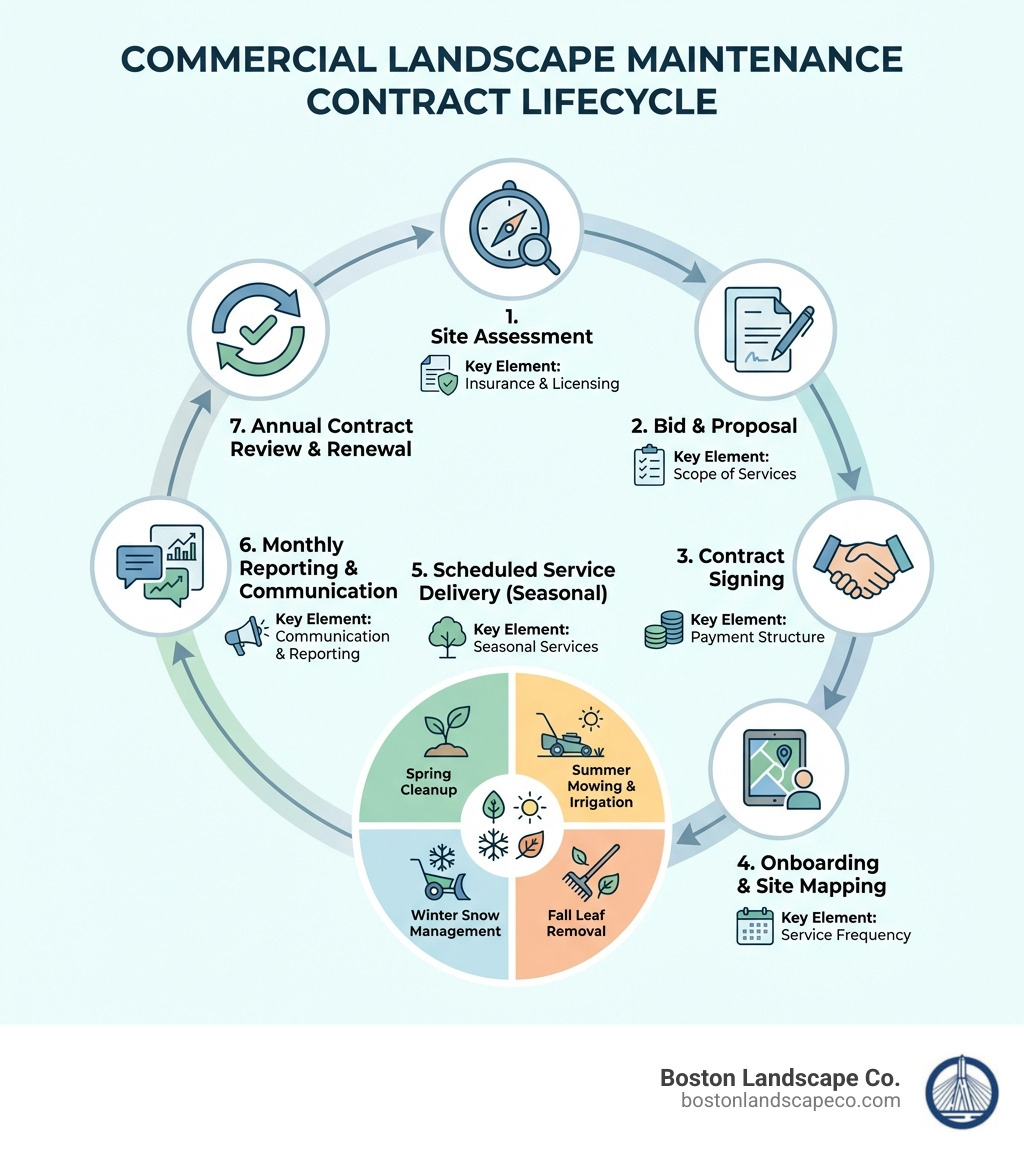
Commercial landscape maintenance contracts basics:
- Commercial Property Maintenance
- Commercial Property Maintenance Inspection Checklist
- Office Building Landscaping Services
Essential Services in Commercial Landscape Maintenance Contracts
When you are reviewing commercial landscape maintenance contracts, the “Scope of Work” is the most critical section. It’s not just about cutting grass; it’s about a comprehensive strategy to keep your property healthy and inviting. In the Greater Boston area, from Bedford to Waltham, our climate demands a high level of precision.

One of the golden rules we follow is the 1/3 rule: we never cut more than one-third of the grass blade length in a single mowing. This preserves nutrients and helps the turf stay resilient against the summer heat. A standard contract should also specify:
- Edging and String Trimming: Creating clean lines along sidewalks and curbs.
- Debris Blowing: Ensuring all hardscapes are clear of clippings after every visit.
- Mulching: Applying 2-3 inches of fresh mulch annually to retain moisture and suppress weeds.
For a deeper dive into these requirements, check out our page on commercial lawn maintenance services.
Core Maintenance and Seasonal Services
In Massachusetts, our seasons are distinct and demanding. A “one-size-fits-all” approach doesn’t work for a property in Stoneham or Burlington. Your contract must include specific seasonal transitions.
- Spring Cleanup: This is the “reset button” for your property. It involves removing winter debris, thatch, and preparing beds for new growth.
- Fall Leaf Removal: We typically recommend three visits between October and December. Letting leaves sit can lead to mold and turf disease.
- Seasonal Pruning: Shrubs should generally be pruned twice a year (June and late summer) to maintain their natural shape and health.
Ensuring these are bundled into your agreement prevents “invoice creep” later in the year. You can learn more about full service lawn maintenance to see how these pieces fit together.
Irrigation and Integrated Pest Management (IPM)
Water is a precious resource, especially during our dry July and August months. Commercial landscape maintenance contracts should explicitly detail irrigation management. This includes:
- Spring Start-up: Testing all zones and heads for leaks.
- Bi-weekly Monitoring: Adjusting controllers for weather changes.
- Winterization: Using professional blow-out equipment to prevent pipe bursts during the freezing Boston winters.
Furthermore, we advocate for Integrated Pest Management (IPM) Principles. Instead of blanket spraying chemicals, IPM focuses on scouting and targeted treatments. This is better for the environment and more effective for long-term weed and pest control. If you’re looking to upgrade your tech, read about irrigation system installation.
Evaluating and Selecting the Right Landscaping Partner
Choosing a partner is about more than just the lowest number on a spreadsheet. In fact, the lowest bid often leads to “hidden” costs when plants die due to neglect. We recommend a 3-bid process to compare service levels accurately.
| Contractor Credential | Why It Matters |
|---|---|
| Years of Local Experience | Knowledge of Boston-area soil and climate. |
| Certified Professionals | Ensures staff are trained in the “art and science” of plants. |
| Site Inspections | Did they actually walk the property before bidding? |
| References | Can they show you other properties in Medford or Woburn? |
For more tips on vetting, visit our guide on landscape management companies. You can also refer to these Guidelines for Selecting a Landscape Contractor for industry-standard checklists.
Licensing, Insurance, and Compliance Requirements
This is the “boring” part of the contract that can save your business from a massive headache. Never sign a contract with a company that isn’t fully covered. Essential requirements include:
- General Liability Insurance: Minimum $1,000,000 per occurrence.
- Workers’ Compensation: To protect you if a crew member is injured on your site.
- Umbrella Coverage: Often required for larger commercial sites (up to $5,000,000).
- Pesticide Applicator License: In Massachusetts, anyone applying weed control must be licensed by the state.
Compliance isn’t just a suggestion; it’s a requirement for professional commercial property landscaping.
Structuring Payments and Additional Services
How you pay is just as important as what you pay for. Most commercial landscape maintenance contracts in the North Shore area use one of three structures:
- Flat Fee (Seasonal): You pay a set amount monthly, regardless of how many mows happen. This is great for budgeting.
- Per-Visit: You pay only when the crew shows up. This can be cheaper in dry years but harder to predict.
- Time and Materials: Usually reserved for “extras” like storm cleanup or new plantings.
Navigating Costs and Invoicing in Commercial Landscape Maintenance Contracts
Let’s talk numbers. Based on average online data and regional market rates in towns like Stoneham and Billerica, a commercial maintenance package can range widely.
Pricing Disclaimer: The following figures are average costs based on internet data and are not the actual prices of Boston Landscape Co. Real-world variability depends on property size, complexity, and specific service levels.
- Small Retail/Office: $1,500 – $4,500+ per season.
- Mid-Sized HOA/Industrial: $5,000 – $15,000+ per season.
- Large Campus/Complex: $20,000 – $60,000+ per season.
For more details on what influences these rates, check out our commercial lawn care services page.
Quality Assurance and Communication Strategies
A contract is only as good as the communication behind it. We believe in “no-surprises” landscaping. Your contract should outline how the contractor will report their work.
- Service Level Agreements (SLAs): These define response times (e.g., “Irrigation emergencies will be addressed within 4 hours”).
- Site Maps: Using GPS-enabled maps to show exactly which areas are included and which are excluded.
- Monthly Reports: A summary of what was done and what is planned for the next 30 days.
For more on professional oversight, see commercial property landscape maintenance.
Leveraging CRM Software for Better Client Retention
Modern landscaping isn’t just about lawnmowers; it’s about software. Using Customer Relationship Management (CRM) tools allows us to provide:
- Client Portals: Where you can see your history and pay invoices.
- Photo Documentation: Proof of service after every visit.
- Automated Updates: Knowing exactly when the crew is arriving at your Somerville or Malden property.
This level of transparency is what separates a “guy with a truck” from a professional exterior grounds maintenance management company.
Avoiding Common Pitfalls in Commercial Landscape Maintenance Contracts
The “fine print” is where the trouble usually hides. We’ve seen many property managers sign contracts that leave them exposed.
Common pitfalls include:
- Vague Scope: Does “mowing” include the steep hill behind the parking lot? If it’s not in writing, it might not happen.
- Missing Termination Clauses: You should be able to end the contract (with 30 days’ notice) if performance isn’t met.
- Uncontrolled Subcontracting: Ensure the company you hire is the one doing the work, not a third party you haven’t vetted.
For those looking ahead to winter, reviewing a commercial snow removal contract follows many of these same principles.
Defining Scope and Exclusions
Be very specific about property boundaries. If your property borders a wetland in Concord or a native garden in Winchester, those areas may require specialized care or be excluded entirely from standard mowing to protect the ecosystem.
- Exclusions: Clearly mark areas like employee “victory gardens” or conservation zones.
- Special Areas: Note high-traffic entrances that might need extra trash “portering” or seasonal color.
Clear boundaries are the foundation of good commercial grounds maintenance.
Frequently Asked Questions about Commercial Landscape Maintenance Contracts
What is the standard duration for a commercial landscape contract?
Most contracts are for one year, but multi-year agreements (3-5 years) are becoming common for government and large corporate sites to ensure price stability.
How often should irrigation systems be inspected under a contract?
At a minimum, we recommend bi-weekly inspections during the growing season (April – October). This ensures heads are adjusted correctly and no water is being wasted on the pavement.
Are snow and ice management typically included in landscape contracts?
In the Greater Boston area, many property managers prefer a “year-round” contract that bundles landscaping and snow management. This ensures you have a single point of contact for all exterior needs.
Conclusion
Navigating commercial landscape maintenance contracts doesn’t have to be overwhelming. By focusing on a clear scope of work, verifying insurance, and insisting on transparent communication, you can ensure your property remains a valuable asset for years to come.
At Boston Landscape Co., we take pride in our deep roots in Stoneham and Billerica. We understand the local challenges and the high standards of our Greater Boston clients. Whether you need a simple maintenance plan or a comprehensive property overhaul, we are here to help.
Ready to secure your property’s future? Explore our commercial property landscape maintenance options or contact us today for a consultation.
