
Commercial Snow Removal Contract: Secure Your 2025
Navigating Your Commercial Snow Removal Contract
A commercial snow removal contract is a formal agreement detailing how a snow removal company will keep your business property safe and clear during winter, specifying services, timing, and costs.
Understanding your contract is key to preventing misunderstandings and ensuring your property remains accessible for smooth winter operations.
- What it is: A legal document between a business and a snow removal service.
- Why you need one: To ensure safety, maintain accessibility, and manage liability during winter.
- Key elements: Scope of services, payment terms, timing, and liability clauses.
- Types: Can be per-event, seasonal, or full-service.
A clear contract reduces business stress during unpredictable winter weather, protecting your property and helping avoid costly delays or accidents.
I’m Steve Schumacher, owner of Boston Landscape Co. since 1991. For over three decades, my team has provided expert commercial snow removal contract management, keeping properties safe and accessible all winter.
Learn more about commercial snow removal contract:
- average cost for commercial snow removal
- commercial snow removal services
- commercial snow removal pricing
Decoding the Options: Types of Snow Removal Contracts
Choosing the right commercial snow removal contract is a strategic decision. Commercial properties like hospitals or retail centers have unique needs, such as high-traffic areas and zero-tolerance policies, that demand immediate response times and comprehensive coverage. Your contract must match your operational demands.
The best contract depends on your property’s needs, budget predictability, and typical Massachusetts weather. Let’s break down the options.
| Contract Type | Cost Predictability | Budget-Friendliness (Mild Winter) | Service Level |
|---|---|---|---|
| Per-Push / Per-Event | Low | High | Reactive, only when triggered |
| Per-Inch / Per-Event | Medium | Medium | Reactive, cost scales with snowfall |
| Seasonal (Fixed-Fee) | High | Low (if no snow) | Proactive, consistent coverage |
| Full-Service/All-Inclusive | High | Low (if no snow) | Most comprehensive, proactive, 24/7 ice treatment |
For more comprehensive information about our commercial services beyond snow removal, check out our commercial landscaping page.
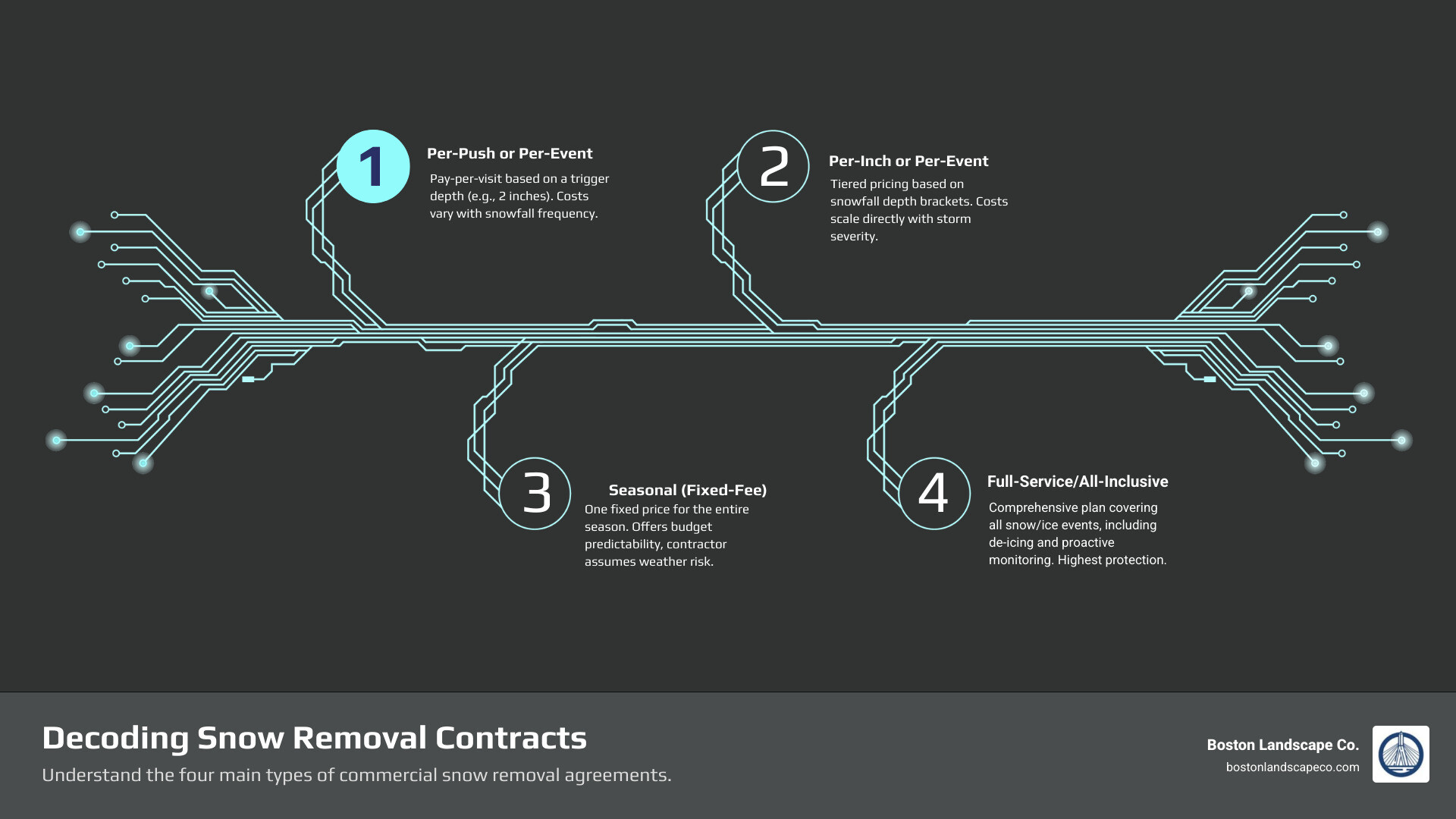
Per-Push or Per-Event
With a per-push contract, you pay a flat fee each time we clear your property after snow reaches a predetermined trigger depth (usually 1-4 inches). This model is cost-effective in mild winters with few snow events: no snow, no charge.
The downside is budget unpredictability. A harsh winter with frequent storms can cause costs to skyrocket, potentially exceeding a seasonal contract. This option suits businesses that prefer paying only for services rendered but must remember that commercial properties require immediate access for safety.
Per-Inch or Per-Event
The per-inch model is similar to per-push, but the cost is tiered based on snowfall depth. You pay less for a light dusting and more for a major storm. This creates a fair arrangement, as the price reflects the effort required.
However, your budget is still vulnerable in heavy snow years. While pricing is transparent, total costs remain unpredictable and dependent on the weather. This option works well for businesses that want their costs directly tied to the storm severity but aren’t ready to commit to a full seasonal fee.
Seasonal (Fixed-Fee)
A seasonal contract offers total budget predictability. You pay one fixed price for the entire winter season, regardless of snowfall. This eliminates budget surprises, making financial planning simple.
Many contracts are multi-year (2-3 seasons), allowing the law of averages to balance costs over time, providing stability for both client and contractor.
The trade-off is paying the full rate in a mild winter. However, for properties where safety and accessibility are non-negotiable, the peace of mind is invaluable.
For more details about our comprehensive snow removal services, visit our snow removal page.
Full-Service/All-Inclusive
This is the most comprehensive option. A full-service contract covers all snow and ice events, including de-icing and proactive weather monitoring. This delivers the highest level of protection, including pre-treatment applications, 24/7 ice monitoring, and snow hauling. It’s a worry-free solution.
This is ideal for hospitals, 24/7 facilities, and large retail centers where downtime is not an option. The cost is justified by ensuring business continuity and managing risk.
The Anatomy of an Ironclad Commercial Snow Removal Contract
A commercial snow removal contract is a legally binding blueprint for winter property management. It sets clear expectations, prevents misunderstandings, and protects your business, ensuring smooth operations.
Key Information and Term
A contract must clearly identify the client and contractor, including legal names and contact information. It specifies the service addresses, often with a detailed site map showing areas to be plowed, shoveled, and avoided. The contract’s “term” (start and end dates) is also defined. Multi-year agreements (2-3 years) are common and can offer price stability and guaranteed service.
Detailed Scope of Services (SOW)
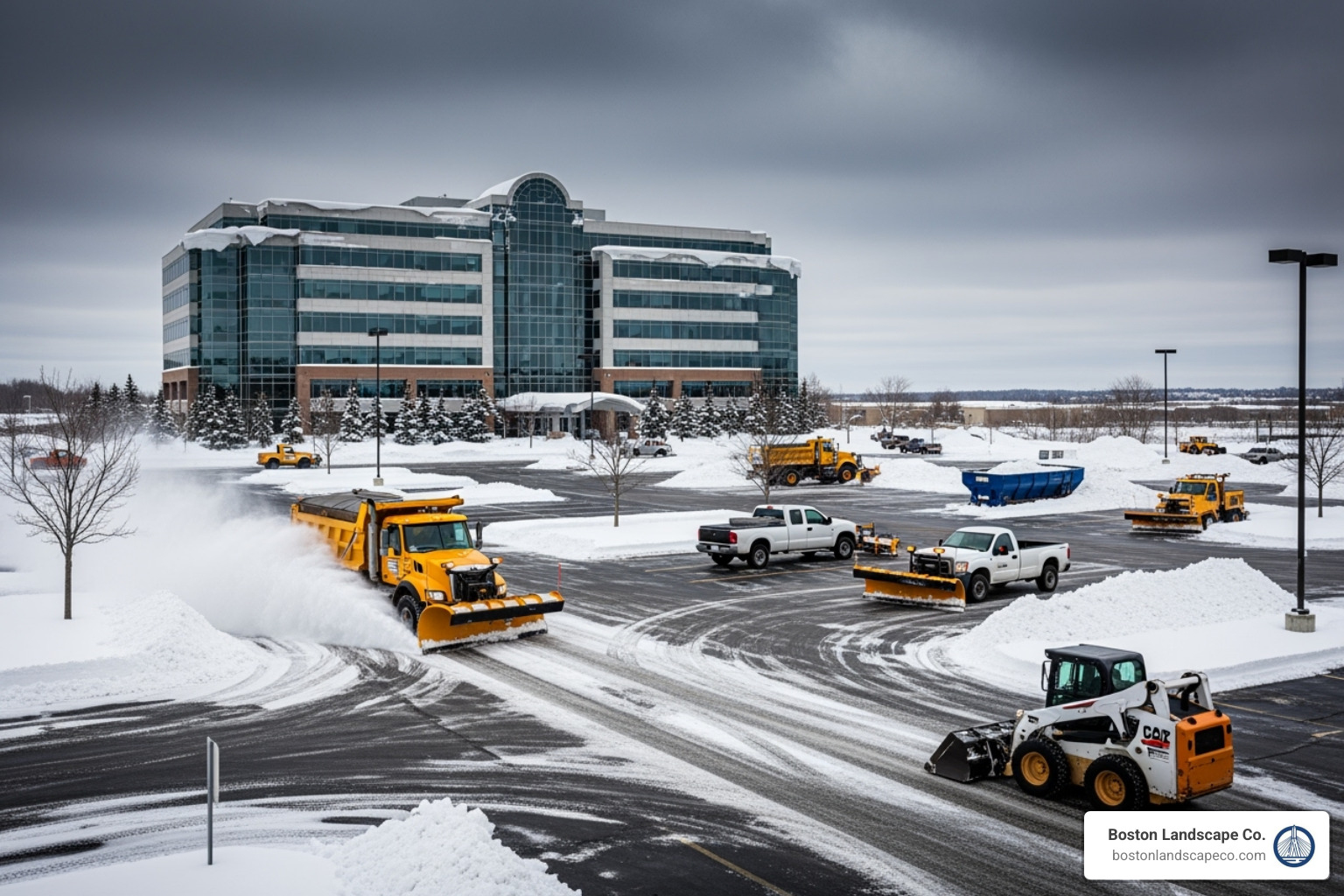
The Scope of Services (SOW) is the heart of the contract, detailing every service to avoid confusion. It typically includes: plowing parking lots at specific trigger depths, shoveling walkways and emergency exits, and de-icing high-traffic areas. It also specifies snow hauling/stacking locations, details any pre-treatment applications, and may list the equipment to be used. The SOW also clarifies what is not included to prevent surprises. For instance, if you have special hardscaping areas, we’ll discuss how our snow removal plans will protect them. You can find more info about hardscaping areas here: More info about hardscaping areas
Triggers, Timing, and Completion Standards
This section defines service activation and completion standards. A snow accumulation trigger (e.g., 2 inches) dictates when plowing begins, while ice event triggers prompt de-icing. The Response Time SLA (Service Level Agreement) states how quickly we respond (e.g., within 2 hours of a trigger). The contract also outlines post-storm follow-up and defines what a “completed” service looks like, leaving no room for guesswork.
Payment Structure and Terms for your commercial snow removal contract
This section ensures financial transparency. It details the pricing model (per-push, seasonal, etc.), specific rates, payment due dates (e.g., NET 30), and any late fees. It also outlines costs for extra services not in the standard agreement, like emergency call-outs or excessive snow hauling. A retainer fee may be required for priority service.
Legal, Liability, and Insurance Clauses
This section is critical for managing risk. We provide proof of insurance (General Liability, Auto, Workers’ Comp) with high limits, and can name your business as an “additional insured.” An Indemnification clause and Hold harmless agreement protect parties from liability arising from the other’s negligence. Limitations of Liability define responsibility for damages (e.g., to unmarked items under snow). Finally, it outlines dispute resolution steps and a termination clause describing how either party can end the agreement early.
For businesses dealing with government entities, procurement processes and compliance are key. Federal contracts often have specific bidding rules and regulations. You can find information on federal contract opportunities at sam.gov.
Understanding the Costs: What Influences Snow Removal Pricing?
The cost of a commercial snow removal contract is customized to each property. Pricing depends not just on size, but on property complexity, location, service level, and weather patterns.
How Property and Location Impact Price
Property characteristics significantly impact price. While square footage is a basic factor, complexity is often more important. A property with many curbs, islands, and tight corners requires more time and precision, increasing costs. Priority areas like loading docks or emergency entrances that need 24/7 clearance also add to the price.
Location also matters. Our base in Massachusetts means we are equipped for severe winter weather. A property’s distance from our operational base can also influence the price due to travel time.
How Contract Type Affects Your Commercial Snow Removal Contract Price
The contract type you choose directly affects your cost structure.
Seasonal contracts offer predictable costs with a single flat rate. Based on internet data, a 100,000 sq ft property might have a seasonal contract from $20,000 to $60,000 or more, depending on service levels. These are average costs based on internet data and not actual costs for Boston Landscape Co.
Per-event pricing is a pay-as-you-go model. It’s budget-friendly in mild winters but can be costly when storms are frequent. Average costs from internet data range from $0.05 to over $1.50 per square foot, depending on complexity and storm severity.
Per-inch pricing creates a middle ground, with costs scaling to snow depth. This is fair, but your total seasonal cost remains variable.
The Cost of Labor and Equipment
The final price reflects significant labor and equipment costs.
Skilled labor is essential. Our trained operators who work in hazardous, overnight conditions earn competitive wages, as noted by sources like the Bureau of Labor Statistics.
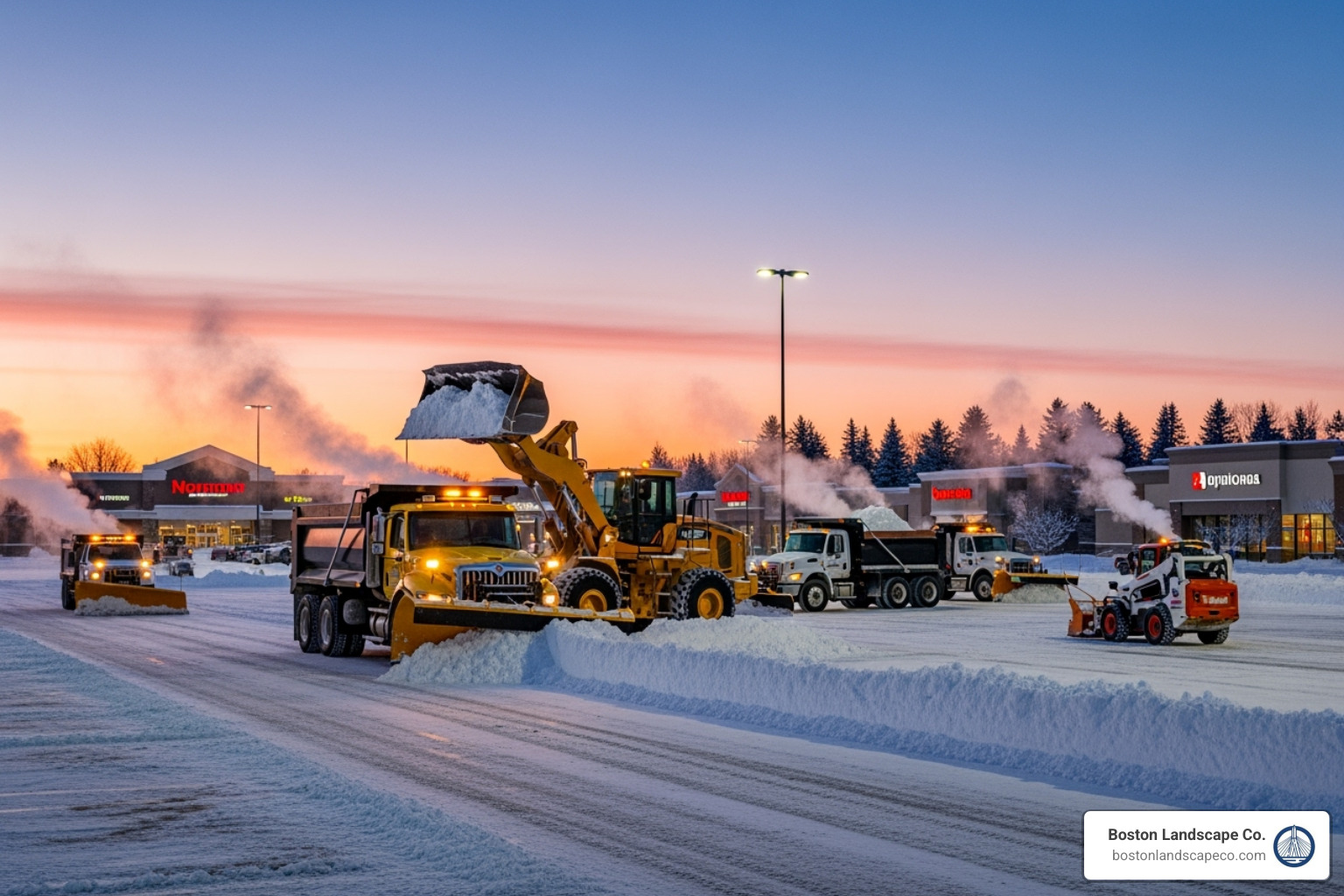
Equipment costs are substantial, including the purchase, maintenance, and repair of our fleet of plow trucks and skid-steers. Fuel costs are also a major, fluctuating expense.
De-icing materials like salt and liquid deicers are another key cost, with prices that can spike during major storms due to high demand.
All these factors—labor, equipment, fuel, and materials—are balanced to create a fair price for dependable winter service.
Frequently Asked Questions about Commercial Snow Removal Agreements
Here are answers to common questions about commercial snow removal agreements.
What is the main difference between commercial and residential snow removal contracts?
Commercial and residential contracts differ significantly due to liability, scale, and operational needs.
Commercial contracts prioritize liability and safety due to higher risks of slip-and-fall lawsuits. They require higher insurance limits and complex clauses not typically found in residential agreements.
Commercial properties require business continuity, meaning faster, often immediate, response times and “zero-tolerance” policies to keep businesses open. Residential services are generally more flexible.
The scope of a commercial contract is far more detailed, with site maps specifying service for parking lots, loading docks, and walkways. Residential contracts are simpler.
Finally, commercial agreements are often multi-year and require heavy-duty equipment like large plows and skid-steers, whereas residential jobs use smaller equipment and have shorter contract terms.
In short, a commercial snow removal contract protects a business’s operations and bottom line, while a residential one focuses on homeowner convenience.
What happens if there is a major blizzard with snowfall beyond the contract’s scope?
A well-drafted commercial snow removal contract includes clauses for “extreme weather events,” defined as snowfall exceeding a certain amount (e.g., 12+ inches) or lasting for an extended period.
During a blizzard, the contract outlines a plan that prioritizes emergency operations, focusing on maintaining access to critical areas until a full clear is possible. Services during such events may trigger billing adjustments, such as a switch to hourly rates or pre-approved charges for additional work.
The contract may also outline procedures and costs for snow hauling if on-site storage is impossible. Clear communication protocols are essential throughout the event. These clauses ensure the property remains functional and fairly compensate the contractor for the extraordinary effort required.
Can I terminate a multi-year snow removal contract early?
Most multi-year commercial snow removal contracts include a termination clause that outlines the conditions for ending the agreement early. It will specify a required notice period (e.g., 30-90 days) that the terminating party must provide.
Early termination may involve a penalty or buyout fee, especially if the contractor made upfront investments in equipment or capacity based on the contract term. The contract also includes default clauses, allowing termination if one party breaches the agreement (e.g., non-payment or failure to provide service).
It is crucial to review this clause before signing. A transparent contract protects both parties if the agreement needs to end.
Conclusion: Secure Your Peace of Mind This Winter
Navigating commercial snow removal contracts can seem complex, but our goal at Boston Landscape Co. is to ensure clarity. A good contract is the foundation of a trustworthy partnership.
Our purpose is to keep your commercial property safe, accessible, and open for business all winter. We prioritize safety, which reduces your risk and ensures business continuity. With over three decades of experience, we offer solutions customized for your property’s needs.
Don’t wait for the next big snowfall. Being proactive and choosing a reliable partner with clear communication makes all the difference. Let us handle winter’s challenges so you can focus on your business.
Ready for peace of mind this winter? Request an estimate for your property today, and let’s build the perfect snow removal plan for your business.
