How Much Is Sod per Pallet? A Quick Answer Before We Dig In
How much is sod per pallet is one of the most common questions we hear from homeowners in the Greater Boston area — and the answer depends on a few key variables. Here’s a fast breakdown to get you oriented:
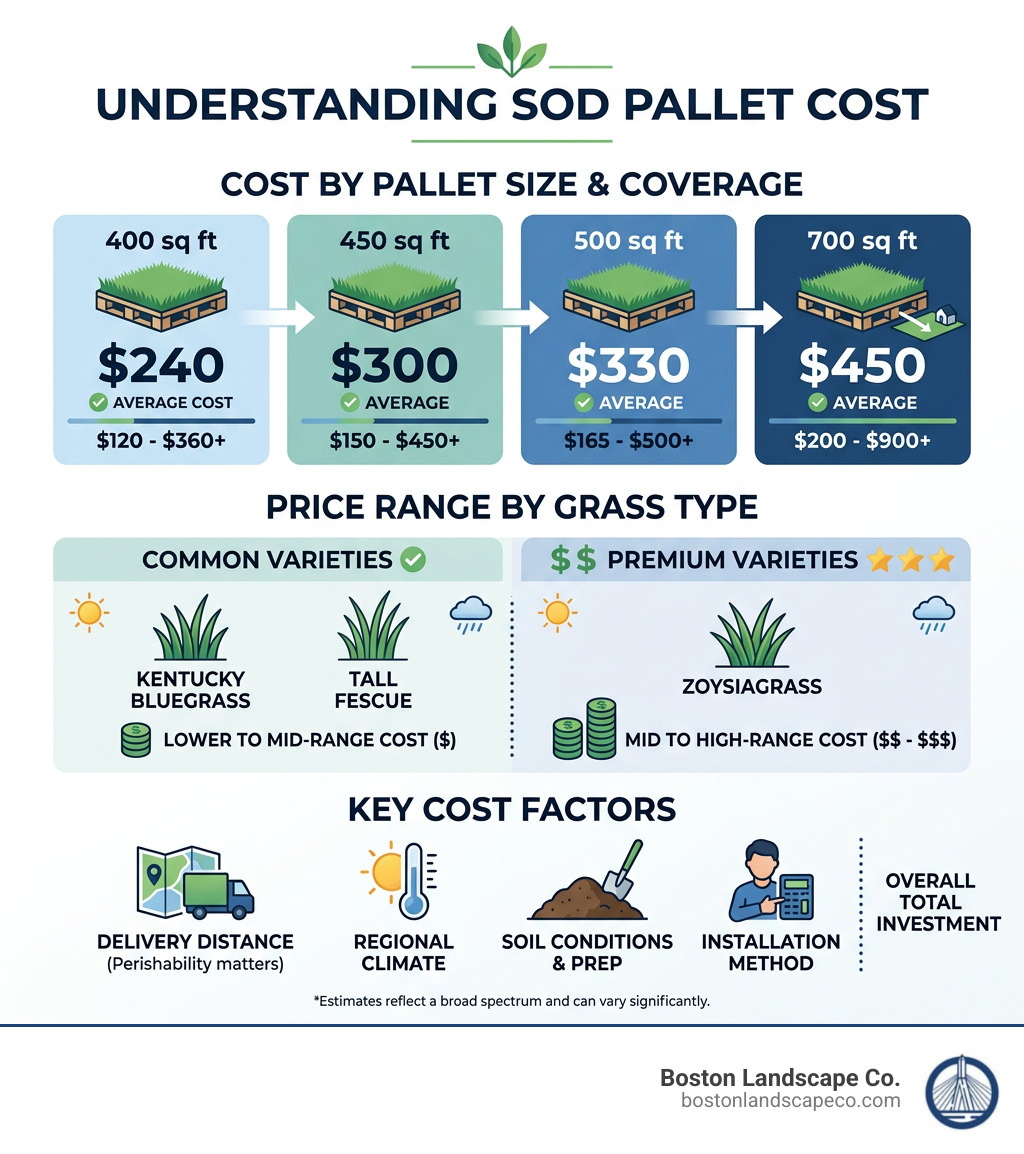
| Pallet Coverage | Low End | Average | High End |
|---|---|---|---|
| 400 sq ft | $120 | $240 | $360+ |
| 450 sq ft | $150 | $300 | $450+ |
| 500 sq ft | $165 | $330 | $500+ |
| 700 sq ft | $200 | $450 | $900+ |
Note: These are average costs based on national internet data and do not reflect the actual pricing of Boston Landscape Co. Real-world prices vary widely by grass type, grade, region, and season.
Getting the right sod at the right price isn’t just about the sticker cost on a pallet. It’s about matching the grass to your climate, your soil, and your budget — then factoring in delivery, site prep, and installation. For homeowners in Stoneham, Billerica, and across the North Shore, those details matter a lot. Massachusetts’ cool-season climate, clay-heavy soils, and short spring installation windows all push prices and decisions in specific directions.
In this guide, we’ll walk you through everything: average pallet costs, grass types, regional pricing, installation expenses, and how to calculate exactly what your yard needs.
I’m Steve Schumacher, owner of Boston Landscape Co. since 1991, and over more than three decades of installing lawns across Greater Boston, I’ve fielded countless questions about how much is sod per pallet — and helped hundreds of homeowners avoid costly mistakes by understanding what they’re actually buying. Let’s break it all down so you can move forward with confidence.
Understanding the National Average: How Much is Sod per Pallet?
When you start researching how much is sod per pallet, you’ll quickly find that “standard” isn’t always standard. While the national average often hovers around $300 per pallet, the range is actually quite broad, stretching from $150 to $900 or more for premium specialty grasses.
According to How Much Does a Pallet of Sod Cost in 2025?, most homeowners find themselves in the $150 to $450 range for common varieties. However, it is vital to remember that sod is a perishable living product. Unlike a pallet of bricks, sod has a ticking clock. From the moment it is harvested at the farm, the roots begin to dry out. This perishability means that logistics, proximity to the farm, and delivery speed all play a massive role in the final price you pay.
Calculating how much is sod per pallet for your yard
Before you can determine your total investment, you need to know your numbers. We always recommend measuring your yard in square feet rather than trying to guess by “pallets.” To do this, break your yard into basic geometric shapes (rectangles, triangles, or circles), calculate the area of each, and add them up.
Once you have your total square footage, the “Golden Rule” of landscaping applies: Add 10% for waste. You will inevitably need to trim pieces to fit around flower beds, walkways, and curved edges. If your yard is 2,000 square feet, you should order enough for 2,200 square feet.
Since pallets typically cover between 400 and 500 square feet (though some premium Kentucky Bluegrass pallets can go up to 700 square feet), dividing your total needed square footage by the pallet size will tell you exactly how many to order. If you’re feeling overwhelmed by the math, you can find more info about lawn installation services to help guide your project planning.
Regional variations and how much is sod per pallet in Massachusetts
In our neck of the woods—from Stoneham and Billerica to Lexington and Winchester—the climate dictates our choices. We live in a “cool-season” grass zone. This means our sod is typically heavier and denser to survive New England winters, which can affect shipping costs.
In Massachusetts, the demand for sod peaks sharply in the spring (April–May) and again in the early fall (September). Because we aren’t in a year-round growing climate like Florida, local supply can fluctuate. If you are ordering during a peak window in Medford or Reading, expect to see higher delivery fees due to high demand for Moffett trucks and specialized delivery equipment. You can explore more info about residential landscaping to see how regional climate impacts overall yard design.
Factors Influencing the Price of Sod per Pallet
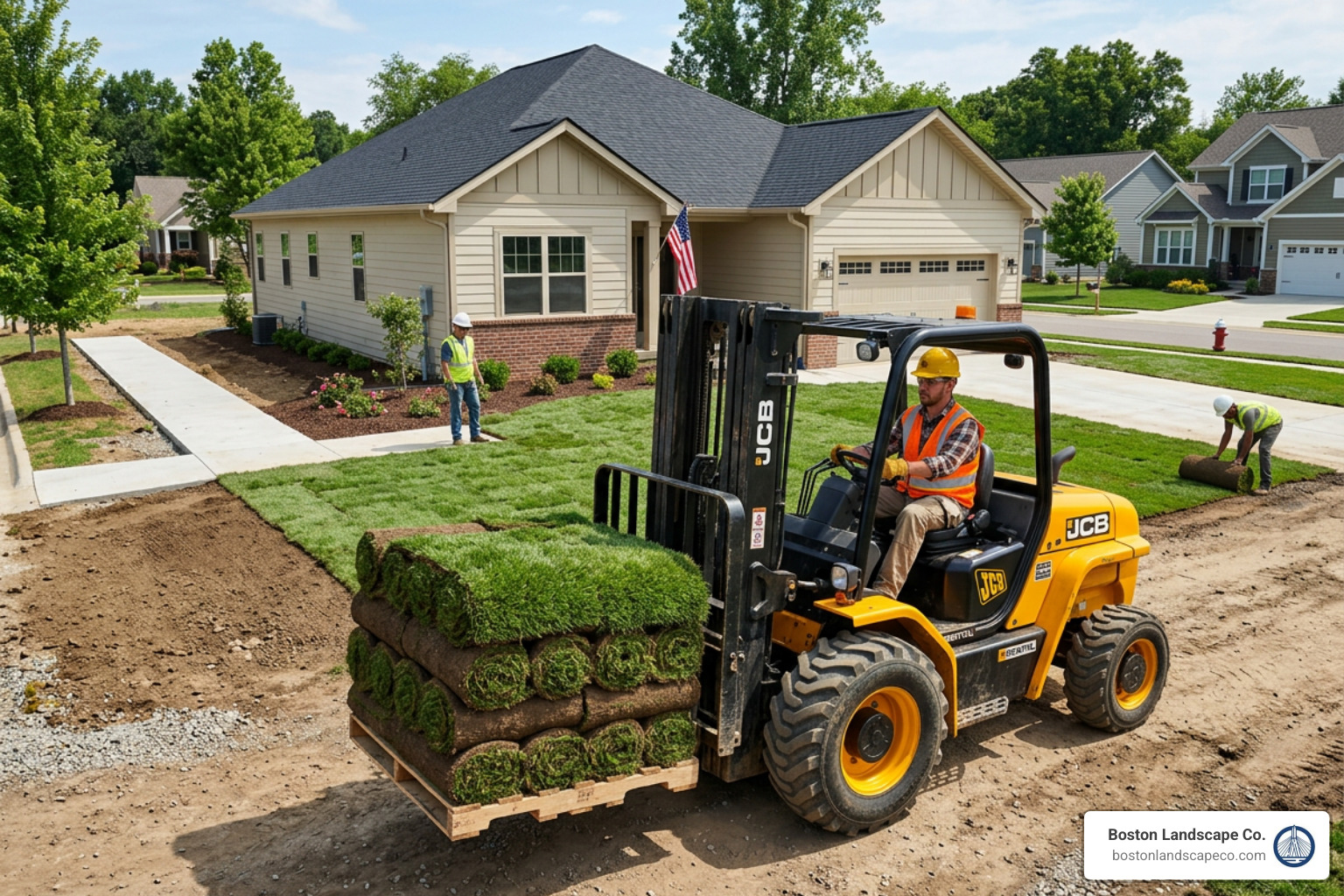
If you see two pallets of grass that look similar but have a $100 price difference, there is usually a good reason for it. Several hidden factors influence how much is sod per pallet.
- Sod Grade: Much like lumber, sod comes in different grades. Economy grade might have a thinner soil layer or less root density. Premium grades are grown longer at the farm, ensuring a thick, “carpet-like” feel that takes root much faster.
- Harvest Timing: Freshness is everything. Sod harvested within 24 hours of delivery will always command a higher price than “clearance” sod that has been sitting in a retail parking lot for two days.
- Soil Quality: High-quality sod is grown in nutrient-rich, sandy loam soil. This makes the pallet heavier (often between 1,500 and 3,000 pounds!) but ensures the grass has the best start possible.
- Fuel and Logistics: With fuel prices fluctuating, the distance from the sod farm to your home in Concord or Waltham can add $65 to $230 in delivery fees per truckload.
For a deeper dive into these variables, Sod Prices: How Much You Can Expect to Pay provides an excellent breakdown of national market trends.
Economy vs. Premium Grade Sod
While it’s tempting to go with the cheapest option, “economy” sod often ends up costing more in the long run. Lower-grade sod usually has lower weed resistance and a higher likelihood of disease. Premium sod, while more expensive per pallet, features higher root density and better disease tolerance. In the harsh Massachusetts climate, that extra root strength is what helps your lawn survive a July heatwave or a February freeze.
Seasonality and Availability
Timing is your best friend when it comes to budgeting. While spring is the most popular time to lay sod, late summer to early fall is often the “sweet spot” for cool-season grasses in the Greater Boston area. During this time, the soil is warm, but the air is cooling down, which is perfect for root establishment. Sometimes, you may even find slight price breaks as farms clear inventory before winter dormancy. If your current lawn is beyond saving, you can look into more info about lawn replacement services to see if a fall installation is right for you.
Sod Costs by Grass Type and Climate Zone
The species of grass you choose is perhaps the biggest driver of how much is sod per pallet. In Massachusetts, we focus on grasses that can handle the “Transition Zone” or strictly cool-season environments.
If you are looking for alternatives to traditional sod, you might also want to check out more info about hydroseeding costs, which can be a more budget-friendly option for very large areas.
Cool-Season Grasses for New England
For our service areas like Bedford, Carlisle, and Concord, these are the most common contenders:
- Kentucky Bluegrass: The “gold standard” for New England. It’s lush, dark green, and has a great “self-healing” ability thanks to its rhizomes. Expect to pay between $135 and $340 per pallet.
- Tall Fescue: Known for its incredible durability and shade tolerance. It handles the “foot traffic” of kids and pets better than almost any other variety.
- Fine Fescue: Often mixed with Bluegrass for areas with high shade.
Warm-Season Grasses and Specialty Turf
While less common in the North Shore, some homeowners opt for specialty turf:
- Zoysia: A premium, dense grass that feels like a thick carpet. It’s incredibly drought-resistant but goes dormant (turns brown) earlier in the fall than Bluegrass. It is often the most expensive, ranging from $225 to $600+ per pallet.
- Bermuda: Rarely used in MA because it loves heat and hates our winters, but it is the king of athletic field durability.
For those interested in the science of what grows best where, the latest research on turfgrass selection offers a deep dive into species performance.
Beyond the Pallet: Installation and Additional Costs
Buying the sod is only half the battle. If you lay $400 worth of sod on top of hard, compacted clay, you’ve essentially bought a very expensive, temporary outdoor rug. To make it last, you have to consider the “all-in” cost.
- Site Preparation: This is the most critical step. It involves removing old grass, tilling the soil, and grading the land so water flows away from your foundation.
- Topsoil Addition: Most yards in Stoneham or Billerica benefit from 2-4 inches of fresh, nutrient-rich topsoil ($12-$55 per cubic yard).
- Soil pH Testing: Massachusetts soil can be acidic. A quick test ($20-$100) tells you if you need lime to balance the pH so the grass can actually “eat” the nutrients in the soil.
You can find a comprehensive breakdown of these “hidden” costs at average-cost-to-resod-a-lawn.
Professional Labor vs. DIY
We’ll be honest: laying sod is back-breaking work. One pallet weighs as much as a small car. If you’re doing a 500-square-foot patch, DIY is totally doable with a few friends and a Saturday. But for a full yard?
Professional installation usually costs between $1 and $2 per square foot (or $400 to $1,000+ per pallet including labor and materials). The benefit of hiring pros is the equipment—we use power sod cutters, heavy-duty tillers, and rollers that ensure 100% soil-to-root contact. Plus, professional installs often come with a warranty. If you’re curious about the full scope of care, check out more info about full-service lawn care.
Post-Installation Care and Maintenance
Once the sod is down, your water bill will go up for a few weeks. New sod needs to stay “squishy” for the first 10-14 days. This means watering 2-3 times a day (during the day, never at night to avoid fungus!).
If you don’t want to drag hoses around your yard in Somerville or Waltham, it might be the perfect time to look into more info about irrigation system installation. A properly timed sprinkler system is the best insurance policy for your new sod investment.
Frequently Asked Questions about Sod Pricing
How many square feet does one pallet of sod typically cover?
Most standard pallets cover 450 square feet. However, depending on the farm and the grass type, you may see pallets ranging from 400 to 700 square feet. Always ask the supplier for the exact square footage per pallet before ordering!
How long does a pallet of sod last after delivery?
In the heat of a Massachusetts summer, sod needs to be laid within 24 hours. In the cooler spring or fall, you might get away with 48 hours. If sod stays rolled up on a pallet too long, it begins to “cook” from the inside out due to nitrogen and moisture trap, leading to yellowing or death.
Does installing sod increase home value?
Absolutely. Real estate experts suggest that a well-landscaped lawn can add significantly to a home’s curb appeal and overall value. In competitive markets like Lexington or Wellesley, an “instant lawn” can be the difference between a quick sale and a house that sits on the market.
Conclusion
Understanding how much is sod per pallet is the first step toward transforming your property. Whether you’re in the historic streets of Concord or a new development in Billerica, a lush lawn provides more than just beauty—it provides a place for memories, increases your property value, and even helps cool the air around your home.
At Boston Landscape Co., we’ve spent over 30 years perfecting the art of the New England lawn. We know the soil in Stoneham, the climate in Reading, and the specific needs of North Shore homeowners. We pride ourselves on a comprehensive range of services, from precise grading and soil prep to the final roll of the sod.
Ready to stop guessing and start growing? Contact us today for a professional estimate for sod installation and let’s give your home the “instant green” it deserves.