
Is Your Lawn Drowning? Here’s What Aeration Can Do for Drainage
Aerating your lawn for drainage is one of the most effective first steps you can take when standing water won’t go away after a rainstorm.
Quick answer: Does aeration improve lawn drainage?
- Yes. Aeration creates small channels in compacted soil, letting water move down into the root zone instead of pooling on the surface.
- Compacted soil can absorb less than 0.1 inches of water per hour. Aerated soil can exceed 1 inch per hour.
- Core aeration is the most effective method for clay-heavy soils common across Massachusetts.
- Most lawns see noticeable drainage improvement after the first heavy rain following aeration.
- Annual aeration is recommended for high-traffic lawns or those with clay soil.
A soggy lawn is more than an eyesore. Persistent standing water damages grass roots, invites weeds and moss, and can even threaten your property’s foundation over time. The frustrating part? The real problem is usually invisible — it’s happening beneath the surface, in soil that has become too compacted to absorb rainfall at a normal rate.
Soil compaction squeezes out the tiny air pockets that normally let water filter downward. When those pockets disappear, water has nowhere to go. It sits on top, suffocating grass roots and turning your yard into a swamp after every storm.
The good news is that mechanical aeration — specifically core aeration — directly addresses this root cause. It physically removes small plugs of soil to restore pore space, improve water infiltration, and give roots room to grow deeper.
This guide walks you through exactly how aeration works, when to do it, and how to know if you need more than just aeration to solve your drainage problem.
I’m Steve Schumacher, owner of Boston Landscape Co. since 1991, and over more than three decades of working on properties across Massachusetts I’ve seen how consistently aerating a lawn for drainage transforms waterlogged, compacted turf into healthy, functional outdoor spaces. If you’d like expert help assessing your lawn’s drainage, I’m happy to walk you through your options.
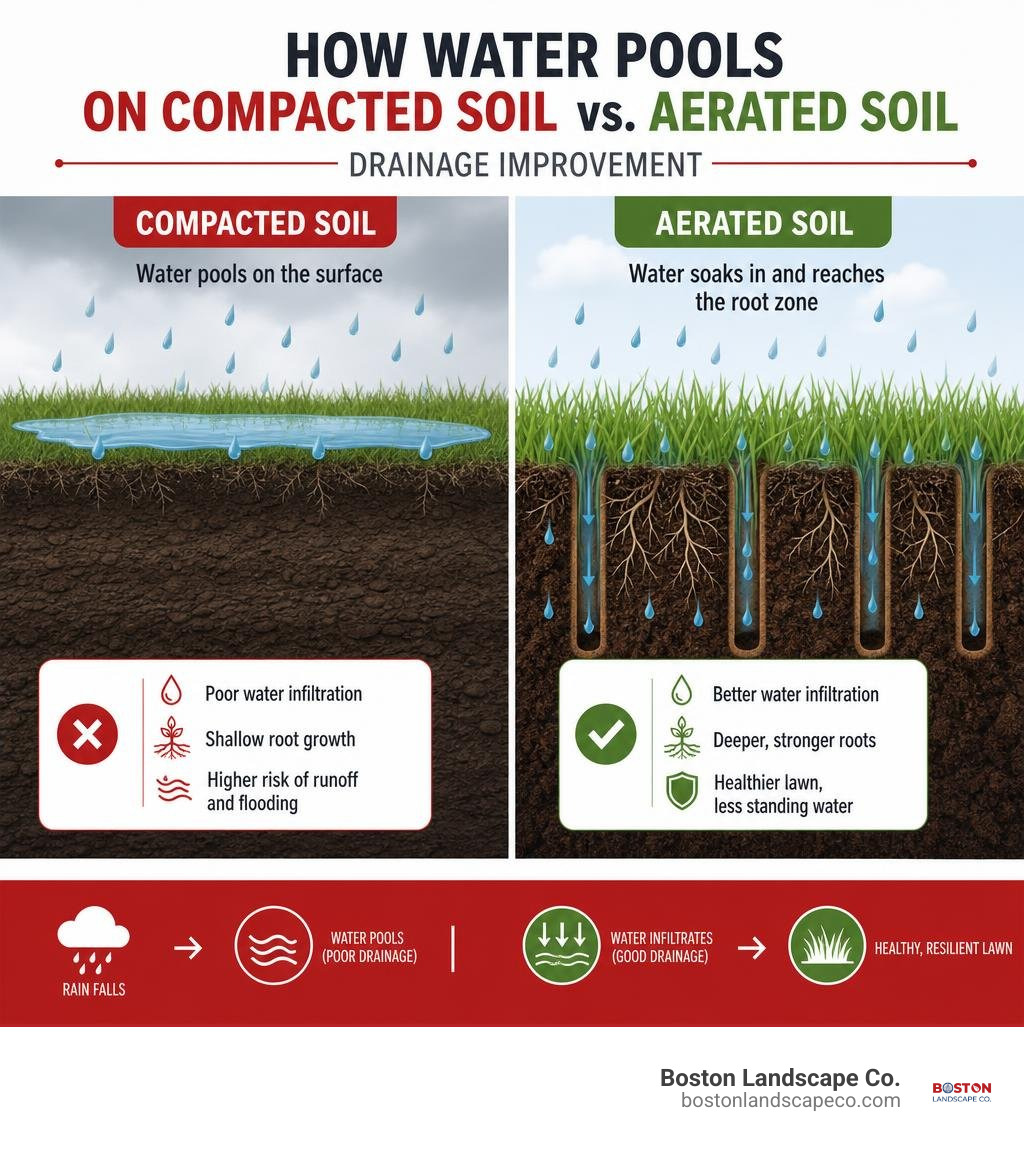
Quick aerate lawn for drainage terms:
The Science of Soil Compaction and Poor Yard Drainage
To understand why water pools in your yard, we have to look closely at the structure of the soil itself. Healthy soil is not a solid block; it is a complex matrix of mineral particles, organic matter, and open spaces called pores. These pores are essential because they hold the oxygen and water that grass roots need to survive.
In a healthy lawn, about half of the soil’s volume consists of these open pore spaces. When rain falls, gravity pulls the water down through these pores, filtering it deeply into the earth.
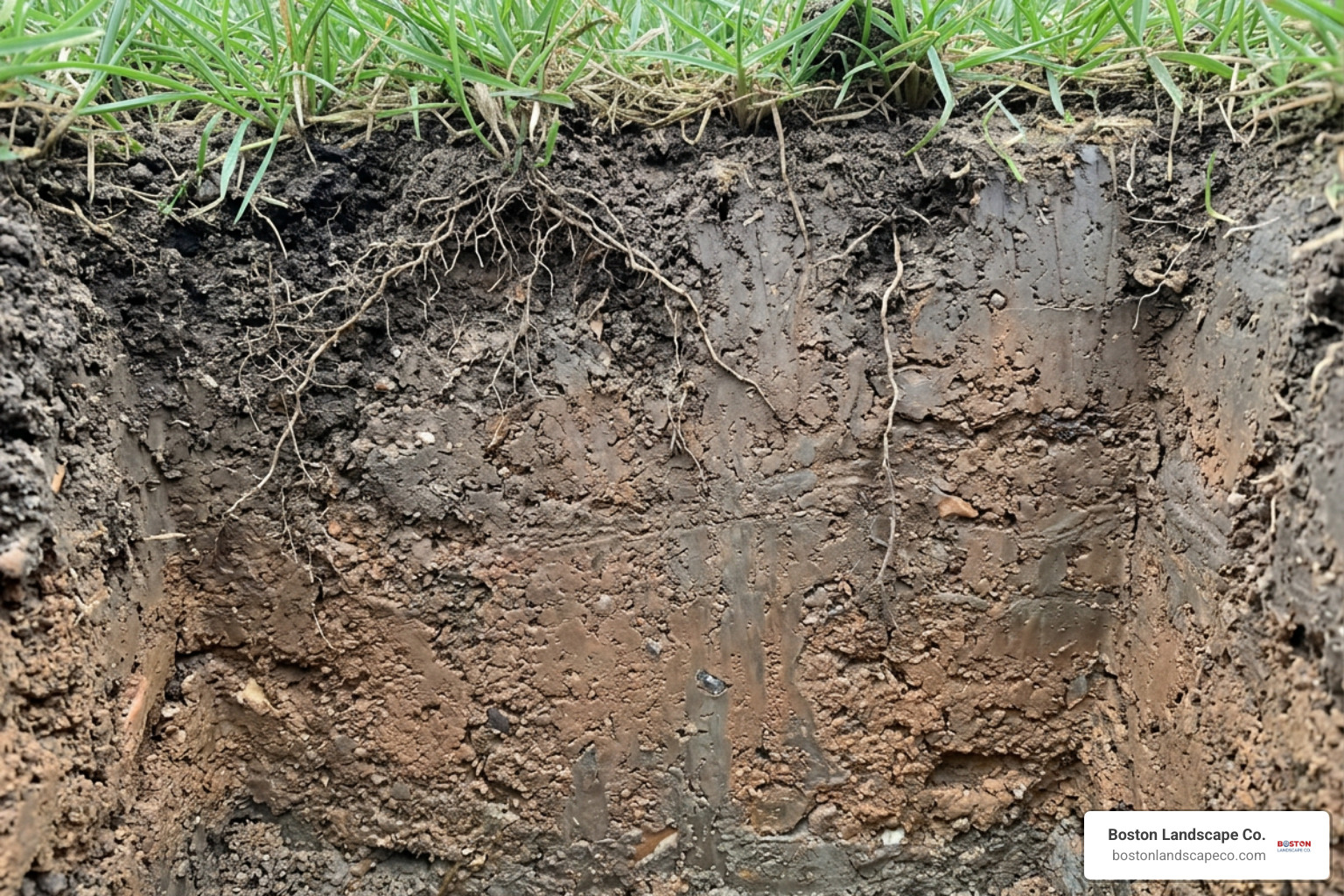
However, clay-heavy soils—which are incredibly common throughout our Massachusetts service areas—are highly susceptible to a phenomenon known as soil compaction. Clay particles are microscopic and flat, resembling tiny plates. Because they are so small, they pack together easily. When your lawn experiences heavy foot traffic from children and pets, heavy lawn care equipment, or even the weight of winter snow accumulation, those flat clay particles are pressed tightly together.
This pressure squeezes out the pore spaces. According to MF2130 Aerating Your Lawn, compacted soil has significantly fewer air-filled pores, which directly restricts gas exchange and prevents oxygen from reaching the root zone.
When soil is compacted, its water infiltration rate drops drastically. In a heavily compacted lawn, the soil can absorb less than 0.1 inches of water per hour. During a typical New England thunderstorm, rain falls much faster than that. Because the water cannot penetrate the compacted layer, it collects on the surface, creating muddy areas, pooling, and runoff.
Furthermore, this lack of oxygen and physical space stunts grass roots, forcing them to remain in the top inch or two of soil. This shallow root system makes the turf weak, thin, and highly vulnerable to drought, weeds, and diseases. If you are struggling with a perpetually soggy yard, implementing proactive yard care strategies is crucial. You can explore our comprehensive guide on Don’t Let Your Lawn Drown With These Better Yard Drainage Tips to see how soil management fits into the bigger picture.
Why You Should Aerate Lawn for Drainage to Prevent Pooling
If soil compaction is the lock that keeps water trapped on your surface, mechanical core aeration is the key that opens it up. When we aerate lawn for drainage, we use commercial-grade machinery equipped with hollow metal tines to extract clean plugs of soil and thatch from the ground.
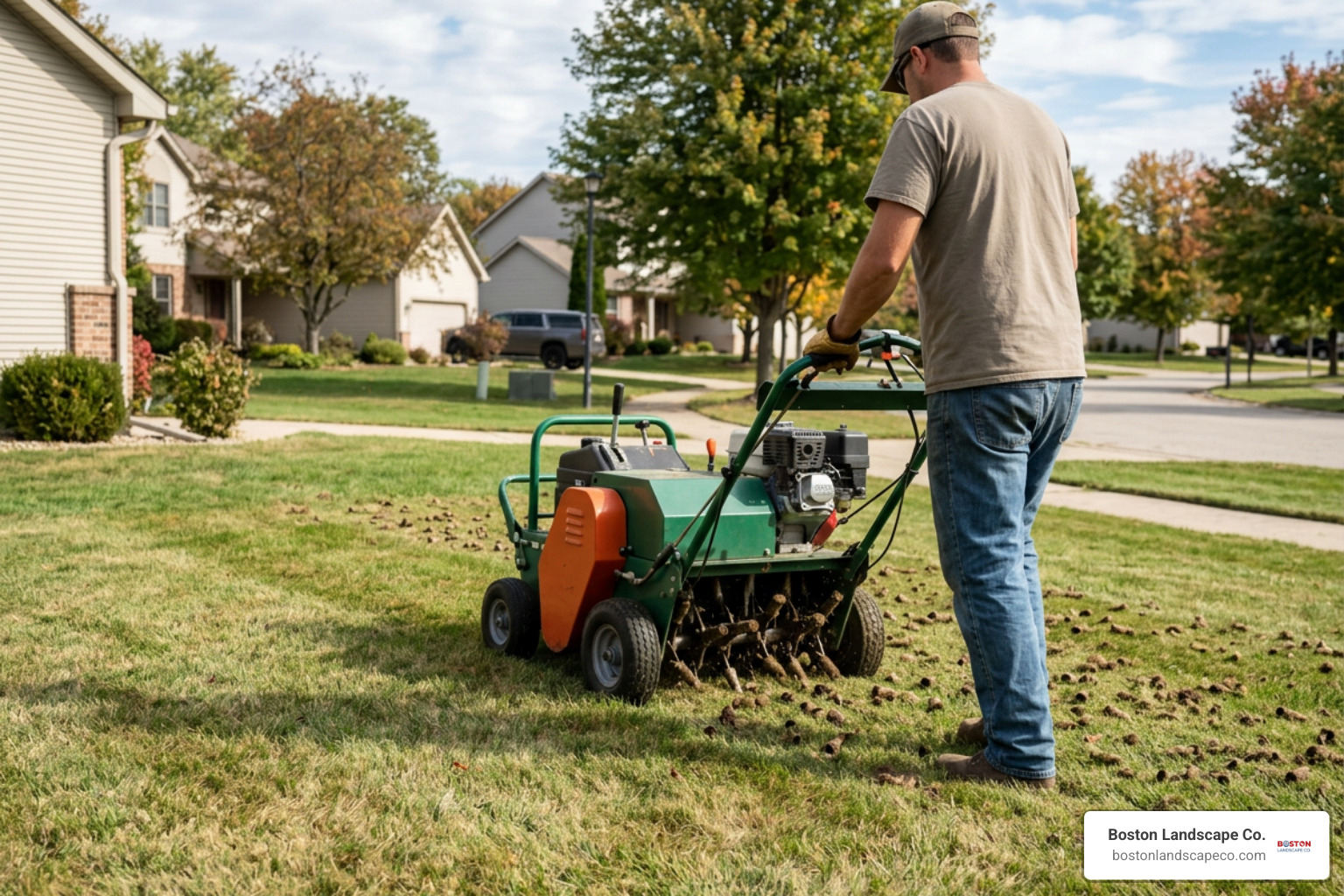
This mechanical extraction provides immediate, physical relief to the compacted turf in several key ways:
- Creates Direct Infiltration Pathways: By removing plugs that are 2 to 4 inches deep and up to 0.75 inches in diameter, core aeration creates thousands of temporary vertical channels across your lawn. Rainwater and surface runoff immediately find these holes and flow downward into the subsoil rather than pooling on top.
- Restores Soil Porosity: As the surrounding soil relaxes into the newly created empty spaces, the overall density of the soil structure decreases. This allows natural pore spaces to reform, increasing long-term water absorption rates.
- Breaks Up Thatch Buildup: Thatch is a layer of dead grass, roots, and organic debris that builds up between the green vegetation and the soil surface. When this layer exceeds 0.5 inches, it acts like a water-resistant sponge, preventing moisture from reaching the soil. Core aeration physically cuts through this barrier and pulls soil microbes to the surface, accelerating natural thatch decomposition.
- Promotes Deeper Root Growth: With the compaction relieved and oxygen restored to the root zone, grass roots naturally grow deeper into the earth. Over time, these deeper roots physically push through the soil, creating a self-sustaining network of biological drainage pathways.
To achieve these benefits, it is essential to follow established guidelines on How to Aerate Your Lawn the Right Way. When core aeration is executed correctly, it acts as a non-invasive, highly effective alternative to disruptive excavation. For properties experiencing severe water accumulation, combining aeration with other Backyard Drainage Best Solutions can restore your outdoor space to peak functionality.
When to Aerate Lawn for Drainage in Massachusetts
Timing is everything when it comes to lawn care. Because our local lawns consist of cool-season grasses like Kentucky Bluegrass, Tall Fescue, and Fine Fescue, we must schedule aeration when the grass is actively growing and can quickly recover from the mechanical stress.
The absolute best window for core aeration in Massachusetts is late summer through early autumn (late August to mid-October). During this period, daytime temperatures are moderate, soil temperatures are warm (ideally between 50°F and 65°F), and autumn rainfall is consistent. This environment encourages rapid root expansion, allowing the grass to fill in the aeration holes and crowd out potential weed growth before winter dormancy.
A secondary window exists in early spring (March to April), but this should only be utilized if compaction is severe and causing immediate drainage issues. Spring aeration carries a higher risk of disrupting pre-emergent crabgrass barriers and exposing open soil to spring weed seeds.
Regardless of the season, soil moisture levels must be perfect. If the soil is dry and rock-hard, the aerator tines will not penetrate deeply enough. If the soil is soaking wet and muddy, the machine will tear up the turf and further compact the walls of the holes. For homeowners in Billerica, Burlington, and Lexington, we recommend watering the lawn deeply 24 to 48 hours before your scheduled service to ensure the soil is damp but not muddy.
Why Professionals Aerate Lawn for Drainage More Effectively
While many homeowners consider renting a walk-behind aerator for a weekend DIY project, professional aeration yields vastly superior results for resolving drainage issues.
Commercial-grade, stand-on core aerators utilize hydraulic down-pressure to consistently drive hollow tines 3 to 4 inches deep into the toughest clay soils. In contrast, standard rental units are lightweight, walk-behind machines that rely on water-filled drums or heavy weights. In hard, compacted Massachusetts soil, these rental machines often bounce off the surface, producing shallow plugs of only 1 inch or less—which is insufficient to break through deep compaction layers.
Furthermore, professional operators understand how to navigate properties safely. In towns like Concord, where historic landscapes and complex irrigation systems are common, we carefully flag all sprinkler heads, shallow utility lines, and invisible dog fences before beginning.
If you are researching costs, please note that average pricing ranges listed online are based on general, nationwide data and do not represent the specific rates of Boston Landscape Co. According to public online data, standard DIY rental costs range from $100 to $300 per day, while basic professional services are cited between $75 and $225. However, for severe compaction and drainage issues requiring deep-core commercial equipment and double-pass techniques, realistic professional service ranges typically span from $350 to $1,500 depending on property size and soil severity.
To get an accurate, customized quote for your property, you can Request an Estimate directly from our team.
Core Aeration vs. Liquid Aeration for Drainage
As you research ways to improve your lawn’s drainage, you will likely come across two primary methods: traditional mechanical core aeration and chemical liquid aeration. While both aim to improve soil structure, they work in entirely different ways and yield different results for drainage management.
| Feature | Core Aeration (Mechanical) | Liquid Aeration (Chemical) |
|---|---|---|
| Primary Mechanism | Physically extracts 2-4″ soil plugs using hollow tines. | Applies liquid wetting agents and soil conditioners. |
| Thatch Management | Physically breaks up and reduces thatch by up to 50%. | Promotes microbial activity to slowly decay thatch. |
| Effect on Clay Soil | Highly effective; physically removes clay and creates immediate voids. | Moderately effective; relies on chemical structure alteration. |
| Immediate Infiltration | Instantaneous; creates thousands of physical drainage holes. | Delayed; requires multiple applications to alter soil structure. |
| Turf Disruption | Leaves visible soil plugs on the surface for 2-4 weeks. | Zero physical disruption; lawn is immediately usable. |
Mechanical core aeration remains the industry gold standard for addressing severe soil compaction and drainage issues. By physically removing the soil plugs, it guarantees the creation of open pathways for water to escape the surface.
Liquid aeration products typically consist of liquid humates, seaweed extracts, and chemical wetting agents (surfactants). These surfactants break the surface tension of water, helping it penetrate dry, hydrophobic soils more easily. While liquid applications can support healthy soil biology and are highly non-invasive, they do not provide the immediate, high-volume physical pathways that a waterlogged yard needs during a heavy Massachusetts rainstorm.
For detailed instructions on integrating these methods into your broader lawn care routine, refer to the Lawn Aeration Guide: When to Aerate, How to Do It, and Why It Matters — Yardcast Blog. Additionally, you can learn more about how physical aeration supports overall grass health by reading When and How to Aerate Your Lawn for Thicker, Healthier Grass.
Aeration vs. Advanced Drainage Solutions
While aerating your lawn for drainage is an excellent, cost-effective starting point, it is important to recognize its limitations. Aeration is designed to solve drainage issues caused specifically by soil compaction. It cannot overcome structural, topographical, or high-water-table challenges.
If your yard has a low spot where water naturally collects due to the slope of your land, or if heavy runoff from your roof and driveway is funneled directly onto your turf, aeration alone will not keep your lawn dry. In these scenarios, you must implement advanced, structural drainage solutions:
- French Drains: A French drain is a trench filled with gravel or rock containing a perforated pipe that redirects surface water and groundwater away from your lawn’s low spots. This is highly effective for severe pooling. To understand how these systems work, read our detailed guide on Trench Drains and French Drain Channels Explained.
- Grading and Re-contouring: Sometimes, the only way to stop the backyard swamp is to physically change the slope of the land. By grading the soil, we can ensure that water flows naturally away from your lawn and home foundation toward a safe exit point.
- Hardscape Drainage Integration: Patios, walkways, and driveways generate massive amounts of runoff. If your hardscaping was not installed with proper drainage channels, it will shed water directly onto your grass, overwhelming the soil’s natural absorption capacity. You can explore our specialized solutions for these areas in Hardscape Drainage Solutions and Stop the Soak With These Clever Patio Flooding Solutions.
- Irrigation Management: Over-watering from an improperly calibrated sprinkler system can keep your soil permanently saturated, leaving no room for rainwater absorption. Managing your watering schedule is a critical step in maintaining proper drainage balance; find out how in our guide to Lawn Irrigation.
Frequently Asked Questions About Lawn Aeration and Drainage
Will aeration fix all standing water issues?
No, aeration will not fix every standing water issue. Aeration is highly effective when the primary cause of pooling is soil compaction or a heavy thatch layer blocking water infiltration. However, if your lawn has grading issues, sits at the bottom of a slope, or experiences severe runoff from large impervious surfaces (like roofs and driveways), you will likely need to pair aeration with structural solutions like French drains, catch basins, or professional regrading.
How long does it take to see drainage improvements after aeration?
You can expect to see initial drainage improvements after the very first heavy rainfall following your core aeration service. Water will drain off the surface much faster as it utilizes the thousands of open core holes. Long-term, permanent drainage improvements will continue to develop over the next 4 to 8 weeks as grass roots expand into the open channels, permanently improving the natural porosity of the soil.
How often should a compacted Massachusetts lawn be aerated?
For standard residential and commercial properties in Massachusetts, we recommend aerating once per year, ideally in the fall. However, if your property in Billerica, Concord, or Lexington has heavy clay soil, experiences heavy foot traffic, or has vehicles parked on the grass, twice-yearly aeration (once in early spring and once in early fall) may be necessary for the first 2 to 3 years to fully break down compaction and establish proper drainage.
Conclusion
A waterlogged, swampy lawn is more than just a nuisance—it is a threat to your turf’s health and your property’s usability. By understanding the science of soil compaction and utilizing professional core aeration, you can restore your soil’s natural ability to absorb water, oxygen, and nutrients.
Whether your property in Billerica, Burlington, Lexington, or Concord requires routine annual maintenance or a comprehensive structural drainage system, the experienced team at Boston Landscape Co. is here to help. We have spent over 35 years designing, building, and maintaining beautiful, highly functional landscapes across Massachusetts.
Don’t let your yard drown this season. Request an Estimate online to schedule your professional core aeration and explore our full range of Professional Landscape Maintenance Services. Let’s work together to stop the backyard swamp and bring your lawn back to life!
