
Durable Hardscaping Materials: 10 Best Proven Choices 2025
Why Durable Hardscaping Materials Are Essential for Your Property
Durable hardscaping materials form the backbone of any successful landscape design, providing the structural foundation that supports both beauty and function for decades to come.
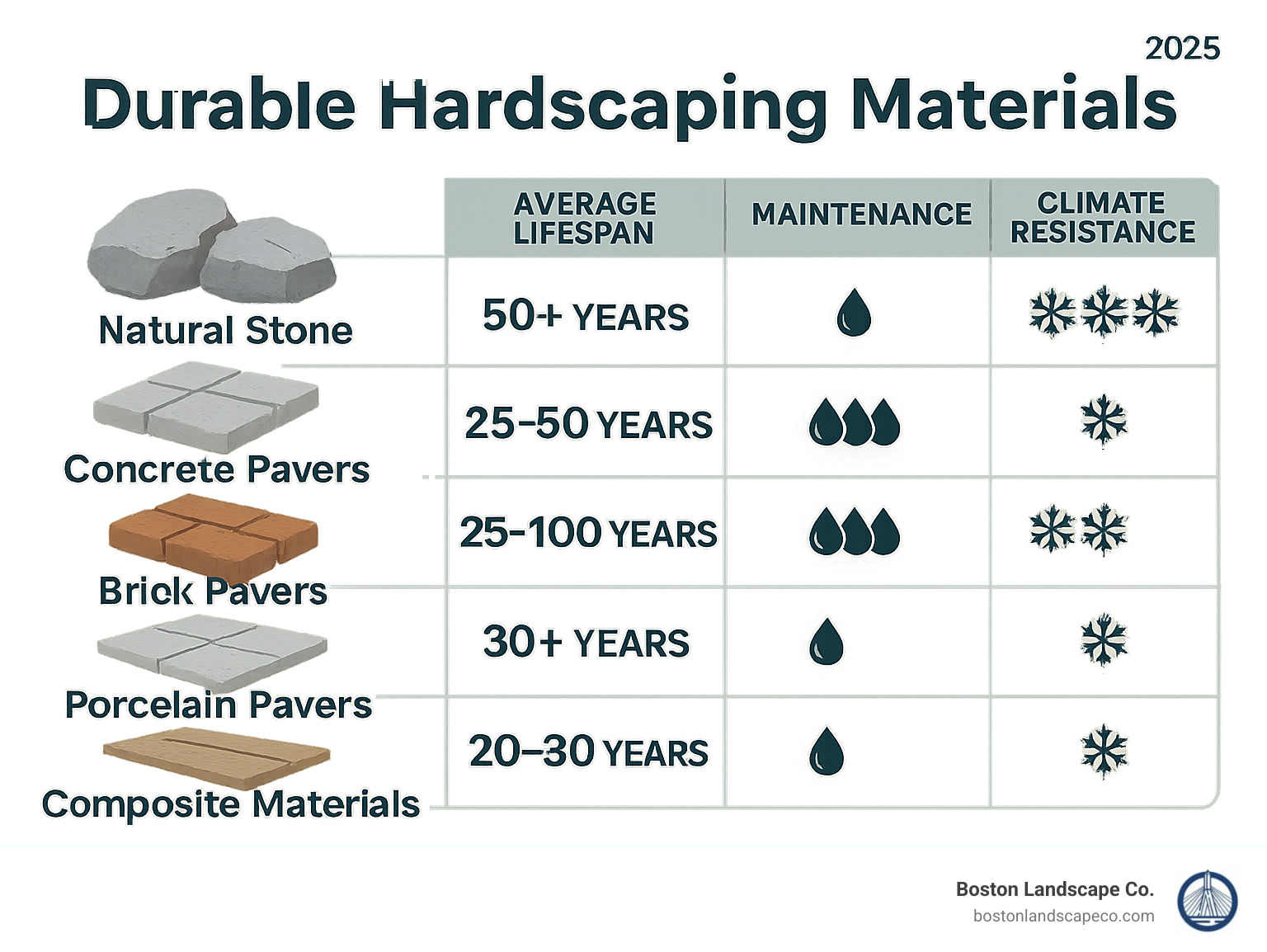
Most Durable Hardscaping Materials:
- Natural Stone (granite, bluestone, limestone) – 50+ years
- Concrete & Concrete Pavers – 25-50 years
- Brick & Clay Pavers – 25-100 years
- Porcelain Pavers – 30+ years, frost-proof
- Composite Materials – 20-30 years, low maintenance
- Gravel & Crushed Stone – Indefinite with proper drainage
The right material choice depends on your specific needs: load-bearing capacity for driveways, freeze-thaw resistance for New England winters, and maintenance requirements that fit your lifestyle.
Whether you’re installing a patio, walkway, or driveway, investing in quality materials upfront saves thousands in repairs and replacements down the road. New England’s harsh climate makes durability especially critical. Freeze-thaw cycles, road salt, and heavy snow loads can destroy inferior materials within just a few seasons.
I’m Steve Schumacher, and over three decades of installing hardscapes across Greater Boston, I’ve seen how the right durable hardscaping materials can transform properties while lasting generations.
Important Durable hardscaping materials terms:
– Stone patio contractors
– Retaining wall construction
– Fire pit construction
What Is Hardscaping & Why Durability Matters?
When you walk across a stone patio or drive up a brick driveway, you’re experiencing the power of hardscapes – the non-living backbone of landscape design. These permanent features include everything from concrete walkways and stone pathways to retaining walls and wooden decks.
Unlike your lawn or flower beds, hardscapes face incredible challenges every day. They must support load-bearing weight from vehicles and heavy furniture while enduring New England’s brutal freeze-thaw cycles that can crack inferior materials. They do all this while maintaining their beauty and safety for decades.
Here’s why durable hardscaping materials matter: hardscapes are permanent investments that either pay dividends for generations or become expensive headaches. A properly installed natural stone patio can look stunning for over 50 years, while poorly chosen concrete might develop dangerous cracks within just five seasons.
The benefits extend beyond aesthetics. Quality hardscapes boost your property value by 15-20% according to real estate studies. They provide critical erosion control by directing water away from your foundation. When properly designed, they create safe, stable surfaces that prevent trips and falls.
Think about the long-term ROI. When hardscape materials range from $10 to $150+ per square foot (based on average internet data, not Boston Landscape Co. pricing), choosing durable options becomes critical for protecting your investment.
Hardscape vs. Softscape: The Backbone of Landscape Design
Hardscapes are like the skeleton of your outdoor space – everything else depends on them working properly. Your beautiful garden beds, lush lawn, and colorful plantings all rely on hardscapes for structure, definition, and access.
We’ve seen gorgeous landscapes fail because the underlying hardscape couldn’t handle its function. Poor drainage from inadequate hardscaping destroys plantings. Unstable surfaces make maintenance impossible. Without proper structural support, even the most expensive landscaping becomes a frustrating money pit.
Why Durable Hardscaping Materials Save Money Over Time
The math is simple: spending more upfront on quality materials costs far less than replacing cheap ones multiple times. Consider the homeowner who installs budget concrete pavers for $8 per square foot. Five years later, freeze-thaw damage forces a complete replacement at $12 per square foot – plus removal costs. Compare that to investing in natural stone at $25 per square foot that only needs minor resealing after 20 years.
Warranties tell the real story about material confidence. Quality concrete pavers often come with 25-year warranties, while natural stone frequently carries lifetime guarantees. Smart homeowners focus on lifetime costs, not just upfront repair costs.
Durable Hardscaping Materials: Comparing Your Options
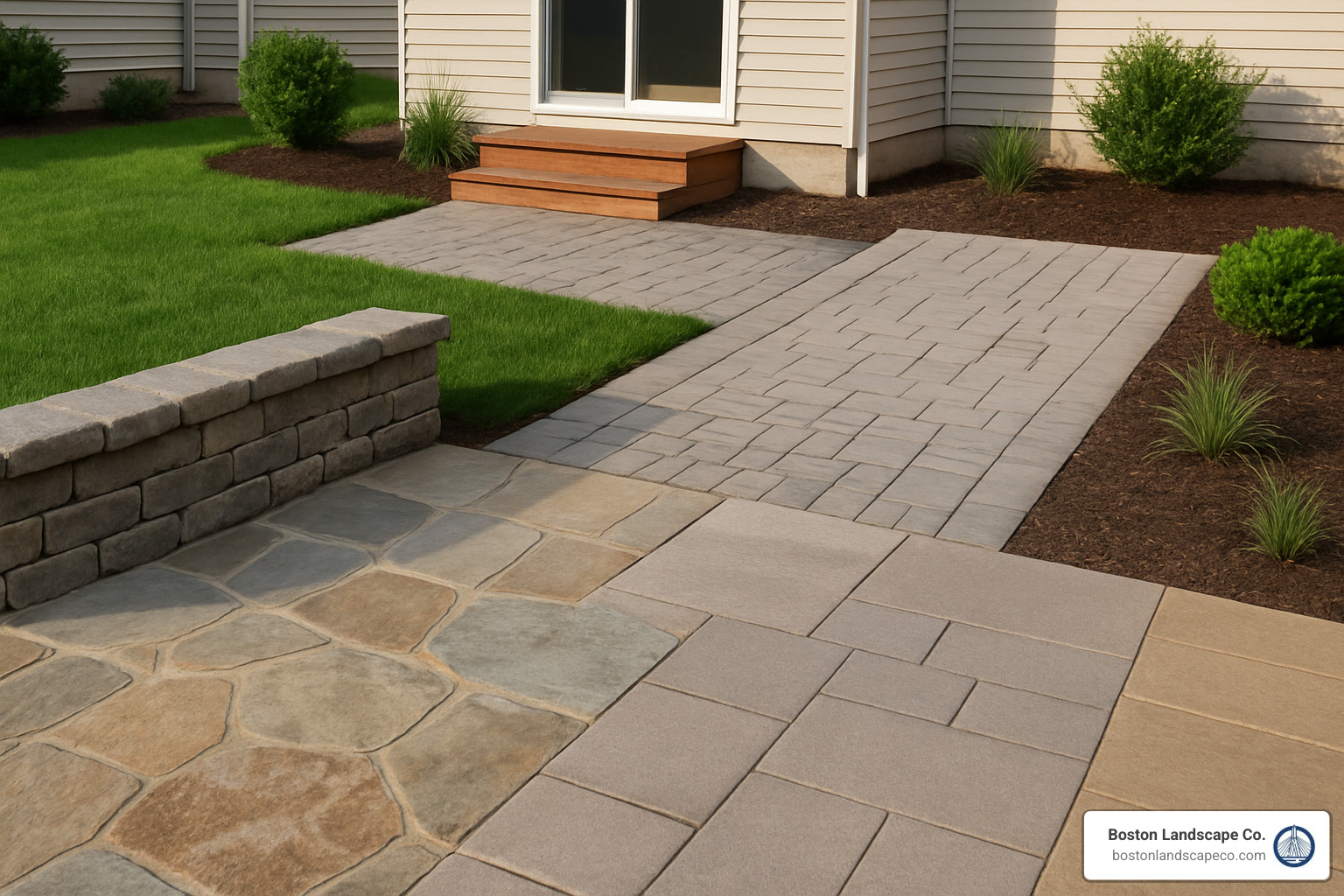
After thirty years of installing hardscapes across Greater Boston, I’ve learned that choosing the right material is like picking a life partner – you want something that looks good, stands the test of time, and doesn’t drive you crazy with maintenance demands.
Today’s durable hardscaping materials offer more options than ever. Granite tops the durability charts at 100+ years but commands premium pricing. Concrete pavers offer the sweet spot of performance and value for most homeowners. Brick pavers bring classic appeal with 25-100 year lifespans, while modern porcelain and composite materials deliver cutting-edge performance with minimal upkeep.
Gravel and crushed stone deserve respect too – they can last indefinitely when properly installed and offer incredible value at a fraction of the cost of other materials.
The key is matching the material to your specific needs. A high-traffic driveway demands different performance than a quiet garden path. Climate matters enormously here in New England – what works in Arizona might crack apart after our first winter.
Based on average internet data (not Boston Landscape Co. pricing), expect to invest anywhere from $3 per square foot for basic gravel up to $150+ per square foot for premium natural stone.
Natural Stone as Durable Hardscaping Materials
Nothing beats natural stone for pure longevity. I’ve restored century-old granite walkways that needed only minor repointing – the stone itself looked ready for another hundred years.
Granite leads the pack with incredible hardness and weather resistance. Its dense structure shrugs off freeze-thaw cycles that destroy lesser materials. We use granite for driveways and high-traffic areas where durability trumps everything else.
Bluestone captures classic New England character with blue-gray tones and naturally textured surface. It provides excellent grip when wet, making it perfect for pool decks and patios. The way it weathers over time actually improves its appearance.
Limestone brings warmth to outdoor spaces with earth tones and smooth finish. While slightly softer than granite, it’s still incredibly durable and ages beautifully. Sandstone offers excellent texture in colors ranging from warm buff to deep red. Slate rounds out the options with fine grain and rich colors, splitting naturally into thin, flat pieces perfect for patios.
Expert insights on timeless palettes suggest that locally quarried stone adapts better to regional climate conditions and reduces transportation costs.
Concrete & Concrete Pavers: Workhorse of Hardscapes
Modern concrete pavers are engineering marvels that offer stone-like durability at a fraction of the cost. With compressive strengths exceeding 8,000 PSI, they’re strong enough to support fire trucks while looking great.
The real beauty lies in versatility. Stamped concrete can mimic flagstone, brick, or wood grain with remarkable accuracy. Stained concrete adds color that penetrates deep into the material. For driveways, concrete pavers excel because of their modular nature – if one cracks, you replace just that piece.
The cost advantage is significant. Based on average internet pricing, basic concrete pavers start around $8-25 per square foot installed, making quality hardscaping accessible for most budgets.
Our Concrete Patio Specialists have perfected installation techniques that maximize concrete’s lifespan in New England’s challenging climate.
Brick & Clay Pavers: Classic Longevity
Brick pavers represent one of the most proven durable hardscaping materials available, with installations regularly lasting 25-100 years. The secret lies in clay’s natural properties – it’s already been fired at extreme temperatures, making it incredibly stable and weather-resistant.
Unlike concrete pavers that can show wear patterns, brick pavers are solid clay throughout, maintaining their rich color and texture indefinitely. Brick excels in freeze-thaw conditions because its slightly porous structure allows moisture to escape rather than building destructive pressure.
Herringbone patterns provide maximum interlock for driveways, while running bond patterns work well for walkways. Color retention sets brick apart – while concrete may fade, brick maintains its color indefinitely.
Composites & Porcelain: Modern Low-Maintenance Options
Modern materials bring high-tech solutions to hardscaping challenges. Composite materials made from recycled plastic and wood fiber resist weathering, decay, and insects while requiring virtually no maintenance.
Porcelain pavers represent the newest evolution in hardscape materials. These extremely dense, non-porous tiles resist heat absorption and are completely frost-proof. Their UV stability means colors won’t fade, while slip resistance provides safety when wet.
The main trade-off is cost. Premium porcelain pavers can cost $20-50 per square foot installed based on average internet pricing, but their minimal maintenance requirements often justify the investment.
Gravel & Crushed Stone Bases and Finishes
Don’t overlook gravel and crushed stone – they’re among the most durable hardscaping materials available and incredibly cost-effective. Properly installed gravel surfaces can last indefinitely with minimal maintenance.
Gravel’s superpower is drainage. It prevents water buildup that destroys other materials. Decomposed granite creates smooth, stable walking surfaces while remaining permeable. For driveways, crushed stone handles heavy loads while preventing ice buildup.
The cost advantages are dramatic. Basic gravel installations can cost as little as $3-12 per square foot based on average internet pricing, making quality hardscaping accessible for large areas.
Installation & Maintenance Best Practices for Long-Lasting Results
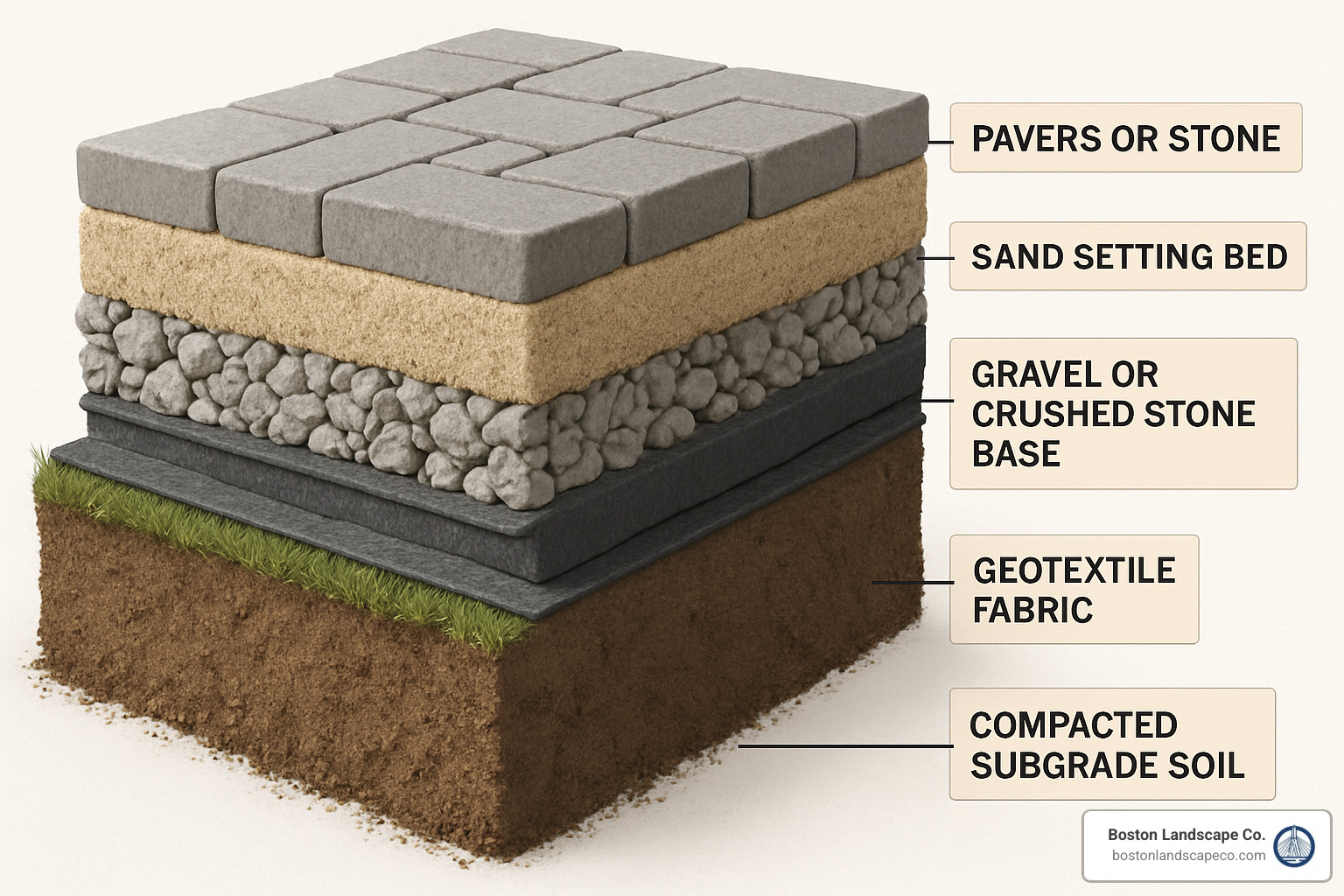
Even the finest granite or premium concrete pavers will fail miserably without proper installation. The foundation literally makes or breaks your hardscape investment.
Site Preparation: Getting the Foundation Right
Site preparation is the invisible hero of hardscaping. Proper excavation starts the process – most hardscapes need 8-12 inches of depth removed to accommodate base materials and achieve the right finished grade.
Subgrade compaction comes next. The native soil must be compacted to 95% density using mechanical compactors. A hand tamper won’t cut it for anything larger than a small walkway.
Drainage slope is absolutely critical in New England. Every hardscape needs at least a 1% slope – one inch of drop for every eight feet of length. Water sitting on or under hardscapes causes more damage than heavy trucks and freeze-thaw cycles combined.
Don’t forget frost depth. Massachusetts frost can penetrate four feet deep. While most residential hardscapes don’t need frost footings, proper base materials and geotextile fabric prevent frost heave damage.
The base layer gets compacted in two to four inch lifts, creating a stable foundation that drains well and won’t shift under load.
Pro Installation vs. DIY: When to Call the Pros
Some hardscape installations require professional expertise to avoid costly disasters. Load-bearing driveways top the list – they must support vehicles weighing 10,000 pounds or more without settling. The engineering needed goes beyond weekend warrior skills.
Retaining walls over three feet tall require engineering calculations and sophisticated drainage systems. When these fail, they can collapse catastrophically. Most municipalities require permits for significant retaining wall projects.
Our Hardscape Installation Company has dealt with every drainage challenge New England can throw at us over three decades.
For major projects requiring Retaining Wall Construction, the cost difference between DIY and professional installation often disappears when you factor in tool rental, material waste, and the possibility of starting over.
Ongoing Care: Keeping Durable Hardscaping Materials in Top Shape
The beauty of choosing durable hardscaping materials is that maintenance requirements stay reasonable. Annual maintenance keeps things simple: power washing removes dirt and stains, re-sanding paver joints prevents shifting, and checking drainage systems takes minutes but prevents major problems.
Seasonal care varies by material. Natural stone sealing every three to five years maintains stain resistance. Concrete sealing every five to seven years keeps surfaces looking fresh.
Winter snow management requires special attention in New England. Metal shovels can scratch surfaces, so plastic shovels protect your investment. Salt-resistant materials handle road salt better, but sand provides traction without chemical damage.
Design, Climate & Budget Considerations
Creating beautiful, lasting hardscapes isn’t just about picking the prettiest materials – it’s about understanding how design, climate, and budget work together. New England’s climate throws everything at our hardscapes: freeze-thaw cycles that can crack inferior materials, road salt that eats away at surfaces, and heavy snow loads that test every joint.
The wide cost range for hardscaping – from $10 to $150+ per square foot based on average internet data – reflects dramatic differences in material quality and installation complexity. The cheapest option usually costs more in the long run.
Blending Materials for Cohesive, Durable Spaces
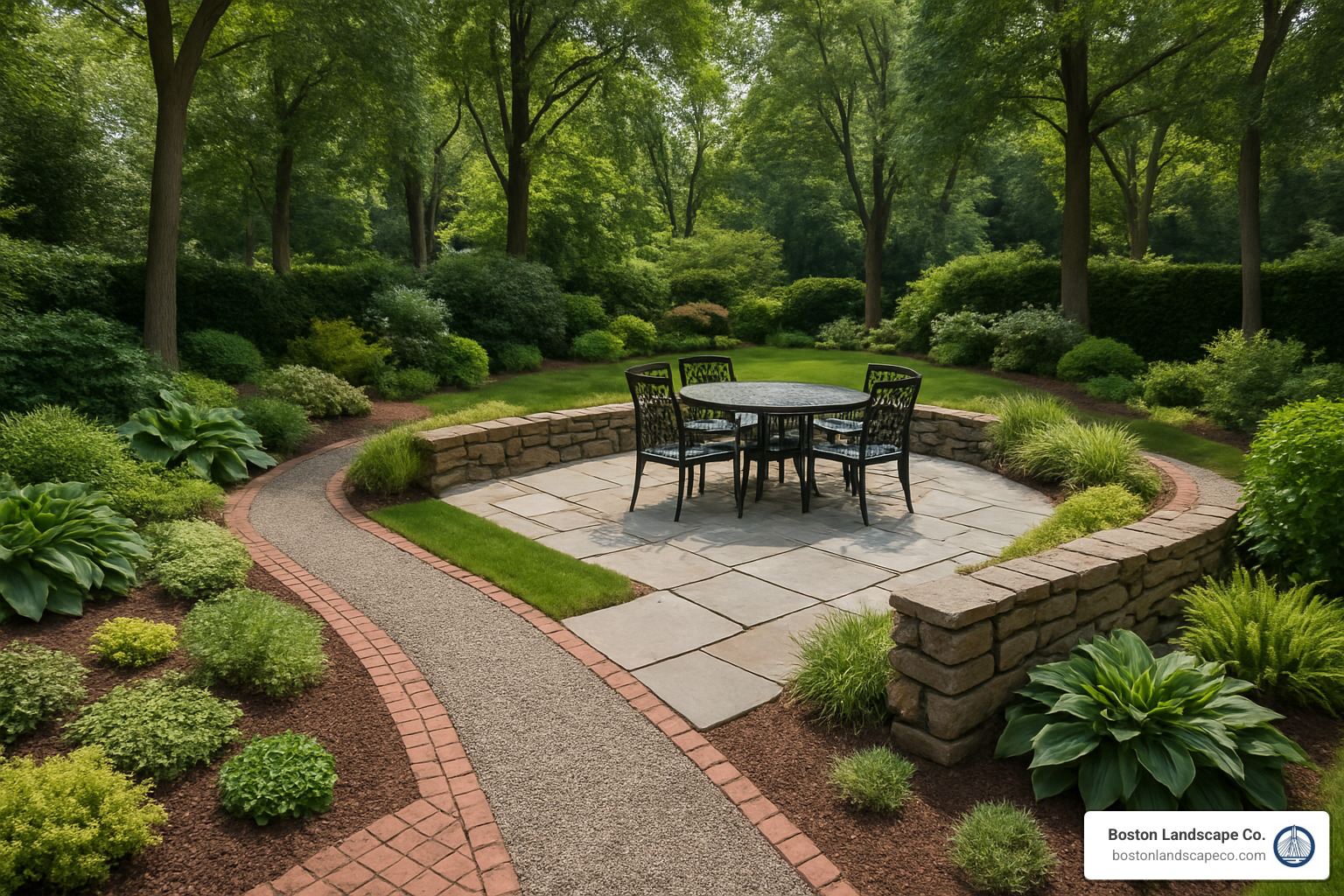
The secret to stunning hardscapes lies in restraint. Limit yourself to three materials maximum – any more and your space looks like a sample display.
Some favorite combinations include natural stone patios anchored by brick edging and connected with gravel pathways. The stone provides elegance and durability, brick adds warmth and definition, while gravel offers practical drainage and cost-effective coverage.
Color tone harmony matters more than exact matches. Think about how materials will look together after they’ve weathered for a few seasons. Focal points work best when created through material contrast rather than competing materials.
Our Backyard Hardscape Contractors have mastered the art of material blending, creating spaces that look intentional and timeless.
Sustainable Choices & Local Sourcing
Real sustainability means choosing durable hardscaping materials that won’t need replacement every decade, sourcing locally to reduce transportation impacts, and designing for long-term performance.
Permeable pavers represent one of the smartest sustainable choices. These specialized pavers allow rainwater to soak through rather than running off into storm drains. They’re particularly valuable in Massachusetts, where regulations increasingly require managing stormwater on-site.
Local sourcing makes environmental and practical sense. New England granite quarried locally performs better in our climate than imported stone. Recycled content materials have come a long way – modern composite decking contains recycled plastic bottles while performing just as well as virgin materials.
Budgeting Smart: Upfront vs. Lifetime Costs
Smart budgeting means thinking beyond the initial price tag. Material cost tiers break down roughly like this: budget options run $10-25 per square foot, mid-range materials at $25-50 per square foot, and premium installations can reach $50-150+ per square foot. These are average costs based on internet data and not actual Boston Landscape Co. pricing.
Maintenance savings add up quickly with quality materials. Natural stone needing sealing every five years costs far less to maintain than concrete pavers requiring replacement every fifteen years. Phased projects let you afford better materials by spreading costs over time.
The long-term ROI on quality hardscaping typically returns 60-80% of investment in increased property value. In Greater Boston, premium installations often return even more.
Frequently Asked Questions about Durable Hardscaping Materials
After three decades of installing hardscapes across Greater Boston, we hear the same questions from homeowners again and again. Let me share the answers that help our clients make confident decisions about durable hardscaping materials.
What are the most durable options for heavy-traffic driveways?
Your driveway takes more punishment than any other hardscape surface. Between daily car traffic, delivery trucks, and moving vans, you need materials that won’t crack, shift, or wear down.
Granite stands as the ultimate choice for durability. With a hardness rating of 6-7 on the Mohs scale, granite laughs off tire wear and heavy loads. We’ve seen granite driveways that look nearly new after 50 years.
Concrete pavers offer the sweet spot between durability and cost. Modern pavers with 8,000+ PSI compressive strength easily handle any residential vehicle load. The real advantage? If one paver gets damaged, you replace just that unit – not the entire driveway.
Cobblestone brings old-world charm with proven performance. These stones supported horse-drawn wagons for centuries, so your SUV won’t phase them. The natural texture provides excellent traction in wet conditions.
The secret to any durable driveway isn’t just the surface material – it’s what lies underneath. We install 6-8 inches of compacted crushed stone base for residential driveways.
How does New England weather affect material choice?
Living in New England means your hardscape faces some of the country’s toughest weather conditions. Freeze-thaw cycles present the biggest challenge. Massachusetts experiences 50-100 freeze-thaw cycles each winter. Water seeps into cracks, freezes, expands, and splits materials apart.
That’s why we recommend porcelain pavers and properly sealed natural stone for our climate. These materials either resist water penetration entirely or handle expansion forces without damage.
Salt exposure from winter road treatments creates another challenge. Road salt can chemically attack concrete and some natural stones. Granite and other dense stones generally shrug off salt damage, while concrete requires special mixes to survive.
Snow loads matter more than most people realize. Heavy, wet snow can weigh 20+ pounds per square foot. Materials need to handle this weight without cracking. Solid materials like natural stone and brick perform much better than hollow blocks.
Are eco-friendly hardscape materials as durable as traditional ones?
Yes – modern eco-friendly durable hardscaping materials often match or exceed traditional options. The key is choosing products from manufacturers who prioritize performance alongside environmental benefits.
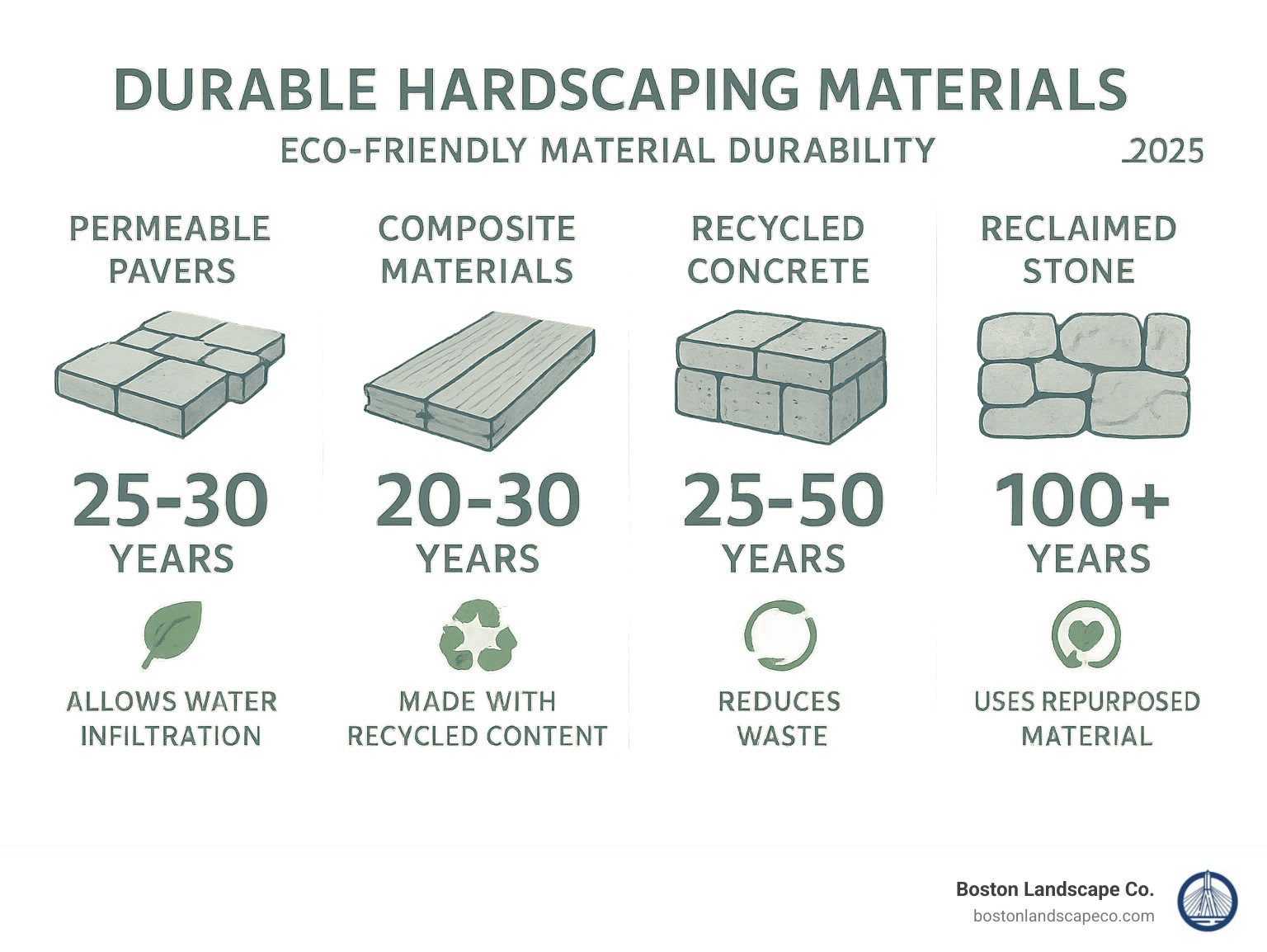
Permeable pavers typically last 25-30 years while solving drainage problems that destroy conventional hardscapes. Composite materials made from recycled plastics resist weathering better than many traditional materials. We’ve installed composite surfaces that still look new after 15+ years with virtually no maintenance.
Recycled content concrete pavers perform identically to virgin materials. Reclaimed materials often outlast new options because they’ve already proven their durability.
Conclusion
Selecting the right durable hardscaping materials isn’t just about creating a beautiful outdoor space – it’s about making a smart investment that will serve your family for generations. After three decades of changing properties across Greater Boston, we’ve witnessed how quality material choices separate lasting success from costly disappointment.
The difference between a hardscape that thrives for fifty years and one that fails within a decade often comes down to three critical decisions: choosing materials suited to New England’s challenging climate, investing in proper installation techniques, and understanding that upfront quality saves money over time.
Natural stone patios we installed twenty years ago still look stunning today, while cheaper alternatives from the same era have been replaced multiple times. Durable hardscaping materials like granite, quality concrete pavers, and properly sealed brick don’t just maintain their appearance – they actually improve with age.
Your hardscape represents one of the largest investments you’ll make in your property’s outdoor spaces. Whether you’re planning an entertaining area, functional driveway, or welcoming pathways, the materials you choose today will impact your daily life and property value for decades.
At Boston Landscape Co., we understand that every project is personal. Our design-build-maintain approach ensures your hardscape performs exactly as intended, from initial consultation through years of seasonal maintenance. We’ve built our reputation on helping homeowners make informed decisions about durable hardscaping materials that match their lifestyle, budget, and long-term goals.
The investment in quality materials and professional installation pays for itself through reduced maintenance, eliminated replacement costs, and daily enjoyment of outdoor spaces that truly work. When you choose durability over shortcuts, you’re not just building a patio or walkway – you’re creating an outdoor legacy.
Ready to find how durable hardscaping materials can transform your property’s beauty and value? Learn more about our hardscaping services and let us help you build outdoor spaces designed to last a lifetime.
