
Drip irrigation for landscaping: Lush 2025 Guide
Why Efficient Watering Matters for Your New England Landscape
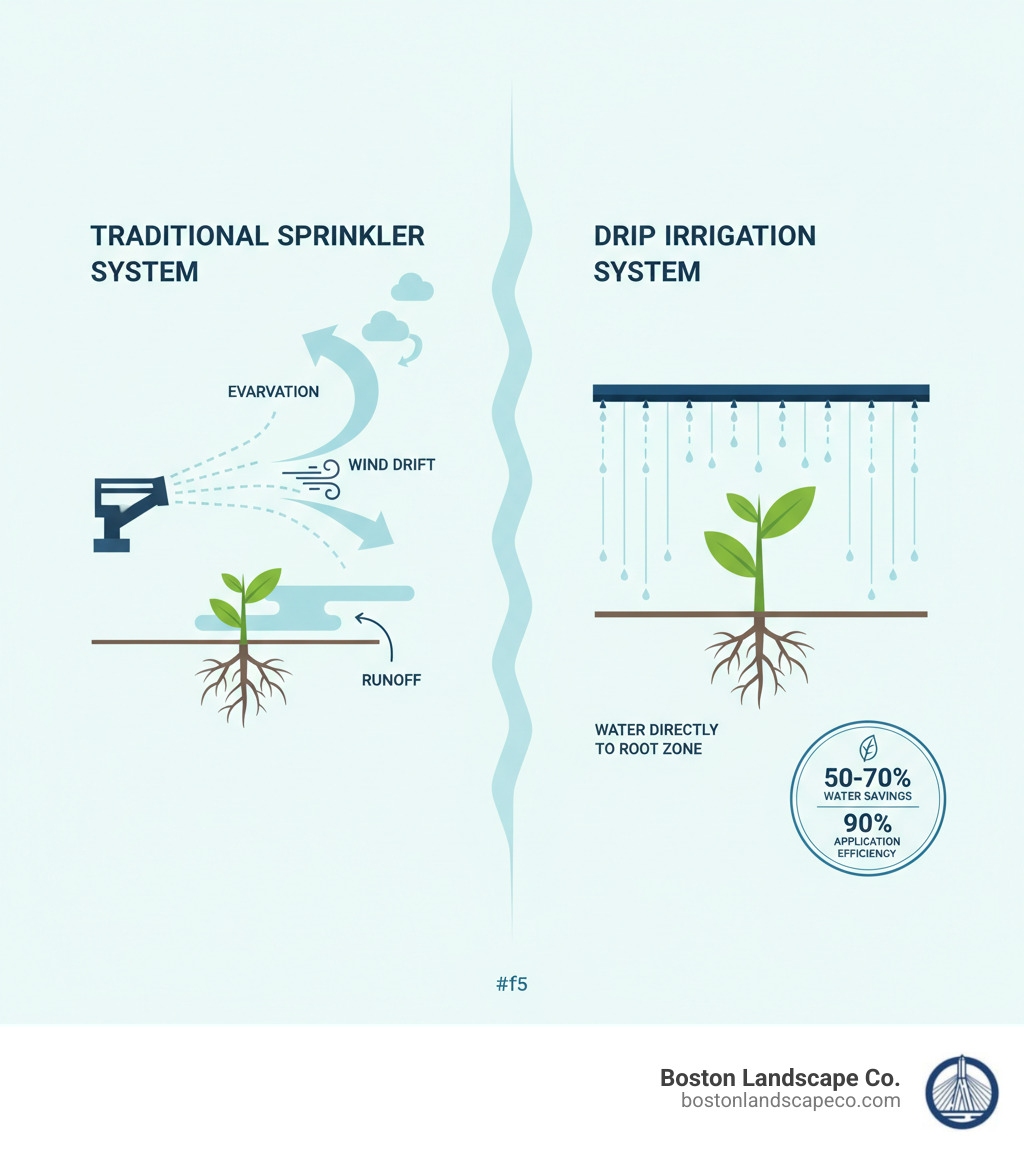
As summer heat peaks in the Greater Boston area, keeping landscapes lush without high water bills is a major challenge. Traditional sprinklers are inefficient, losing much of their water to evaporation and runoff. The smarter alternative is drip irrigation for landscaping, a low-flow method that delivers water directly to plant roots, reducing waste by up to 70%.
Key Benefits of Drip Irrigation:
- Water Savings: Uses 20-50% less water than conventional spray systems.
- Healthier Plants: Delivers consistent moisture directly to root zones.
- Reduced Weeds: Waters only your plants, not the bare soil between them.
- Lower Costs: Can save over 25,000 gallons of water per year for a typical home.
- Disease Prevention: Keeps water off foliage, reducing fungal problems.
- Year-Round Value: Works for gardens, shrubs, trees, and container plants.
Drip irrigation is becoming essential for New England properties facing water restrictions and unpredictable weather. A simple system of tubing, emitters, and a timer automates watering while cutting consumption dramatically. Unlike sprinklers that water everything, drip systems target individual plants, leading to healthier roots, fewer diseases, and landscapes that thrive even in dry spells.
I’m Steve Schumacher, owner-operator of Boston Landscape Co. since 1991. I’ve helped countless New England property owners switch to efficient drip irrigation for landscaping systems that slash water bills and improve plant health. The long-term payoff in savings and reduced maintenance makes it one of the smartest landscaping investments you can make.
Why Drip Irrigation is a Smarter Choice for Your Landscape
Here in New England, unpredictable summer weather makes consistent watering a challenge. Drip irrigation for landscaping takes the guesswork out of the equation, making every drop count. Unlike traditional sprinklers that waste water through evaporation and runoff, drip systems deliver water directly to each plant’s root zone. Research from sources like MIT shows drip irrigation can cut water consumption by up to 70%.
This efficiency translates directly to financial and environmental savings. According to the EPA, these systems use 20-50% less water than spray sprinklers, which can save a typical home over 25,000 gallons annually. In Massachusetts, where water costs are significant, this means hundreds of dollars back in your pocket each year. Furthermore, an efficient irrigation system can increase property value, with many homeowners recovering a large portion of the installation cost at resale. For a detailed breakdown, see our guide on the cost to install an irrigation system.
The benefits extend to plant health. Steady, direct moisture encourages deeper root growth, making plants more drought-resistant. By keeping foliage dry, drip systems also prevent fungal diseases like powdery mildew and black spot. Another advantage is fewer weeds; since you’re only watering your plants and not the bare soil between them, weed seeds don’t get the moisture needed to germinate. This means less time weeding and more time enjoying your landscape.
While sprinklers are great for large lawns, drip systems offer best precision for garden beds, trees, and container gardens. The combination of lower water bills, healthier plants, and reduced maintenance makes drip irrigation one of the smartest investments for your landscape.
Understanding the Anatomy of a Drip System
Drip irrigation for landscaping systems are surprisingly simple, consisting of two main parts: the headworks assembly (the control center) and the water distribution network (tubing and emitters).
The “Headworks”: Your System’s Control Center
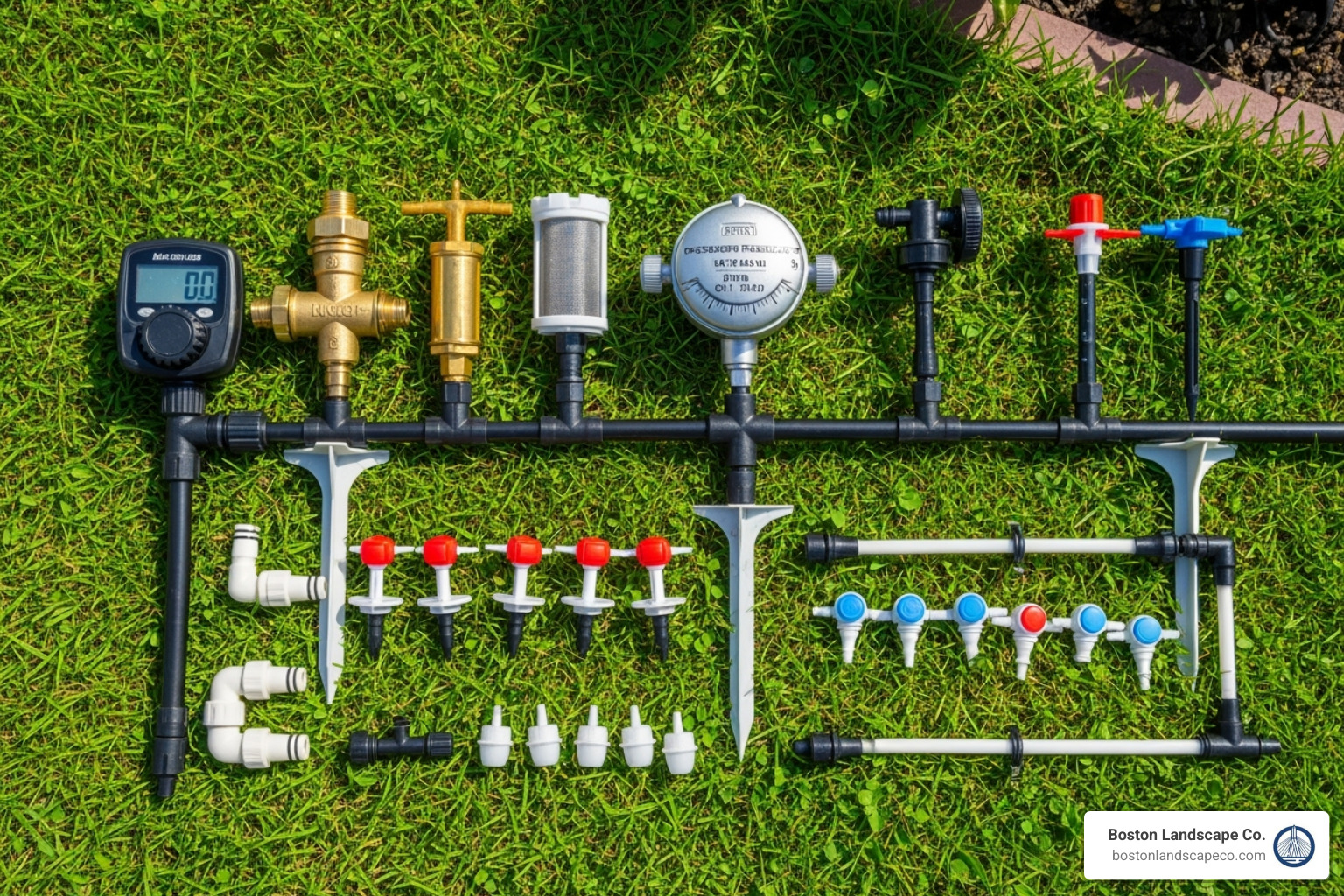
The headworks connects to your spigot or main water line and prepares the water for distribution. It includes several key components:
- Backflow Preventer: A critical safety device required by code in Massachusetts. It stops irrigation water from flowing back into your home’s drinking water. Learn more about proper backflow preventer installation.
- Filter: Catches sediment and mineral deposits that can clog the small openings in drip emitters. Cleaning the filter is much easier than fixing dozens of clogs.
- Pressure Regulator: Reduces your home’s high water pressure (50-80 PSI) to the low pressure (15-30 PSI) that drip systems require, preventing blown fittings and ensuring even flow.
- Automatic Timer: Automates your watering schedule for consistency, even when you’re away. Smart controllers can even adjust based on weather forecasts.
Tubing and Emitters: Delivering Water Where It Counts
Once water passes the headworks, a network of tubing carries it to your plants. Mainline tubing (1/2″ or 5/8″) acts as the backbone, while smaller micro-tubing (1/4″) branches off to reach individual plants. The water is released through emitters, which come in several types to match different plant needs:
- Drippers: Point-source emitters perfect for individual shrubs or container plants, delivering a slow, steady flow (0.5-2 gallons per hour) directly to the root zone.
- Inline Emitter Tubing: Tubing with pre-installed emitters at regular intervals (e.g., every 12 or 18 inches), ideal for hedges, vegetable rows, or dense plantings.
- Micro-Sprayers: Small spray heads that cover a radius of 3-10 feet, useful for groundcover or flower beds where you want wider coverage.
- Bubblers: Higher-flow devices that quickly flood the soil around large trees or mature shrubs.
The versatility to mix and match these components allows you to create a custom solution for every part of your landscape. For more on how these parts form complete systems, see our overview of watering and irrigation systems.
How to Install Drip Irrigation for Landscaping: A Step-by-Step Guide
Installing a drip irrigation for landscaping system is a manageable DIY project with proper planning. While we at Boston Landscape Co. often handle design and installation, understanding the process is empowering for any homeowner.
Step 1: Design and Map Your System
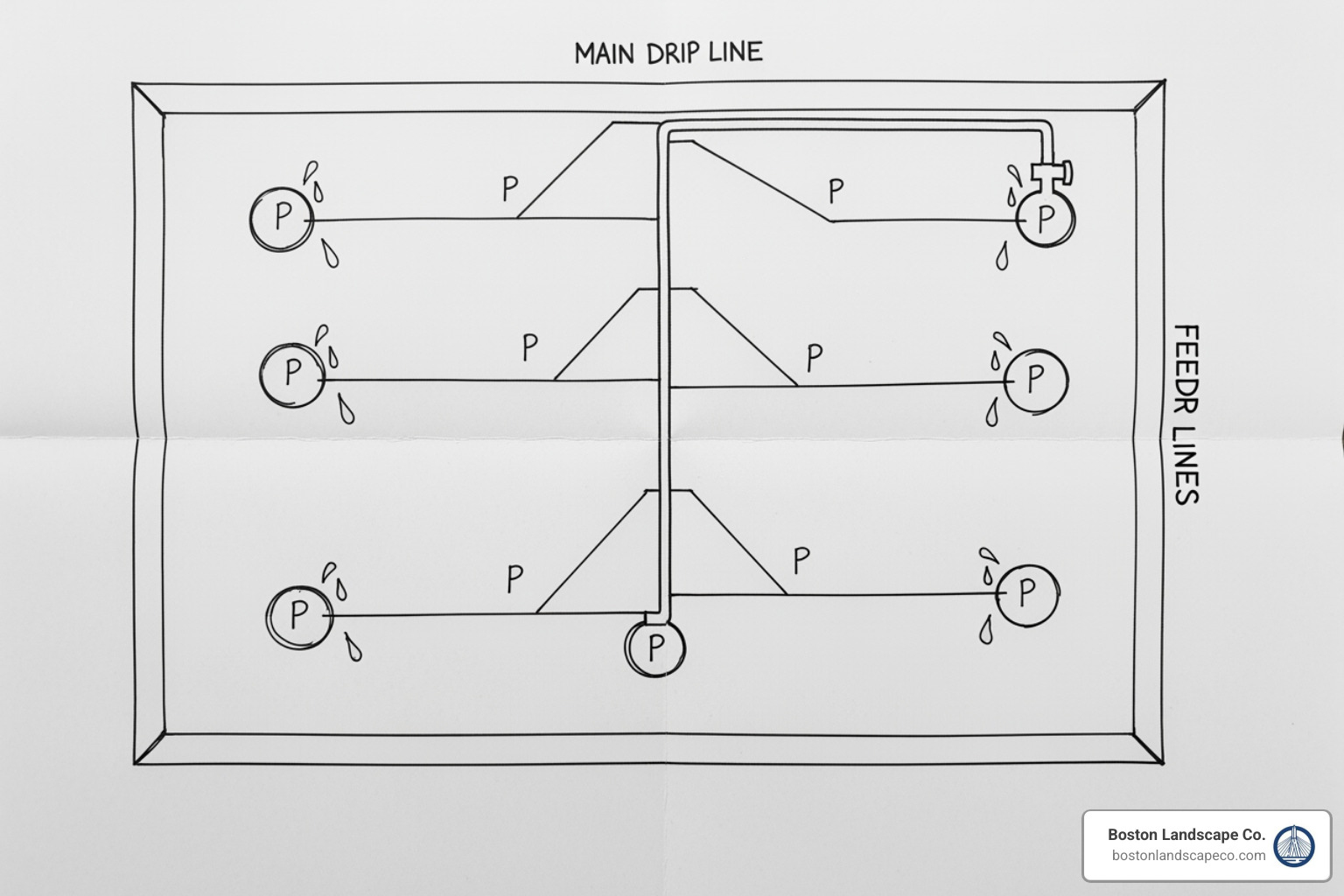
This planning phase is the most crucial step. Start by sketching your garden beds, marking pathways and existing plants. Group plants with similar water needs into “hydrozones” to ensure efficient watering. Plan the path for your main tubing, usually along the edges of beds, and mark where smaller micro-tubing will branch off. Measure these paths to calculate the total tubing length needed, adding 10-20% extra for adjustments. Finally, choose emitter types based on your plants and soil. For example, sandy soil requires closer emitter spacing (12 inches) than clay soil (24 inches) to ensure even water distribution. For more planning insights, see our guide on irrigation system installation.
Step 2: Assemble the Headworks
Assemble the control center at your water source, typically an outdoor spigot. The components connect in a specific sequence:
- Screw the backflow preventer onto the spigot.
- Attach the filter to the backflow preventer.
- Connect the pressure regulator to the filter.
- Attach the tubing adapter, which connects the mainline tubing to the assembly.
If using an automatic timer, it usually goes between the spigot and the backflow preventer. Hand-tighten each component for a secure, leak-free connection.
Step 3: Lay Out and Connect the Tubing
To make the polyethylene tubing more flexible, roll it out in the sun for an hour. Lay the main tubing according to your map, avoiding sharp kinks. Use a tubing cutter for clean, straight cuts. Insert barbed fittings (tees, elbows, couplings) to create branches and steer corners, pushing the tubing firmly over the barb for a tight seal. Secure the tubing every few feet with stakes to prevent it from shifting under pressure.
Step 4: Install Emitters for Drip Irrigation for Landscaping
Use a punch tool to make clean holes in the mainline tubing where needed. For individual plants, you can push a dripper’s barbed end directly into the hole. Alternatively, insert a barbed connector and attach a length of 1/4″ micro-tubing to reach plants farther from the mainline. Run the micro-tubing to the plant’s base and attach an emitter, securing it with a small stake.
For larger plants, use multiple emitters. Before capping the ends, turn the water on for a minute to flush out any debris. Then, install end caps on all tubing runs. Turn the system on and walk the lines, checking for leaks or malfunctioning emitters and making adjustments as needed. This final check ensures your system operates efficiently from day one. For more on different watering systems, visit our page on general watering systems.
System Maintenance and Seasonal Care
Your drip irrigation for landscaping system requires some seasonal attention to perform its best, especially with New England’s dramatic weather cycles. A few simple tasks will keep your system running efficiently for years.
Routine Checks and Common Fixes
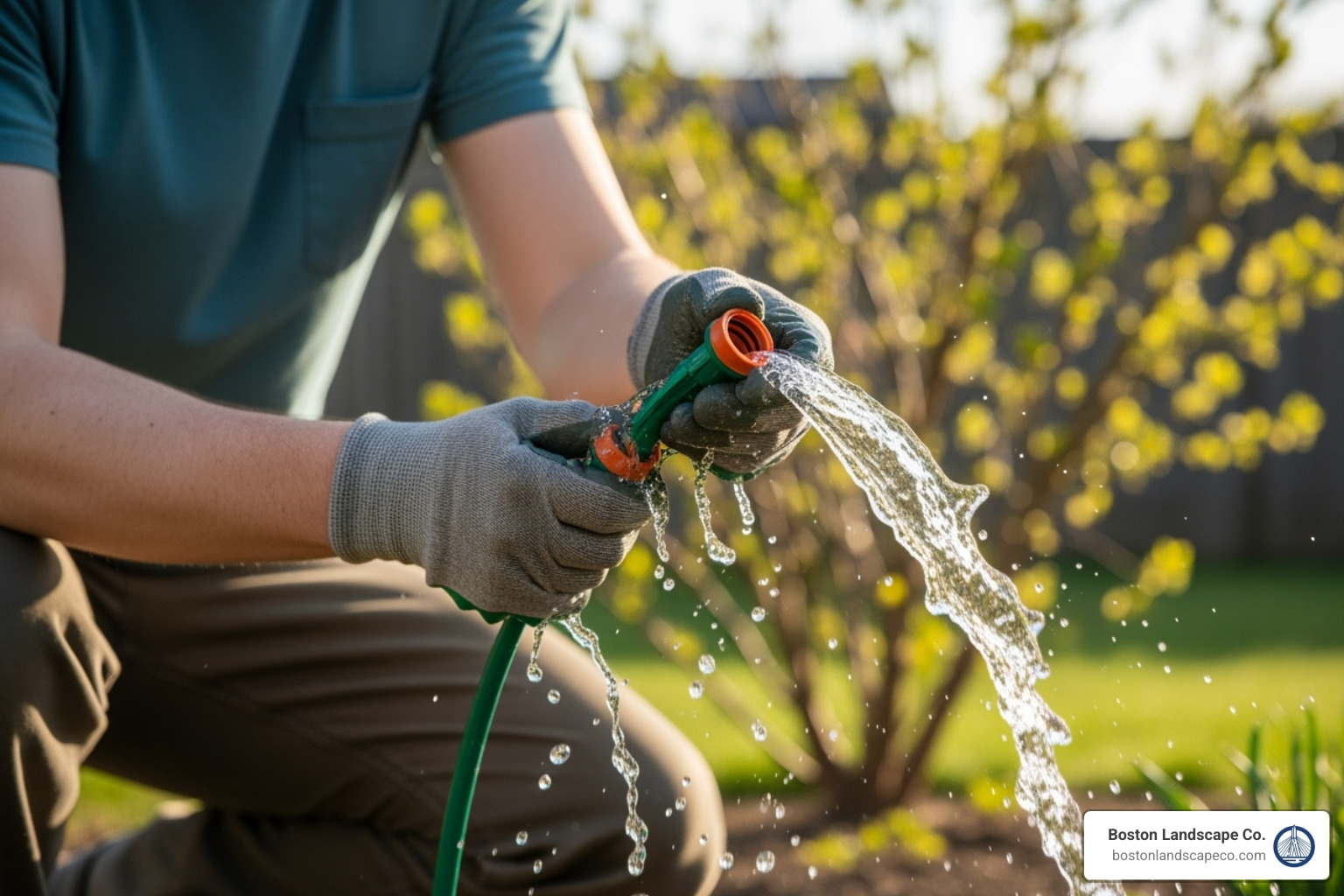
During the growing season, periodically walk your lines to check for problems. Look for clogged emitters (which can often be cleaned or easily replaced) and leaks from damaged tubing or loose fittings. Clean your system’s filter monthly by rinsing the screen; this is the best way to prevent clogs. As plants grow, you may need to adjust emitter placement or add more to cover expanding root zones.
Preparing Your Drip Irrigation for Landscaping for a Boston Winter
Winterization is mandatory in our climate to prevent freezing water from cracking tubing and fittings. The primary goal is to drain the system completely. For most systems, this requires using an air compressor to “blow out” the lines, forcing all water out. If you’re not comfortable with this process, professional service is a wise investment to avoid costly spring repairs.
Before the first hard freeze (typically by mid-October in the Boston area), you must also disconnect and store your headworks assembly—the backflow preventer, filter, pressure regulator, and timer. Bring these components indoors to a location that stays above freezing. Proper winterization ensures your system will be ready for a hassle-free startup next spring.
Frequently Asked Questions about Drip Irrigation
Over three decades at Boston Landscape Co., I’ve answered many questions about drip irrigation for landscaping. Here are the most common ones.
How much does a drip irrigation system cost?
The cost varies widely. Basic DIY kits for a small garden bed can start around $20-$100, while larger DIY projects might cost $100-$500 in materials. For professional installation, costs are influenced by landscape size, soil type (rocky New England soil increases labor), component quality, and system complexity (e.g., multiple watering zones).
Based on internet data, most homeowners invest between $2,500 and $6,500 for a professionally installed system, with the full range spanning from $1,600 to over $15,000 for large or complex properties. Please note these are average costs based on internet data and not actual quotes from Boston Landscape Co. Smart controllers can add $170 to $530 but often pay for themselves in water savings. While there’s an initial investment, drip irrigation pays you back through lower water bills and healthier plants. For a more detailed look, see our page on irrigation system installation cost.
Can drip irrigation be used for a lawn?
Technically yes, via subsurface drip irrigation (SDI), but it’s rarely the best choice for most residential lawns. SDI, where drip lines are buried under the turf, is highly efficient but is more complex and expensive to install than a well-designed sprinkler system. For large, uniform turf areas, traditional sprinklers are typically more practical. Drip irrigation truly excels in garden beds, for shrubs and trees, in container pots, and for vegetable gardens where its precision is most valuable. We can design hybrid systems that use the right tool for each area. Our resource on irrigation for large lawns can help you weigh your options.
How long should I run my drip irrigation system?
There’s no single answer, as the ideal run time depends on several factors:
- Soil Type: Sandy soil needs shorter, more frequent watering (e.g., 30-45 min, 3-4 times/week), while clay soil needs longer, less frequent sessions (e.g., 60-90 min, 1-2 times/week).
- Plant Needs: A thirsty hydrangea needs more water than a drought-tolerant native plant. Grouping plants by water needs into zones is key.
- Weather: Hot, dry spells require more water; cool, rainy periods require less. A smart controller automates these adjustments.
- Emitter Flow Rate: A 1 GPH (gallon per hour) emitter delivers half the water of a 2 GPH emitter in the same amount of time, so adjust run times accordingly.
A good starting point for average soil with 1 GPH emitters in summer is 45-60 minutes, 2-3 times per week. The best approach is to observe. Check the soil moisture a few inches down after a cycle and adjust your schedule until it’s moist but not soggy.
Get a Flawless, Water-Wise Landscape
This guide has shown how drip irrigation for landscaping is a transformative approach to caring for your property. By cutting water use by up to 70%, reducing weeds and disease, and automating your watering, it saves you water, money, and time. These are real benefits that New England homeowners see every summer.
While a basic system can be a rewarding DIY project, complex landscapes with diverse plants, multiple zones, or challenging terrain benefit from professional expertise. A pro ensures the design is flawless and the system performs optimally for years.
At Boston Landscape Co., we’ve designed and installed custom irrigation systems across the Greater Boston area since 1991. We understand our region’s unique soil and climate, allowing us to create drip irrigation for landscaping systems precisely calibrated to your property. We handle everything from design and installation to winterization and ongoing maintenance.
An investment in a professionally designed system pays dividends in plant health and peace of mind. You’ll spend your summer enjoying your landscape, not worrying about watering. Ready to switch to a smarter, more efficient system? Contact us for a professional irrigation system installation and let’s discuss how drip irrigation can transform your property.
