
Automatic Sprinkler System: Hassle-Free 2025 Lawn
Why an Automatic Sprinkler System Changes Everything
An automatic sprinkler system turns lawn care into a set-it-and-forget-it solution, saving you time while promoting a healthier landscape. Here’s a quick overview:
Key Benefits:
- Saves time: No more dragging hoses around your yard.
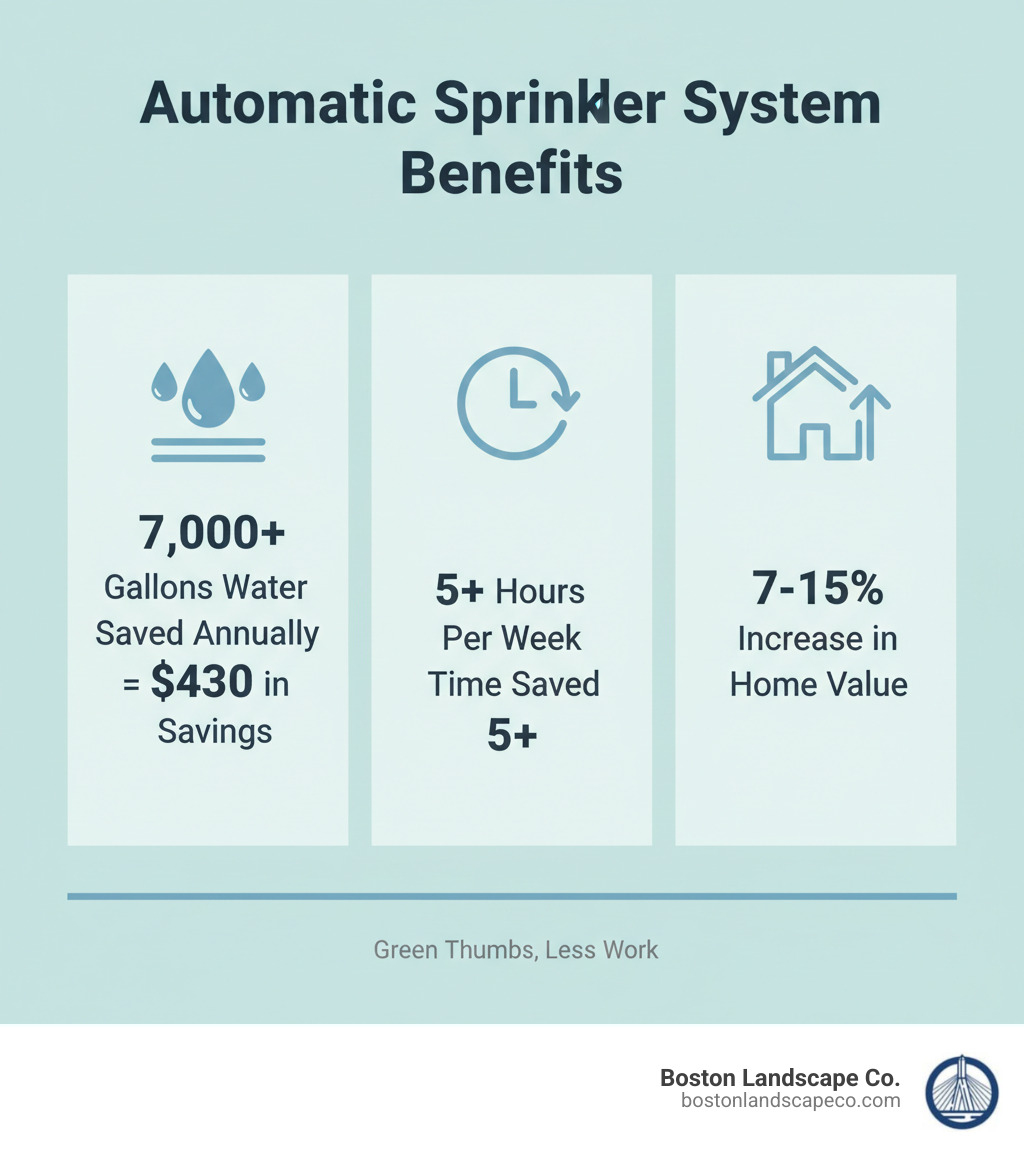
- Conserves water: Smart systems use up to 30% less water than manual methods.
- Healthier lawn: Consistent watering encourages deeper, more resilient roots.
- Increases home value: Professional irrigation can add 7-15% to your property value.
- Prevents problems: Eliminates the stress of over- and under-watering.
Main Components:
- Controller: The “brain” that programs watering schedules.
- Valves and pipes: The “heart” that distributes water to different zones.
- Sprinkler heads: The delivery system that applies water where needed.
- Sensors (optional): Adjusts watering based on rain and soil moisture.
If you’re tired of brown patches despite your best efforts, an automatic system is the answer. Spring and summer are the perfect times to install a system in Massachusetts, as your lawn is actively growing. Professional installation typically takes just 1-2 days, and the system can pay for itself in 3-5 years through water savings.
I’m Steve Schumacher, owner of Boston Landscape Co. since 1991. With over three decades of experience designing and installing automatic sprinkler systems in the Greater Boston area, I know that proper design is key to a system that lasts 20+ years without headaches.
Automatic sprinkler system definitions:
- Drip Irrigation System Installation Guide
- How are Irrigation Systems Installed
- Lawn Irrigation Cost Estimate
Why Go Automatic? The Surprising Benefits for Your Lawn and Wallet
Imagine your lawn getting perfectly watered every morning without you lifting a finger. That’s the convenience of an automatic sprinkler system, but the benefits go much deeper.
A professionally installed system delivers consistent watering that transforms your lawn’s health, eliminating brown patches and soggy spots. It’s also engineered for water conservation, using precision to avoid waste. This efficiency saves you time—often 5+ hours a week—and money. A quality system can even increase your property value by 7-15%, making it a smart landscaping investment. The result is healthier turf and plants with deeper roots that naturally crowd out weeds. For a broader look at irrigation solutions, check out our Lawn Irrigation page.
The Environmental and Financial Payoff
Modern smart watering technology delivers a significant financial return. The EPA’s research on smart controllers shows these systems can save over 7,000 gallons of water annually, which can translate to hundreds of dollars back in your pocket from reduced water bills. Smart controllers adjust watering based on local weather, skipping a cycle after it rains or increasing duration during a heatwave.
Automatic systems also excel at preventing runoff. By applying water at a rate the soil can absorb, they keep nutrients and topsoil in your yard, not flowing into storm drains. From a financial standpoint, the return on investment is compelling. Research from the National Association of Realtors shows that professional irrigation installations typically recover 83-86% of their cost at resale, making it one of the best home improvements for strong ROI.
A Healthier Landscape, Automatically
The real magic of an automatic sprinkler system happens underground. Consistent, properly timed watering encourages deeper root growth, making your lawn more drought-resistant. Disease prevention is another key benefit. By watering in the early morning (4-6 AM), grass blades have time to dry before evening, reducing the risk of fungal problems.
The system’s greatest advantage is targeted watering for different plant types. A well-designed system uses separate zones for your sunny lawn, shaded flower beds, and vegetable garden, each with a custom schedule. This precision eliminates over-watering and under-watering stress entirely. For areas needing ultra-precise delivery, like vegetable gardens, we often integrate drip irrigation. Learn more in our Drip Irrigation System Installation Guide.
Anatomy of an Automatic Sprinkler System
An automatic sprinkler system is a coordinated team of components working together to keep your landscape healthy.
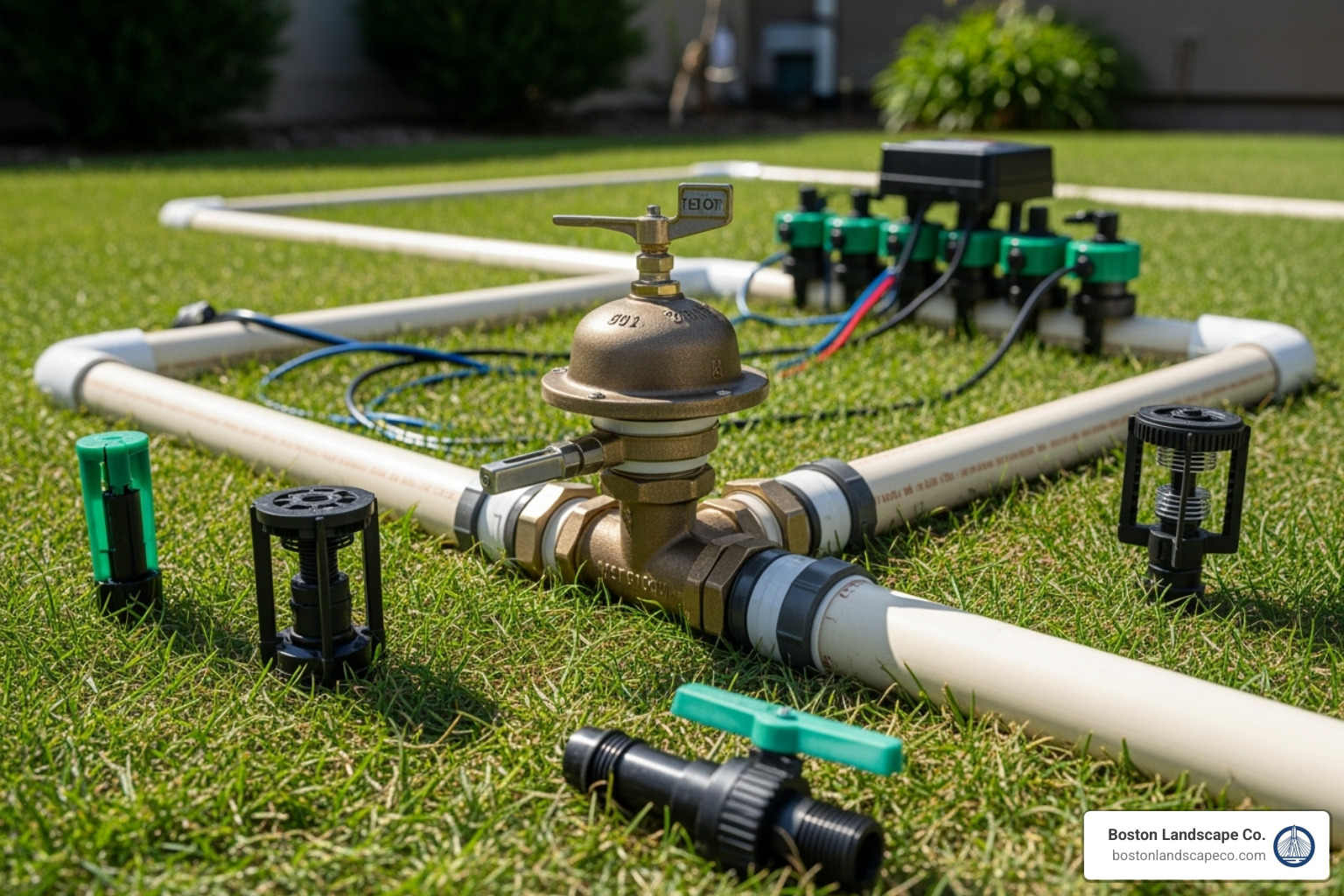
Water enters from your home’s main line through a water source connection. It first passes through a backflow preventer, a critical safety device required by most Massachusetts towns to protect your drinking water. From there, mainline piping carries water to valve manifolds, which direct flow to specific zones in your yard. Smaller lateral lines branch off to the individual sprinkler heads. The entire operation is managed by the controller, which automates the watering schedule.
The Brains: Controllers and Smart Technology
The controller is the command center of your automatic sprinkler system. While basic models are simple timers, modern smart controllers have revolutionized irrigation. These Wi-Fi-enabled devices connect to your smartphone, allowing you to make adjustments from anywhere. More importantly, they use local weather data to automatically adjust watering schedules—skipping a cycle after a thunderstorm or adding time during a heatwave. Many systems also incorporate rain sensors and soil moisture sensors for even greater efficiency, creating a truly hands-off system that adapts to the season.
The Heart: Valves, Pipes, and Zones
The network of valves and pipes is the circulatory system. Its design depends on your home’s water pressure (PSI) and flow rate (GPM), which determine how many sprinkler heads can run at once. To manage this, we divide your landscape into watering zones. Your sunny front lawn, for example, has different needs than your shaded side yard, so each gets its own zone with a custom schedule. A typical residential property has 4-8 zones. The pipes are usually durable PVC or flexible polyethylene, both of which are frost-resistant when properly winterized for our New England climate.
The Business End: Sprinkler Heads and Nozzles
Sprinkler heads are what deliver the water. A well-designed automatic sprinkler system uses different types for different areas.
- Pop-up spray heads have a fixed pattern, making them ideal for smaller, intricate areas like flower beds or narrow strips of lawn. They retract into the ground when not in use.
- Rotary sprinklers (rotors) shoot a rotating stream of water to cover larger lawn areas, typically from 15 to 40 feet. Modern rotors use advanced nozzles that create wind-resistant droplets for even coverage.
- Drip irrigation emitters deliver water directly to the roots of plants, shrubs, and trees. This method is incredibly efficient, minimizing evaporation and runoff. You can learn more in our Drip Irrigation System Installation Guide.
A typical system might use rotors for large lawns, spray heads for tight spaces, and drip lines for garden beds. For properties with very large lawns, see our guide on Irrigation for Large Lawns.
Planning and Installing Your Automatic Sprinkler System
The difference between a system that works beautifully for decades and one that becomes a constant headache? Proper planning. Every successful automatic sprinkler system installation begins long before we break ground.
When we visit your property, we’re not just looking at grass and plants—we’re reading your landscape like a map. We note every detail: the size and shape of your lawn, where your garden beds sit, which areas bake in full sun all afternoon, and which spots stay shaded under that big oak tree. These details matter because your sunny front lawn will drink up water differently than those hostas tucked under the porch.
Soil type is another crucial piece of the puzzle. Sandy soil drains fast, meaning water needs to be applied more frequently but for shorter periods. Clay soil, common throughout Massachusetts, holds water much longer, requiring less frequent but deeper watering sessions. And if you’ve ever tried to dig in New England, you know about the rocks—they’re practically our unofficial state flower. Rocky soil influences everything from trenching methods to pipe placement.
Then there’s the paperwork side. Most Massachusetts towns, including places like Concord and Lexington where we work regularly, require permits for irrigation installations. These aren’t just bureaucratic hoops—they ensure systems meet safety standards, especially for backflow prevention. We handle all permit applications so you don’t have to steer town hall requirements. For more details on the complete installation journey, check out our Lawn Sprinkler Installation page.
DIY vs. Professional Installation
I get it—when you see the price tag on professional installation, the DIY route looks tempting. You might be handy around the house, and how hard could it really be? Let me share what we’ve learned from three decades in this business.
| Feature | DIY Installation | Professional Installation |
|---|---|---|
| Cost | Lower upfront material cost; high potential for hidden costs (rentals, repairs) | Higher upfront cost; transparent pricing, fewer surprises |
| Time | Significant time investment (20-40+ hours for typical install) | Minimal time investment for homeowner (8-16 hours for consultation/oversight) |
| Tools | Requires specialized tools (trenchers, pipe cutters, crimpers, wire locators) or rentals | Professionals bring all necessary specialized equipment |
| Expertise | Requires learning complex design principles, hydraulic calculations, plumbing, and electrical wiring | Experts handle design, hydraulic calculations, plumbing, electrical, and zoning |
| Warranty | No warranty on labor; manufacturer warranty on parts only | Comprehensive warranty covering parts and labor, plus ongoing support |
| Outcome | Risk of uneven coverage, leaks, inadequate pressure, system failure, utility strikes, permit violations | Optimized design for efficiency, proper installation, reliable operation, compliance with codes |
The DIY path starts with renting a trencher—assuming you can find one available during peak spring installation season. Then comes the physical labor of trenching, which in our rocky New England soil can turn a weekend project into a week-long ordeal. You’ll need to calculate hydraulic requirements, figure out proper pipe sizing, connect to your home’s plumbing system (without violating code), and install a backflow preventer that meets local regulations.
Here’s where things get expensive fast: hit an unmarked utility line and you’re looking at average repair costs of $500-$2,000. Fail an inspection due to permit violations? That’s another $300-$1,500 to correct. These aren’t scare tactics—we’ve seen it happen when well-meaning homeowners underestimate the complexity.
For a typical quarter-acre yard, DIY materials might run $1,600-$2,500 based on internet averages, but that doesn’t include tool rentals, your time (20-40+ hours is typical), or fixing mistakes. Professional installation for the same property averages $3,500-$5,500, and you get a system designed by experts, installed correctly the first time, with a warranty covering both parts and labor.
If you’ve got a very small, simple yard and solid plumbing experience, DIY might work. For everyone else? Your weekends are too valuable to spend wrestling with frozen pipe fittings and confusing valve manifolds.
The Professional Installation Process
When you choose Boston Landscape Co. for your automatic sprinkler system, you’re getting a process we’ve refined over hundreds of installations since 1991. Let me walk you through exactly what happens.

The initial consultation is where we really get to know your property. We’ll walk every inch of your yard together, discussing your vision for the space and noting challenges like slopes, existing utilities, or that low spot that always stays soggy. This isn’t a quick drive-by estimate—we’re gathering the information needed to design your custom system.
Back at the office, we create a custom system design specifically for your landscape. We calculate your home’s water pressure and flow rate, determine how many zones you’ll need, and select the right sprinkler heads for each area. Your front lawn might get rotary heads for broad coverage, while those narrow side beds get precision spray heads. Every design prioritizes water conservation and uniform coverage—no dry spots, no water wasted on the driveway.
When installation day arrives, trenching and pipe laying begins. We use specialized equipment like pipe-pullers or compact trenchers that minimize lawn damage. The trenches are narrow—just wide enough for the pipes—and we dig deep enough (typically 8-12 inches in Massachusetts) to protect against freeze damage during our brutal winters. You’ll be amazed at how quickly we can lay hundreds of feet of pipe while barely disturbing your lawn.
Next comes head and valve installation. We position each sprinkler head exactly where our design specifies, connect the valve manifolds, and begin the meticulous process of adjusting spray patterns. Each head gets fine-tuned to ensure it’s covering its assigned area without overspray onto sidewalks, driveways, or your neighbor’s petunias.
Connecting to your water source and controller requires both plumbing and electrical expertise. We tap into your main water line, install the required backflow prevention device, and mount your controller in a convenient location—usually in the garage or basement. If you’ve chosen a smart controller, we’ll connect it to your Wi-Fi network.
Before we call any job complete, system testing and adjustment is mandatory. We run every single zone, checking water pressure, looking for leaks, and verifying coverage. We make adjustments on the spot, tweaking head positions or angles until everything’s perfect.
Finally, the final walkthrough and programming is your chance to learn your new system inside and out. We’ll show you how to operate the controller, explain the watering schedule we’ve set up, and answer every question you have. You’ll know exactly how to make seasonal adjustments, run manual cycles, and troubleshoot minor issues.
The entire process typically takes one to two days for an average residential property, and we leave your yard looking great—trenches carefully backfilled, sod replaced, and your new automatic sprinkler system ready to keep everything green all summer long. For a deeper dive into our installation methods, visit our How are Irrigation Systems Installed page.
Living With Your System: Maintenance and Upkeep
An automatic sprinkler system is designed for low maintenance, but a little seasonal care ensures it runs efficiently for years. While we program your initial schedule, you may need to make seasonal adjustments as your lawn’s needs change from the cool, wet spring to the hot, dry summer. Modern controllers make this easy. Periodically walk your property to check for leaks (soggy spots) and clean any sprinkler heads or filters that may have collected debris.
Key Maintenance for New England Homeowners
In Massachusetts, seasonal maintenance is crucial to protect your investment from our freezing winters.
- Spring Start-Up: In mid-April or early May, we carefully turn the water back on, check the system for any winter damage, and program the controller for spring watering needs.
- Mid-Season Checks: During summer, visually inspect the system while it’s running. Look for heads that aren’t spraying correctly or zones that seem to be over-watering.
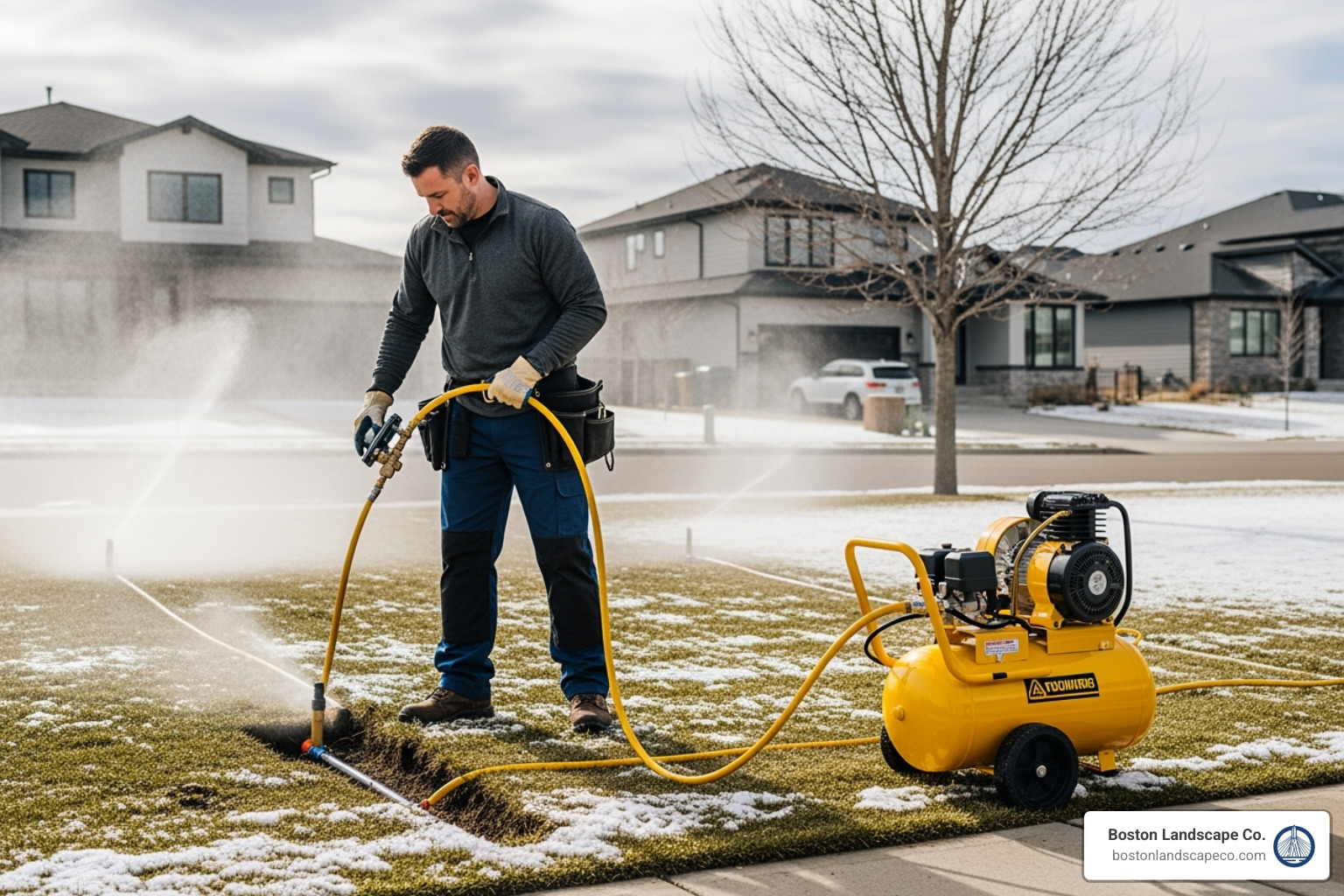
- Winterization/Blow-Outs: This is the most critical task. Before the first hard freeze (late October to mid-November), all water must be forced out of the pipes with an air compressor. Water left in the lines will freeze, expand, and crack pipes and components, leading to expensive repairs. Professional winterization is a small investment (averaging $60-$120 based on internet data) that prevents thousands in potential damage.
Troubleshooting Your Automatic Sprinkler System
Most issues are minor and easy to fix. Here are a few common problems:
- Low Pressure: If heads aren’t spraying far enough, check that your main water valve is fully open. Other causes could be a clogged filter or a leak in the line.
- Clogged or Broken Heads: A head that won’t pop up or spray correctly may be clogged with dirt. Most can be unscrewed and rinsed. Damage from a lawnmower is also common and requires replacement.
- Controller Malfunctions: If your schedule isn’t running, first check for power. A simple reset often fixes glitches, especially after a power outage.
- Zone Not Turning On: If one zone fails while others work, it often indicates a faulty solenoid valve for that zone, which is a straightforward professional repair.
For any issues beyond basic cleaning, especially electrical problems or underground leaks, it’s best to call a professional.
Frequently Asked Questions about Automatic Sprinkler Systems
We get a lot of great questions from homeowners in Boston, Medford, and our other service areas. Here are the most common ones.
How much does an automatic sprinkler system cost?
The cost of an automatic sprinkler system varies based on several factors. Based on industry averages we see online, a professionally installed system for a typical residential property can range from $2,500 to $6,500, though total costs can range from $1,600 to over $10,000 depending on complexity.
Key factors influencing the price include:
- Yard Size and Shape: Larger, more complex yards require more materials and labor.
- Soil Type: Rocky New England soil can increase labor costs compared to softer soil.
- System Components: The choice of controller (basic vs. smart) and sprinkler heads impacts the price. Smart controllers add to the upfront cost but save money on water bills over time.
- Labor and Permits: Labor typically accounts for 50-60% of the total cost, and most towns require permits that add a small fee.
It’s important to note that these are average costs based on internet data and not actual costs for Boston Landscape Co. We provide personalized estimates for your specific property. For a more detailed breakdown, visit our Lawn Irrigation Cost Estimate page.
How many watering zones do I need?
The number of zones your automatic sprinkler system needs depends on your property’s water pressure (PSI) and flow rate (GPM), as well as the different needs of your landscape. Lawns, flower beds, and shady areas all require different amounts of water and should be on separate zones. As a general guideline:
- Small yards (under 5,000 sq ft) typically need 2-3 zones.
- Medium yards (5,000-10,000 sq ft) usually require 3-5 zones.
- Large yards (over 10,000 sq ft) often need 5-8 zones or more.
Does a sprinkler system really save water compared to manual watering?
Yes, absolutely. A well-designed automatic sprinkler system is far more efficient than watering by hand.
- Precision: The system delivers a precise, uniform amount of water, avoiding the over- and under-watering common with manual methods.
- Optimal Timing: Watering in the early morning minimizes water loss from evaporation and wind.
- Smart Technology: Smart controllers use weather data to automatically skip watering when it rains, saving up to 30% more water. The EPA estimates these systems can save an average home over 7,000 gallons of water annually.
Conclusion
An automatic sprinkler system is a smart investment in your property’s value, your free time, and the long-term health of your landscape. It ends the chore of dragging hoses and the worry of brown patches, giving you a consistently lush, vibrant lawn automatically.
Over three decades of working with homeowners throughout Greater Boston, from Lexington to Woburn, I’ve seen these systems transform not just lawns, but lifestyles. Families get their weekends back and gardens thrive.
With summer heating up in Massachusetts, your lawn needs consistent moisture. A professionally designed automatic sprinkler system gives your landscape exactly what it needs while you enjoy the season. At Boston Landscape Co., we’ve been perfecting irrigation design and installation since 1991. Every system we build is custom-designed for your property’s unique soil, sun exposure, and layout.
Ready to enjoy a beautiful, low-maintenance lawn? Let’s make it happen. Get a professional irrigation system installation quote from us today.
