
Why Flooding Patio Solutions Matter for Greater Boston Homeowners
Flooding patio solutions are the first thing you need when standing water is damaging your outdoor space, threatening your foundation, or simply making your patio unusable after every rainstorm. Here is a quick overview of the most effective fixes:
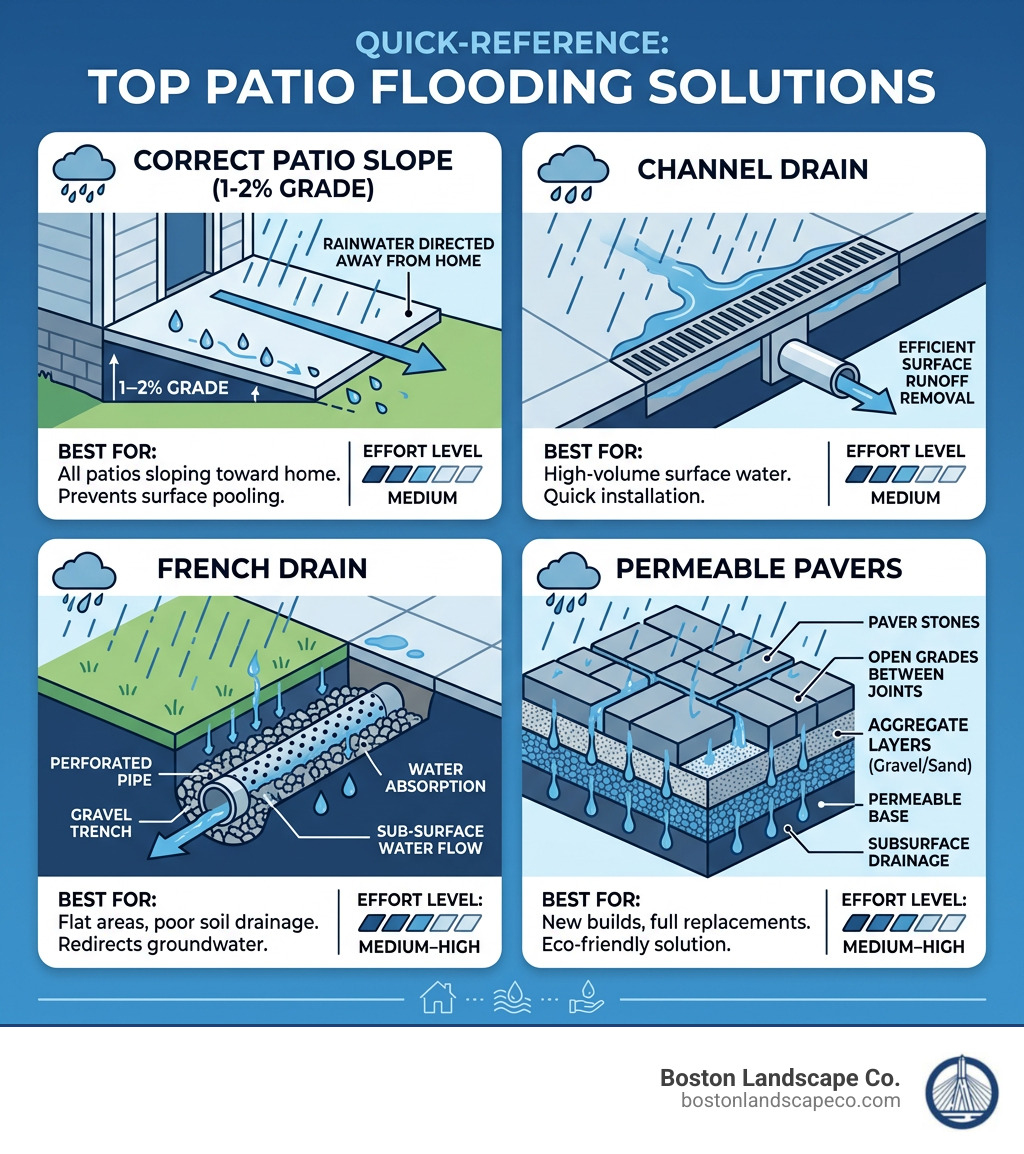
Quick-reference: Top Patio Flooding Solutions
| Solution | Best For | Effort Level |
|---|---|---|
| Correct patio slope (1–2% grade) | All patios sloping toward home | Medium |
| Channel drains | High-volume surface runoff | Medium |
| French drains | Flat ground, poor soil drainage | Medium–High |
| Permeable pavers | New builds or full replacements | Medium–High |
| Gravel channels | Existing patios, low-cost fix | Low |
| Gutter/downspout extensions | Roof runoff onto patio | Low |
| Re-grading and dry wells | Severe pooling near foundation | High |
The problem is more common than most homeowners realize. The Royal Horticultural Society estimates that 1 in 3 front gardens in the UK are now fully paved over — and Greater Boston is seeing a similar trend, with more hard surfaces and less permeable ground to absorb rainfall. Add in our region’s heavy spring rains and winter freeze-thaw cycles, and a poorly drained patio can quickly go from an eyesore to a serious structural risk.
Standing water doesn’t just ruin a backyard gathering. It can:
- Erode soil and undermine your patio’s base
- Seep toward your home’s foundation
- Breed mosquitoes and promote mold growth
- Crack and heave concrete or sink paver stones
The good news? Most patio drainage problems are fixable — often without tearing everything out and starting over.
I’m Steve Schumacher, owner of Boston Landscape Co. since 1991, and over more than three decades of landscaping work across Greater Boston, I’ve helped hundreds of homeowners diagnose and solve flooding patio solutions that protect both their property and their peace of mind. Let’s walk through everything you need to know.
Identifying the Root Causes of Patio Waterlogging
Before we can fix the flood, we have to understand why the water is hanging around in the first place. In towns like Lexington, Winchester, and Concord, we often deal with heavy clay soils. Clay is like nature’s bathtub; it holds onto water and refuses to let it drain away quickly. When you combine that with soil compaction—common in older properties in Medford or Malden—you get a surface that acts more like a parking lot than a backyard.
Another major culprit is hydrostatic pressure. This is a fancy term for the force of water pushing against your patio or foundation. If your yard slopes toward your house, gravity is working against you. Over time, this pressure can force water through tiny cracks in your foundation or cause your patio pavers to shift and sink.
We also have to look at how your plants are reacting. According to expert Jess Thomas at Drainage Central, waterlogged plants often show symptoms that look like drought. Because the roots are sitting in water without oxygen, they literally “drown” and stop transporting water to the leaves. You might see yellowing between leaf veins or a distinct rotting smell coming from the soil. If your garden is struggling, it’s a giant red flag that you need hardscape-drainage-solutions to protect your investment.
Common Symptoms of Poor Patio Drainage
If you aren’t sure if you have a drainage issue, look for these tell-tale signs:
- Efflorescence: That white, powdery salt residue on your pavers. It’s caused by water evaporating and leaving minerals behind.
- Slippery Algae or Moss: If your patio feels like a slip-and-slide in the shade, you have too much moisture.
- Sinking Pavers: When the base material washes away, pavers lose their support and begin to dip, creating even deeper puddles.
- Standing Water: If puddles remain more than an hour after the rain stops, your drainage has failed.
For homeowners looking for Exterior Drainage Lexington MA, identifying these symptoms early can save thousands in foundation repairs.
The Role of Roof Runoff and Gutters
You might be surprised to learn that your roof is often the biggest enemy of your patio. A standard roof can shed hundreds of gallons of water during a typical Massachusetts downpour. If your downspouts are dumping directly onto your patio, no amount of slope will save you.
We recommend installing downspout extensions or splash blocks to move that water at least five to ten feet away from the patio area. In some cases, we even pipe that water underground to a dry well. Keeping your gutters clear of New England’s famous fall leaves is also essential; an overflowing gutter is just a waterfall aimed at your patio’s edge. Proper maintenance here is a key part of Disaster Restoration Services in Malden, MA prevention.
Effective Flooding Patio Solutions for New and Existing Spaces
When we design a new patio in places like Wellesley or Waltham, drainage is the very first thing we plan. For an existing patio, the fixes range from simple gravel channels to more intensive re-grading.
The “Golden Rule” of patio construction is the pitch. To ensure effective water runoff, a patio should have a slope of 3/16 to 1/4 inch per foot (or about a 1% to 2% grade) away from your home. If your patio is perfectly level, it’s actually broken! Water needs a path to follow, or it will simply sit and soak.
Comparing Drainage Solutions
| Feature | French Drain | Channel (Trench) Drain |
|---|---|---|
| Primary Use | Underground water/Saturated soil | Surface water runoff |
| Visibility | Hidden (covered by grass/stone) | Visible grate |
| Installation | Deep trench (0.5m+) | Shallow trench (100-200mm) |
| Maintenance | Low (occasional flushing) | Medium (clearing the grate) |
For more tailored advice, check out our guide on backyard-drainage-solutions.
Installing Channel Drains and French Drains
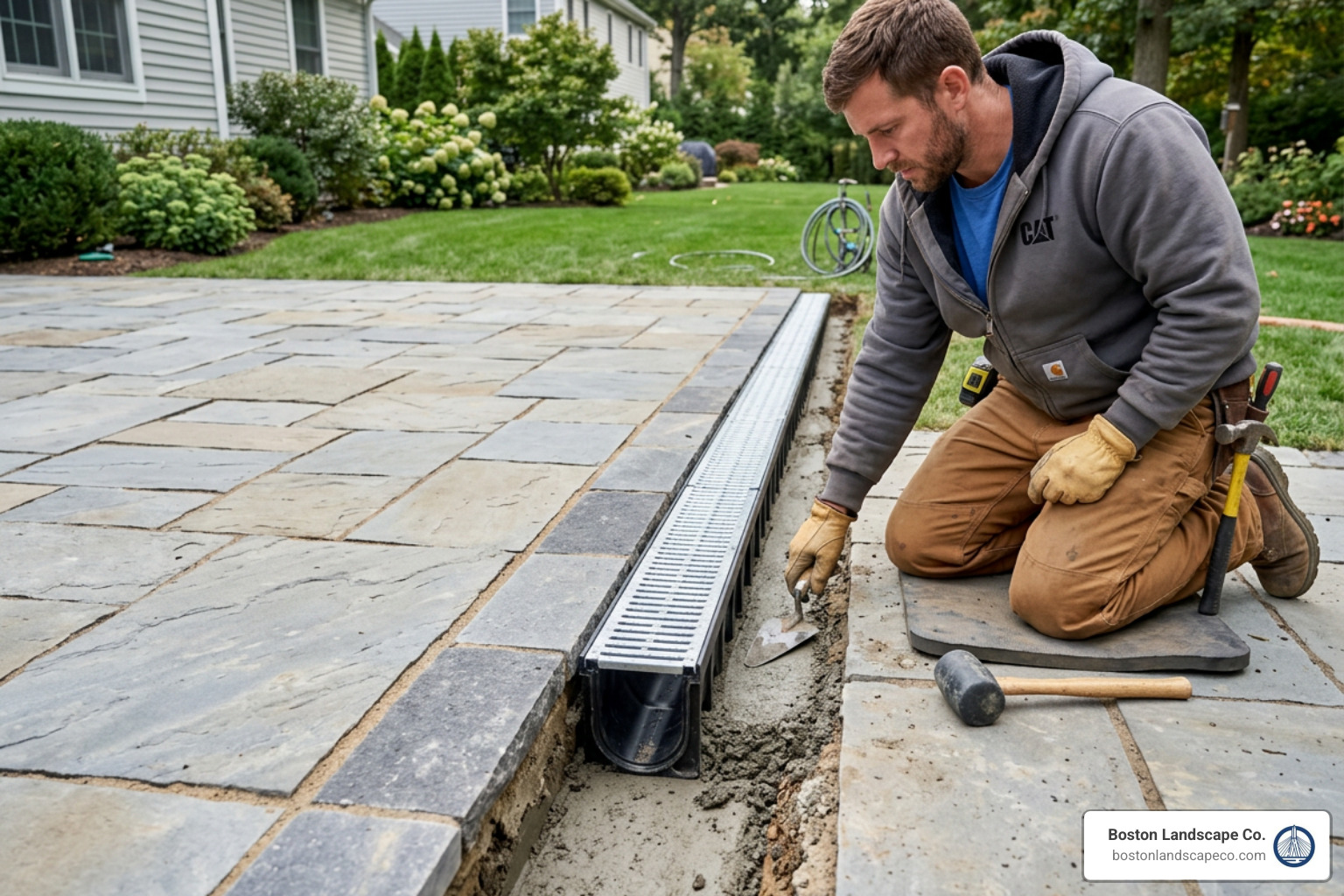
If your patio is already built and you’re seeing pooling against the house, a channel drain is often the best flooding patio solution. This involves cutting a narrow strip out of the patio (usually at the lowest point or where it meets a wall) and installing a long, grated U-channel.
Steps for Channel Drain Installation:
- Dig a trench with at least 100mm of space on either side for backfill.
- Lay a 50mm aggregate base for stability.
- Install the channel sections, ensuring they slope toward your discharge point.
- Backfill with concrete or decorative stone to lock it in place.
For French drains, the process is different. These are ideal for the perimeter of your patio. We dig a trench at least half a meter deep, line it with geotextile fabric to keep out silt, lay a perforated pipe, and fill it with clean crushed stone. This allows water to seep into the pipe and be carried away to a safer location. You can find more technical details in a detailed commercial installation manual.
Advanced Landscaping and Structural Flooding Patio Solutions
Sometimes, the water isn’t coming from the patio itself, but from a sloped yard behind it. In these cases, a retaining wall acts as a “shield.” However, a wall without drainage is just a dam waiting to burst.
When we build retaining walls in Stoneham or Billerica, we follow National Concrete Masonry Association standards, which require perforated pipes and gravel backfill behind the wall to relieve hydrostatic pressure. In New England, we also have to account for the frost line—which is about 4 feet deep here. If your wall foundation isn’t deep enough, the winter freeze will heave the whole structure, ruining your patio’s drainage. For properties near protected areas, our wetland-services can help navigate the complex regulations involved in water management.
Permeable Paving and Sustainable Drainage Systems (SuDS)
One of the most modern flooding patio solutions is to stop fighting the water and start working with it. Permeable paving uses specially designed stones with wider joints filled with fine aggregate. Instead of water running across the surface, it sinks directly through the joints into a thick bed of crushed stone underneath.
This is part of a broader movement called Sustainable Drainage Systems (SuDS). SuDS aims to mimic natural drainage by slowing down water and letting it soak back into the water table rather than overwhelming our local storm drains. In Burlington and surrounding towns, local authorities are increasingly looking for SuDS-compliant designs for new driveways and large patios.
If you don’t want to replace your whole patio, you can create “gravel channels” or bioswales along the edges. These are essentially decorative ditches filled with rocks and water-loving plants that catch and hold runoff until it can soak away.
Strategic Planting and Rain Gardens
Plants are nature’s sump pumps. A well-placed “rain garden” at the edge of your patio can absorb up to 30% more water than a standard lawn. The key is to choose “thirsty” plants that don’t mind having “wet feet” for a day or two.
Native Massachusetts species like Joe Pye Weed, Swamp Milkweed, and certain types of Ferns are excellent for this. Their deep root systems create channels in the soil, helping water move downward. We often integrate these with drip-irrigation-for-lawns to keep the garden healthy during dry spells, and ensure proper irrigation-system-backflow-preventer-installation to keep your drinking water safe from any patio runoff.
Grading and Dry Well Integration
If your yard is a “bowl” where water naturally collects, we might need to look at grading or dry wells. Grading involves moving soil to create a gentle slope that directs water toward a “catch basin”—a plastic box with a grate on top.
From the catch basin, the water travels through solid PVC pipes to a dry well or a pop-up emitter. A dry well is a large, perforated underground tank that stores water temporarily and lets it dissipate into the surrounding soil slowly. This is a common fix for in-ground-trampoline-drainage issues as well. Whether it’s a simple grade change or a complex hardscaping project, the goal is always to keep the water moving away from your home.
Professional vs. DIY: When to Call the Experts
We love a good DIY project as much as anyone, but drainage is one area where “guessing” can be expensive. In many North Shore communities like Everett or Saugus, any retaining wall over 3-4 feet requires a permit and sometimes even a structural engineer’s stamp.
If you’re just adding a splash block or cleaning a gutter, go for it! But if you need to use heavy equipment, dig near utility lines (always call 811 first!), or manage significant foundation seepage, it’s time to call in the pros. We have the laser levels and transit tools to ensure that “1% slope” is actually 1%—something that’s very hard to eyeball. Our landscaping team has the experience to handle these complex calculations.
Cost Estimates for Flooding Patio Solutions
It’s important to have a realistic budget when looking for flooding patio solutions. Please note that the prices below are average costs based on internet data and are not the actual prices of Boston Landscape Co. Every site has unique challenges like access, soil type, and existing structures.
- Minor Drainage Fixes (Gutter extensions, gravel channels): $500 – $2,500
- Standard French Drain or Channel Drain Installation: $2,500 – $8,000
- Large-Scale Re-grading or Dry Well Systems: $5,000 – $15,000
- Major Retaining Walls and Comprehensive Drainage: $10,000 – $35,000+
Real-world variability means that a project in a tight Somerville backyard might cost significantly more than the same project on a wide-open lot in Billerica due to labor and equipment access. For a detailed look at what’s possible, see our residential-landscaping services.
Long-Term Maintenance for Drainage Success
Even the best drainage system will fail if it’s ignored. We recommend an “Annual Drainage Physical” for your property:
- Spring Cleanup: Clear out any winter debris from channel drain grates and catch basins.
- Pipe Flushing: Every few years, run a high-pressure hose through your solid pipes to clear out silt or spider webs.
- Inspect the “Outfall”: Make sure the place where the water is supposed to go (like a pop-up emitter) isn’t buried under mulch or overgrown grass.
- Check for Sinking: If you notice new puddles, your patio may have settled, requiring a “lift and reset” of the pavers.
For business owners, our commercial-landscaping packages include these regular inspections to keep your property safe for customers.
Frequently Asked Questions about Patio Drainage
What is the ideal slope for a patio to prevent flooding?
The industry standard is a slope of 1/8 to 1/4 inch per foot. At Boston Landscape Co., we aim for 1/4 inch whenever possible. This is enough to keep water moving but not so steep that your patio furniture feels like it’s on a hill.
How do I fix a patio that slopes toward my home foundation?
This is a serious issue that needs immediate attention. If it’s a paver patio, we can often “pull” the pavers, add more base material to create the correct pitch, and relay them. For concrete, “mudjacking” or foam leveling can sometimes lift the slab. If those aren’t options, a channel drain installed right against the house is the best secondary defense.
Can I add drainage to an existing concrete patio without removing it?
Yes! We can use a concrete saw to cut a trench for a channel drain or drill “weep holes” in surrounding walls. Another option is to install a French drain immediately adjacent to the concrete to catch the runoff as it leaves the slab.
Conclusion
Protecting your home from water damage is one of the best investments you can make. Whether you’re dealing with a swampy backyard in Reading or a sinking patio in Billerica, there is always a solution. By focusing on proper pitch, smart drain placement, and seasonal maintenance, you can ensure your outdoor space remains a place of relaxation rather than a source of stress.
At Boston Landscape Co., we’ve been the “drainage doctors” for the Greater Boston area for over 30 years. From Stoneham to Wellesley, we know the local soil, the local weather, and exactly what it takes to keep your patio dry.
Ready to stop the soak? Request an estimate today, and let’s get your drainage flowing in the right direction!
