
What Is the Sod Cost per Yard? Quick Answer for Greater Boston Homeowners
Sod cost per yard is one of the most common questions we hear from homeowners ready to transform a patchy or bare lawn into something they’re proud of. Here’s a fast answer before we dig into the details:
Average Sod Costs at a Glance
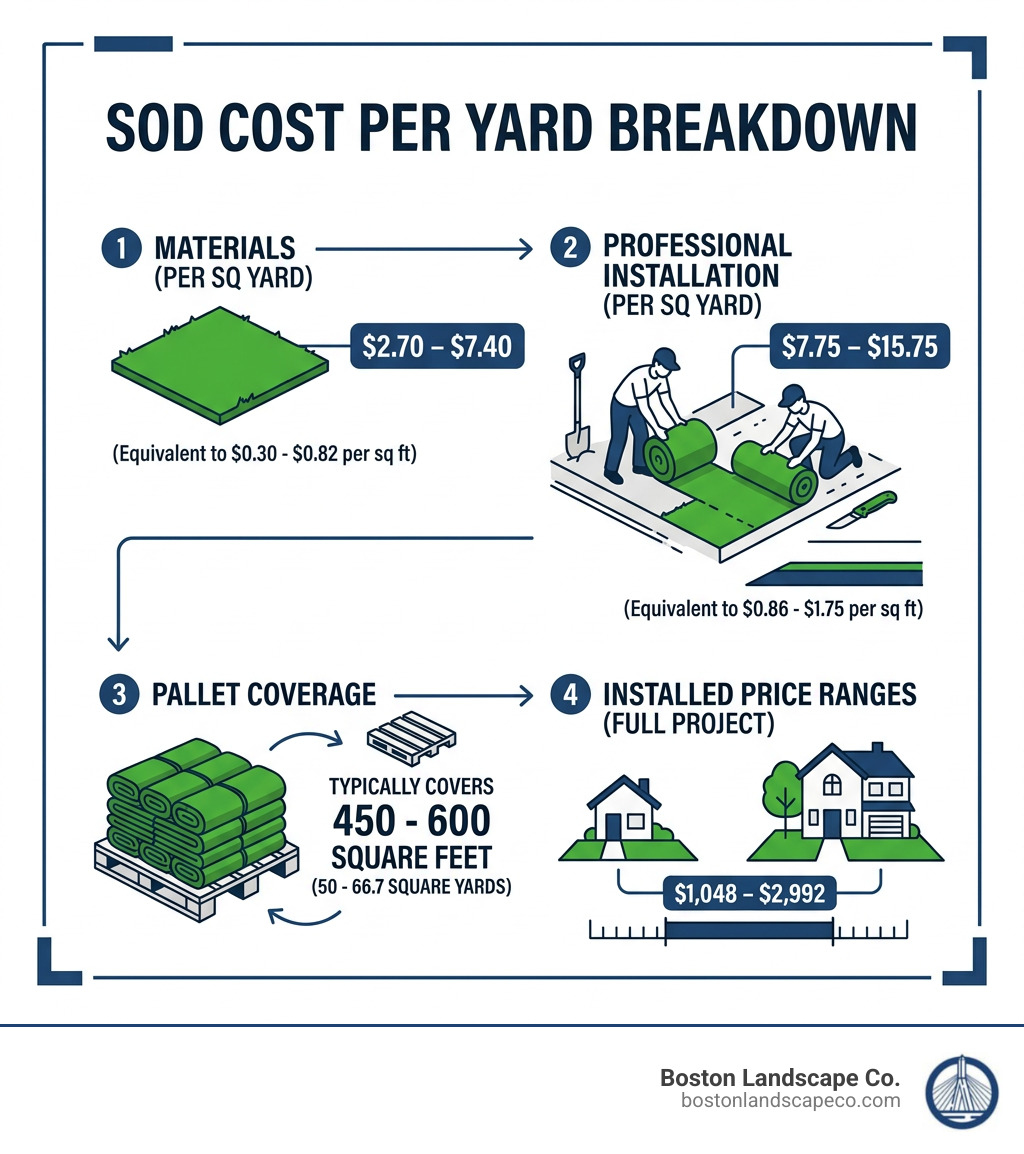
| What You’re Buying | Typical Price Range* |
|---|---|
| Sod materials only (per sq ft) | $0.30 – $0.82 |
| Sod materials only (per sq yd) | $2.70 – $7.40 |
| Professional installation (per sq ft) | $0.86 – $1.75 |
| Professional installation (per sq yd) | $7.75 – $15.75 |
| Full project (average residential lawn) | $1,048 – $2,992 |
*These are average costs based on national online data and do not reflect the actual pricing of Boston Landscape Co. Real-world costs can vary significantly based on your property, location, grass type, and site conditions.
A lush, green lawn doesn’t happen by accident. For homeowners across Greater Boston, sod offers something that grass seed simply can’t: instant results. Whether you’re dealing with erosion on a slope, a muddy backyard, or a front yard that’s become an eyesore, freshly laid sod can turn things around in a single day. But knowing what you’ll pay — and what drives that number up or down — makes all the difference when you’re planning your budget.
I’m Steve Schumacher, owner-operator of Boston Landscape Co. since 1991, and over more than three decades of hands-on landscaping work in the Greater Boston area, I’ve helped countless homeowners navigate the real sod cost per yard for their specific property and goals. In the sections ahead, I’ll walk you through everything that affects your final number so you can plan with confidence.
Understanding the Average Sod Cost per Yard and Square Foot
When you start shopping for a new lawn, you’ll notice that some suppliers talk in square feet while others quote the sod cost per yard. To keep things simple: one square yard equals nine square feet. If a farm tells you the sod is $5.00 per yard, they are talking about a 3-foot by 3-foot patch of grass.

Material vs. Installed Costs
It is important to distinguish between the price of the “rolls” themselves and the price of having a professional team bring them to your home and install them. Based on national online data, the material for sod typically ranges from $0.30 to $0.82 per square foot. However, when you factor in professional labor, equipment, and logistics, the total price usually sits between $1.00 and $6.00 per square foot.
For a more complex project involving significant grading or premium grass varieties, costs can easily reach $15.00 to $20.00 per square foot.
| Service Level | Est. Cost Per Sq. Ft.* | Est. Cost Per Sq. Yd.* |
|---|---|---|
| Material Only | $0.30 – $0.85 | $2.70 – $7.65 |
| Basic Installation | $1.00 – $2.50 | $9.00 – $22.50 |
| Full Service (Prep + Install) | $3.00 – $6.00 | $27.00 – $54.00 |
| Premium/Complex Project | $10.00 – $20.00 | $90.00 – $180.00 |
*Disclaimer: These figures are based on general internet research and industry averages. They do not represent the specific pricing of Boston Landscape Co. Actual costs in the Greater Boston area can vary based on local fuel prices, disposal fees, and specific site challenges.
How Grass Variety Impacts Your Sod Cost per Yard
Not all grass is created equal. The type of “green” you choose will be one of the biggest drivers of your sod cost per yard. In our neck of the woods—from Billerica to Wellesley—we primarily deal with cool-season grasses.
- Kentucky Bluegrass: The gold standard for many. It’s lush, soft, and has that classic deep blue-green hue. It typically costs between $0.30 and $0.60 per square foot for materials.
- Tall Fescue: This is a hardy choice for families with pets or kids. It handles foot traffic well and is often slightly more affordable, though premium blends can reach the same price points as Bluegrass.
- Zoysia Grass: While often associated with the South, some cold-hardy varieties are used here. It is a premium “luxury” grass that grows slowly and crowds out weeds, often costing $0.60 to $1.25 per square foot for materials alone.
- Bermuda Grass: Less common in the Northeast but used on some athletic fields; it typically ranges from $0.40 to $0.85 per square foot.
Choosing the right variety isn’t just about the price tag; it’s about survival. A grass that isn’t suited for our Massachusetts winters will end up costing you more in the long run when it needs to be replaced. Scientific research on proper site preparation shows that even the most expensive grass will fail if the ground isn’t prepped correctly to support those specific roots.
Calculating the Total Sod Cost per Yard for Common Lawn Sizes
To get a realistic budget, you need to know your numbers. Most residential projects we see in towns like Lexington or Winchester fall into a few standard categories:
- The “Patch” (500 sq. ft.): Often a backyard dog run or a small front entry. Materials and labor might range from $500 to $3,000 depending on prep.
- The Standard Lawn (2,000 sq. ft.): This is a typical suburban yard size. Total installed costs often range from $2,000 to $12,000.
- The Quarter-Acre (approx. 10,000 sq. ft.): For a full property overhaul, you are looking at a much larger investment. Material alone could be $3,000 to $8,000, with total professional installation ranging from $10,000 to $30,000+.
The “Waste” Factor: We always recommend adding a 10% waste allowance to your order. Why? Because yards aren’t perfect rectangles. You’ll be cutting pieces to fit around mulch beds, trees, and walkways. If you order exactly 1,000 square feet for a 1,000-square-foot yard, you will run out before the job is done.
For those looking at alternatives to a full sod replacement, you might find more info about lawn maintenance service costs helpful for reviving what you already have.
Key Factors Influencing Your Total Investment
The sod cost per yard is just the starting point. Several “real world” factors can turn a simple quote into a more complex financial picture.
Yard Accessibility and Shape
If our crews can get a forklift or a specialized sod “mule” right to the work area, the job goes quickly. However, if we have to hand-carry 50-pound rolls through a narrow 36-inch gate in a Somerville backyard, the labor hours (and costs) will increase. Similarly, a perfectly square lawn is much faster to lay than a yard full of curves, fire pits, and flower beds that require constant trimming.
Delivery Fees
Sod is heavy. A single pallet can weigh between 1,500 and 3,000 pounds depending on how much moisture is in the soil. Delivery fees in the Greater Boston area typically range from $65 to $400 per truckload. Some farms require a minimum order (often 1–3 pallets) to even schedule a delivery.
Soil Condition and Grading
You can’t just throw sod on top of hard-packed clay and expect it to live. Proper drainage is the “secret sauce” of a successful lawn. If your yard has standing water or slopes toward your foundation, you’ll need professional grading. This involves moving dirt to ensure water flows away from the house, which can add $1.00 to $3.00 per square foot to the project. If you’re starting with a mess, you can check out more info about yard cleanup costs to see what it takes to get the slate clean.
Hidden Expenses in New Lawn Projects
When budgeting, don’t forget the “prep” work that happens before the first roll of grass hits the ground:
- Old Grass Removal: Stripping out the old, weedy turf usually costs $0.50 to $2.00 per square foot.
- Topsoil Addition: Most new lawns need 2–4 inches of fresh, nutrient-rich topsoil ($12 to $55 per cubic yard).
- Fertilizer: A “starter” fertilizer is essential for root development.
- Irrigation: New sod needs a massive amount of water in the first 14 days. If you don’t have a sprinkler system, you’ll be spending hours with a hose. Many homeowners choose to bundle their projects, and you can find more info about irrigation system installation costs to see if it’s a fit for your budget.
Professional Installation vs. DIY Labor Costs
The “Do-It-Yourself” route is tempting. You see the rolls at a big-box store and think, “I can do that this weekend!” While you can certainly save on the $35 to $90 per hour labor rates, there are hidden costs to the DIY approach.
The DIY Reality Check:
- Equipment Rentals: You’ll likely need a sod cutter ($100/day), a rototiller ($80/day), and a water-filled lawn roller ($20/day).
- The Clock is Ticking: Sod is a living, breathing product. Once it’s harvested, it needs to be in the ground within 24 hours (and ideally within 8 hours during a hot Massachusetts July). If you get halfway through and get exhausted, the remaining sod on the pallet will literally start to cook and die.
- Success Rates: Industry data suggests professional installations have a 90%+ success rate, while DIY attempts often hover around 60-70% due to poor soil contact or improper watering.
If you’re planning a DIY project for the spring, it’s worth looking at more info about spring clean up costs to ensure your yard is actually ready for the work.
Long-Term Value and Maintenance of New Sod
Installing sod is an investment in your property’s value—often increasing it by up to 15-20%. But that value only stays if the grass stays alive.
Root Establishment: It takes about 10 to 14 days for the roots to “knit” into the soil. During this time, the lawn is fragile. You should avoid walking on it, and you certainly shouldn’t let the dog run laps.
Watering Schedule: For the first two weeks, you’ll be watering 1–2 times a day, ensuring the soil underneath the sod remains moist but not a swamp. After that, you can transition to deeper, less frequent watering to encourage the roots to grow deep into the earth.
Mowing: Don’t rush to mow! Wait until the grass is at least 3.5 to 4 inches tall (usually 2–3 weeks post-install). Set your mower to its highest setting for the first few cuts.
If the upfront sod cost per yard feels too high, there are other ways to get a green lawn. You can find more info about hydroseed costs for a middle-ground option, or if you never want to mow again, check out more info about synthetic lawn costs.
Frequently Asked Questions about Sod Pricing
How much area does a typical pallet of sod cover?
In our region, a standard pallet usually covers 450 to 500 square feet. However, some farms stack them smaller (around 400 sq. ft.) to make them easier to transport. Always ask your supplier for the exact square footage per pallet so you don’t end up short. A full pallet is heavy—often weighing as much as a small car—so don’t plan on picking it up in a standard half-ton pickup truck!
What is the best time of year to install sod in Massachusetts?
The “sweet spots” for Greater Boston are late spring (May) and early fall (September).
- Spring: Provides plenty of rain and moderate temperatures that help roots take hold before the summer heat hits.
- Fall: This is actually my favorite time. The ground is still warm, but the air is cool. There is less weed competition, and the grass has two full seasons (fall and the following spring) to establish before facing a New England summer.
Is sodding more cost-effective than seeding in the long run?
While seeding is much cheaper upfront ($0.10 to $0.20 per square foot), sod is often more cost-effective over a 5-year window for three reasons:
- Erosion Control: Sod acts like a blanket, stopping soil from washing away during heavy rains.
- Weed Suppression: High-quality sod is grown in a weed-free environment. It’s so thick that weed seeds struggle to reach the soil.
- Time: A seeded lawn takes 1–2 years of constant “nursing” (reseeding bare spots, heavy fertilizing, weeding) to look as good as sod looks on day one.
Conclusion
At Boston Landscape Co., we’ve spent decades perfecting the art of the “instant lawn” for our neighbors in Stoneham, Reading, Woburn, and the surrounding North Shore towns. We know that understanding the sod cost per yard is the first step in a much bigger journey toward a beautiful outdoor space.
Whether you are looking for a complete property redesign or just want to fix that one stubborn brown patch in the front yard, we bring the local expertise and professional equipment needed to get the job done right the first time. If you’re ready to stop looking at dirt and start enjoying your yard, we’re here to help. You can find more info about professional lawn installation or contact us today to discuss your project.
