
Rectangle Trampoline In The Ground: Top 5 Ultimate Benefits
Why In-Ground Rectangle Trampolines Are Revolutionary for Your Backyard
A rectangle trampoline in the ground combines superior bounce performance with improved safety and seamless landscape integration. For homeowners considering this addition to their yard, here’s what you need to know:
| Feature | Rectangle In-Ground Trampoline Benefits |
|---|---|
| Safety | Eliminates fall height risks; reduces injury potential |
| Aesthetics | Blends with landscape; doesn’t obstruct views |
| Performance | Provides even bounce across entire surface; ideal for gymnastics |
| Durability | Less prone to wind damage; longer lifespan |
| Space Efficiency | Maximizes usable yard space; fits neatly in corners |
Rectangle in-ground trampolines are rapidly becoming the preferred choice for homeowners who want to combine recreation with landscape design. Unlike traditional above-ground models that sit at least three feet high, these trampolines sit flush with your lawn, creating a seamless look while significantly reducing fall risks.
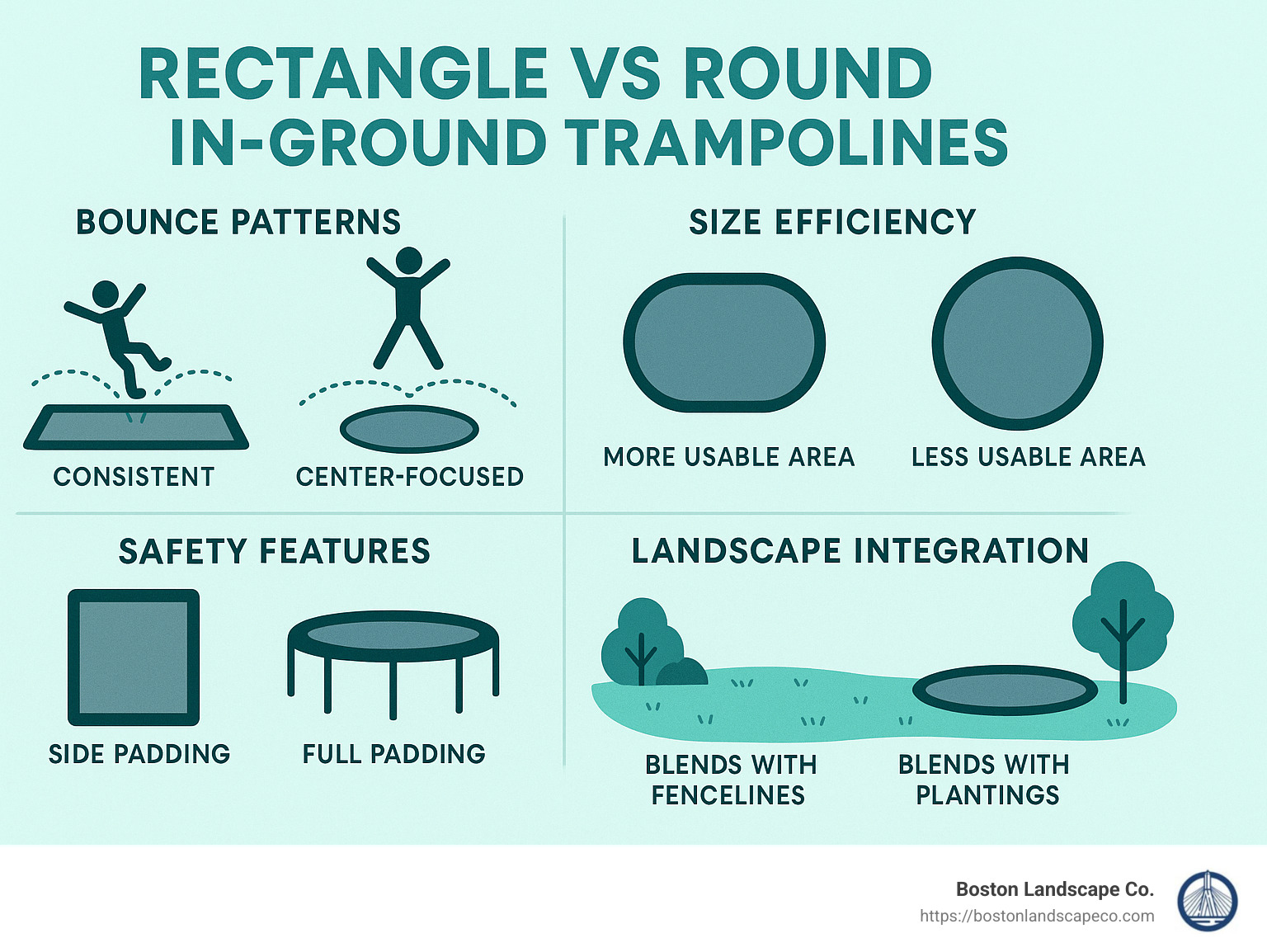
The rectangular shape offers distinct advantages over round models. With an even bounce across the entire surface rather than just a central “sweet spot,” rectangle trampolines provide superior performance for activities like gymnastics, tumbling, and dance. The jumping surface is more responsive and controlled, making it ideal for users of all skill levels.
Installation requires thoughtful planning with proper drainage and retaining wall construction. While this might seem complex, the benefits far outweigh the initial setup challenges. A properly installed in-ground trampoline can last for years with minimal maintenance while enhancing your property’s aesthetic appeal and value.
As Steve Schumacher, I’ve overseen numerous rectangle trampoline in the ground installations as part of comprehensive landscape designs at Boston Landscape Co, ensuring they complement outdoor spaces while providing safe recreational options for families. My three decades in landscaping have taught me that integrating recreational features like trampolines requires precise excavation and drainage planning to ensure longevity and performance.
Rectangle trampoline in the ground word guide:
– how to install an in ground trampoline
– in-ground trampoline drainage
– in ground trampoline retaining wall
Why Choose a Rectangle Trampoline in the Ground?
There’s something magical about watching kids bounce with pure joy on a trampoline. But not all trampolines are created equal. A rectangle trampoline in the ground offers a remarkable upgrade from the traditional above-ground versions that dominate most backyards.
At Boston Landscape Co., we’ve installed dozens of in-ground trampolines throughout Massachusetts, and I’ve personally witnessed how they transform ordinary yards into extraordinary recreational spaces. Families consistently tell us it’s one of their best backyard investments.
In-ground trampolines represent the fastest-growing segment of the trampoline market, and the reasons are compelling. The rectangular shape creates a longer jumping surface that gymnasts, dancers, cheerleaders, and active kids absolutely love. Unlike round trampolines that funnel jumpers toward the center, rectangle models deliver consistent, reliable bounce across the entire surface.
One piece of advice we share with almost every family: “Trust us, they will grow into a larger trampoline.” It’s worth selecting the largest rectangle model that reasonably fits your space. Your kids may be small now, but they grow quickly, and their jumping skills (and ambitions!) grow right along with them.
Modern in-ground trampolines use innovative shelf systems that significantly reduce installation complexity. Traditional methods might require removing a whopping 400 square feet of soil, but newer designs with concave cuts reaching about 3 feet deep can reduce excavation by approximately one-third. This makes the installation more manageable and less disruptive to your yard.
Want to explore more about what makes in-ground trampolines special? Check out our comprehensive guide at More info about trampolines in ground.

Safety Benefits of In-Ground Installation
Let’s talk about what keeps parents up at night: safety. While no recreational activity is entirely risk-free, in-ground trampolines offer significant safety improvements that give parents greater peace of mind.
The most obvious advantage is the elimination of fall height. Traditional trampolines sit three or more feet above ground, creating a serious fall risk. In-ground models sit flush with your lawn, dramatically reducing the potential for injury from falls off the side. This design also makes trampolines more accessible for younger children, people with mobility challenges, and even your four-legged family members.
The lowered profile doesn’t eliminate all risks, however. If your yard has obstacles like trees, rocks, or drop-offs within 4 feet of the trampoline, we still recommend a safety enclosure. That said, industry data shows only about 15% of in-ground trampoline owners opt for enclosures – a testament to their inherent safety advantages.
“With TDU Systems you know you are buying quality products designed with safer jumping in mind.”
This commitment to safety extends beyond the design. At Boston Landscape Co., we carefully plan each installation, ensuring proper clearance around the trampoline and advising on appropriate safety measures based on your specific yard layout.
Another safety benefit that often goes unmentioned: in-ground trampolines stay put during high winds. Above-ground models can become dangerous projectiles during storms, while in-ground installations remain secure regardless of weather conditions – a particularly important consideration in our sometimes wild New England weather!
Aesthetic and Practical Advantages
Beyond safety, the visual appeal of a rectangle trampoline in the ground can’t be overstated. Instead of a bulky metal structure dominating your yard, an in-ground trampoline creates a sleek, intentional look that complements rather than competes with your landscape design.
One of the most frequent comments we hear after installation is how much larger the yard feels. In-ground trampolines preserve sightlines across your property, maintaining that open, spacious feeling that makes outdoor living so enjoyable. This is especially valuable if you have a smaller yard or cherish scenic views that would otherwise be blocked.
From a practical standpoint, lawn maintenance becomes significantly easier. No more awkwardly maneuvering around trampoline legs or dealing with that patchy, sad-looking grass that inevitably develops beneath above-ground models. The flush design allows for smooth, uninterrupted mowing patterns and eliminates those frustrating unmaintainable spaces.
Let’s talk property value for a moment. While recreational features generally improve home value, there’s a distinct difference in perception between a temporary-looking play structure and a thoughtfully integrated landscape element. An in-ground trampoline falls firmly in the latter category, presenting as a permanent, professional addition that potential buyers view as an asset rather than an eyesore.
Weather resistance is another significant advantage, especially here in New England where we experience everything from nor’easters to occasional tropical storm remnants. In-ground trampolines withstand harsh conditions much better than their above-ground counterparts, with significantly reduced risk of wind damage or weather-related deterioration.
For more detailed information about creating effective retaining walls for your in-ground trampoline installation, visit our comprehensive guide on in-ground trampoline retaining wall.
Key Features of High-Quality Rectangle In-Ground Trampolines
When investing in a rectangle trampoline in the ground, understanding the critical components that determine quality, performance, and longevity is essential. At Boston Landscape Co., we’ve installed countless trampolines and have developed a keen eye for what separates the exceptional from the merely adequate.
The best in-ground rectangle trampolines are specifically engineered for below-ground installation—not just converted above-ground models. This purpose-built design addresses the unique challenges of in-ground placement, including proper airflow, moisture management, and corrosion resistance.
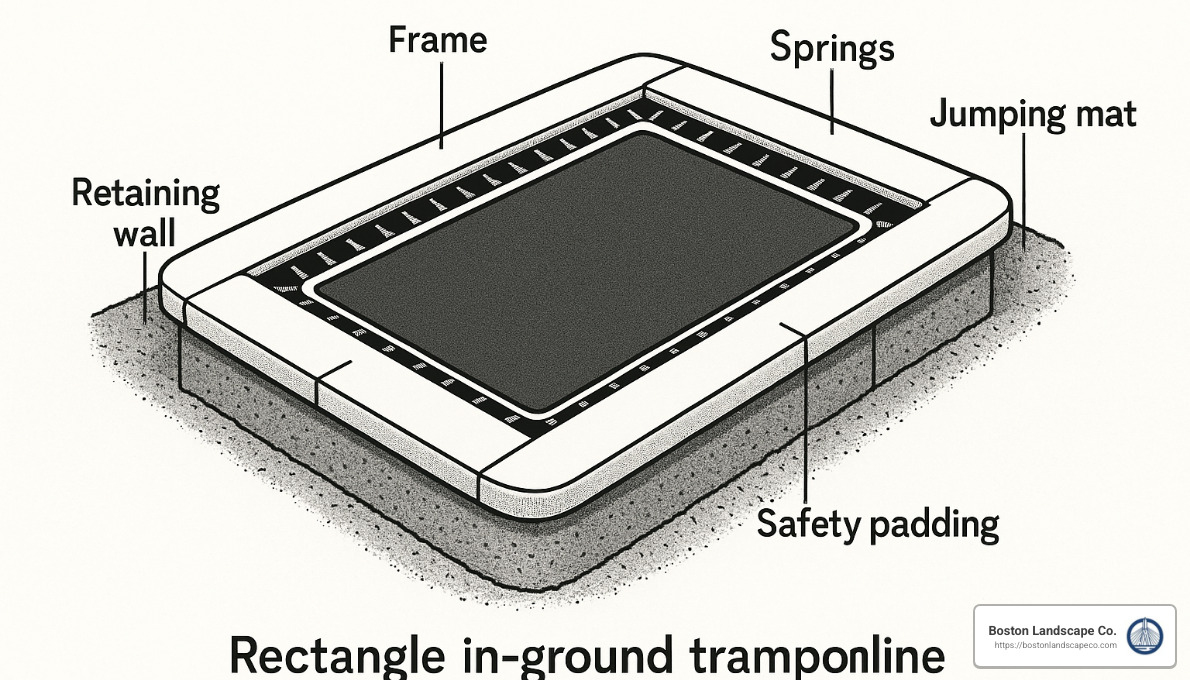
Frame thickness tells you a lot about a trampoline’s quality. Premium models feature heavy-gauge galvanized steel—typically 9-11 gauge for the upper frame (that’s about 3mm thick) and 14-18 gauge for the lower components. Think of it like the foundation of a house: the stronger it is, the more stable and durable your trampoline will be.
The spring system is where the magic happens for bounce quality. High-performance rectangle trampolines feature at least 100 springs, with top models boasting 120+ double-galvanized 8.5-inch springs plus specialized corner springs. This configuration creates that consistent, responsive bounce that makes rectangular trampolines so popular with gymnasts and active jumpers.
The Importance of Frame Construction and Materials
The frame is quite literally the backbone of your in-ground trampoline. The best models use Dualtek® Double Dipped Hot Galvanized steel or similar treatments that provide robust protection against moisture and corrosion—particularly important when your trampoline will be partially buried in the ground.
When examining frame specifications, lower gauge numbers mean thicker steel. A 9-gauge frame (about 3.0mm thick) will significantly outperform and outlast a 14-gauge frame (about 1.5mm thick). This difference becomes particularly noticeable when multiple people use the trampoline or when you have active teenagers practicing tricks.
Weight capacity is directly tied to frame quality. Premium rectangle trampolines can support impressive total weights—some boasting maximum capacities up to 1,750 pounds! While that’s the structural limit, most manufacturers recommend individual jumper weights around 350 pounds for safe, optimal performance.
Warranty coverage speaks volumes about quality. The most confident manufacturers offer lifetime frame warranties, with 5-10 years for springs and 2-5 years for jumping mats and pads. If a company is willing to stand behind their product for that long, it’s usually a good sign they’ve built something to last.
Double frames with additional stabilizer legs or reinforced corners provide superior support for rectangular shapes, which distribute weight differently than round trampolines. These reinforcements prevent frame warping and maintain consistent performance year after year.
For our Massachusetts customers from Boston to Wellesley, we can help arrange delivery of quality components. Many premium manufacturers offer Free Shipping To All Lower 48 States!, making it convenient to obtain top-tier equipment regardless of your location.
Advanced Jumping Mat and Spring Technology
The jumping mat and spring system are where technology truly lifts the performance of modern rectangle trampolines in the ground. Recent innovations have dramatically improved bounce quality, durability, and the overall jumping experience.
Air permeability is perhaps the most significant advancement in jumping mat design for in-ground installations. Traditional mats can restrict airflow when installed in-ground, creating a “bottoming out” feeling and that distinctive slapping noise as air becomes trapped. Advanced designs like the Avyna Air X-TREAM™ jumping mat allow up to 70% more airflow than standard mats, preserving that perfect bounce even when installed in-ground.
Vented pad technology has been a game-changer for in-ground trampoline performance. These clever systems allow air to escape through specially designed vents in the frame pads, eliminating the annoying “pad slap” noise while maintaining optimal bounce characteristics. Some manufacturers even make this a central selling point, advertising their products as “the only in-ground trampoline with vented pads.”
New England’s variable climate can be tough on outdoor equipment, which is why UV resistance in jumping mats is crucial. Premium mats incorporate UV-resistant materials and treatments that prevent premature deterioration from sun exposure. For maximum protection, we often recommend applying additional UV-protective sprays like Formula 303 after seasonal cleaning to extend your mat’s lifespan.
Spring configuration significantly impacts bounce quality. Rectangle trampolines typically feature different spring lengths along the sides versus the corners, creating that consistent, responsive bounce across the entire surface. Commercial-grade springs with tapered designs provide progressive resistance that accommodates jumpers of different weights while maintaining consistent performance.
For families with gymnasts, dancers, or active kids learning new skills, the even bounce pattern of a rectangle trampoline offers distinct advantages. Unlike round trampolines that direct energy toward the center, rectangular designs distribute energy evenly, allowing for consistent performance regardless of where on the mat the jumper lands.
For those interested in exploring specific rectangular trampoline models, the Rectangle Supertramp Trampolines Archives offers a comprehensive selection of high-quality options designed specifically for in-ground installation.
Installation Guide for Rectangle Trampoline in the Ground
Ready to transform your backyard with a rectangle trampoline in the ground? I’ve guided dozens of families through this process at Boston Landscape Co., and while it’s definitely a substantial project, the results are absolutely worth it.
Think of installing an in-ground trampoline like creating a small pond—it requires thoughtful excavation, proper drainage, and careful finishing. The good news is that modern trampoline designs have made the process more straightforward than it was just a few years ago.
Start by selecting the perfect spot in your yard. You’ll want good natural drainage, a location away from trees (those roots can be a nightmare during excavation), and a safe distance from any utility lines. Before your shovel touches dirt, make that call to have utilities marked—it’s not just smart, it’s required by law in Massachusetts.
The excavation phase is where most DIYers realize what they’ve signed up for. A typical 10×17′ rectangle trampoline needs a pit about 3 feet deep with specific dimensions to match your trampoline frame. The modern “shelf system” design means you don’t have to dig the entire area to full depth—instead, you create a concave depression with a shelf around the perimeter to support the frame. Even with this improved design, you’re still looking at removing several cubic yards of soil. Hope you’ve been hitting the gym!
For detailed guidance that walks you through each step of the process, check out our comprehensive guide on how to build trampoline in ground.
Excavation and Retaining Wall Considerations
The pit you dig isn’t just a hole—it’s the foundation of your trampoline’s performance. The concave shelf design is crucial: approximately 3 feet deep at the center while maintaining that all-important shelf around the perimeter to support the frame.
Water is your in-ground trampoline’s nemesis, so drainage planning is non-negotiable. Without proper drainage, your beautiful new trampoline pit becomes a swimming pool after the first good rain, potentially damaging components and drastically reducing bounce quality. Most successful installations use one of three approaches: creating a natural drain by digging deeper in the center and filling with gravel; installing a French drain system that channels water away; or incorporating a sump pump for properties with high water tables or particularly stubborn drainage issues.
The retaining wall is your pit’s support system, preventing soil erosion and maintaining the integrity of your installation. Many manufacturers offer purpose-built retaining wall panels made from recycled plastic that are designed specifically for in-ground trampolines. Alternatively, concrete blocks, pressure-treated lumber, or other durable materials can work well when properly installed.
| Installation Aspect | DIY Approach | Professional Installation |
|---|---|---|
| Average Cost | $300-$600 (materials only) | $1,500-$4,500 (includes labor) |
| Time Required | 1-3 weekends | 1-2 days |
| Equipment Needed | Excavator/Bobcat rental, shovels, level, measuring tools | Included with service |
| Expertise Required | Moderate to high | Handled by professionals |
| Warranty Considerations | May affect product warranty | Often preserves manufacturer warranty |
Note: Costs are average estimates based on internet data and not actual costs for Boston Landscape Co.
Soil conditions can throw you curveballs during installation. If your property has soft clay soil, we typically recommend placing compactable road base or concrete blocks beneath each trampoline leg to prevent sinking over time. Rocky soil might make you question your life choices during excavation, but it typically provides excellent natural drainage—a silver lining to those blisters on your hands.
For specific guidance on creating effective retaining walls for your in-ground trampoline, visit our detailed resource on in-ground trampoline retaining wall.
Frame Assembly and Final Setup
With the heavy digging behind you, it’s time for the more rewarding part—assembling and installing the actual trampoline. This stage requires precision to ensure your trampoline sits perfectly level and functions as designed.
Begin by assembling the trampoline frame according to the manufacturer’s instructions. Most designs have you start with the upper frame components, connecting them in the correct sequence. Once assembled, carefully position the frame on the prepared shelf around your pit. This is where having a few friends to help really pays off—these frames are not lightweight!
Leveling is absolutely crucial for proper performance and safety. I always recommend using a long, straight 2×4 (at least 12 feet for larger rectangle trampolines) placed across various points of the frame along with a quality level. Check multiple points around the frame and make adjustments to the supporting shelf as needed. Taking your time here prevents headaches later.
Spring installation follows a specific pattern to ensure even tension. Most manufacturers recommend what I call the “opposites attract” method—installing springs at opposite points around the frame, gradually working your way around rather than completing one side first. This prevents the frame from being pulled out of shape during installation.
The jumping mat connects to these springs, again following the manufacturer’s specific pattern. This step requires significant physical effort—those springs are tight for a reason! Having multiple people helps tremendously, and spring pulling tools (usually included with your trampoline) are absolutely essential.
Once the mat is secured, install the vented safety pads over the springs. These specialized pads are crucial for in-ground installations as they allow proper airflow while providing essential safety coverage. The venting design prevents that annoying “pad slap” noise that poorly designed in-ground trampolines often develop.
Before declaring victory, perform these essential safety checks:
– Ensure the frame is completely level from all angles
– Verify all springs are properly seated and evenly tensioned
– Confirm the safety pad completely covers all springs and frame components
– Check that the retaining wall is stable and properly backfilled
– Test the drainage system by pouring water into the pit and ensuring it drains properly
Many curious homeowners ask me if they can simply place a standard trampoline in a hole in the ground. While technically possible, purpose-built in-ground trampolines address specific challenges like airflow and moisture that standard models weren’t designed to handle. For more information on this approach and why purpose-built models are worth the investment, see our article on can I put a normal trampoline in the ground?
Maintenance and Care for In-Ground Rectangle Trampolines
Investing in a rectangle trampoline in the ground is just the beginning—proper maintenance ensures you’ll enjoy safe bouncing for years to come. At Boston Landscape Co., we’ve seen how simple, consistent care dramatically extends the life of these outdoor features while keeping them safe for the whole family.
Think of your trampoline maintenance like caring for a car—regular check-ups prevent bigger problems down the road. We recommend establishing a twice-yearly inspection routine, ideally in spring and fall. During these inspections, give special attention to the frame (looking for any rust or bending), springs (checking for stretching or corrosion), jumping mat (examining for tears or UV damage), and safety pads (inspecting seams and attachment points). Don’t forget to check that your drainage system is flowing properly and that the retaining wall remains stable.
Cleaning your trampoline doesn’t require fancy products—just good old soap and water will do the trick for most situations. Grab a bucket with mild soapy water and a soft cloth to wipe down the frame, mat, and pads. Your garden hose can help with rinsing, but avoid pressure washers which might damage protective coatings. For stubborn dirt, a soft brush works wonders, but steer clear of abrasive scrubbers that could scratch or wear down surfaces.
Rust is the enemy of any metal outdoor equipment, and in-ground trampolines face extra challenges due to their constant exposure to soil moisture. Even with galvanized steel components, a little extra protection goes a long way. Consider applying a rust inhibitor to exposed metal parts once a year—especially important if you live near the coast where salt accelerates corrosion. A quick spray in spring can prevent headaches later.
Winter Care and Weather Protection
New England winters can be brutal on outdoor equipment, and your rectangle trampoline in the ground needs special attention during these months. A little preparation before the snow flies can save you from finding damaged components come spring.
When it comes to snow removal, remember the manufacturer’s warning that always makes me smile: “DO NOT USE A SNOW SHOVEL on the jump bed as it can rip through it immediately.” They’re not kidding! Instead, use a soft broom to gently sweep off light snow. For heavier accumulations, many of our clients simply remove the mat entirely for winter storage—a smart move if you won’t be jumping during the colder months.
A quality weather-resistant cover is worth its weight in gold during winter. These covers shield your trampoline from UV damage (yes, even winter sun can degrade materials), prevent leaves and debris from collecting, and keep excessive moisture at bay. Most premium trampolines offer custom-fitted covers that secure properly without damaging components.
Drainage becomes especially critical during freeze-thaw cycles. When water freezes beneath your trampoline, it can expand and potentially damage your frame or retaining wall. After major storms or during thaws, check that water is draining properly from the pit. If you notice standing water, you may need to address drainage issues before they cause lasting damage.
Many trampoline owners in our service area opt to partially disassemble their equipment for winter. Removing the jumping mat, springs, and pads during the harshest months can significantly extend their lifespan. Store these components in a dry garage or shed, and you’ll be amazed at how much longer they last compared to those left exposed to winter’s worst.
For the Olympus Pro Galactic Xtreme 10×17 FT Rectangle Trampoline and similar high-end models, winter protection is especially important to preserve their premium components and performance characteristics.
Extending the Lifespan of Your In-Ground Trampoline
With proper care, your rectangle trampoline in the ground can provide a decade or more of family fun. The key is addressing small issues before they become big problems.
UV protection might not seem obvious for something partially in the ground, but the sun’s rays are relentless on trampoline materials. The jumping mat and safety pads are particularly vulnerable to UV degradation, which weakens fibers and leads to premature failure. Apply a UV protectant spray designed for outdoor fabrics at least once a year—ideally in early spring before summer’s intense rays arrive. This simple step can double the lifespan of these components.
Weight limits exist for a reason, and respecting them dramatically extends your trampoline’s life. While manufacturers often boast impressive maximum capacities (some up to 1,750 pounds!), these typically refer to structural integrity testing rather than recommended daily use. For optimal performance and longevity, stick to the recommended individual jumper weight (usually 250-350 pounds) and avoid overcrowding the jumping surface.
Regular cleaning prevents the sneaky damage that comes from accumulated debris. Leaves, pine needles, and other yard waste hold moisture against trampoline surfaces, accelerating deterioration and potentially causing staining. A quick sweep or rinse after windy days or falling leaves keeps your trampoline clean and extends its life—particularly important when surrounded by landscaping that might drop debris.
Be proactive about component replacement rather than waiting for complete failure. Safety pads typically need replacement every 2-5 years, springs every 5-10 years, and jumping mats every 5-7 years with regular use. By replacing components before they completely fail, you maintain consistent performance and safety while potentially preventing damage to other parts of the system.
Don’t forget about your warranty! Premium trampolines often come with impressive coverage—lifetime on frames, 5-10 years on springs, and 2-5 years on mats and pads. Register your product immediately after purchase and keep records of all maintenance performed. Should components fail prematurely, having documentation of proper care strengthens your warranty claims and might save you significant replacement costs.
With these simple maintenance practices, your in-ground trampoline will remain a backyard centerpiece for years to come, providing countless hours of active fun while maintaining its seamless integration with your landscape design.
Frequently Asked Questions about Rectangle In-Ground Trampolines
When helping families across the Boston area with their rectangle trampolines in the ground, we hear many of the same questions time and again. After installing dozens of these recreational features, I’ve gathered the most common concerns and addressed them with insights from our real-world experience.
Do Rectangle In-Ground Trampolines Provide Better Bounce than Round Ones?
The bounce difference between rectangle and round trampolines is one of the first things curious homeowners ask about. The truth is, it’s less about “better” and more about “different” – each shape offers distinct advantages depending on what you’re looking for.
Round trampolines naturally pull jumpers toward the center with a predictable bounce pattern. There’s a clear “sweet spot” in the middle that provides the highest bounce. This guiding action can be helpful for younger children or casual jumpers who appreciate the natural centering effect.
Rectangle trampolines, on the other hand, deliver an even, consistent bounce across the entire surface. My gymnast clients particularly appreciate this feature since it allows for more controlled movement and technical skill development. The rectangular shape provides space for running approaches and directional movements that simply aren’t possible on round models.
For families with multiple children (though we always recommend one jumper at a time for safety), the rectangle shape eliminates competition for that central “sweet spot.” With an even bounce throughout, jumpers can enjoy quality performance regardless of where they land on the mat.
When it comes to pure bounce height, well-designed trampolines of either shape can provide impressive results. The real difference lies in how that bounce feels and how it distributes across the jumping surface. Many serious jumpers tell me they’ll never go back to round after experiencing the consistent, responsive feel of a quality rectangle trampoline.
What Safety Measures Should Be Considered with In-Ground Trampolines?
While in-ground installation eliminates the fall height risk, comprehensive safety planning remains essential. I’ve seen how proper safety measures prevent accidents and extend the enjoyment of these backyard additions.
Adult supervision is non-negotiable, regardless of installation type. The American Academy of Pediatrics actually recommends children under six avoid trampolines altogether due to their developing coordination and bone structure. For families with younger children, I always have an honest conversation about supervision requirements before proceeding with installation.
Safety enclosures present an interesting choice for in-ground models. Industry data shows only about 15% of in-ground trampoline owners opt for enclosures, but they remain valuable in certain settings. If your trampoline will be near trees, structures, slopes, or other potential hazards, an enclosure provides essential protection. We offer various styles, from full-height nets to lower barriers designed specifically for in-ground installations.
Maintaining proper clearance around your trampoline is crucial. I recommend at least 4 feet of obstacle-free space on all sides – no trees, garden beds, or hardscape features that could pose a hazard if a jumper exits the trampoline unexpectedly.
Quality safety pads remain essential even with in-ground models. These protective covers prevent contact with the springs and frame during use. For in-ground installations, vented pads serve a dual purpose – they provide safety coverage while allowing the airflow necessary for optimal performance.
If you’re in the Boston area and looking for professional guidance on trampoline options and installation, visit our page on trampolines near me to learn more about our services.
How Does Airflow Affect the Performance of In-Ground Trampolines?
Airflow management is perhaps the most significant technical challenge with in-ground installations, and it directly impacts both performance and neighborhood relations (through noise).
Think about what happens when you jump on a trampoline – as you land, the air beneath the jumping surface compresses and needs somewhere to go. With above-ground models, this air escapes freely in all directions. But in-ground setups restrict this natural airflow, potentially causing several issues.
Without proper venting, you’ll experience reduced bounce quality as air pressure fights against the mat’s movement. You’ll also notice the distinctive “pad slap” noise – that loud flopping sound as the safety pad moves with each jump. This noise can quickly make you unpopular with neighbors! Beyond these immediate concerns, poor airflow can create increased stress on components and potential moisture accumulation leading to premature deterioration.
Thankfully, modern in-ground trampolines address these challenges with vented pad technology. These clever systems incorporate strategically placed openings in the safety pads, creating escape routes for compressed air while maintaining the pad’s protective function. The difference is remarkable – some manufacturers claim their vented pads eliminate up to 90% of typical in-ground trampoline noise.
The bounce quality improves dramatically with proper airflow. When air can escape efficiently, the trampoline responds more like an above-ground model, providing that optimal rebounding experience everyone wants. Some advanced jumping mats even feature perforated designs for additional air permeability, enhancing performance further.
The installation design itself plays a crucial role in airflow management. Beyond the trampoline components, we carefully design the pit configuration to incorporate adequate space beneath the trampoline for air circulation. Some of our installations include channels or vents in the retaining wall system to further facilitate airflow, especially in areas with heavier clay soils that might restrict natural air movement.
After dozens of installations, I can confidently say that proper airflow management makes the difference between a mediocre in-ground trampoline and one that delivers years of quiet, high-performance enjoyment.
Conclusion
Investing in a rectangle trampoline in the ground transforms your backyard into a recreation destination while maintaining aesthetic appeal and enhancing safety. Throughout Massachusetts communities from Boston to Wellesley, we’ve seen how these installations become the centerpiece of family outdoor activities while seamlessly integrating with thoughtful landscape design.
When families add an in-ground trampoline to their property, they’re not just purchasing a recreational item—they’re making a lasting investment. A properly installed in-ground trampoline can potentially increase your property’s resale value while providing years of enjoyment. The rectangular shape delivers superior performance for everything from casual family bouncing sessions to more advanced gymnastics practice, making it versatile enough to grow with your family’s changing needs.
The safety advantages of in-ground installations simply can’t be overstated. By eliminating the traditional fall height, these trampolines significantly reduce injury risks that are common with above-ground models. The flush design integrates naturally with your yard’s existing safety features, creating a more cohesive and secure play environment. When paired with common-sense supervision and reasonable usage guidelines, in-ground trampolines offer families a safer alternative that doesn’t compromise on fun.
The aesthetic improvement is immediately apparent to anyone who visits your home. Unlike bulky above-ground trampolines that create visual barriers and dominate your yard’s appearance, in-ground models preserve your landscape’s sightlines and natural beauty. This integration is especially valuable if you have a smaller yard or property with scenic views you’d like to maintain.
Professional installation makes all the difference in both performance and longevity. At Boston Landscape Co., our expertise in excavation, drainage solutions, and retaining wall construction ensures your trampoline performs at its best while standing up to New England’s challenging and variable climate. Our comprehensive approach covers everything from initial site selection to final safety checks, providing you with complete peace of mind throughout the process.
For homeowners ready to explore adding a rectangle trampoline in the ground to their property, we invite you to learn more about our installation services and options. Our experienced team serves communities throughout the Boston area, bringing decades of landscaping expertise to every project we undertake. To find more about in-ground trampoline options and benefits, visit our detailed resource on inground trampolines.
With proper installation, regular maintenance, and responsible use, your in-ground rectangle trampoline will become more than just a recreational feature—it’ll be the backdrop for countless family memories, impromptu neighborhood gatherings, and healthy outdoor activity for years to come. The smiles, laughter, and joy that these trampolines bring to families make them one of our favorite landscape features to install.
