
Paver walkway installation: Pro 5-Step Guide
Why a DIY Paver Walkway Transforms Your Outdoor Space
A paver walkway installation is a rewarding DIY project that combines durability and aesthetics to improve your property’s curb appeal. A well-built path connecting your driveway to your door or different backyard areas can last 50 to 100 years with minimal maintenance.
Quick Overview: What You Need to Know
- Foundation Layers – A proper walkway consists of compacted soil, 4-6 inches of gravel base, 1 inch of bedding sand, pavers, and polymeric sand in the joints.
- Typical Timeline – Most DIY paver walkways can be completed in a few days.
- Cost Range – DIY materials typically cost $8-$15 per square foot. Professional installation averages $15 to over $50 per square foot (these are industry averages, not Boston Landscape Co. quotes).
- Essential Prep Work – Proper excavation, base compaction, and drainage are critical for long-term success.
- Key Challenge – This is physically demanding work requiring digging, hauling materials, and compacting layers.
Installing a paver walkway is undeniably difficult, dirty work. You’ll excavate 8-10 inches of soil and handle heavy base materials and pavers. But the payoff is a beautiful, functional pathway that adds value to your property. Spring and early summer are ideal times for this project in the Greater Boston area, as the ground has thawed and is ready for digging.
As Steve Schumacher, owner-operator of Boston Landscape Co. with over three decades of landscaping experience, I’ve overseen countless paver walkway installation projects. While this guide will walk you through the DIY process, Boston Landscape Co. is here to help if you prefer professional expertise for your hardscaping project.

Planning and Preparation: Your Blueprint for Success
Thoughtful planning prevents major headaches during your paver walkway installation. Start by visualizing the path’s purpose and route, which will shape your design choices. Develop a realistic budget, as material costs for pavers, gravel, and sand add up quickly.
Before you dig, address local regulations. Communities in the Greater Boston area like Stoneham or Billerica may require a permit, especially if the walkway connects to a public sidewalk. A quick call to your local building department can clarify this. Most importantly, call 811 a few days before you start. This free service marks underground utility lines, preventing dangerous and costly accidents. Remember to use safety gear like glasses, hearing protection, and a dust mask, and lift heavy materials properly.
Choose a paver pattern that fits your skill level and aesthetic:
- Running Bond: Simple, staggered rows like brickwork. Ideal for beginners and requires minimal cutting.
- Herringbone: A strong, zigzag pattern. Beautiful but involves more complex cuts.
- Basketweave: Pairs of pavers alternate direction for a rustic look. Moderately complex.
Essential Tools and Materials for Paver Walkway Installation
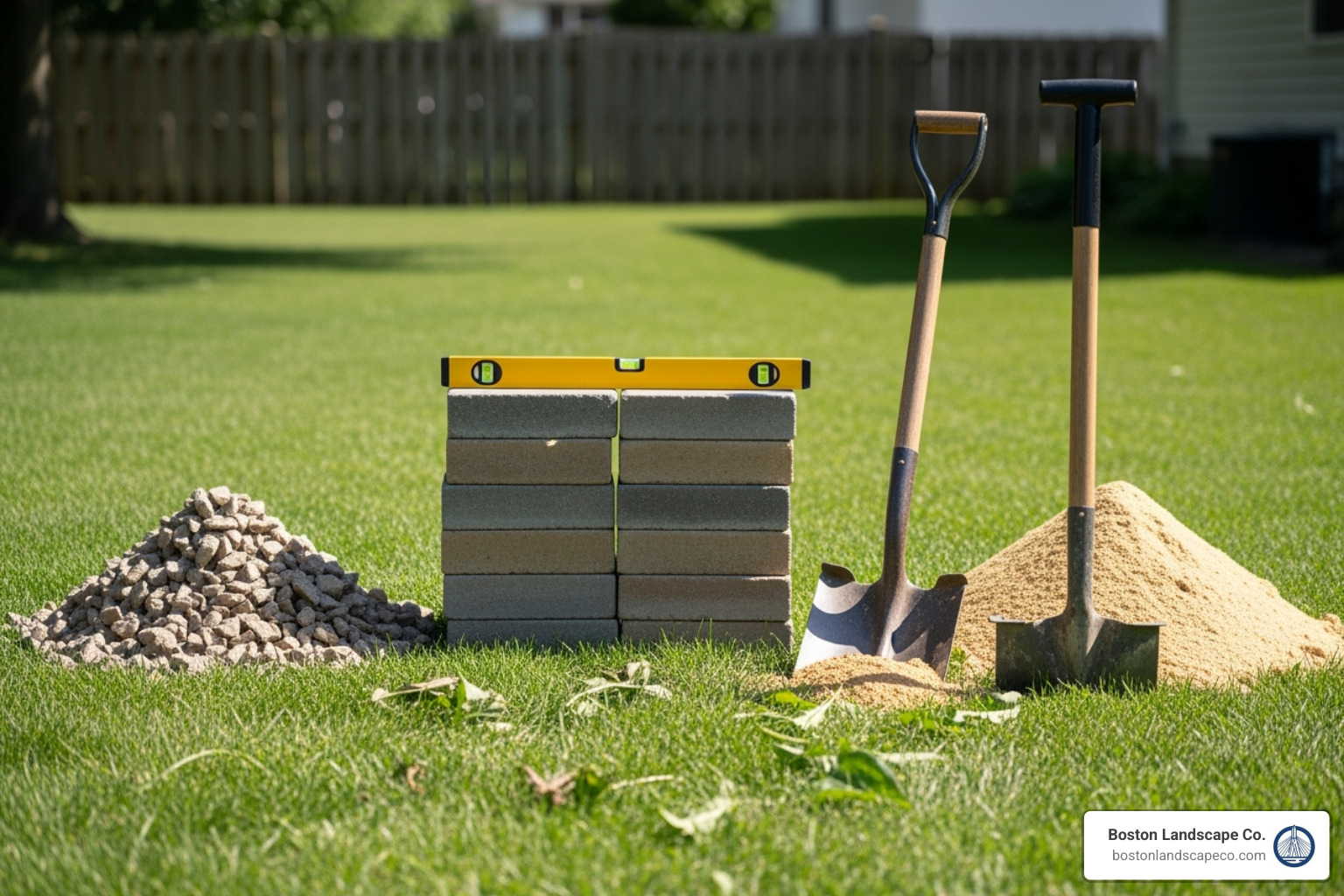
Gather all your tools and materials beforehand to maintain momentum.
- Excavation & Hauling: Shovel, spade, wheelbarrow, tape measure.
- Leveling & Layout: 4-foot level, line level, stakes, mason’s line.
- Compaction & Placement: Plate compactor (rental), hand tamper, rubber mallet.
- Finishing: Screed board (a straight 2×4), push broom, circular or wet saw with a masonry blade.
- Safety Gear: Gloves, safety glasses, hearing protection, dust mask, knee pads.
For materials, you’ll need your chosen pavers (order 5-10% extra), gravel base (3/4-inch minus aggregate), bedding sand (washed concrete sand), edge restraints with spikes, polymeric sand for joints, and landscape fabric (geotextile) for unstable soil.
Designing Your Walkway: Width, Slope, and Pattern
Design choices impact both the look and function of your walkway. A 36-inch width is standard, but 48 inches feels more inviting and allows two people to walk side-by-side. For wheelchair accessibility, maintain a 36-inch minimum width.
Proper drainage is critical to prevent water damage and ice patches. Your walkway must slope away from your house. A gentle 1/4-inch drop per foot is ideal—subtle enough not to be noticed but effective at shedding water. The paver pattern you choose affects difficulty. A simple Running Bond is best for a first paver walkway installation, while more complex patterns like Herringbone require more time and cuts.
Traditional Gravel Base vs. Paver Base Panels
Your walkway’s foundation is key to its longevity. The traditional gravel base is the time-tested standard. It involves excavating 7-10 inches to install a 4-6 inch layer of compacted gravel, providing superior stability and drainage, especially in regions with freeze-thaw cycles. While labor-intensive, this method ensures a walkway that can last over 50 years.
Paver base panels are a modern, DIY-friendly alternative. These lightweight panels replace the heavy gravel layer, reducing excavation depth to 4-6 inches and significantly cutting down on labor and project time. They offer excellent support for pedestrian paths.
| Feature | Traditional Gravel Base | Paver Base Panels |
|---|---|---|
| Excavation Depth | Deeper (7-10 inches) | Shallower (4-6 inches) |
| Material Handling | Labor-intensive (heavy gravel) | Less labor-intensive (lightweight panels) |
| Stability | Excellent; proven long-term | Excellent; interlocking design |
| Project Timeline | Longer | Faster |
While panels are faster, a traditional gravel base offers extra insurance against ground movement in areas with poor soil or harsh winters. For more guidance, check out our hardscaping services.
Step-by-Step Paver Walkway Installation Guide
A DIY paver walkway installation is hard work, but building something so permanent is deeply satisfying. Pace yourself, stay hydrated, and follow these steps in order for a professional-looking result.
Step 1: Excavation and Area Preparation
Proper excavation is the most critical phase for long-term stability.

First, use stakes and mason’s line to mark the walkway’s perimeter. A garden hose is great for outlining curves. Use a line level to establish your slope—a 1/4-inch drop per foot away from any structures.
Next, remove sod, large roots, and rocks. Calculate your excavation depth by adding the paver height (2-3 inches), the sand bed (1 inch), and the gravel base (4-6 inches), for a total of 7-10 inches. The goal is for the finished walkway to sit slightly above the surrounding ground.
Finally, level the excavated soil (the subgrade) and run a plate compactor over the entire area multiple times to prevent future settling. If you have clay soil, lay down landscape fabric now to separate the soil from your gravel base.
Step 2: Building the Foundation
This hidden layer is your walkway’s hero. If you haven’t already, install landscape fabric across the excavated trench, running it up the sides.
For a traditional gravel base, add 3/4-inch crushed gravel in 2-inch layers, compacting each layer thoroughly with the plate compactor before adding the next. A 4- to 6-inch compacted base is ideal for pedestrian walkways in New England.
Once the gravel base is solid, spread 1 inch of washed concrete sand over it. To level the sand, lay two 1-inch PVC pipes parallel on the gravel, pour sand between them, and drag a straight 2×4 (a screed board) across the pipes. Remove the pipes and fill the voids. Do not compact this sand layer; the pavers will be set into it later. If using paver base panels, spread and screed a 1/2-inch sand layer, then lay the interlocking panels on top.
Step 3: Laying the Pavers
This is the most satisfying part of the paver walkway installation.

Start laying pavers from a fixed edge, like your house or patio, and work outward. Place each paver using a “click-and-drop” method: set it straight down onto the sand without sliding it. Work from on top of already-laid pavers to avoid disturbing the sand bed.
Maintain consistent 1/4-inch gaps between pavers for jointing sand. Frequently check that your rows are straight and level, using a rubber mallet to gently tap pavers into place.
You will need to cut pavers to fit edges and curves. A circular saw with a masonry blade or a rented wet saw works best. When using a wet saw, always wear safety glasses and hearing protection, ensure the water reservoir is full, and follow all manufacturer instructions.
Step 4: Securing and Finishing the Walkway
These final steps lock your walkway together. Install paver edging along the perimeter, securing it into the ground with spikes every 12 inches. This is essential to prevent pavers from shifting over time.
Next, spread dry polymeric sand over the entire surface and use a push broom to sweep it into every joint until they are full. Run the plate compactor over the pavers to settle them into the sand bed and vibrate the polymeric sand down into the joints. Sweep in more sand and repeat until the joints are completely filled.
Crucially, you must remove all excess polymeric sand from the paver surfaces before adding water. Use a leaf blower on a low setting to blow away all dust. Any sand left on the surface will cure into a permanent, hazy stain. Once clean, gently mist the walkway with a fine spray nozzle until the joints are saturated. Allow the walkway to cure for at least 24 hours, keeping it free from foot traffic and rain. For more project inspiration, view our portfolio.
Advanced Techniques & Troubleshooting
Even well-planned projects can present challenges. These advanced techniques will help you handle slopes, steps, and future repairs for your paver walkway installation.
Working with Slopes and Building Steps
For a walkway on a gentle slope, a consistent, well-compacted gravel base is critical to manage water runoff. It’s often easiest to lay pavers while working downhill, using temporary stakes to hold rows in place until the edge restraints are installed.
For steeper elevation changes, building steps is safer and more effective. To do this, first measure the total vertical rise to determine the number of steps needed (a comfortable riser height is 4-7 inches). Each step tread should be 12-18 inches deep. Build each step on its own compacted gravel and sand base. Use interlocking retaining wall blocks for the vertical risers, backfilling behind them with compacted gravel. Lay the paver treads on top, securing them with construction adhesive and ensuring each tread has a slight forward slope for drainage. The most important rule is consistency: every step must have the same rise and run to prevent tripping hazards.
How to Repair a Sinking or Uneven Paver Walkway
Over time, a paver or two may sink or become uneven. Luckily, repairs are straightforward. First, identify the cause, such as water erosion or a tree root. Use a flat-head screwdriver to carefully pry up the affected pavers. Remove the old sand and either add or remove base material (gravel and/or sand) to level the area. Compact any new gravel with a hand tamper. Re-lay the original pavers, tapping them with a rubber mallet until they are flush with the surrounding walkway. Finally, sweep fresh polymeric sand into the joints and mist with water to cure.
Finishing Touches for Your New Walkway
Transform your project into a polished landscape feature with a few final details.
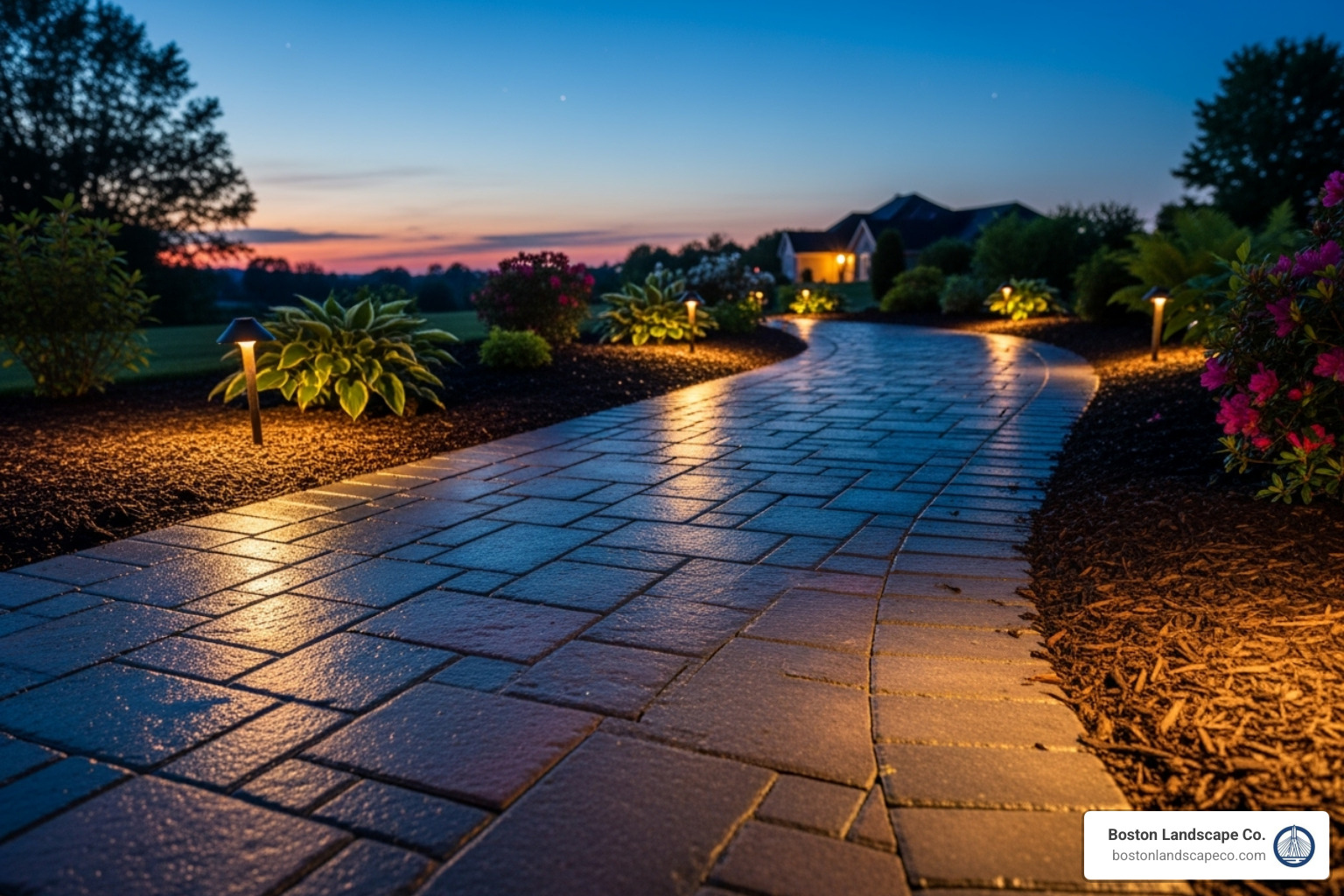
Landscape lighting adds safety and ambiance. Low-voltage or solar path lights create a warm, welcoming glow. New garden beds along the walkway, filled with fresh plantings and a layer of mulch, define the edges and integrate the path into your yard. Ensure any visible paver edging is covered with soil or mulch for a clean, professional look. For more ideas on integrating your walkway into a complete landscape design, explore our residential landscaping services.
Frequently Asked Questions about Paver Walkway Installation
Here are answers to some common questions about paver walkway installation.
How much does a paver walkway cost?
Cost varies widely based on materials, size, complexity, and whether you DIY or hire a professional. For a DIY project, material costs for concrete pavers typically range from $8 to $15 per square foot. Natural stone will be significantly more.
For professional installation, which includes labor, materials, and equipment, industry averages range from $15 to over $50 per square foot. Concrete pavers often fall between $8-$25/sq ft installed, while natural stone can be $12-$60/sq ft or more. Site preparation and permit fees (often $200+) can add to the total. That costs in the Greater Boston area may be higher than national averages. Please note these are industry average costs based on internet data and not a quote from Boston Landscape Co.
How do you prevent weeds from growing between pavers?
Properly installed polymeric sand is your best defense. When activated with water, it hardens into a durable barrier that blocks weed growth and deters insects. The key is to fill joints completely and sweep the paver surfaces perfectly clean before misting with water to prevent a permanent haze. Regular sweeping to remove debris also helps prevent seeds from taking root. If a weed appears, pull it by hand. You may need to re-apply polymeric sand in a few years as part of routine maintenance.
How long do paver walkways last?
With a proper base and minimal maintenance, a paver walkway can last 50 to 100 years. Unlike solid concrete slabs that crack, individual pavers can flex with ground movement caused by New England’s freeze-thaw cycles. This makes them incredibly durable. Another major advantage is the ease of repair. If a single paver ever cracks or gets stained, it can be lifted and replaced without redoing the entire walkway, making it a cost-effective and long-lasting investment.
Conclusion
Standing back to admire a paver walkway installation you built yourself is deeply satisfying. This path is more than just a functional upgrade; it’s a beautiful, lasting improvement to your home’s curb appeal and value.
We’ve been honest: this is difficult, dirty, and back-breaking work. It requires excavating earth, hauling heavy materials, and precise placement. But by following the steps for proper base preparation and finishing, you can create a professional-quality walkway that will last for generations. Spring and early summer in the Greater Boston area are the perfect time to tackle this project.
However, not everyone has the time or physical ability for such a demanding DIY undertaking. If you want a stunning paver walkway without the sore muscles and lost weekends, Boston Landscape Co. is here to help. Our experienced team has been creating beautiful hardscapes in Stoneham, Billerica, and surrounding communities for over 30 years. We handle everything with professional-grade equipment and an expert crew, guaranteeing a flawless result.
Spend your weekends enjoying your yard, not excavating it. For a beautiful, durable walkway built with professional precision, consider the expert hardscaping services from Boston Landscape Co. to bring your vision to life.
Like us on Facebook!
