
What Is Berm Landscape Design (And Why Your Flat Yard Needs It)
Berm landscape design is the practice of building gently mounded ridges of soil to add height, visual interest, drainage control, and privacy to an otherwise flat yard. Here’s a quick overview of what it involves:
- What it is: A berm is a rounded mound of layered soil, typically 18–24 inches tall, with gradual slopes that blend naturally into the surrounding ground
- What it does: Redirects water runoff, screens unwanted views, reduces noise, creates planting beds, and adds dimension to flat properties
- Who it’s for: Homeowners and property managers who want more from their yard than a flat, featureless lawn
- What it’s not: A raised bed (which has walls) or a retaining wall (which holds back a slope)
Flat yards are common across the Greater Boston and North Shore area — and they can feel dull or one-dimensional no matter how well-maintained they are. A well-built berm changes that. It turns grade-level ground into a sculpted landscape feature that works harder than a simple planting bed ever could.
The difference is striking. One landscape professional put it well: a flat lawn with a shrub island can feel dull, but that same island placed on a berm completely transforms the look.
Whether your goal is to block a neighbor’s headlights, improve drainage away from your foundation, or simply give your yard a focal point worth noticing from the street — berms are one of the most versatile tools in residential landscape design.
I’m Steve Schumacher, owner of Boston Landscape Co., and with over 30 years of hands-on landscaping experience in the Greater Boston area, berm landscape design is something I’ve applied to countless properties — from tight suburban lots in Stoneham to larger North Shore estates. In this guide, I’ll walk you through everything you need to know to plan, build, and plant a berm that looks like it was always meant to be there.
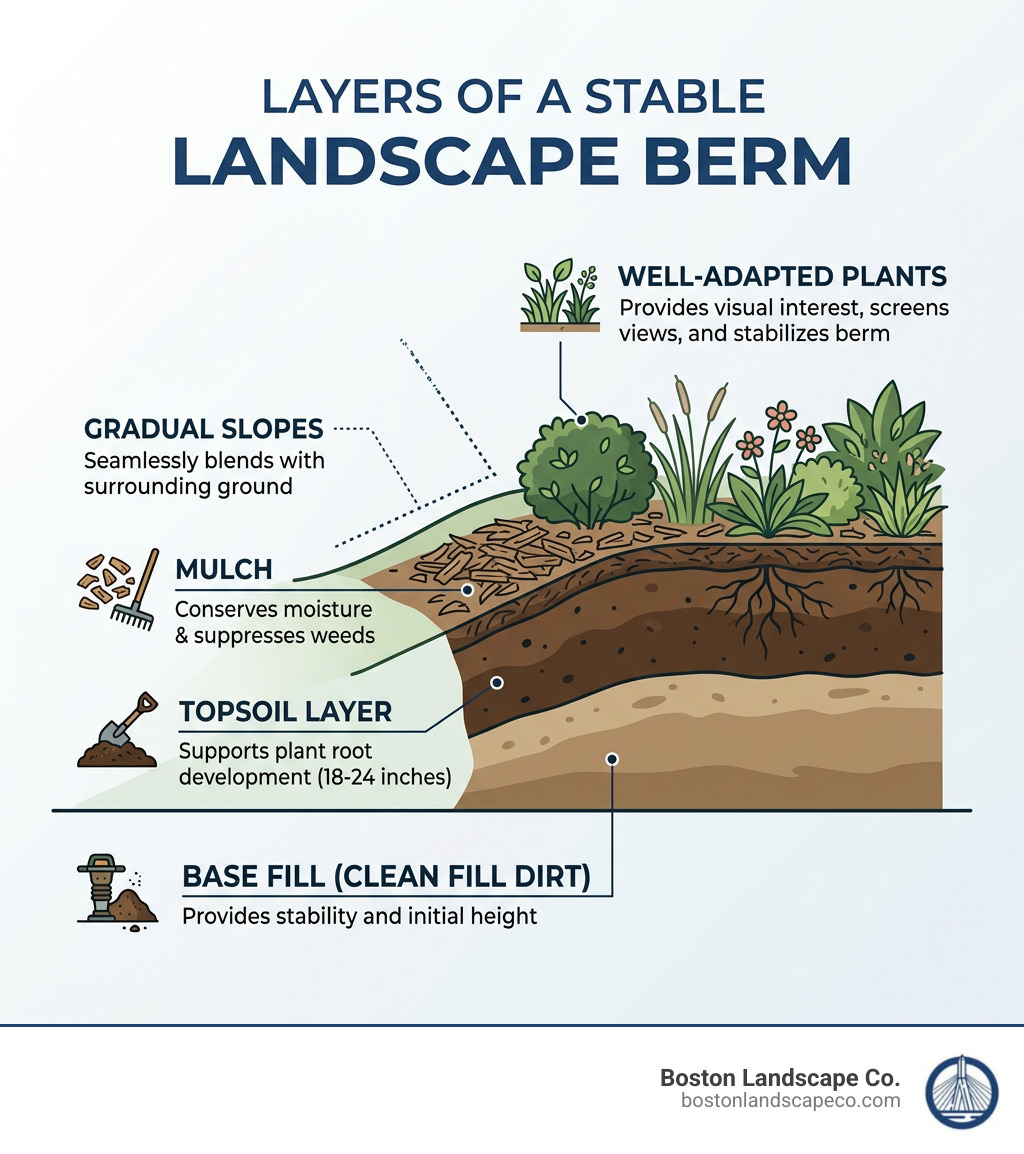
Berm landscape design vocab explained:
Understanding Berm Landscape Design vs. Raised Beds
One of the most common questions we get from homeowners in Burlington or Lexington is: “Isn’t a berm just a fancy raised bed?” Not exactly. While both elevate your plants, they serve different aesthetic and structural roles.
A raised bed is typically a geometric box—rectangular or square—contained by walls made of wood, stone, or concrete. It sits on top of the existing grade like a piece of furniture. A berm, however, is a “living” part of the land. It is a mound of soil that tapers gradually into the lawn, creating a seamless transition.
| Feature | Landscape Berm | Raised Garden Bed |
|---|---|---|
| Structure | Sloped soil mound (no walls) | Enclosed frame (wood/stone/metal) |
| Aesthetic | Natural, organic, flowing | Structured, formal, architectural |
| Drainage | Directs water away via slopes | Vertical drainage through soil |
| Main Use | Privacy, aesthetics, windbreaks | Vegetable gardening, accessibility |
| Maintenance | Mowing around curved edges | Weeding within a confined space |
When we talk about berm landscape design, we are focusing on creating “islands” of interest. Because berms lack rigid walls, they allow for more creative, sweeping shapes that mimic the natural rolling hills of the New England countryside. Read more about data and privacy in landscaping to understand how these features protect your property’s boundaries.
The Functional Benefits of Berm Landscape Design
Beyond just looking pretty, berms are the Swiss Army Knives of the backyard. If you live on a busy corner in Medford or Somerville, a berm topped with dense evergreens acts as a powerful privacy screen and noise reducer. The mass of the earth itself helps absorb sound waves from traffic, while the height of the plants blocks the glare of neighbor’s headlights.
Berms also act as effective windbreaks. In the winter, a strategically placed berm can shield delicate patio areas from the biting North Shore winds. Furthermore, they are excellent for masking unsightly but necessary utilities, such as AC units or electrical boxes, without completely burying them.
Creating Microclimates with Berms
One of the coolest “secret” benefits of a berm is its ability to create microclimates. Because a berm has different faces—one side facing south, one north—it changes how the sun hits your plants.
- The South Slope: This side stays warmer and dries out faster, making it perfect for sun-loving perennials that enjoy a “head start” in the spring.
- The North Slope: This side stays cooler and holds moisture longer, ideal for plants that prefer a bit of relief from the summer heat.
- The Crest: The very top of the berm drains the fastest. This is the spot for drought-tolerant species.
By varying the elevation, you can actually grow a wider variety of plants than you could on a flat lot. You can find native plants for your berm zones to ensure your new microclimate thrives in our Massachusetts weather.
Planning and Sizing Your Berm for a Natural Look
The biggest mistake we see in DIY berm landscape design is the “volcano effect”—a tiny, steep pile of dirt that looks like it fell off a dump truck. For a berm to look natural, it needs to be long and lean.
A good rule of thumb is the 5:1 ratio: the base of your berm should be five feet wide for every one foot of height. If you want a two-foot-tall berm, it needs to be at least ten feet wide at the base. This gradual slope ensures the berm blends into the yard and prevents the soil from washing away during a heavy Reading or Woburn rainstorm.

Strategic Placement in the Yard
Where you put your berm is just as important as how you build it. We often design them along property lines to create a soft border between neighbors. They also work beautifully as “island beds” in the middle of a large, flat lawn to break up the monotony.
Always consider sightlines. If you are standing at your kitchen window, does the berm frame a beautiful view or block it? If you’re building a berm near the street in Winchester or Wellesley, ensure it doesn’t obstruct the view for drivers pulling out of driveways.
Recommended Dimensions and Slopes
For most residential yards in the Greater Boston area, a height of 18 to 24 inches is the “sweet spot.” It’s high enough to provide visual impact but low enough to manage easily.
When shaping the berm, think in “kidney beans” or “crescent moons” rather than perfect circles. Nature rarely works in straight lines or perfect spheres. Give your berm multiple peaks of varying heights to make it look like a natural landform. Also, keep the “crest” (the top) flat enough to hold plants—usually about 12 to 24 inches wide.
Step-by-Step Guide to Building a Landscape Berm
Building a berm is a workout, but the results are worth the sweat. If you’re tackling this as a weekend project, follow these steps to ensure structural stability.
- Outline the Shape: Use a flexible garden hose or a length of rope to play with the shape. Once you like it, mark the perimeter with landscape spray paint.
- Remove the Sod: You can’t just pile dirt on top of grass; the grass will rot and cause the berm to slump. Use a spade to flip the sod over (it can actually serve as a base layer of “fill”) or remove it entirely.
- Build the Core: For a cost-effective berm, use “fill dirt” for the center. This is cheaper, heavier soil that provides the bulk.
- Add the “Shell”: Top the fill with 6 to 12 inches of high-quality, screened topsoil. This is where your plants will live, so don’t skimp here.
- Tamp and Settle: This is the most skipped step! Use a mechanical tamper or the flat end of a rake to firm the soil as you go. Once the shape is finished, give it a good soak with a hose to help it settle before you start planting.
For more complex projects involving grading or large-scale earthmoving, you can find more info about residential landscaping services to see how we handle professional installations.
Essential Tools and Materials
To do the job right, you’ll need:
- A sturdy pointed spade and a flat shovel
- A high-capacity wheelbarrow (you’ll be moving more dirt than you think!)
- A garden rake for shaping
- Fill dirt (for the bulk)
- Screened topsoil (for the planting layer)
- Organic mulch (to lock it all in)
Pro Tip: Avoid using landscape fabric under your berm. It can interfere with deep root growth and often ends up sliding down the slope over time.
Managing Water Drainage and Erosion
A berm is essentially a dam. If you build it in the wrong spot, you might accidentally send a river of water toward your basement. Always ensure the berm allows water to flow around it, not trap it against your house.
In areas with heavy clay soil—common in parts of Billerica and Concord—we often pair berms with a swale (a shallow, rock-lined ditch) on the uphill side. This catches runoff and directs it safely to a drain or a lower part of the yard. To prevent the berm itself from eroding, use shredded hardwood mulch; it “knits” together better than large bark nuggets, which tend to roll down the hill during a downpour.
Selecting the Best Plants for Your Berm
Planting a berm is different than planting a flat bed. Because you have a “3D” canvas, you want to layer your plants to maximize the height.
Think of it like a group photo:
- The Backdrop: Place your tallest shrubs or small trees (like Serviceberry or Upright Evergreens) toward the back or the highest peak.
- The Mid-Ground: Use mounded shrubs like Hydrangeas or Spirea on the slopes.
- The Front: Use low-growing perennials and groundcovers at the “toe” (the base) of the berm to knit it into the lawn.
Planting by Zone: Crest, Slope, and Base
Not every plant likes every part of the berm.
- The Crest (Driest): Use drought-tolerant plants like Sedum, Lavender, or Ornamental Grasses. They can handle the fast drainage and wind exposure.
- The Slopes: This is the place for deep-rooted shrubs and “spreading” perennials that help hold the soil in place.
- The Base (Moistest): Water naturally settles here. This is a great spot for moisture-loving plants like Siberian Iris or Ferns if the area stays shaded.
Enhancing Berm Landscape Design with Hardscaping
To truly make a berm look like it’s been there for a century, incorporate stone. We love using fieldstone or large boulders, which are plentiful in our local Massachusetts soil.
The secret to making boulders look natural is the “iceberg style”: bury at least one-third of the boulder into the soil. If it just sits on top, it looks like a “pet rock.” If it’s buried, it looks like an ancient outcropping that the berm formed around. You can find more info about hardscaping services to see how we integrate stone into our designs.
Frequently Asked Questions about Berms
How much does a professional berm installation cost?
The cost of a berm varies wildly based on size, the amount of soil needed, and the plants selected.
- Small DIY-style berms: Might cost between $1,500 and $4,500 in materials and basic labor.
- Large, professionally designed privacy berms: These can range from $5,000 to over $15,000, especially if they require heavy machinery, significant drainage work, or mature trees.
Note: These are average costs based on general internet data and are not the actual prices of Boston Landscape Co. Every property in the North Shore has unique soil and access challenges that affect the final estimate.
What is the best mulch for a sloped berm?
Avoid “pine bark nuggets” or smooth stones, as they will slide right off the slope during the first Nor’easter. The best choice is shredded hardwood mulch. The jagged edges of the wood fibers lock together, creating a mat that stays put on a 4:1 or 5:1 slope.
When mulching around trees on the berm, avoid “mulch volcanoes”—piling mulch against the trunk. Instead, create a “donut” shape with a gap around the bark to prevent rot.
When should I hire a professional instead of DIY?
If your berm is more than 2 feet tall or 15 feet long, it’s time to call in the pros. Moving that much soil by hand is back-breaking work—one cubic yard of soil weighs about 2,000 pounds!
Furthermore, if your yard already has drainage issues, a professional landscaper can use laser levels to ensure your new berm landscape design doesn’t flood your neighbor’s yard or your own garage. In towns like Stoneham and Billerica, where soil can be heavy and rocky, professional equipment makes the difference between a berm that lasts and one that washes away in three seasons.
Conclusion
A well-designed berm is more than just a pile of dirt; it’s a strategic landscape tool that adds privacy, solves drainage issues, and gives your home a high-end, custom look. Whether you’re in Waltham, Winchester, or Woburn, transforming a flat yard into a multi-dimensional paradise is one of the best investments you can make in your property’s curb appeal.
At Boston Landscape Co., we’ve spent decades perfecting the art of the North Shore landscape. We understand the local soil, the local climate, and exactly which plants will thrive on a windy Massachusetts crest. From the initial design to the final layer of mulch, we’re here to help you sculpt the yard of your dreams.
Ready to add some dimension to your property? Request a landscape estimate for your property today, and let’s start planning your “bermy” paradise.