
How to install a lawn irrigation system 2025: Masterful
Why Installing Your Own Lawn Irrigation System Is Easier Than You Think
How to install a lawn irrigation system involves planning your layout, measuring water pressure, digging trenches, connecting to your water source, laying pipes, installing sprinkler heads, and wiring a controller. Most DIY installations take a full weekend (16-24 hours).
Quick Installation Steps:
- Plan – Call 811, sketch your yard, and determine zones.
- Measure – Test water pressure (40-65 PSI is ideal) and flow rate (GPM).
- Dig – Trench 6-12 inches deep for pipes.
- Connect – Tap your water line, then install a backflow preventer and valves.
- Assemble – Lay pipes, attach sprinkler heads, and wire the controller.
- Test – Check for leaks, adjust coverage, and backfill trenches.
A lush, green landscape doesn’t require dragging hoses around your yard. An automatic sprinkler system is the best way to maintain a healthy lawn while minimizing water use. Installing your own system can save money on labor and gives you total control over your watering schedule. While professional installations can range from $2,500 to $8,000+, a DIY project typically costs $1,000 to $3,000 for materials.
Many homeowners worry about tapping into their main water line or hitting a buried utility cable. But with proper planning, this project is manageable for someone with basic DIY skills.
Water conservation is another key benefit. Smart controllers can reduce water usage by 15-30% compared to manual watering, saving thousands of gallons annually and lowering your utility bills.
As Steve Schumacher, owner-operator of Boston Landscape Co. since 1991, I’ve designed and installed hundreds of irrigation systems. Whether you tackle this project yourself or bring in professionals, understanding the process helps you make informed decisions for your landscape.
Step 1: Planning Your Sprinkler System Layout
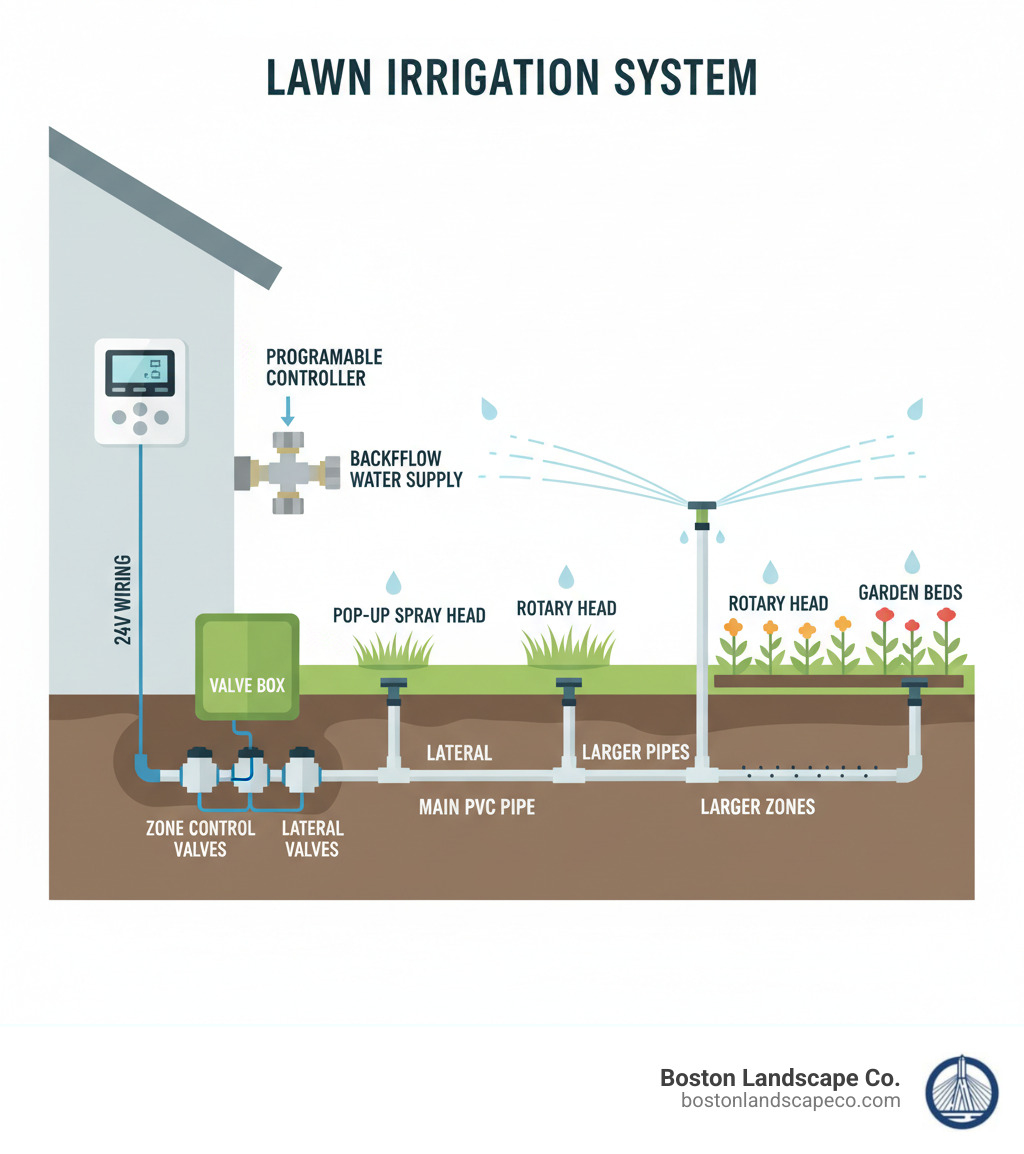
Proper planning is the key to a successful DIY irrigation project. Before you dig, you need a solid blueprint.
First, call 811 at least three business days before you plan to dig. This free service marks all buried utility lines on your property, preventing a dangerous and costly accident. Next, check with your local building department for any necessary permits or specific codes, like the irrigation bylaws in Concord, MA.
Now, map your property on graph paper (a scale of 1 inch = 10 feet works well). Sketch everything: your house, driveway, patios, trees, flower beds, and property lines. Note sun vs. shade areas, slopes, and your general soil type. Sandy soil drains fast and needs frequent, short watering, while dense clay soil (common in Massachusetts) absorbs water slowly and requires less frequent, longer watering sessions. If you’re starting from scratch, our Lawn Installation Services can help build the right foundation.
How to Determine Water Pressure and Flow Rate
Your home’s water pressure and flow rate dictate your system’s design. Most sprinkler systems perform best between 40 and 65 PSI (pounds per square inch). To measure yours, attach a pressure gauge (about $10 at a hardware store) to an outdoor spigot and turn it on fully. Ensure no other water is running in the house for an accurate static pressure reading.
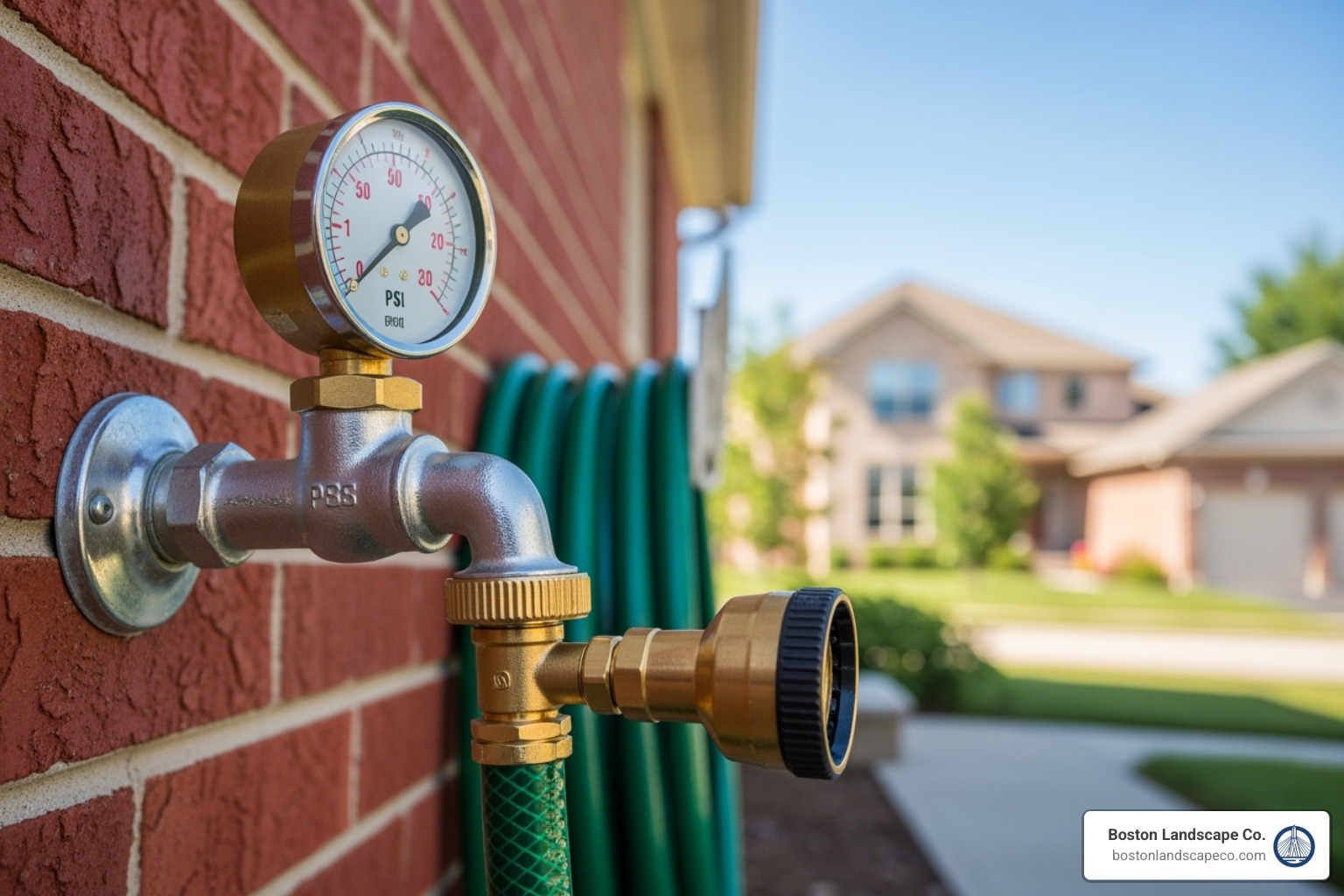
Next, measure your flow rate in Gallons Per Minute (GPM). Time how long it takes to fill a 5-gallon bucket from the spigot. Use this formula: (5 gallons ÷ seconds to fill) × 60 = GPM. Most homes have between 10 and 13 GPM. This data is crucial because the total GPM of all sprinkler heads in a single zone must be less than your available GPM.
Choosing Pipes and Sprinkler Heads
Your two main pipe choices are rigid PVC and flexible polyethylene (poly) pipe. PVC is strong and ideal for straight main lines, connected with primer and cement. Flexible poly pipe is easier to work around curves and connects with clamps, making it great for lateral lines. It also handles New England’s freeze-thaw cycles better.
Choose sprinkler heads based on the area they need to cover:
- Pop-up spray heads: Best for small lawns and garden beds (10-15 foot radius).
- Rotary nozzles and rotors: Ideal for larger lawn areas, as they cover more ground (25-30 feet).
- Drip irrigation: The most efficient option for garden beds, shrubs, and trees, applying water directly to the roots.
The golden rule is head-to-head coverage, where the spray from one sprinkler reaches the next. Crucially, do not mix different head types in the same zone, as they have different watering rates. Create separate zones for spray heads, rotors, and drip lines.
Estimating Your Irrigation System Installation Cost
Understanding the costs helps you decide between DIY and professional installation. For a typical yard, DIY materials cost between $1,000 and $3,000. Professional installation generally ranges from $2,500 to $8,000, with larger or more complex properties costing up to $15,000+.
These are average costs based on internet research and not actual pricing from Boston Landscape Co. Your specific project cost depends on your yard’s size, complexity, and material choices. We provide detailed, customized estimates for every project.
Key cost drivers include lawn size, number of zones, trenching depth, and soil type. A basic controller is cheaper, while a smart controller ($150-$300) costs more upfront but saves money on water bills over time. Don’t forget tool rentals, like a trencher ($75-$150 per day), which is a worthwhile investment to save time and labor.
Step 2: How to Install a Lawn Irrigation System
With your plan complete, it’s time to start building. This is where your vision for an effortlessly green lawn begins to take shape.
Digging the Trenches for Your System
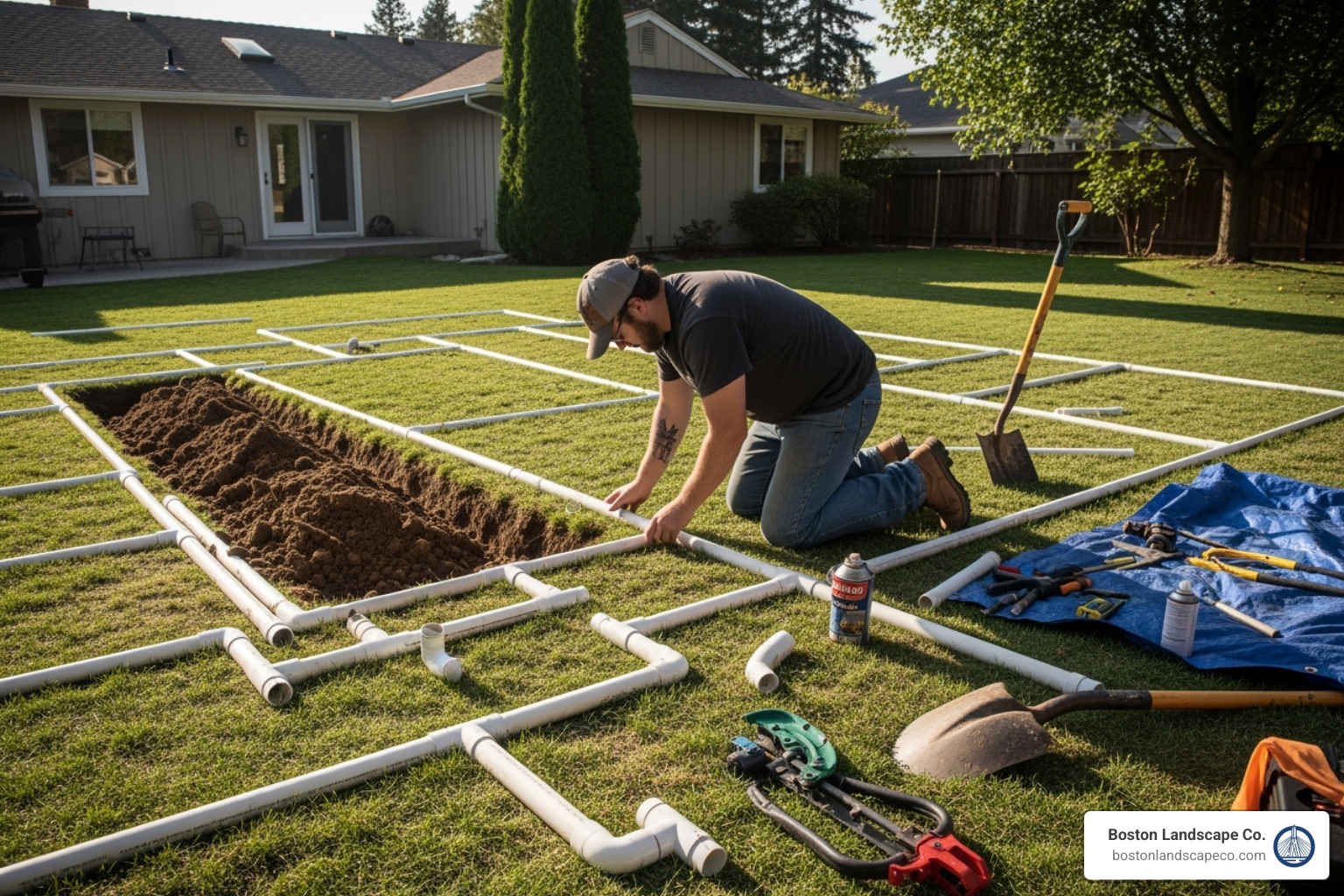
Mark your trench lines with spray paint or flags according to your plan. While you can dig by hand, renting a trencher will save you hours of backbreaking work, especially in rocky New England soil.
Dig trenches 6 to 12 inches deep. In Massachusetts, we recommend 12 inches for main lines (which are always under pressure) for better frost protection. Lateral lines to individual heads can be shallower, around 6 to 8 inches. Place excavated soil and sod on a tarp next to the trench for easy backfilling. To get under a sidewalk or driveway, you can bore a tunnel using water pressure from a garden hose attached to a piece of PVC pipe.
Connecting to the Water Source and Installing Valves
This is a critical step. If you’re not comfortable with plumbing, hire a licensed plumber. First, shut off the main water supply to your house. Tap into the main line by splicing in a T-fitting.
Next, install the backflow preventer. This device is non-negotiable, as it stops contaminated irrigation water from flowing back into your home’s drinking water supply. Most municipalities, including those around Boston, legally require one. Check local codes, like those for Irrigation Systems in Concord, MA, for specific requirements.
Assemble your valve manifold, which groups the valves for each zone. Place the manifold in a valve box, set in a hole on a bed of gravel for drainage. The box lid should sit flush with the ground.
For more on how irrigation fits into a larger project, see our Residential Landscape Installation services.
How to Assemble and Lay the Irrigation Pipes
For PVC pipes, cut the pipe, clean the ends, and apply PVC primer and cement to both the pipe and fitting. Push them together with a quarter-turn and hold for 30 seconds to create a permanent chemical weld. For poly pipe, slide on stainless steel clamps, insert the barbed fitting, and tighten the clamps securely.
Lay the assembled pipes in the trenches. Before installing any sprinkler heads, you must flush the system. Turn on the water and run each zone for a few minutes to clear out any dirt or debris that got into the pipes during installation. This prevents your new sprinkler heads from clogging immediately.
How to Install Sprinkler Heads and the Controller
At each sprinkler location, connect a riser (flexible risers are best) to the pipe fitting, then screw on the sprinkler head. Adjust the height so the top of the head sits flush with the ground.
Next, wire the valves to the controller using low-voltage (24V) underground wire. Run a single common wire (usually white) to one wire on every valve. Then, run a separate colored wire from the other side of each valve to the corresponding zone terminal on the controller (e.g., Zone 1 valve to Terminal 1).
Mount the controller in a sheltered location, like a garage, near a standard power outlet. Before backfilling, test the system from the controller to ensure each zone turns on correctly. Modern smart controllers are a great investment; they use local weather data to adjust watering automatically, saving 15-30% on water use according to the EPA.
Step 3: Testing, Adjusting, and Finalizing Your Installation
Before you bury your hard work, it’s time to test the system to ensure it runs perfectly. This final check prevents underground surprises later on.
Testing for Leaks and Proper Coverage
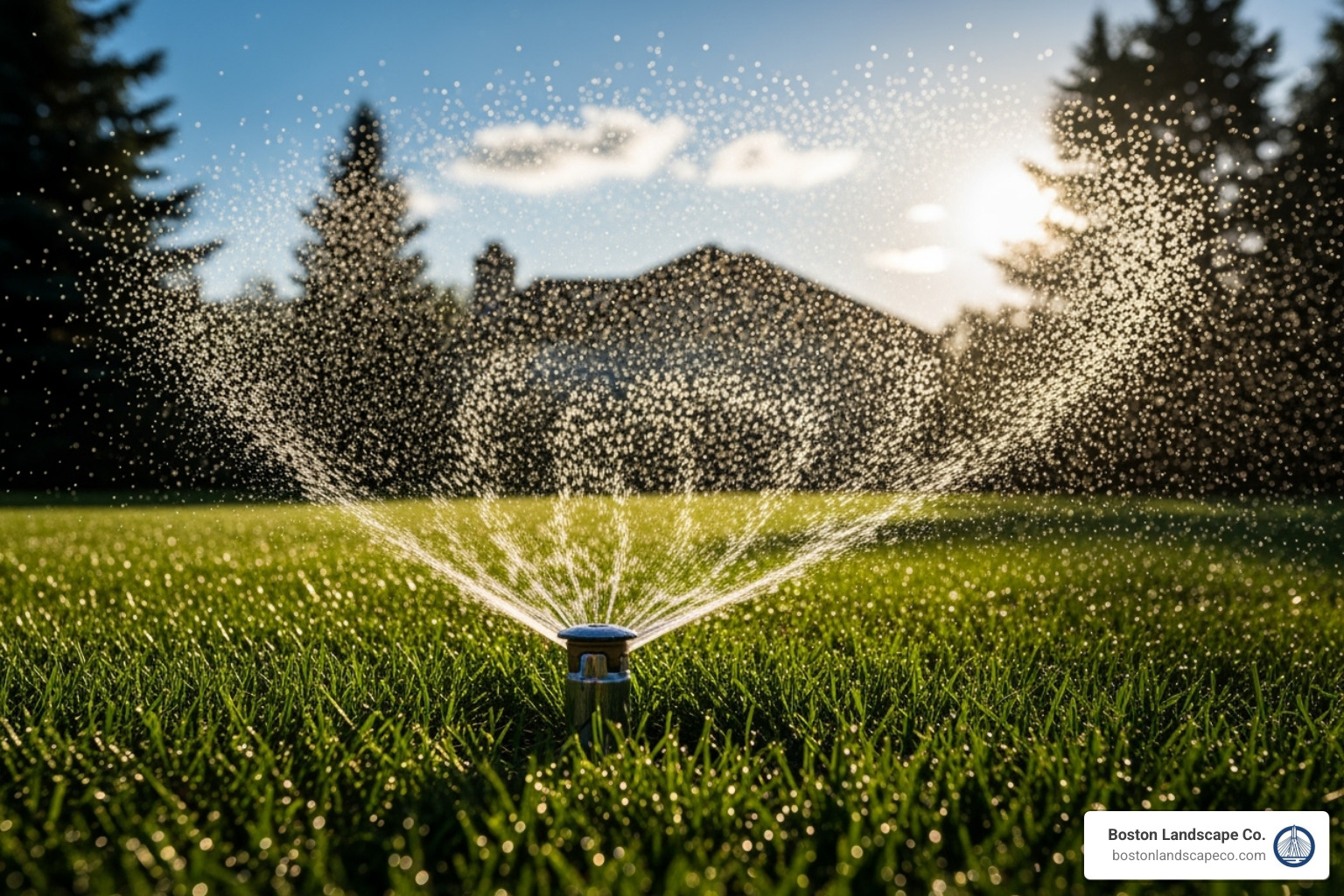
Turn on the water slowly to prevent a pressure surge from damaging your connections. Manually run each zone from the controller, one at a time. Walk along each trench line, checking every fitting and sprinkler head for drips, pooling water, or hissing sounds that indicate a leak. It’s much easier to tighten a clamp or re-glue a PVC joint now than after the trenches are filled.
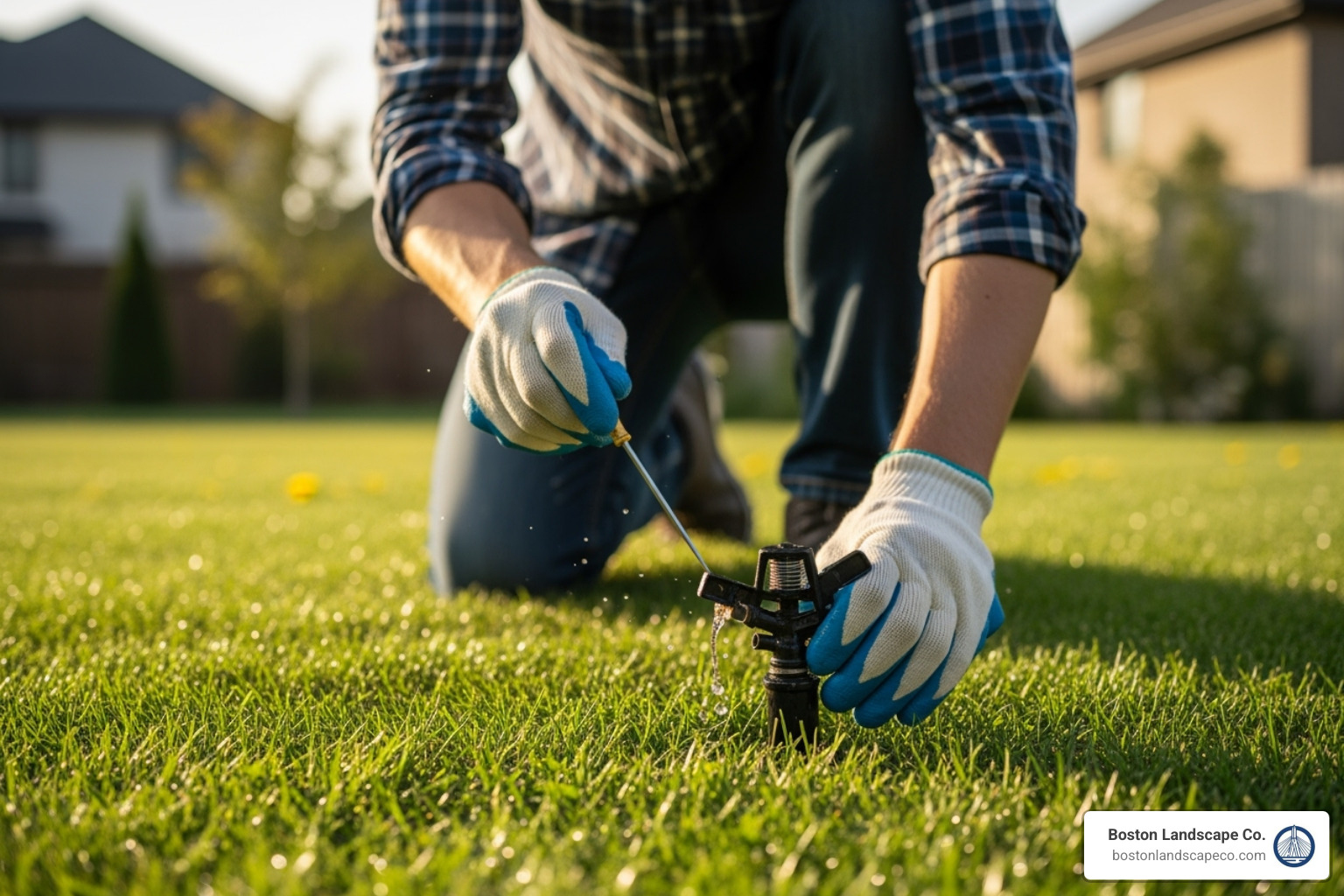
Next, evaluate the spray coverage. The goal is even, head-to-head watering. To check for uniformity, perform a “catch can test”: place several small, identical containers (like tuna cans) throughout a zone, run it for 10 minutes, and measure the water in each. If the amounts vary widely, you have uneven coverage. Use the adjustment key or a small screwdriver to fine-tune each sprinkler’s spray pattern and radius until you’re watering the lawn, not the driveway.
Backfilling Trenches and Clean-Up
Once you’ve confirmed there are no leaks and the coverage is even, you can backfill the trenches. Carefully push the soil from the tarps back into the trenches, making sure the pipes stay level and the sprinkler heads remain flush with the ground.
If you saved the sod, replace it over the trench lines like a puzzle and water it well. If not, reseed the disturbed areas. Fall is an excellent time for seeding in Massachusetts. Ensure your valve box lid is secure and flush with the lawn, then do a final clean-up of the area.
You’ve just completed a major home improvement project. For more on integrating new features into your yard, check out our Step-by-Step Guide to Landscape Installation.
Step 4: Maintaining Your New Lawn Irrigation System
Congratulations on installing your system! Now, a little seasonal maintenance will keep it running efficiently for years to come.
Seasonal Maintenance Tasks
Your system’s needs change with the New England seasons.
- Spring Start-Up: After the last frost, slowly turn the water back on. Run each zone and check for leaks or damaged heads that may have occurred over winter. Clean filters, adjust spray patterns, and set your controller for cool, rainy spring weather. Many towns also require an annual backflow preventer test by a certified professional.
- Summer Monitoring: Once a month, walk your property while the system runs. Look for clogged or misaligned heads and dry spots. Adjust your controller’s schedule based on the weather—increase watering during heat waves and reduce it during rainy periods.
- Fall Winterization: Before the first hard freeze, you must winterize your system. This involves shutting off the water and blowing out all the lines with an air compressor to remove every drop of water. Frozen water expands and will crack pipes and fittings. We strongly recommend hiring a certified professional for this task to prevent costly damage.
Our guide to Essential Landscape Maintenance Tasks for Every Season can help you plan your year. We can also handle your irrigation winterization as part of our Fall Lawn Clean-Up services.
Troubleshooting Common Sprinkler Problems
Most issues are simple to fix. Here are a few common problems:
- Leaks: A soggy patch or high water bill often signals a leak. Dig up the area, cut out the damaged pipe section, and replace it with a new piece and fittings.
- Clogged Heads: If a head has a weak or uneven spray, it’s likely clogged. Unscrew the head, remove the filter screen, and rinse both under water to clear debris.
- Low Water Pressure: This can be caused by a leak, a partially closed valve, or too many heads on one zone. Check for obvious issues first.
- Controller/Valve Issues: If a zone won’t turn on or off, check the wiring at both the controller and the valve for loose or corroded connections. Also, replace the controller’s backup battery annually.
For complex problems, it’s best to call a certified professional. You can find qualified experts through organizations like the Irrigation Association.
Frequently Asked Questions about Lawn Irrigation Installation
Here are answers to some of the most common questions we hear from homeowners learning how to install a lawn irrigation system.
How deep should I dig the trenches for my sprinkler system?
For most climates, trenches should be 6 to 12 inches deep. Here in Massachusetts, we recommend burying main lines at least 12 inches deep for frost protection. Lateral lines, which go to the sprinkler heads, can be slightly shallower at 6 to 8 inches. A few extra inches of depth is good insurance against damage from freezing or aeration.
Can I mix different types of sprinkler heads in the same zone?
No, you should never mix different head types (like sprays and rotors) in the same watering zone. They apply water at very different rates, which leads to severe over-watering in some spots and under-watering in others. Always group similar head types into their own dedicated zones for even, efficient coverage.
How long does it take to install a DIY sprinkler system?
For an average-sized yard, plan for a full weekend of work, roughly 16 to 24 hours. This timeline can be cut down significantly by renting a power trencher for about $100-$150 a day. Digging by hand is the most time-consuming part of the job, and a trencher makes quick work of it, even in our rocky New England soil.
Let the Professionals Handle the Hard Work
You’ve learned how to install a lawn irrigation system, and you know it’s a significant but rewarding project. It’s a great DIY challenge if you have the time, skills, and patience.
However, some steps—like tapping the main water line, ensuring proper electrical connections, and meeting local backflow prevention codes—can be intimidating. A small mistake can lead to leaks, water waste, or a system that fails during the first New England winter.
That’s where Boston Landscape Co. comes in. Since 1991, we’ve been designing and installing professional Lawn Irrigation systems across the Greater Boston area. We handle everything, from design and permits to installation and programming.
Working with our team means you get a system perfectly optimized for your landscape’s unique soil, slopes, and sun exposure. We use commercial-grade components and industry best practices to maximize water efficiency and ensure long-term reliability. You get peace of mind knowing the job is done right the first time.
Your spring and summer weekends are precious. Instead of spending them in a trench, let us give you a flawless, automated system that keeps your lawn lush and green all season long. You get to enjoy a beautiful landscape without the backache and hassle.
Ready for a perfect lawn without the work? Request an estimate for your irrigation system installation today!
