
Understanding Snow Emergencies in Boston
Emergency snow removal Boston services become critical when winter storms threaten public safety, block essential access, or risk property damage. Here’s what you need to know:
What Qualifies as an Emergency:
- Blocked emergency vehicle access or driveways
- Impassable commercial parking lots affecting business operations
- Dangerous ice accumulation creating liability risks
- Risk of roof collapse from excessive snow weight
- Medical facility access blocked
Key Boston Requirements:
- Clear sidewalks within 3 hours of snowfall ending (or 3 hours after sunrise)
- Maintain a 42-inch wide accessible path
- Never push snow from private property into streets
- Move vehicles from snow emergency arteries when declared
Response Times:
- Emergency services: Immediate to 2-hour response (24/7 availability)
- Standard services: Scheduled visits during or after storms
When Boston declares a snow emergency, the city mobilizes its fleet of 175 in-house snow clearing vehicles and over 800 additional pieces of equipment to tackle 2,000 lane miles of roadway. Property owners face their own responsibilities—and potential fines—if they don’t comply with strict clearing rules.
Boston winters bring an average of 43 inches of snow each year, and major Nor’easters can dump two feet or more in a single storm. Understanding the difference between routine snow removal and true emergency service can mean the difference between maintaining safe access and facing dangerous, costly situations.
I’m Steve Schumacher, owner-operator of Boston Landscape Co. since 1991. Over three decades, we’ve managed countless emergency snow removal Boston events for commercial and residential clients, from clearing hospital access during blizzards to maintaining critical business operations throughout the region.
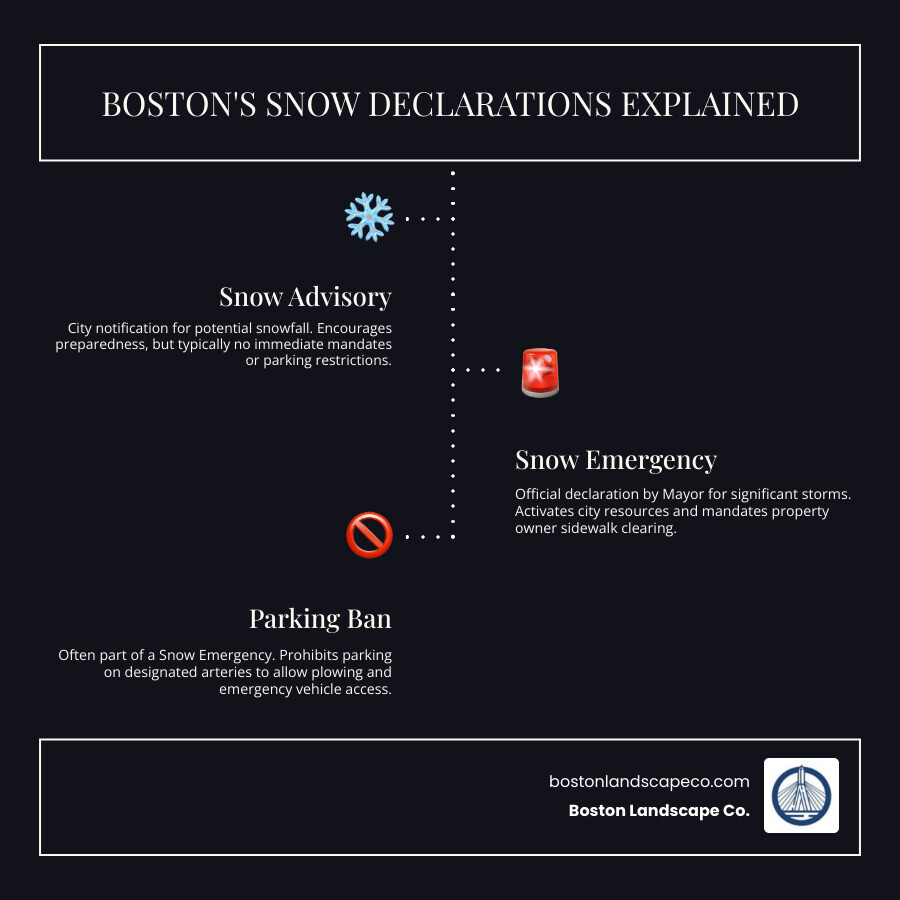
Emergency snow removal Boston terms simplified:
Decoding Boston’s Snow Removal Mandates
Boston winters are no joke, and the City of Boston has clear regulations to ensure public safety and accessibility. As property owners in Boston and the surrounding communities we serve, like Stoneham, Billerica, and Lexington, it’s crucial to understand these rules. Failure to comply can lead to fines and, more importantly, create hazardous conditions for pedestrians and vehicles.
The city’s regulations cover everything from how quickly you must clear your sidewalks to where you can and cannot park during a snow event. These rules are designed to keep Boston moving, even under several feet of snow. We know it can feel like a lot to keep track of, but that’s where local experts like us come in to help you steer the winter wonderland—or nightmare, depending on your perspective!
A core principle is that property owners are responsible for clearing sidewalks and curb ramps abutting their property. This isn’t just a suggestion; it’s a mandate. You can find more details directly from the city: You must clear snow, sleet, and ice from sidewalks and curb ramps abutting your property.
Another critical rule is about snow disposal. You absolutely cannot shovel or push snow from your private property into the street or onto public sidewalks. Doing so can impede traffic, create dangerous obstacles for plows and emergency vehicles, and result in fines. This also applies to businesses that might be tempted to push their parking lot snow onto city property.
During snow emergencies, parking bans are often declared, which means you need to move your vehicle from designated snow emergency arteries. We’ll dive deeper into that shortly. Finally, the contentious “space saver” rules allow residents to temporarily claim a parking spot they’ve shoveled, but these come with strict timelines and geographical limitations. For instance, space savers are banned entirely in the South End and Bay Village.
Your Responsibilities as a Property Owner
Let’s get down to the nitty-gritty of what’s expected of you when the snow starts falling. The City of Boston is very specific about property owner responsibilities.
First, the clock starts ticking the moment the snowfall ends. You must clear snow, sleet, and ice from sidewalks abutting your property within three hours of the snowfall ending. If it snows overnight, you have three hours after sunrise to get the job done. This quick turnaround is vital for pedestrian safety, especially for those commuting to work or school.
It’s not enough to just clear a narrow path. You must create at least a 42-inch-wide path on sidewalks. Why 42 inches? This width ensures that individuals using wheelchairs, strollers, or other mobility devices can pass safely and comfortably. Accessibility is a key concern for the city, and we fully support this requirement.
Ice is often more treacherous than snow. After clearing the snow, you need to treat icy patches to bare pavement or make them level and treat them with sand or sawdust to provide traction. This is where de-icing agents like salt or pet-safe ice melt become invaluable.
Don’t forget the curb ramps! These are critical access points for people with disabilities. You are required to clear curb and pedestrian ramps to the street fully and continually over the duration of the storm to ensure they remain accessible.
Another often-overlooked responsibility is clearing fire hydrants and catch basins. While not strictly mandated for private property owners, keeping these clear helps prevent flooding (when snow melts) and ensures that firefighters can quickly access hydrants in an emergency. If you’re able, we highly recommend taking a few extra minutes to clear any hydrants or catch basins near your property.
Failure to comply with these shoveling rules can lead to fines. The city takes this seriously, and so do we. If you see an unshoveled sidewalk, you can report it to 311: Report an unshoveled sidewalk. For our commercial clients, we understand that maintaining clear and safe sidewalks is paramount for customer access and avoiding liability. Our Commercial Sidewalk Snow Removal services are specifically designed to meet these stringent requirements.
Navigating a Declared Snow Emergency
When a major snowstorm is heading our way, Mayor Wu or city officials will often declare a snow emergency. This isn’t just a heads-up; it triggers a cascade of city-wide actions and specific rules you need to follow.
The most immediate and impactful consequence of a snow emergency is the declaration of parking bans. These bans restrict parking on designated “snow emergency arteries”—main roads that need to be clear for plows and emergency vehicles. The city has 2,000 lane miles of roadway to plow, and these arteries are prioritized. To avoid being ticketed and towed, move your car. We highly recommend signing up for alerts from the city: Get an alert next time. AlertBoston is a great resource that can send notifications directly to your phone.
If your car is towed, it’s not a fun experience (trust us, we’ve seen it happen!). The city provides discounted parking garages during snow emergencies to give residents an alternative. Always check the City of Boston website for a list of available garages and their locations.
The city’s plowing priorities during a snow emergency focus on keeping main roads, routes for emergency vehicles, and public transportation routes clear. Protected bike lanes are also a priority and are typically cleared within 24 hours after snowfall ends. The Public Works Department (PWD) deploys its 175 in-house pieces of equipment and can call upon over 800 additional pieces during larger storms, operating across 200 plowing routes.
It’s also important to remember that snow removal isn’t just a city-level effort. Highways like I-93 are cleared by the Massachusetts Department of Transportation (MassDOT), while parkways such as the Jamaicaway, Storrow Drive, and Morrissey Boulevard are handled by the Massachusetts Department of Conservation and Recreation (MassDCR). This coordination ensures that major transportation arteries across the state remain as clear as possible.
Standard vs. Emergency Snow Removal: What’s the Difference?
When it comes to snow removal, not all services are created equal. We often get calls from clients asking about the difference between standard, contract-based snow removal and emergency snow removal Boston. It’s a crucial distinction that impacts response times, service scope, and cost.
Standard snow removal is typically a proactive, contract-based service. Clients, especially commercial properties and larger residential complexes, sign up for seasonal contracts before winter even begins. This allows us to plan routes, allocate equipment, and ensure that your property is on our schedule for every significant snowfall. It’s about consistent maintenance, ensuring your property remains safe and accessible throughout the winter.
Emergency snow removal Boston, on the other hand, is reactive and on-demand. It’s for those unexpected, urgent situations that arise during or immediately after a storm. Think of it as calling for a rapid response team when things go sideways. These services are typically deployed when safety is compromised, access is completely blocked, or there’s a risk of damage if snow isn’t removed immediately.
The response time is the most significant difference. For standard contracts, we follow a pre-determined schedule based on snowfall accumulation. For emergency calls, we mobilize as quickly as possible, often within hours, because the situation demands immediate attention. This rapid response capability, combined with the flexibility required to divert resources, naturally comes with a different cost structure, often higher than pre-negotiated contract rates.
Here’s a quick comparison:
| Feature | Standard Snow Removal | Emergency Snow Removal |
|---|---|---|
| Service Type | Scheduled, Proactive | On-demand, Reactive, Urgent |
| Contract | Pre-season contract | Ad-hoc or part of a comprehensive emergency plan |
| Response Time | Scheduled based on snow depth/timing | Immediate to 2-hour response (often 24/7) |
| Cost Structure | Seasonal flat rate, per-event, or per-inch pricing | Hourly, per-visit, or premium rates for urgency |
| Equipment | Standard plow trucks, shovels, salt spreaders | Heavy-duty equipment, specialized tools, additional crews |
| Availability | During and after regular snowfall | 24/7 during critical storm conditions |
What Qualifies for Emergency Snow Removal Boston?
So, when do you truly need emergency snow removal Boston? It’s more than just “a lot of snow.” It’s about situations that pose immediate threats or critical disruptions.
- Blocked Emergency Access: This is paramount. If snowdrifts or large accumulations block fire lanes, hospital entrances, or access points for police and ambulance services, it’s an immediate emergency. For medical facilities, maintaining clear access is non-negotiable.
- Impassable Driveways or Parking Lots: For businesses in our service areas like Waltham, Woburn, or Medford, an impassable parking lot means lost revenue and frustrated customers. If your commercial property’s main access points or parking areas are completely snowed in, halting operations, that qualifies as an emergency.
- Roof Collapse Risk: Heavy, wet snow can put immense stress on roofs, especially on older buildings or large commercial structures. If you notice signs of structural strain, or if the snow load is dangerously high, immediate snow removal from the roof is critical. Safety first: More on Roof Safety advises hiring professionals for this dangerous task.
- Business Closure Risk: Beyond just parking lots, if snow accumulation prevents employees from getting to work, blocks loading docks, or makes your facility unsafe for operations, it’s an emergency that threatens your business continuity.
- Severe Ice Accumulation: Ice is arguably more dangerous than snow. Black ice, freezing rain, or significant ice buildup on walkways, parking lots, and stairs creates extreme slip-and-fall hazards. This not only risks injury but also exposes property owners to significant liability. Our Commercial Ice Management services are crucial in these scenarios.
These situations require immediate attention, and we are equipped to handle them with rapid deployment.
How to Contact an Emergency Snow Removal Boston Service
When an emergency strikes, you don’t have time to sift through phone books or wait for business hours. That’s why professional emergency snow removal Boston services typically offer 24/7 hotlines. For us, being “here when you need us” isn’t just a motto; it’s a commitment.
When you contact an emergency service, whether by phone or online request form, be prepared to provide critical information quickly:
- Property Address: The exact location, including suite or unit numbers if applicable.
- Type of Emergency: Clearly describe the problem. Is it a blocked driveway? Dangerous ice? A collapsing roof? The more specific you are, the better we can understand the situation and dispatch the right team and equipment.
- Site Access Details: Are there gates? Specific entry codes? Obstacles to be aware of? Any areas that are particularly sensitive?
- Contact Person On-Site: Provide a name and phone number for someone who can meet our crew or be available for questions once we arrive.
Having this information ready will significantly speed up our response time, helping us get to you faster when every minute counts.
What to Expect from Professional Emergency Snow Removal Boston Services
When you call on us for emergency snow removal Boston, you’re not just getting a plow truck; you’re getting a coordinated, professional response aimed at quickly resolving your snow-related crisis.
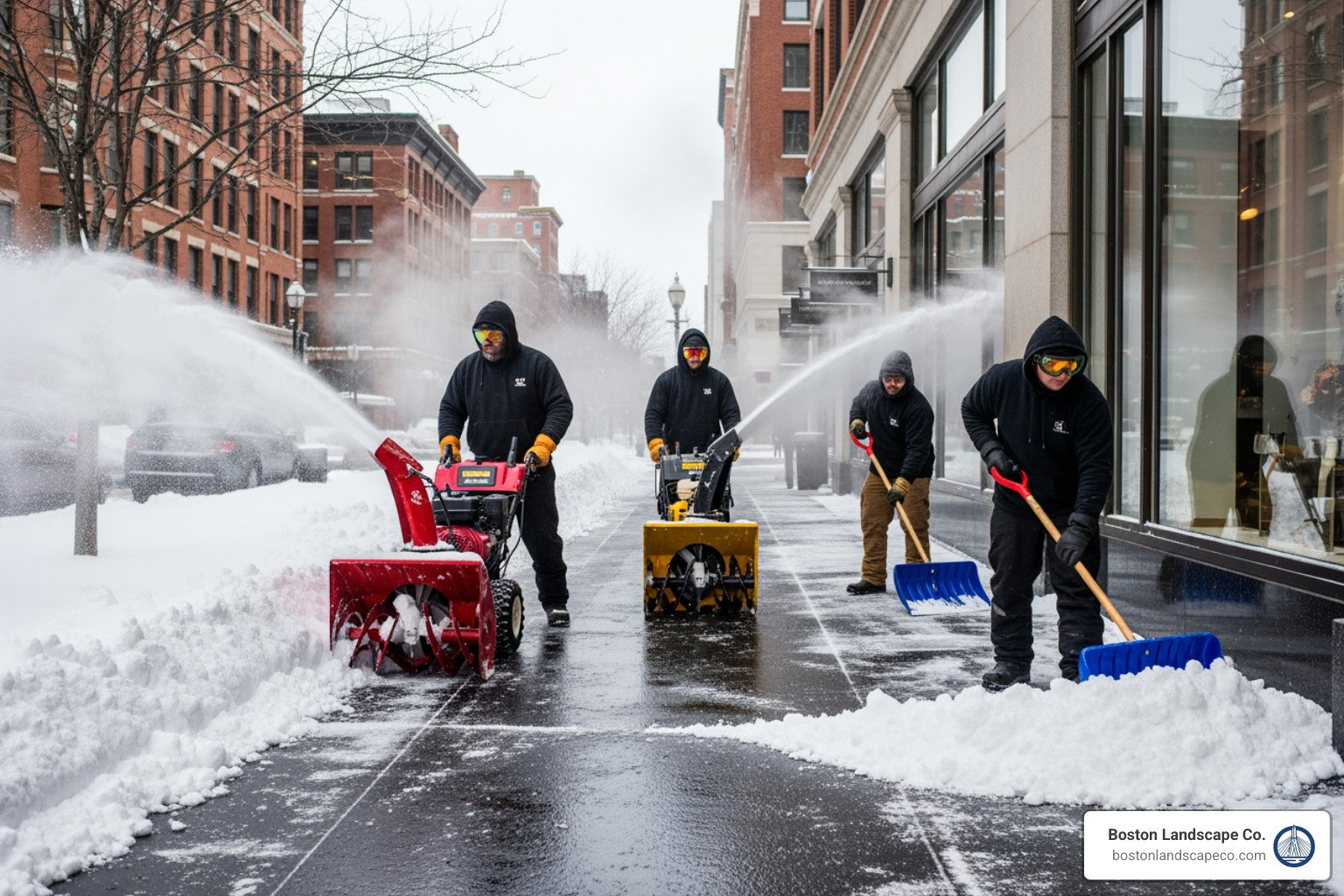
Our process typically begins with a rapid response. We understand the urgency, and our teams are on standby during major snow events. Once contacted, we perform a quick site assessment to confirm the scope of work and potential hazards. Throughout the process, clear communication protocols are in place. You can expect updates on our estimated arrival, progress, and completion.
For our commercial clients, service level agreements (SLAs) often define the expected response times and service standards, even for emergencies. Crucially, professional services like ours carry comprehensive insurance and liability coverage. This protects both our team and your property in case of any unforeseen incidents. Understanding Winter Liability Risks for Businesses: Snow Removal and Legal Responsibility is vital, and choosing an insured provider mitigates your risk.
Equipment and Techniques for Major Storms
Tackling Boston’s heavy snowfall requires serious firepower. We use a diverse fleet of specialized equipment to handle any snow removal challenge:
- Plow Trucks: Our backbone for clearing roadways, driveways, and parking lots.
- Skid-Steers: Agile and powerful, perfect for clearing sidewalks, tight spaces, and stacking snow.
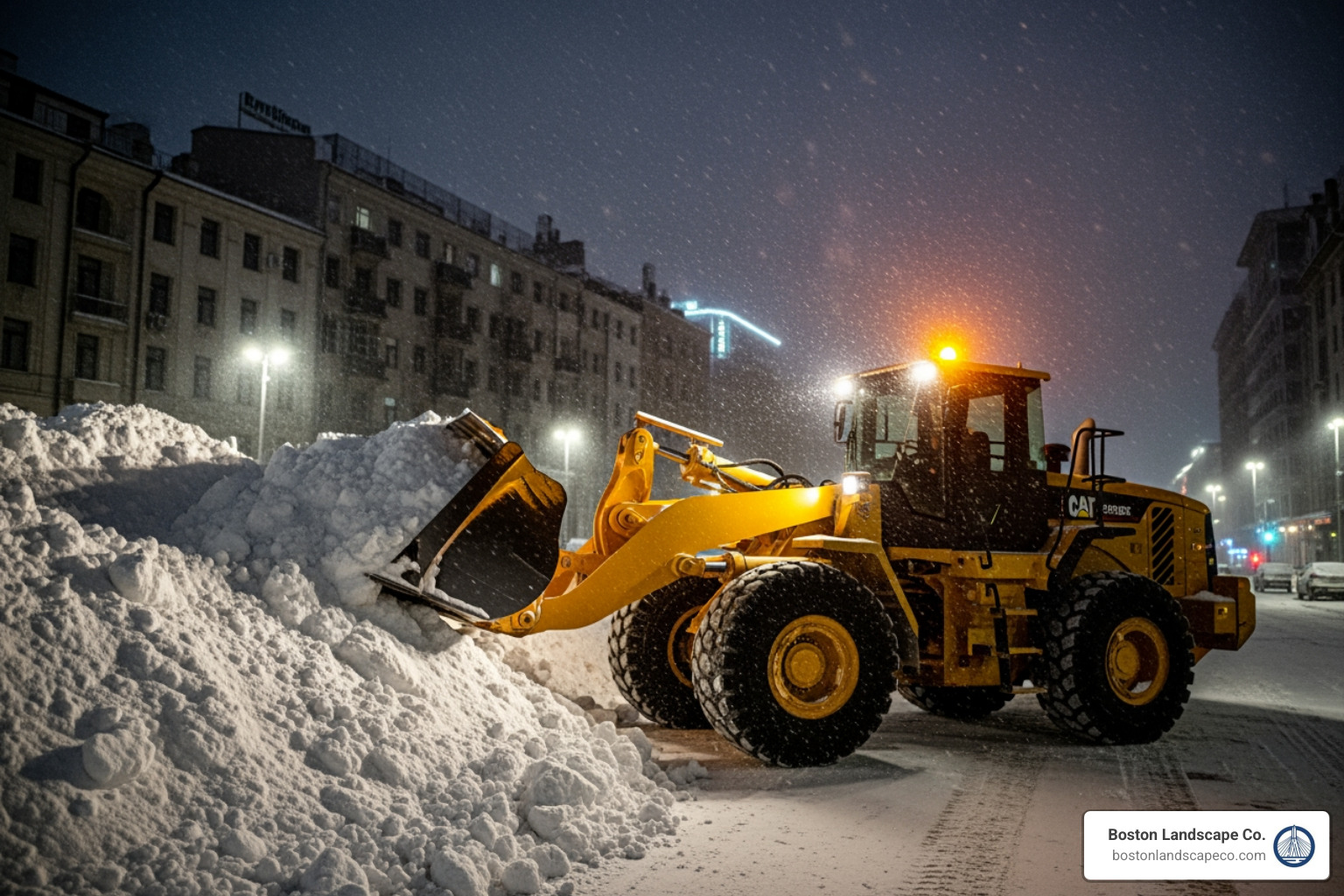
- Front-End Loaders: Essential for moving large volumes of snow, especially for snow hauling operations.
- Dump Trucks for Hauling: When on-site storage is limited, these trucks transport snow off-site to designated dump locations.
- Salt Spreaders: For applying rock salt or other granular de-icers to prevent ice buildup and improve traction.
- Liquid De-icers: Pre-treatment liquids that prevent snow and ice from bonding to surfaces, making removal easier and more effective.
- Snow Blowers: For precise clearing of walkways, entrances, and areas where plows can’t reach.
Our Commercial Snow Removal Equipment is regularly maintained and updated to ensure peak performance when winter hits. For major storms, we also have backup equipment and mobile repair services to minimize downtime, ensuring continuous operation.
Commercial vs. Residential Emergency Needs
While the goal is always to clear snow, the priorities and scale of emergency snow removal Boston differ significantly between commercial and residential properties.
For commercial properties, the focus is heavily on business continuity. This means:
- Parking Lot Snow Plowing is critical to ensure customers and employees have safe access.
- Loading dock clearing keeps supply chains moving.
- Walkway safety for customers is paramount to prevent slip-and-fall incidents and maintain a welcoming environment.
- Access to dumpsters and other essential services must be maintained.
We understand that for businesses in areas like Burlington, Concord, or Stoneham, every hour of closure or reduced accessibility can mean lost revenue. Our services aim to get you back to full operation as quickly as possible.
For residential properties, the primary concern is personal access and safety:
- Driveway Snow Removal Service ensures residents can get in and out of their homes.
- Clear pathways to front doors and garages are essential.
- Mailbox and fire hydrant access may be important for residents to consider, though usually less critical than emergency vehicle access.
While residential emergencies are often smaller in scale, they are no less important to the homeowner.
Snow Hauling and Off-Site Disposal
After a particularly heavy snowfall, especially in dense urban areas like Boston, simply plowing snow to the side isn’t always enough. This is when snow hauling and off-site disposal become necessary.
Hauling is required when:
- Limited on-site storage space: Many properties, especially commercial ones, simply don’t have enough room to pile up massive amounts of snow without blocking parking spaces, entrances, or visibility.
- Large volume removal: After a major Nor’easter, the sheer volume of snow can overwhelm available space.
- Maintaining usable property: To ensure your parking lots, walkways, and access points remain fully functional, hauling snow away is the best solution.
We deploy front-end loaders to scoop up the snow and dump trucks to transport it to designated snow dump locations, often outside the city. This process ensures that your property is not only clear but also remains fully usable, preventing the accumulation of unsightly and inconvenient snow mountains. This specialized service is crucial for many businesses we serve in the Greater Boston area.
Preparing Your Property for a Snow Emergency
An ounce of prevention is worth a pound of snow removal. The best approach to emergency snow removal Boston is to minimize the chances of an emergency in the first place through proactive measures and pre-season planning.
Establishing a relationship with a reputable service provider like Boston Landscape Co. before the snow flies is key. This allows us to assess your property, understand your specific needs, and create a detailed site plan. We can identify potential obstacles, discuss snow piling locations, and ensure we’re ready to go when the first flake falls. Our Winter Preparedness: Why Your Business Needs Professional Snow Removal guide offers more insights into this.
During this planning phase, we can also discuss marking obstacles like curbs, fire hydrants, and delicate landscaping elements with snow stakes. This helps our crews operate efficiently and safely, minimizing damage during low-visibility conditions.
Pre-Storm Checklist for Homeowners and Businesses
As a storm approaches, here’s a checklist to help both homeowners and businesses prepare:
- Clear Gutters: Ensure your gutters are free of leaves and debris to prevent ice dams and proper drainage when snow melts.
- Trim Overhanging Branches: Remove any weak or dead tree branches that could break under the weight of snow and ice, potentially damaging your property or blocking access.
- Stock Up on Supplies: Have an ample supply of rock salt or pet-safe ice melt for your walkways and steps. For homeowners, ensure you have shovels, warm clothing, and emergency supplies (batteries, flashlights, non-perishable food).
- Ensure Exterior Lighting Works: Good lighting is crucial for safety during and after snow events, especially for commercial properties and for anyone shoveling at night.
- Move Vehicles: If a parking ban is anticipated, move vehicles from snow emergency arteries to designated off-street parking or discounted city garages.
- Communicate Plans: For businesses, communicate your snow removal plan to employees and tenants. For homeowners, let family members know what to expect.
- Clear Catch Basins and Fire Hydrants: If you’re able, clear any catch basins or fire hydrants near your property. This helps prevent localized flooding from melting snow and ensures emergency access.
- Check Detectors: Ensure smoke and carbon monoxide detectors have fresh batteries. Snow can block heater vents or car exhaust pipes, leading to dangerous carbon monoxide buildup.
Frequently Asked Questions about Boston Snow Emergencies
We know Boston’s snow rules can be a bit confusing, so here are answers to some of the most common questions we hear:
How quickly must I shovel my sidewalk in Boston?
Property owners in Boston must clear sidewalks within three hours of snowfall ending. If the snow stops falling overnight, the deadline is three hours after sunrise. Additionally, you must clear a path that is at least 42 inches wide to ensure accessibility for wheelchairs and strollers.
Can I be fined for not shoveling or for pushing snow into the street?
Yes, absolutely. The City of Boston can issue fines for failing to clear your sidewalk within the mandated timeframe. They can also fine you for illegally pushing, shoveling, or plowing snow from your private property onto public streets or sidewalks. This is to prevent creating new hazards and interfering with city plowing operations.
What is the difference between a snow emergency and a parking ban?
A snow emergency is an official declaration made by the Mayor of Boston. It signals that a significant snowstorm is expected or underway and activates city-wide resources and protocols. A parking ban is a key component of a snow emergency. It restricts parking on designated “snow emergency arteries” to allow plows and emergency vehicles clear passage. While a snow emergency covers the broader response, a parking ban specifies the parking restrictions.
Stay Safe and Clear with Professional Snow Management
Boston winters are a unique challenge, demanding respect and preparedness. Understanding Boston’s specific rules for snow removal, from sidewalk clearing timelines to parking bans, is the first step in protecting your property and ensuring public safety.
The distinction between standard and emergency snow removal Boston is critical. While proactive contracts keep your property consistently clear, knowing when and how to call for emergency services can be a lifesaver—or a business saver—when urgent situations arise.
At Boston Landscape Co., we pride ourselves on being a trusted, local, and experienced landscaping provider, extending our expertise to comprehensive snow management. Our teams are equipped with the right tools and knowledge to handle everything from routine plowing to critical emergency situations across Boston, Stoneham, Billerica, Lexington, and our other service areas.
For comprehensive and reliable winter services, explore our professional Snow Plowing Services. Let us help you steer the winter season with peace of mind, ensuring your property remains safe, accessible, and compliant with city regulations.
