
Commercial ice management: Secure 2025 Safety
Why Winter Ice Control Is Essential for Your Business Success
Commercial ice management is the strategic prevention and removal of ice from business properties to ensure safety, accessibility, and legal compliance. It’s a comprehensive system involving proactive anti-icing, reactive de-icing, 24/7 weather monitoring, and risk assessment of high-priority areas like walkways and parking lots.
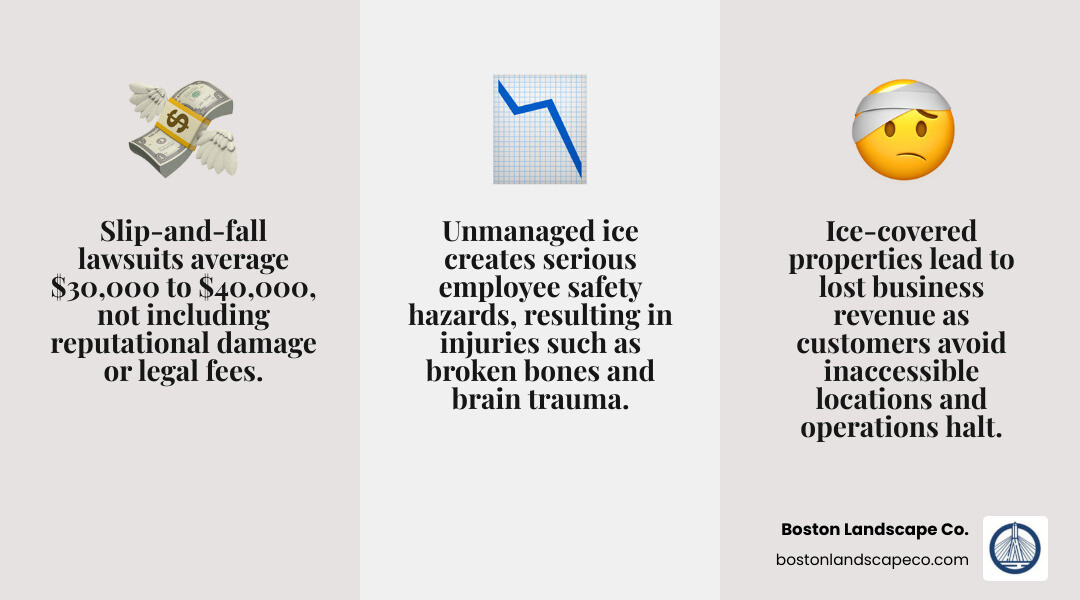
When winter storms hit the Greater Boston area, a well-managed property maintains normal operations, while a neglected one faces lawsuits, lost revenue, and safety hazards. The stakes are high: the average cost of a slip-and-fall injury ranges from $30,000 to $40,000, and failure to maintain a safe property is legally considered negligence.
Beyond liability, ice-covered properties bring business to a halt. Employees can’t get to work, customers stay away, and deliveries stop. A normal business day turns into a costly shutdown.
As Steve Schumacher, owner-operator of Boston Landscape Co with over three decades in the industry, I’ve seen how proper commercial ice management can make or break a business during harsh New England winters. Our comprehensive approach has helped countless commercial properties maintain safe, accessible operations while protecting them from costly liability issues.
Basic Commercial ice management vocab:
Why Ice Management is a Critical Investment for Your Business
For any business in New England, winter is a test of preparedness. Commercial ice management is one of the smartest investments you can make, directly protecting your bottom line, reputation, and the safety of everyone on your property.
Think of it as insurance that prevents problems. The benefits include:
- Improved Safety: Proactively managing ice prevents injuries and emergencies.
- Liability Protection: Demonstrating proper care through professional service shows courts you take safety seriously.
- Business Continuity: While competitors close due to icy conditions, your doors stay open and accessible.
- Property Protection: The right de-icing methods prevent freeze-thaw damage to pavement and landscaping.
- Peace of Mind: With professionals monitoring the weather 24/7, you can focus on your business, not the forecast.
Our team at Boston Landscape Co. offers more info about our commercial services designed for winter risk management. A proactive approach is essential for mitigating snow season risks.
The High Cost of Negligence
Ice can turn a property into a hazard in an instant. A slip-and-fall can lead to devastating injuries like broken hips, fractured wrists, and serious head trauma. Legally, inadequate ice maintenance equals negligence. Courts view proper ice management as a basic responsibility, and failure to meet that standard opens your business to significant liability.
The financial impact is multi-faceted. The average slip-and-fall injury costs between $30,000 and $40,000, but complex cases can be much higher. These costs include medical expenses, compensation for pain and suffering, and lost wages for the injured party. On top of that, legal fees accumulate from the moment a lawsuit is filed. The reputational damage can be the most painful, as word of an unsafe business spreads quickly and can drive away customers for years.
Ensuring Accessibility and Smooth Operations
Your business depends on people reaching you safely. Ice creates barriers that can shut down operations faster than any other winter hazard.
When your property is icy, employee access is compromised, leading to late arrivals and absenteeism that hurts productivity. Customer traffic plummets as people avoid hazardous-looking properties and go to competitors with clear, safe access. Furthermore, deliveries become impossible when trucks can’t steer your loading areas, disrupting your entire supply chain.
Professional commercial ice management ensures your parking lots, walkways, and entrances remain navigable and welcoming. This commitment to accessibility means uninterrupted operations, no matter what winter brings.
Learn more info about keeping your property accessible throughout the challenging New England winter season.
Proactive vs. Reactive: A Tale of Two Ice Control Strategies
When it comes to commercial ice management, there are two fundamental approaches: proactive and reactive. You can either prepare for the storm before it arrives or clean up the mess afterward. One is clearly smarter and more efficient.
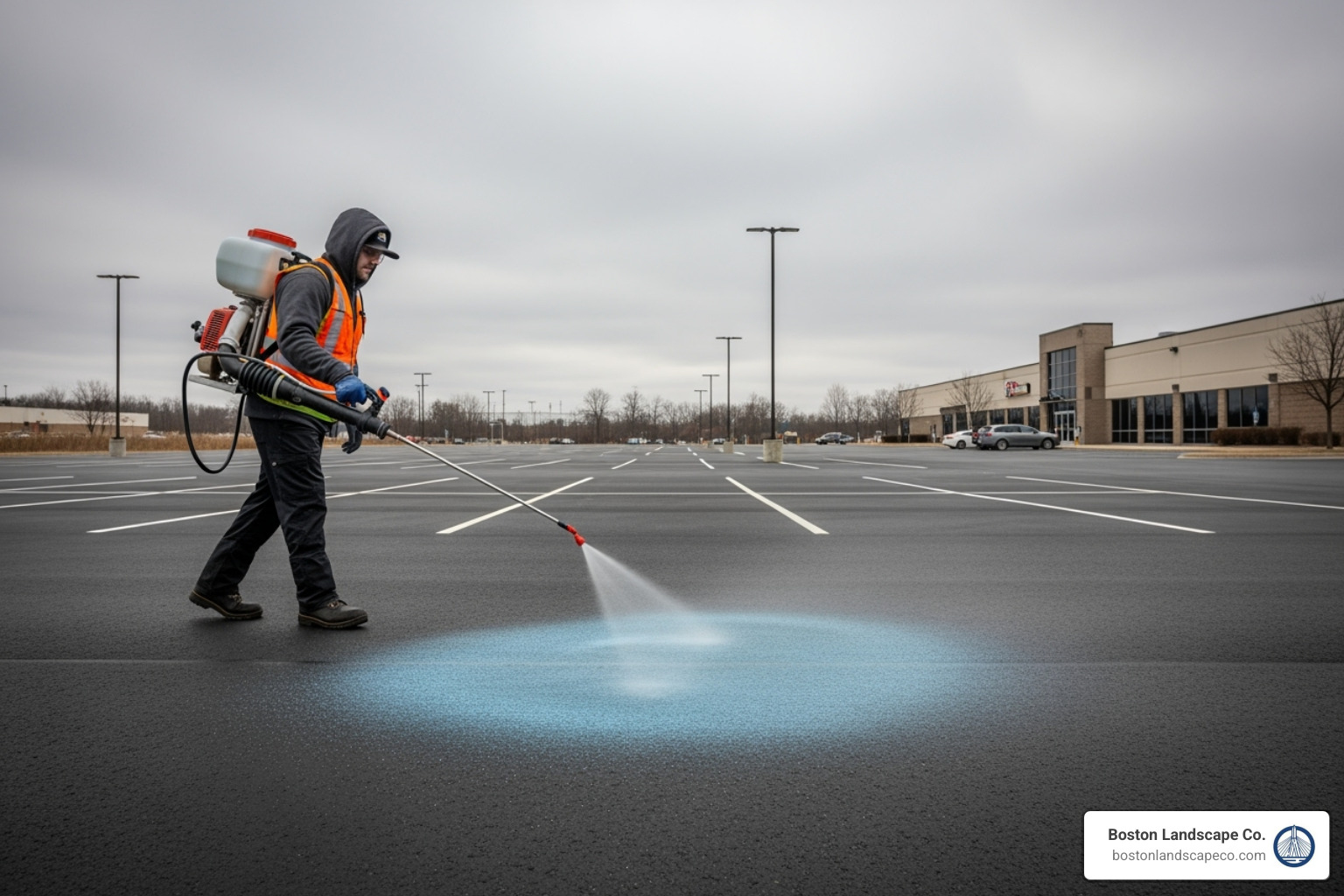
The proactive approach, or anti-icing, involves treating surfaces with liquid agents before a storm. This creates a protective shield that prevents ice from bonding to your pavement.
The reactive approach, or de-icing, happens after ice has already formed. This involves breaking the bond between the ice and the pavement.
While both have their place, a proactive strategy is almost always more cost-effective. Preventing the ice bond makes removal significantly easier and requires less material.
The Power of Anti-Icing: Your First Line of Defense
Anti-icing is one of the smartest investments in winter property management. We apply a liquid de-icing agent, usually a salt brine, to pavement before precipitation starts. This solution creates an invisible barrier that prevents snow and freezing rain from forming a hard bond with the surface.
Instead of chipping away at solid ice, you’re left with a slushy mixture that’s easily plowed or shoveled. A single application can be effective for weeks without new precipitation and works at temperatures as low as -32°F. We focus anti-icing on high-traffic areas like sidewalks and entrances, which improves safety and reduces the amount of de-icing material needed later, saving you money.
Understanding De-Icing: The Essential Reactive Solution
Even with a great anti-icing strategy, de-icing is still a crucial part of commercial ice management. It’s necessary when a storm deviates from the forecast, temperatures drop unexpectedly, or slush refreezes into black ice.
De-icing involves applying granular or liquid agents to existing ice to break its bond with the pavement. These agents work by lowering the freezing point of water, turning ice back into slush. We use this method after plowing to clear remaining packed snow and ice, focusing on critical areas like parking lot entrances, pedestrian walkways, and loading docks to keep your property safe and operational.
The Core Components of a Professional Commercial Ice Management Plan
A professional commercial ice management program is a carefully orchestrated system, not a last-minute reaction. It starts months before the first storm and continues all winter, ensuring your property is protected.
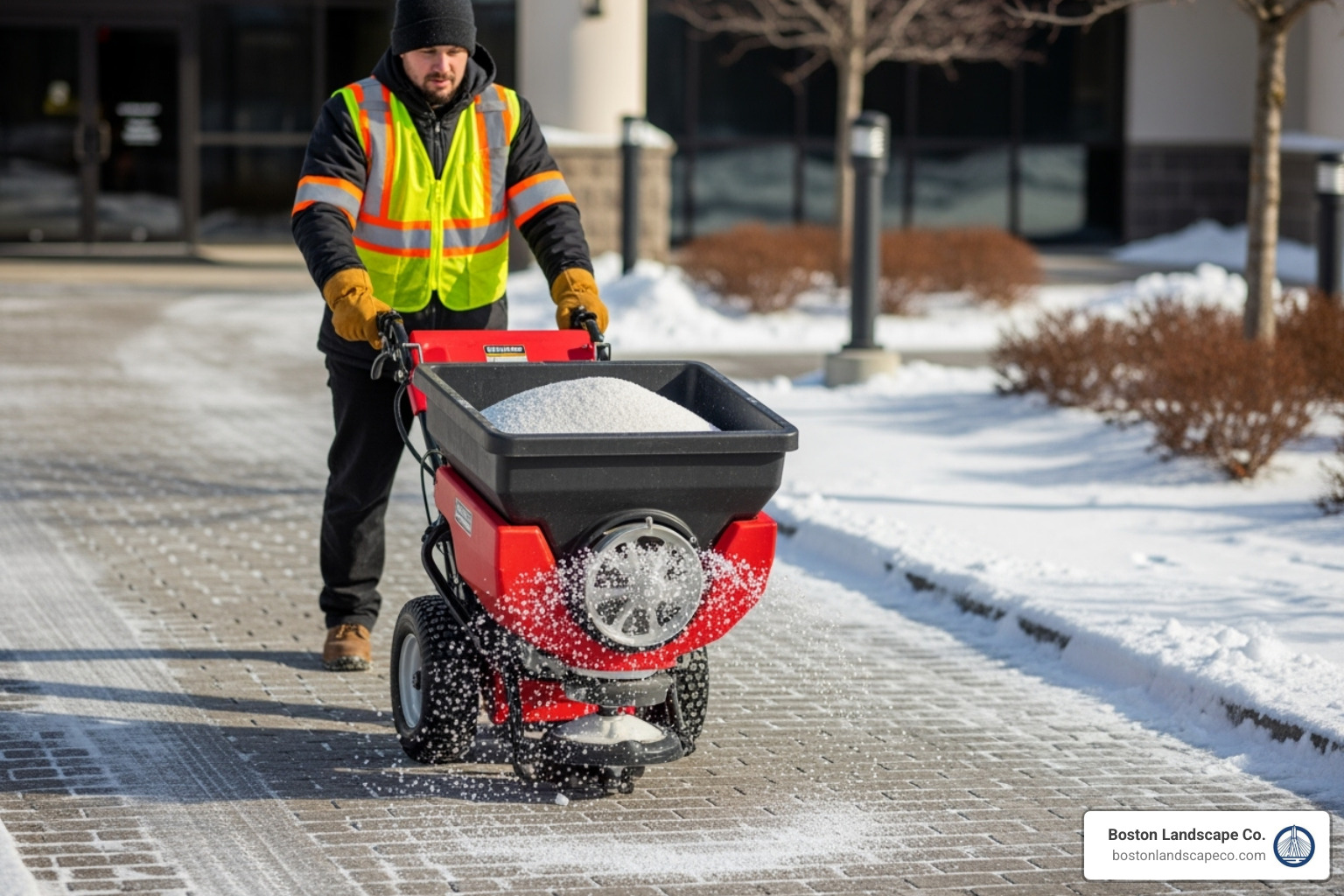
The foundation is a thorough site assessment to identify trouble spots like drainage issues, slopes, and high-traffic zones. From there, we establish protocols for:
- Pre-storm mobilization: When our monitoring detects a storm, we load equipment and stage materials, often applying anti-icing treatments before the first snowflake falls.
- In-storm service: This includes active snow plowing and strategic de-icing, with crews working around the clock to adapt to changing conditions.
- Post-storm reporting: You receive clear communication on services performed, timing, and materials used. No guesswork, just transparency.
The Role of Advanced Weather Monitoring
Professional commercial ice management relies on sophisticated weather monitoring that goes beyond a simple forecast. Pavement temperature can be much lower than air temperature, allowing ice to form unexpectedly. We use 24/7 tracking systems that provide hyper-local data for your property’s specific microclimate.
Pavement temperature sensors are a game-changer, giving us a crucial head start to apply anti-icing treatments. We also analyze real-time forecasts from multiple sources, focusing on precipitation types and temperature shifts. This data helps us establish trigger points for service—specific conditions that automatically activate our response. This intelligence ensures our crews are dispatched at precisely the right time for maximum effectiveness.
Choosing the Right De-Icing Agents for Your Property
Not all de-icing agents are created equal. The right choice depends on conditions, budget, and environmental concerns.
- Rock salt (sodium chloride) is the affordable industry workhorse, effective down to about 15°F. However, it can be corrosive to concrete and harmful to landscaping.
- Calcium chloride works faster and in colder temperatures (down to -15°F). It’s less corrosive than rock salt but still requires careful application near vegetation.
- Magnesium chloride is a gentler option for plants and concrete, effective to about 5°F, but comes at a higher cost.
- Liquid brine is our preferred choice for anti-icing. This salt-water mixture starts working immediately and uses less material than granular products, reducing environmental impact.
| De-Icing Agent | Effectiveness | Temperature Range | Cost | Environmental Impact |
|---|---|---|---|---|
| Rock Salt (Sodium Chloride) | Effective, widely available | Down to -9°C (15°F) | Low | Can corrode concrete/metal, harmful to plants/grass, can contaminate water supplies |
| Calcium Chloride | Very effective, fast-acting | Down to -26°C (-15°F) | Medium | Less corrosive than rock salt, but can still harm vegetation if over-applied. Absorbs moisture, can leave residue |
| Magnesium Chloride | Effective, less corrosive than rock salt | Down to -15°C (5°F) | Medium-High | Less harmful to plants and concrete than sodium chloride |
| Potassium Acetate | Highly effective, airport-friendly | Down to -60°C (-76°F) | High | Biodegradable, low toxicity, very low corrosion |
| Liquid Brine (Salt/Water Mix) | Excellent for anti-icing, faster action | Varies by concentration/mix | Low-Medium | Less material used, so less environmental impact than granular salt |
We match the agent to your specific situation, considering factors like landscaping sensitivity and traffic patterns to maximize safety while minimizing environmental impact.
Selecting Your Professional Ice Management Partner
Choosing the right partner for your commercial ice management is a critical decision that impacts your safety, liability, and winter operations. You wouldn’t trust just anyone with your finances; the same standard should apply to protecting your property and people.
When evaluating providers, look for these key qualities:
- Experience: You need a team that has weathered many New England winters. At Boston Landscape Co., we bring over three decades of experience to every job.
- Insurance: Ensure your provider carries comprehensive liability insurance to protect your business.
- Equipment: A fleet of well-maintained, commercial-grade equipment is non-negotiable for timely and effective service.
- Communication: Look for a company with clear protocols for pre-storm, in-storm, and post-storm updates.
- Certifications: Industry training from organizations like SIMA shows a commitment to best practices.
Why Industry Certification Matters for Commercial Ice Management
Certifications from the Snow & Ice Management Association (SIMA) are more than just a credential; they represent a commitment to a higher standard. The science and strategy behind effective ice management are complex.
SIMA-certified professionals are trained in:
- Industry Best Practices: They understand advanced de-icing techniques, proper application rates, and environmental considerations.
- Risk Management: A core part of the training focuses on identifying potential hazards and taking proactive steps to mitigate slip-and-fall liability.
- Professionalism: Certification signifies a dedication to high ethical standards, accountability, and continuous improvement.
Working with a certified team means you’re partnering with experts who prioritize safety and efficiency.
Establishing Clear Communication and Expectations
Once you’ve chosen a provider, establishing clear expectations is key to a successful partnership. This starts with a detailed Service Level Agreement (SLA), your roadmap for the winter. The SLA should specify service areas, response triggers (e.g., snow depth), and materials to be used.
Clear communication protocols are just as vital. We work with you to determine how you’ll receive updates, whether by text, email, or phone. During our pre-season meetings, we walk your property with you to mark hazards, note sensitive landscaping, and align on priorities.
After each event, we provide post-event reports documenting all services performed. This transparency provides accountability and can be invaluable for insurance or legal purposes. Effective communication is a two-way street, ensuring we can adapt to your needs throughout the season.
Frequently Asked Questions about Commercial Ice Services
Business owners often have questions about commercial ice management. With three decades of experience in New England winters, here are my answers to the most common ones.
How much does commercial ice management cost?
The cost of ice management varies widely depending on your needs. The following figures are average costs based on internet data from various providers and are not actual costs for Boston Landscape Co. We provide customized quotes based on your specific property.
Pricing is typically structured in one of three ways: per-event, per-visit, or a seasonal contract with a flat rate for budget predictability. Key factors influencing the cost include property size and complexity, the level of service required (e.g., anti-icing, sidewalk clearing), and your chosen service triggers.
Based on internet data, commercial plowing rates can range from $50 to over $160 per hour, with emergency services potentially reaching $500 per hour or more depending on storm severity. De-icing material costs also vary based on the agent used and the application rate.
What are the most common mistakes businesses make?
I’ve seen businesses make the same costly mistakes year after year. The most common include:
- Waiting too long: By the time the first snow falls, the best contractors are already booked.
- Choosing on price alone: The cheapest bid often means unreliable service, inadequate equipment, or insufficient insurance, leaving you exposed.
- Lacking a clear contract: Without a detailed Service Level Agreement, misunderstandings about service expectations are inevitable.
- Ignoring pedestrian areas: Focusing only on parking lots while neglecting sidewalks and entryways is a major safety and liability risk.
How can I prepare my property for winter?
Smart winter preparation starts long before the first storm. A pre-season site walk with your provider is the most valuable step to identify problem areas and set priorities.
Next, mark hazards and obstacles like curbs, fire hydrants, and storm drains with bright stakes to prevent damage. Perform a drainage inspection to clear catch basins of debris, preventing meltwater from refreezing into dangerous ice patches.
Finally, review your landscaping by trimming overhanging branches and securing any outdoor furniture or equipment. Establishing clear communication protocols with your provider is the final step to ensuring a smooth partnership.
For more info about property preparation, we’re always happy to discuss how to get your property winter-ready.
Conclusion
Winter in the Greater Boston area doesn’t have to be a source of stress for your business. Professional commercial ice management is a comprehensive strategy that protects your operations, your customers, and your bottom line.
With slip-and-fall injuries averaging $30,000 to $40,000, the cost of neglect far outweighs the investment in professional service. A proactive approach, centered on anti-icing and strategic de-icing, is always the most effective and cost-efficient path.
Having the right partner makes all the difference. A SIMA-certified professional brings industry knowledge, advanced weather monitoring, and specialized equipment to turn a potential winter disaster into a managed event. They understand the unique needs of your property and prioritize clear communication.
At Boston Landscape Co., we have steerd New England winters for over three decades, helping businesses thrive by managing their winter risks. Don’t let ice put your business on thin ice this winter. Take control with a professional plan that keeps everyone safe and your operations running smoothly.
Contact us for a comprehensive snow and ice management plan custom specifically to your commercial property’s unique needs.
