
Educational Wetland Landscape Architecture: 2025’s Ultimate Benefits
Why Educational Wetlands Are Changing Learning and Landscapes
Educational wetland landscape architecture combines ecological restoration with hands-on learning to create living laboratories that benefit both students and the environment. These carefully designed ecosystems serve dual purposes: managing stormwater while providing immersive educational experiences that teach environmental science, biology, and sustainability principles.
Key Components of Educational Wetland Design:
- Constructed wetlands that mimic natural functions for water filtration and habitat creation
- Boardwalks and observation platforms for safe student access and wildlife viewing
- Native plant communities that demonstrate local ecology and support biodiversity
- Integrated curriculum connections linking wetland functions to STEM education
- Community engagement opportunities through volunteer programs and public access
The results speak for themselves. The Willow School in New Jersey treats 380,000 gallons of wastewater annually through its constructed wetland system while engaging all 250 students in hands-on environmental education. Students at the school consistently demonstrate strong environmental literacy – with 82% identifying landscape features like wetlands as green building elements and 86% understanding proper stormwater management principles.
These projects deliver measurable benefits beyond education. Constructed wetlands remove approximately 45% of total nitrogen and 60% of suspended solids from stormwater, while creating valuable wildlife habitat and reducing flood risks. The Staten Island Bluebelt project saves over $80 million in conventional sewer costs while managing stormwater for 14,000 acres.
I’m Steve Schumacher, owner-operator of Boston Landscape Co., and in my three decades of landscaping experience, I’ve seen how educational wetland landscape architecture creates lasting impact for both communities and ecosystems. Our team specializes in integrating sustainable water management with educational design to create outdoor classrooms that inspire environmental stewardship.
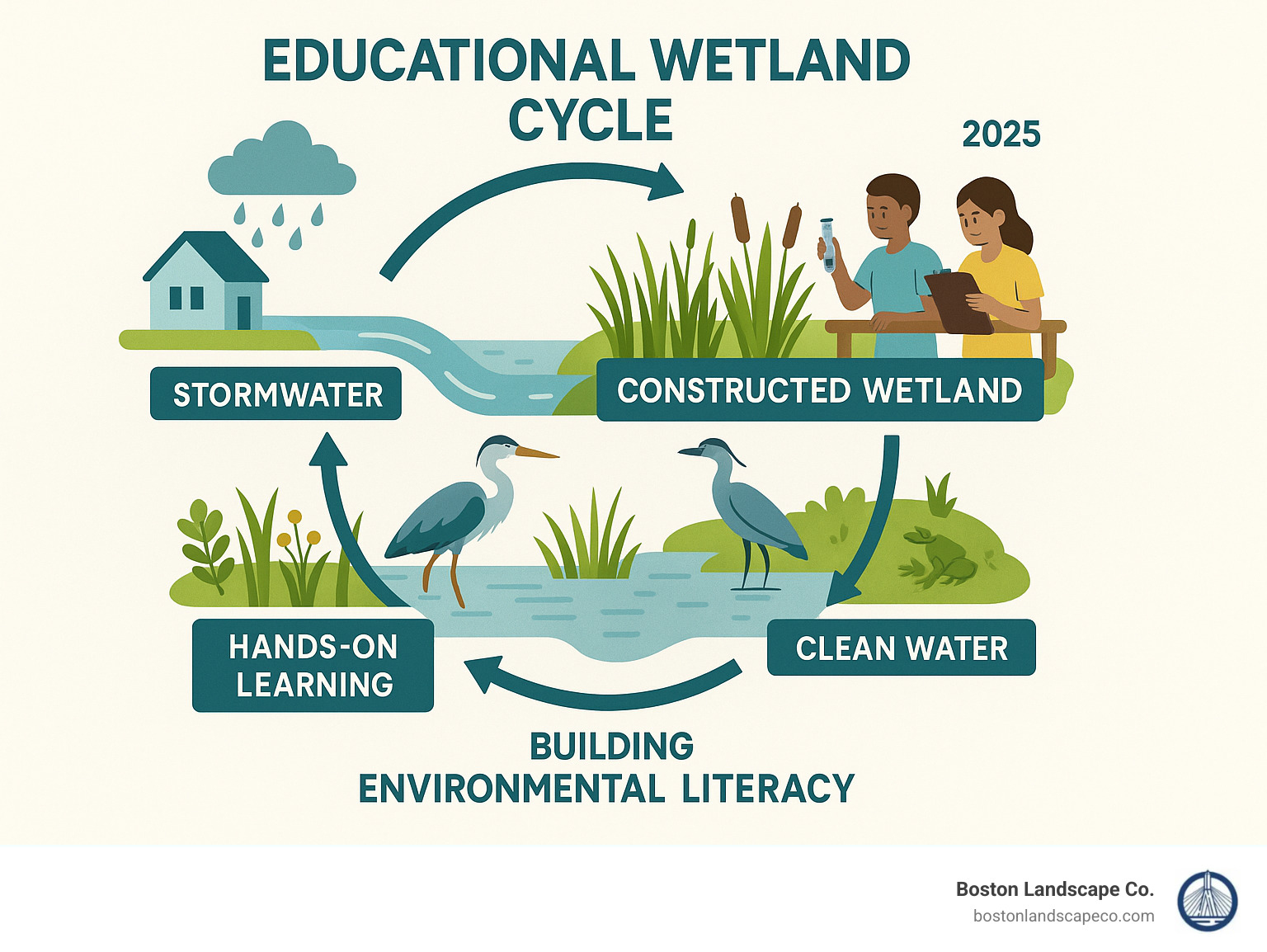
Explore more about educational wetland landscape architecture:
- wetland design landscape architecture
- constructed wetlands in the sustainable landscape
- Ecological Restoration
What is Educational Wetland Landscape Architecture?
Educational wetland landscape architecture transforms outdoor spaces into living classrooms. These systems serve a dual purpose: performing critical ecological functions like stormwater management and habitat creation, while also providing immersive educational experiences. The goal is to make abstract concepts like nutrient cycling and biodiversity tangible by allowing students to observe them firsthand.
The Core Objectives of Designing for Learning
The heart of this practice is fostering environmental literacy. By connecting students to nature, these landscapes make complex ecological principles accessible. When students can test water quality or track seasonal changes, they gain a deeper understanding than a textbook can provide. This approach also offers ongoing research opportunities, allowing classes to contribute to long-term environmental monitoring. The design must be flexible, catering to younger students observing wildlife and older students conducting data analysis.
Learn more about our comprehensive wetland services and how we can help create educational wetlands in your community.
Natural vs. Constructed Wetlands
While natural wetlands evolve over thousands of years, constructed wetlands are engineered systems designed to mimic natural functions in a controlled, predictable manner. They use specific growth media and water-loving vegetation to filter stormwater and support wildlife.
The key advantage of constructed wetlands for education is their design flexibility and accessibility, particularly in urban environments. They can be integrated with boardwalks, observation decks, and sampling stations, allowing safe student interaction without harming the ecosystem. This purposeful site integration ensures educational objectives are met alongside environmental ones, like improved water quality and biodiversity.
For more information about the science behind these systems, visit the EPA’s research on green infrastructure performance.
The Multifaceted Benefits of Living Laboratories

Educational wetland landscape architecture solves more than one problem at a time. A single installation can clean stormwater, shelter wildlife, reduce flooding, and function as an outdoor classroom.
Environmental Gains
- Removes roughly 45 % of total nitrogen and 60 % of suspended solids from runoff.
- Creates immediate habitat—species such as red-winged blackbirds often appear in the first season.
- Stores stormwater to lower flood risk; projects like the Staten Island Bluebelt have shown up to 350,000 gal of temporary storage during big storms.
- Encourages carbon sequestration because saturated soils slow organic decay.
Educational & Social Value
- Turns abstract STEM lessons into tangible experiences—students test water, track species, and graph real-world data.
- Integrates easily across subjects: chemistry (pH testing), math (data analysis), art (field-guide sketches), and social studies (policy discussions).
- Becomes a community hub for weekend walks, volunteer days, and citizen-science events.
Economic Advantages
- Compared with conventional infrastructure, constructed wetlands can cost far less. Seadrift, TX built a 110-acre wetland for about US $1.3 million versus a projected US $40 million treatment plant (figures are public-domain averages, not Boston Landscape Co. pricing).
- Schools often trim water bills; The Willow School saves ≈375,000 gal of potable water every year and reduces operating costs by over US $4,000.
- Grant programs frequently prioritize projects that combine education and green infrastructure.
For a deeper dive into ecosystem services, download The Case for Green Infrastructure.
The Blueprint for Success: Design, Planning, and Implementation
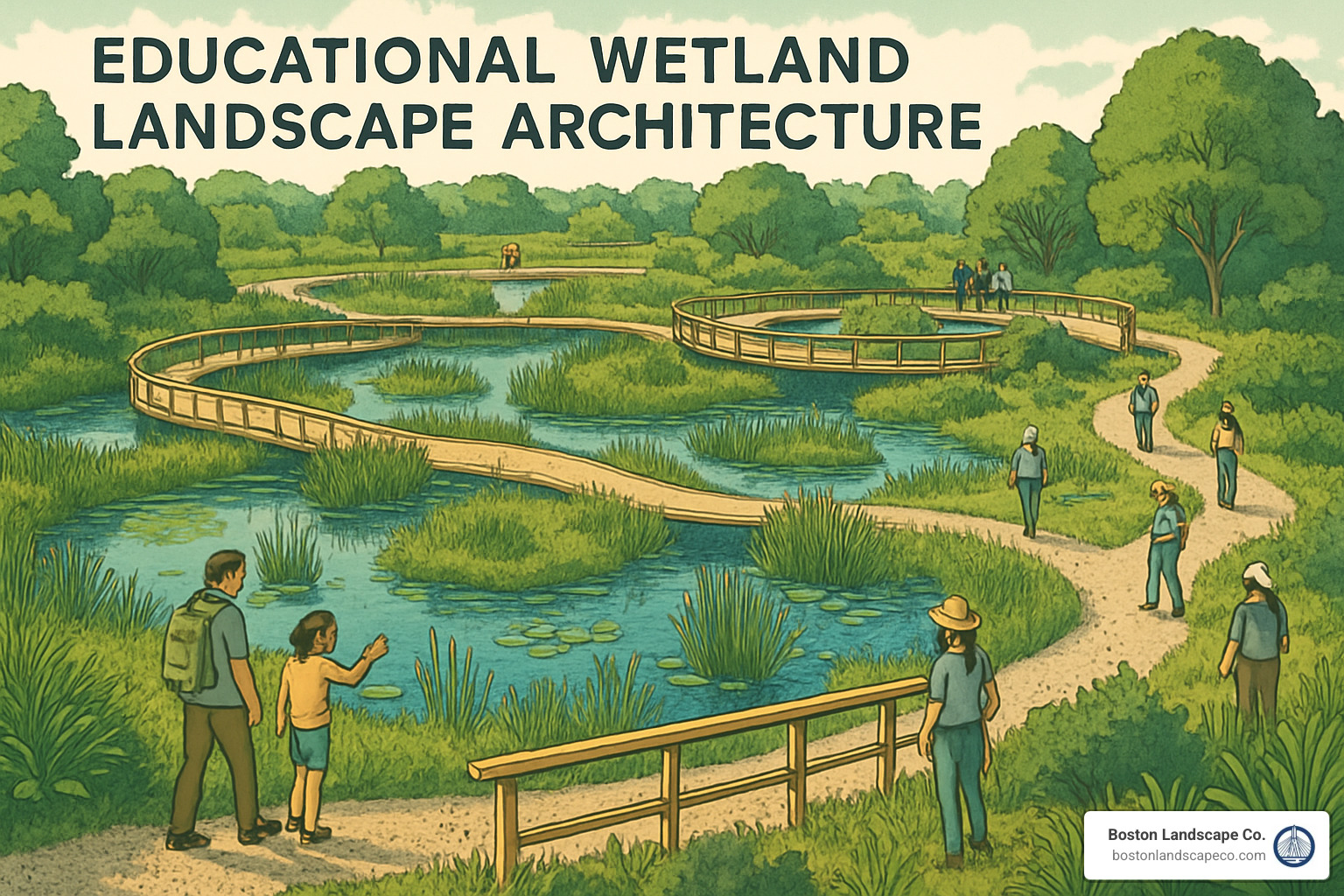
Designing a living laboratory is part science lab, part park design. We start by asking, How will learners move through and study this space?
The Landscape Architect’s Role
- Site analysis – map water flow, soils, and safe access.
- Visioning workshops – gather ideas from teachers, students, and neighbors.
- Permitting – translate educational goals into language regulators understand.
- Construction oversight – protect sensitive zones and ensure boardwalks, railings, and plantings match the plan.
More about our interdisciplinary approach: residential landscape architects.
Design Elements That Matter
- Boardwalks & skywalks – durable, slip-resistant, and ADA-friendly.
- Observation decks – placed where habitat edges meet for maximum wildlife viewing.
- Cut-and-fill landforms – create shallow shelves for emergent plants, deeper pools for open water study.
- Buffer gardens – native flowers for pollinators and extra filtration.
- Low-maintenance signage – simple, weather-proof panels instead of electronics that fail outdoors.
Plant & Material Choices
- Prioritize native species; they establish quickly and teach local ecology.
- Blend emergent, floating, and riparian plants for year-round interest.
- Use recycled or locally sourced wood, stone, and steel to lower embodied energy.
Need help selecting plant palettes for Massachusetts soils? See our wetland improvement services.
From the Field to the Classroom: Curriculum Integration

A wetland only succeeds educationally if it shows up in lesson plans—not just on field-day. The Willow School proves the formula: every grade uses the wetland, every year.
Classroom Connections
- Science – measure dissolved oxygen, track frog life-cycles, map plant zones.
- Math – calculate pollutant-removal percentages, chart seasonal water depths.
- Art – sketch macro-invertebrates, design interpretive posters.
- Social studies – debate local water policy and historic wetland use.
Building Community Literacy
- Open trails after school so families enjoy the space.
- Offer weekend workshops on birding, native-seed collection, or rain-garden DIY.
- Recruit volunteers; at Willow this saves ≈US $2,160 in annual maintenance while deepening public ownership.
Navigating Challenges in Educational Wetland Landscape Architecture
Even the best design can stumble without early planning for red tape and upkeep.
Permitting Tips
- Begin talks with conservation commissions and the U.S. Army Corps of Engineers while concepts are still sketches.
- Emphasize public benefits—education and water quality often open up variances, as seen at The Willow School.
- Pair with required mitigation projects when possible; the outside funding can cover construction.
Summary of the Clean Water Act
Long-Term Care
- Draft a maintenance matrix during design: who inspects boardwalk footings, who removes sediment from forebays, and when.
- Teach students to help manage invasives like Phragmites—it turns a problem into a lab exercise.
- Leverage community volunteers for spring planting and fall cut-backs; clear task lists keep enthusiasm high.
Smart Tech for Smarter Wetlands
- GIS & GPS – map vegetation changes each semester.
- Low-cost sensors – stream live pH and temperature data to the classroom.
- National Wetlands Inventory Mapper – great homework tool for watershed context.
Inspiring Case Studies: Wetlands as Outdoor Classrooms

Below are three very different—but equally successful—projects.
1. The Willow School (NJ)
- 34-acre campus; wetland treats ≈380,000 gal of wastewater yearly.
- 100 % of students participate in data collection.
- Saves ≈US $4,000 per year in water and volunteer labor.
2. Qunli National Urban Wetland (Harbin, China)
- 34 ha of former marsh revitalized with simple cut-and-fill earthwork.
- Liftd skywalk protects habitat while serving 300,000 local residents.
- Now nicknamed the city’s “green sponge” for stormwater control.
3. High Plains Environmental Center (CO)
- 1-acre demonstration garden shows homeowners that retention ponds can be beautiful.
- Programming—tours, seed-collection days—changed regional attitudes toward stormwater design.
- Earned an ASLA Land Stewardship Award for blending ecology and outreach.
Conclusion
Educational wetlands prove that infrastructure can educate, beautify, and pay for itself. From huge municipal systems like the Bluebelt to intimate campus ponds in Greater Boston, these landscapes clean water and spark curiosity at the same time.
Boston Landscape Co. has helped schools and municipalities across Stoneham, Billerica, Lexington, and beyond design spaces that hit both goals. Ready to explore a living laboratory for your site? Contact us for your wetland services project. Together we can turn runoff into a resource and students into stewards.
