
Why Your Snow Removal Pricing Formula Matters More Than Ever
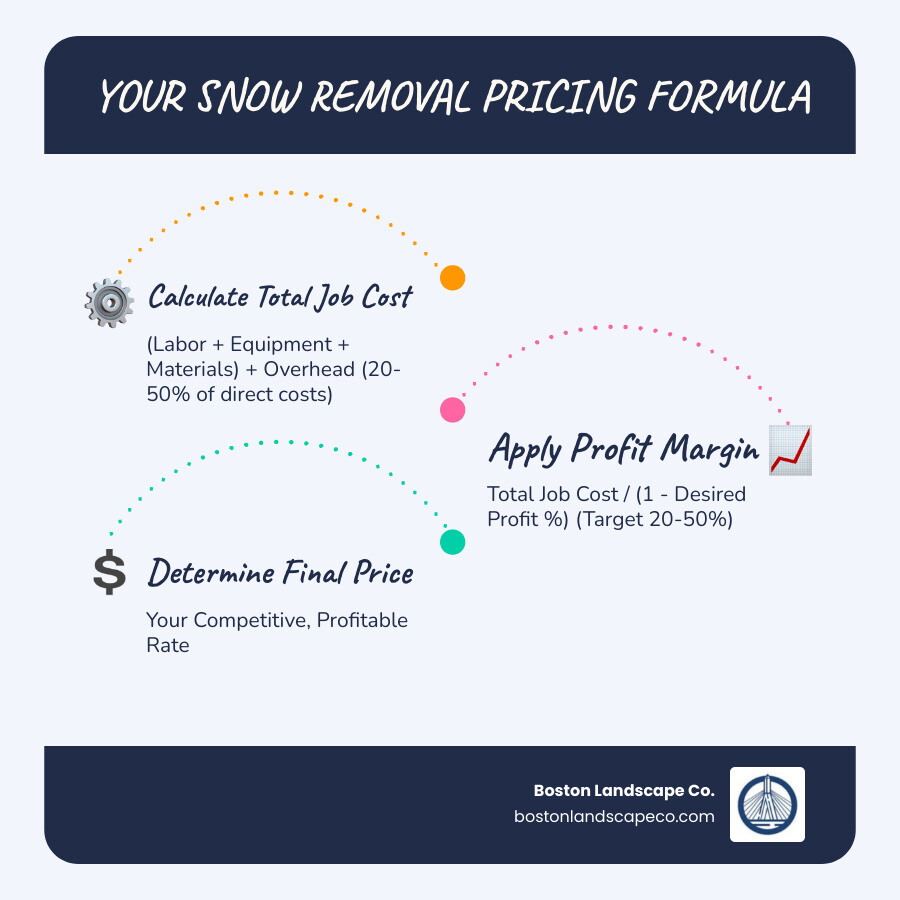
A snow removal pricing formula is your roadmap to profitability during winter. Here’s the essential formula to calculate fair, profitable snow removal rates:
Basic Snow Removal Pricing Formula:
- Calculate Total Job Cost = (Labor Cost + Equipment Cost + Material Cost) + Overhead
- Apply Profit Margin = Total Job Cost ÷ (1 – Desired Profit Margin %)
- Final Customer Price = Your competitive, profitable rate
Quick Reference:
- Labor: Hourly wage × workers × estimated hours
- Materials: Salt, sand, de-icers (typically $10-$50 per job)
- Overhead: Insurance, fuel, maintenance (often 20-50% of direct costs)
- Profit Margin: Typically 20-50% depending on market and risk
When winter tightens its grip on the Greater Boston area, snow removal becomes essential—but pricing it wrong can bury your business. According to industry data, overhead costs like wages, fuel, and insurance make up approximately 50% of total snow removal costs. That’s why guesswork won’t cut it. You need a reliable system that covers every expense, rewards your hard work, and keeps you competitive when property owners are comparing quotes.
The challenge? Snow removal pricing involves more variables than most landscaping services. Snowfall depth changes by the hour. Driveways vary wildly in size, slope, and accessibility. Equipment breaks down. Salt prices fluctuate. And customers want both fair pricing and guaranteed service when the next nor’easter hits.
As Steve Schumacher, owner-operator of Boston Landscape Co. since 1991, I’ve spent over three decades refining our snow removal pricing formula to handle everything from residential driveways to commercial parking lots across the North Shore. A solid formula isn’t just about making money—it’s about building trust with clients who depend on you when winter strikes.
Snow removal pricing formula definitions:
- average cost for commercial snow removal
- commercial snow plowing contracts
- commercial snow removal services
Deconstructing Your Costs: The Foundation of Every Quote
Before we can even think about what to charge, we need to understand what it costs us to deliver top-notch snow removal services. This isn’t just about how much gas we put in the truck; it’s a deep dive into every expense, big and small, that ensures we can keep your property safe and clear. These are the key cost factors that influence our snow removal pricing.
Calculating Labor and Equipment Costs
Labor is often the most significant direct cost. We calculate this by considering the hourly wages of our dedicated crew members and the estimated time it will take to complete a job. For example, if a large commercial parking lot in Woburn is estimated to take two hours with two workers, and each worker is paid $25 per hour, the base labor cost for that job is $100. But that’s just the start! We also factor in labor burden, which typically adds an additional 20%-40% to base labor costs to cover payroll taxes, workers’ compensation, and other benefits.
Our equipment is the backbone of our operation, and it comes with its own set of costs. From powerful gas-powered snow blowers (which can range from $250 to $2,300) to heavy-duty plows, these machines require significant investment. We account for:
- Equipment depreciation: The gradual loss of value over time.
- Fuel costs: Especially with fluctuating gas prices, this is a major variable.
- Maintenance expenses: Regular servicing, repairs, and replacement parts keep our fleet running smoothly, but they add up.
Factoring in Materials and Overhead
Beyond labor and equipment, materials are crucial for effective snow and ice management. De-icing materials like salt and sand help prevent slips and falls, and their cost can vary. We carefully estimate the quantity needed for each job in places like Lexington and Medford.
Then there are the less obvious, but equally vital, overhead costs. These are the expenses that keep our business running smoothly, even when it’s not snowing. Overhead costs, such as wages, fuel, and insurance, make up approximately 50% of the total cost for snow removal services. This includes:
- Administrative costs: Office staff, utilities, and general business operations.
- Marketing: Reaching out to new clients and maintaining our reputation.
- Business insurance: Liability coverage is paramount in an industry with inherent risks.
- Licenses and permits: Necessary for operating legally in our service areas.
To calculate our overhead rate, we use a formula: (Total monthly overhead costs ÷ total monthly sales) x 100. This helps us accurately allocate these costs to each job, ensuring our snow removal pricing formula is comprehensive.
The Impact of Property and Snowfall
Every property in our service area, from a quaint residential home in Stoneham to a sprawling commercial complex in Waltham, presents unique challenges that influence pricing:
- Property size: Larger areas naturally require more time and resources.
- Driveway length, slope, and surface material: A long, steep, gravel driveway in Concord will take more effort to clear than a short, flat, paved one. Obstacles like landscaping or tight turns also increase complexity.
- Snow depth and type: A light dusting is very different from six inches of heavy, wet snow. The latter requires more power, more time, and puts more strain on our equipment. The average cost to plow four to six inches of snow is $60–$100, with an additional $3–$10 for every additional inch of snow.
- Obstacles: Cars, landscaping features, or specific architectural elements that require careful maneuvering.
Weather conditions and accessibility are also huge factors. Unpredictable snowfall in the Greater Boston area means we must be prepared for anything. Properties with difficult access or specific clearing requirements will naturally incur higher costs.
Choosing Your Strategy: Common Snow Removal Pricing Models
Once we understand our costs, the next step in developing a robust snow removal pricing formula is to choose the right pricing model. Different models suit different client needs and types of snow events. We offer a variety to provide flexibility and peace of mind.
Note: All prices mentioned are national averages for educational purposes and do not reflect the actual rates of Boston Landscape Co. Costs in the Greater Boston area can vary significantly. Always request a custom quote for accurate pricing.
Per-Event or Per-Push Pricing
This model involves a fixed rate each time our crew visits your property to clear snow. It’s straightforward and excellent for one-off jobs or properties in areas with less predictable snowfall.
- Average Price Range: $30 – $250+ per visit.
- Trigger Depths: Often, a minimum snow depth (e.g., 2 inches) is required to trigger a service.
- Per-Push vs. Per-Event: “Per push” means we charge every time we clear your property, which could be multiple times during a long storm. “Per event” means one flat rate for a single, defined snowstorm, regardless of how many visits it takes. A 2022 survey revealed that more than 60% of commercial snow removal businesses used the “per push” pricing model.
Per-Inch Pricing
For regions with highly variable snowfall, this tiered model charges based on the actual accumulation of snow. It’s often structured with a flat fee for the initial few inches, then an additional rate for every inch beyond that.
- Average Price Range: $60 – $200+ for the first 6 inches, with an additional $3-$10 per inch beyond that.
- Best For: Areas where snowfall amounts fluctuate widely.
Hourly Rates
Charging by the hour is simple: we multiply our hourly rate by the number of hours spent on the job.
- Average Price Range: $25 – $150+ per hour.
- Best For: Unpredictable jobs, deep snow, or situations where the exact scope of work is hard to determine upfront.
- Customer Uncertainty: The main drawback for customers is not knowing the final cost until the job is done. However, for complex jobs in places like Wellesley or Burlington, it can be the fairest method.
Seasonal Contracts
A seasonal contract offers a single, fixed price for the entire winter season. This provides ultimate predictability for both us and our clients.
- Average Price Range: $350 – $1,200+ per season, but can be much higher for larger or commercial properties.
- Contract Limits: These contracts often include a limit on the number of snow events or total snowfall inches.
- Predictable Revenue: This model is a favorite for many property owners in our service area who value peace of mind and consistent service.
| Pricing Model | Pros | Cons | Best For |
|---|---|---|---|
| Per-Push / Per-Event | Simple, predictable cost per service. | Can be expensive during heavy winters if “per push” is used frequently. | One-off jobs, properties with moderate snowfall, commercial properties prioritizing immediate clearing. |
| Per-Inch | Fairer for variable snowfall, client pays for actual snow cleared. | Requires accurate measurement, can lead to higher costs during heavy snow. | Regions with unpredictable snowfall amounts. |
| Hourly | Flexible, accurate reflection of time/effort for complex jobs. | Cost uncertainty for the client, requires trust. | Unpredictable jobs, deep snow, ice removal, complex properties. |
| Seasonal Contract | Budget predictability for client, steady revenue for business. | Risk of overpaying in light winters, or undercharging in heavy winters. | Clients seeking peace of mind, consistent service, and predictable budgeting. |
The Ultimate Snow Removal Pricing Formula: From Costs to Profit
Now that we’ve broken down our costs and explored various pricing models, it’s time to assemble our ultimate snow removal pricing formula to ensure every job is profitable and sustainable. This formula isn’t just about covering expenses; it’s about valuing our expertise, equipment, and the critical service we provide. The role of profit margin and markup is crucial here. Businesses that offer snow removal services add a markup of 2 – 50% for profit, depending on the size of the business and how much your overhead is.

Step 1: Calculate Your Total Job Cost
This is where we bring together all the individual cost components we discussed earlier.
Total Job Cost = (Labor Cost + Equipment Cost + Material Cost) + Overhead
Let’s break it down further:
- Labor Cost: (Hourly rate × Number of workers × Estimated hours).
- Equipment Cost: This includes the portion of depreciation, maintenance, and fuel directly attributable to this job.
- Material Cost: (Cost per unit of salt/sand × Quantity used).
- Overhead: We apply our calculated overhead rate to the direct costs of the job. For example, if our overhead rate is 50% and the direct costs (labor, equipment, materials) are $100, the overhead for this job would be $50.
Step 2: Apply Your Profit Margin
Once we have the Total Job Cost, we add our desired profit margin. This is the percentage we need to make above our costs to grow the business, invest in better equipment, and provide for our team. Profit margins typically range from 15%-25% in competitive markets to 25%-40% in high-demand, heavy-snow regions like ours.
Final Price = Total Job Cost / (1 – Desired Profit Margin %)
For example, if your Total Job Cost is $100 and you aim for a 30% profit margin, the calculation would be:
$100 / (1 – 0.30) = $100 / 0.70 = $142.86
This ensures that after all costs are covered, you achieve your target profit.
Step 3: A Sample Snow Removal Pricing Formula in Action
Let’s walk through a residential driveway scenario in Stoneham:
Scenario: Clearing a standard two-car residential driveway and connecting sidewalk after a 5-inch snowfall. Estimated time: 1.5 hours, 1 worker.
1. Calculate Direct Costs:
- Labor Cost: 1 worker x $35/hour x 1.5 hours = $52.50
- Equipment Cost (fuel, wear & tear for snow blower/shovel): $10.00
- Material Cost (small amount of salt for sidewalk): $5.00
- Total Direct Costs: $52.50 + $10.00 + $5.00 = $67.50
2. Incorporate Overhead:
- Let’s assume our overhead rate is 50% of direct costs.
- Overhead: $67.50 x 0.50 = $33.75
- Total Job Cost (before profit): $67.50 + $33.75 = $101.25
3. Apply Profit Margin:
- We aim for a 25% profit margin for residential jobs.
- Final Customer Price: $101.25 / (1 – 0.25) = $101.25 / 0.75 = $135.00
So, for this particular residential job, our snow removal pricing formula would lead to a charge of $135.00. This rate covers all our expenses and allows us to maintain a healthy, sustainable business.
Residential vs. Commercial: Tailoring Your Prices
While the core snow removal pricing formula remains consistent, the application differs significantly between residential and commercial properties. We understand that the needs, expectations, and risks associated with each are unique.
Pricing for Residential Properties
For our residential clients in communities like Bedford, Malden, and Reading, snow removal is often about convenience and safety for their families.
- Driveways: As seen in our example, pricing considers length, width, slope, and material. You can expect to charge between $30 and $100+ per visit for driveway snow removal.
- Sidewalks: Residential sidewalk snow removal rates typically range from $25 – $75 an hour, or $30 – $70 per visit. This is often an add-on service to driveway clearing.
- Roofs: Roof snow removal is a specialized service, costing an extra $200 – $500 on top of other snow removal services. For larger homes with difficult roof access, it may cost upwards of $1,000 per visit.
- Smaller Scale: Residential jobs are generally smaller in scope, often requiring less heavy equipment.
- Add-on Services: We often bundle services like de-icing for walkways or clearing paths to oil tanks.
Our residential landscaping services page offers more insights into how we improve outdoor spaces year-round.
Pricing for Commercial Contracts
Commercial snow removal in areas like Billerica, Burlington, and Woburn is a different beast entirely. It’s not just about aesthetics; it’s about maintaining operational continuity, ensuring public safety, and managing significant liability.
- Large Lots: Commercial properties often have expansive parking lots, access roads, and multiple pedestrian walkways. This requires larger teams, heavier equipment (like commercial plows that weigh 2,500 to 8,000 pounds), and more time.
- Zero-Tolerance Policies: Many commercial clients have “zero-tolerance” policies for snow and ice, meaning properties must be clear and safe around the clock. This demands 24/7 availability and rapid response times.
- Higher Insurance Requirements: The increased liability means we carry comprehensive insurance policies, a significant overhead cost that is reflected in commercial pricing.
- Detailed Contracts: Commercial contracts are typically much more detailed, outlining trigger depths, response times, areas to be cleared, and de-icing protocols.
- Frequency: Commercial properties often require more frequent service, sometimes multiple times during a single, prolonged snow event, especially with “per push” contracts.
Our commercial landscaping services page provides further details on our comprehensive offerings for businesses.
Frequently Asked Questions about Snow Removal Pricing
We get a lot of questions about how we price our snow removal services. Here are some of the most common ones, helping you understand the intricacies of our snow removal pricing formula.
How do you price for specialized services like ice or roof snow removal?
Specialized services require specialized pricing.
- Ice Removal: This is critical for safety. We often price salting or sanding applications separately, ranging from $20 to $100+ per application, depending on the area size and material used. Sometimes, it’s bundled into an hourly rate if extensive scraping is needed.
- Roof Snow Removal: This is a high-risk service that requires specialized equipment and safety protocols. Roof snow removal typically costs an extra $200 – $500 on top of other snow removal services. For larger homes with difficult roof access in places like Wellesley, roof snow removal may cost upwards of $1,000 per visit. We remove snow from roofs before it accumulates beyond six inches to prevent damage.
What is the difference between “per push” and “per event” pricing?
This is a common point of confusion for clients.
- “Per push”: You are charged every time our snow plow or crew visits your property to clear snow. If a storm lasts for 24 hours and requires us to clear your property three times to maintain accessibility, you would be charged three “pushes.” This model is great for properties that need continuous clearing during prolonged snowfall.
- “Per event”: You pay a single flat rate for a defined snowstorm, regardless of how many times we need to clear your property during that specific event. This provides budget certainty for a single storm. The average cost of snow removal per storm or snow event ranges from $30 to $100, but can be significantly higher for commercial properties.
Should I charge per square foot for snow removal?
Snow removal companies don’t typically charge per square foot for general snow removal, with the exception of heated driveways where rates are usually between $10–$50 per square foot for installation. Most companies, including Boston Landscape Co., choose to calculate rates per hour or use a flat-rate model that indirectly considers square footage. This approach better reflects the actual cost of labor, equipment usage, and the varying complexities of each job (like obstacles, snow depth, and type of snow) rather than just a flat area measurement. While square footage helps us estimate the time a job will take, it’s rarely the sole determinant of the final price.
Win More Bids and Grow Your Business
A carefully crafted snow removal pricing formula is more than just a way to bill clients; it’s a powerful business tool. It builds customer trust by providing transparent, fair pricing, and it ensures our long-term profitability, allowing us to invest in our team and equipment.
When we bid on snow removal contracts, particularly for commercial properties in the Greater Boston area, our formula allows us to be precise and competitive. We factor in all elements: labor, equipment wear, fuel, de-icing materials, insurance, and administrative costs. This comprehensive approach helps us avoid surprises and deliver on our promises.
Using snow removal estimate templates and software also streamlines our pricing and business management. These tools help us quickly generate accurate quotes, manage schedules efficiently, and track costs in real-time, which is essential for a winter service.
A well-defined snow removal pricing formula helps Boston Landscape Co. grow and remain competitive by:
- Ensuring profitability: Covering all costs and maintaining healthy margins.
- Building trust: Providing transparent and justifiable pricing to our clients.
- Improving efficiency: Streamlining our quoting and operational processes.
- Allowing for investment: Reinvesting in better equipment and training for our team.
As your trusted, local, and experienced landscaping provider, we pride ourselves on our commitment to quality service, even in the harshest winter conditions. We invite you to experience the peace of mind that comes with reliable, professionally priced snow removal services.
Ready to keep your property safe and clear this winter? Request a professional estimate for your property from Boston Landscape Co. today.
