
Why Maintenance Charges for Commercial Property Affect Your Bottom Line
Maintenance charges for commercial property — commonly called CAM (Common Area Maintenance) charges — are fees tenants pay to cover the cost of maintaining shared spaces like parking lots, lobbies, landscaping, and building systems.
Here’s a quick breakdown of what you need to know:
| Topic | Key Point |
|---|---|
| What they are | Fees covering shared space upkeep: parking, lobbies, landscaping, utilities, janitorial |
| Who pays | Tenants pay a pro-rata share based on their percentage of total rentable space |
| How they’re calculated | Tenant SF ÷ Total Building SF × Total CAM Expenses |
| Lease type matters | Triple net (NNN) leases pass CAM through separately; gross leases bundle it into rent |
| Annual reconciliation | Estimates are billed monthly, then trued-up against actual costs each year |
| Typical cost range | Roughly $1.50–$18.00 per square foot annually, depending on property type and location |
These charges aren’t just a line item on a lease. They directly affect how much tenants actually pay to occupy a space — and how predictably landlords can cover operating costs.
For commercial property owners and managers in Greater Boston, getting CAM right means protecting asset value, keeping tenants happy, and avoiding budget surprises. Ignore it, and you’re looking at disputes, vacancies, and deferred maintenance that compounds over time.
I’m Steve Schumacher, owner-operator of Boston Landscape Co. since 1991, and over three decades of managing commercial grounds in the Greater Boston area has given me a front-row seat to how maintenance charges for commercial property get built, disputed, and resolved. In this guide, I’ll walk you through everything you need to budget smarter and manage these costs with confidence.
Simple maintenance charges for commercial property glossary:
- commercial building maintenance costs
- commercial property maintenance inspection checklist
- building maintenance near me
Defining Maintenance Charges for Commercial Property (CAM)
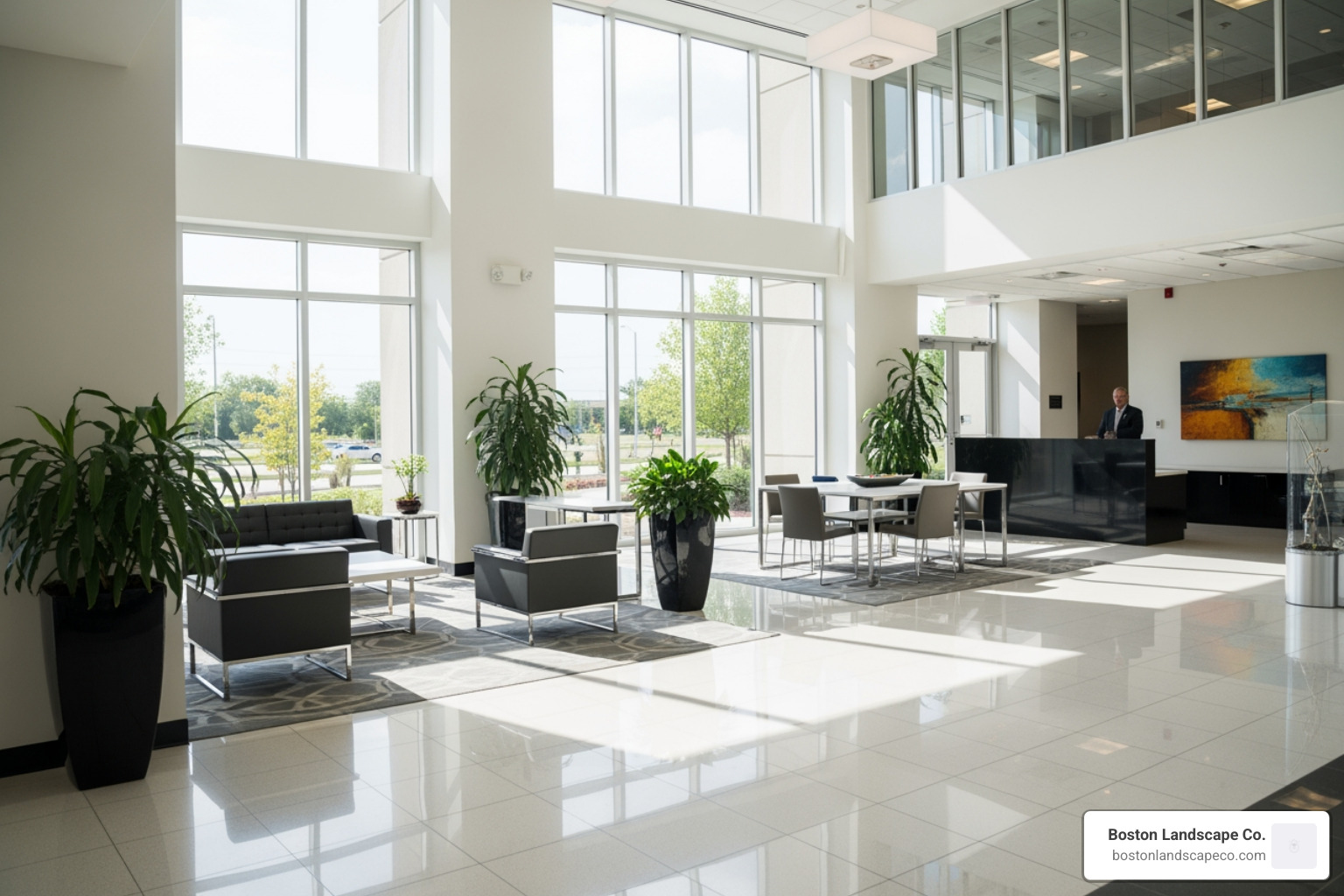
At its heart, Common Area Maintenance (CAM) is an agreement that ensures the shared parts of a property remain functional, safe, and attractive. Think of it as a “community pot” where everyone who benefits from the property’s shared amenities contributes to their upkeep. In a multi-tenant office building in Waltham or a retail center in Burlington, these shared spaces include everything from the lobby where clients wait to the parking lot where they leave their cars.
These maintenance charges for commercial property are essential because they reimburse the landlord for the actual costs of operating the building. Without them, a landlord might be hesitant to invest in high-quality landscaping or frequent snow removal, which could eventually hurt the business image of every tenant on-site. For a deeper dive into the basics, check out this Quick Guide to CAM Fees.
By pooling resources, tenants often get better service than they could afford individually. For instance, high-quality commercial landscape maintenance ensures that the first impression a customer gets of your storefront is one of professionalism and care.
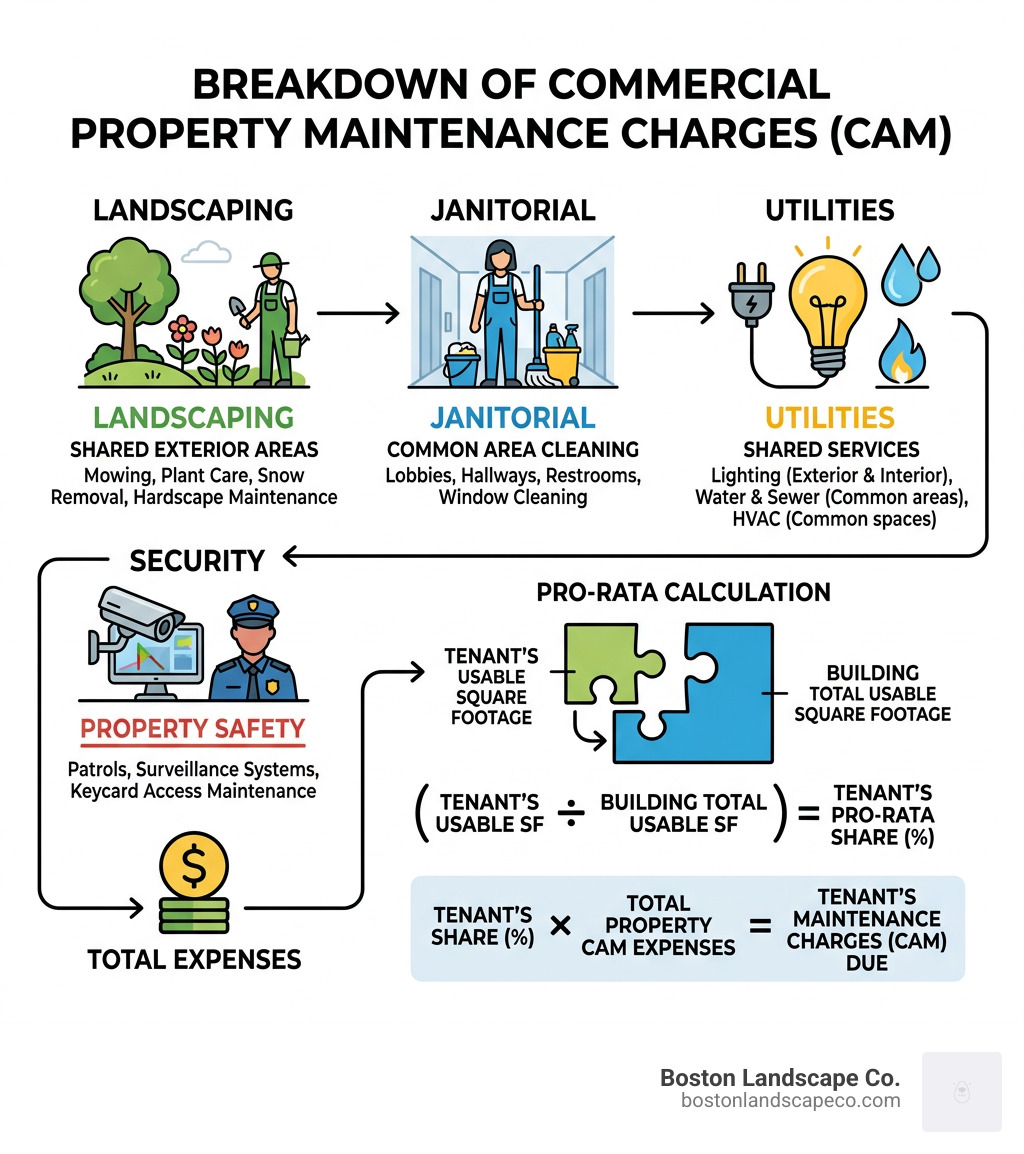
What is Included in Maintenance Charges for Commercial Property?
The list of what fits under the CAM umbrella can be quite long. Generally, it includes any expense that benefits all tenants rather than a specific one. Here in Massachusetts, our “Exterior Trio” — landscaping, snow management, and lot sweeping — are major players.
- Landscaping: This covers mowing, mulching, seasonal flower rotations, and tree care. Professional landscape management services keep the property value high and the curb appeal sharp.
- Snow Management: In towns like Lexington and Concord, snow removal is a non-negotiable safety expense. This includes plowing, salting, and sidewalk clearing.
- Janitorial Services: Cleaning shared restrooms, hallways, and elevators.
- Security Systems: Monitoring cameras, gate maintenance, and on-site security personnel.
- Common Area Utilities: Lighting for the parking lot, water for irrigation systems, and heating/cooling for the lobby.
Common Exclusions from Maintenance Charges for Commercial Property
Not everything a landlord spends money on can be passed through to the tenant. It is vital to distinguish between daily “maintenance” and long-term “investment.”
- Capital Expenditures: Major replacements, like a total roof overhaul or a new HVAC system for the entire building, are usually excluded (though some leases allow for the “amortized” portion of these costs).
- Debt Service: Interest payments on the landlord’s mortgage.
- Marketing Costs: Fees the landlord pays to advertise vacant units to new tenants.
- Tenant Improvement Allowances: The money a landlord spends to renovate a specific unit for a new neighbor.
Understanding these boundaries is key to a fair lease. You can find more details in this CAM Charges Guide: Definition and Examples.
How CAM Charges are Calculated and Allocated
Calculating maintenance charges for commercial property isn’t a guessing game; it’s a formula based on the “pro-rata share.” This ensures that a small coffee shop in a Stoneham strip mall isn’t paying the same maintenance fee as the massive anchor grocery store next door.
The allocation is based on the Gross Leasable Area (GLA). The landlord totals all eligible expenses into an “expense pool” and then divides that pool among the tenants based on how much of the building they occupy. To keep things organized, many managers use a commercial property maintenance inspection checklist to track what needs work and what the associated costs will be.
| Feature | Office Property | Retail Center | Industrial Warehouse |
|---|---|---|---|
| Primary CAM Focus | Lobbies, Elevators, HVAC | Parking Lots, Lighting, Security | Loading Docks, Pest Control |
| Calculation Base | Rentable Square Footage | Gross Leasable Area (GLA) | Total Acreage/Footprint |
| Typical Billing | Often bundled in Gross Lease | Almost always Triple Net (NNN) | Usually Triple Net (NNN) |
The Pro-Rata Share Formula
The math is straightforward: (Tenant Square Footage ÷ Total Building Square Footage) × Total Annual CAM Expenses = Tenant’s Share
For example, if you lease 5,000 square feet in a 100,000-square-foot building in Woburn, your pro-rata share is 5%. If the total annual maintenance costs are $200,000, you would owe $10,000 per year ($833 per month). Most landlords bill a monthly estimate and then adjust at the end of the year. For help with your own numbers, try this Commercial Property Maintenance Cost Calculator.
Understanding CAM Reconciliation and Audit Rights
At the end of the year, the landlord performs a “reconciliation” or “true-up.” They look at the actual invoices paid versus the monthly estimates gathered from tenants.
- If the landlord spent less than estimated, you should receive a credit toward next year’s rent.
- If the landlord spent more (perhaps due to a particularly brutal Massachusetts winter requiring extra snow plowing), you’ll receive an invoice for the difference.
As a tenant, you have the right to challenge the accuracy of a landlord’s audit. Always check your lease for an “audit window” — usually 30 to 90 days — during which you can request to see the actual receipts and vendor contracts.
Navigating Lease Types and Expense Responsibility
Who pays for what depends entirely on the lease structure. In our experience working with property managers from Medford to Winchester, the “Triple Net” lease is the most common for retail and industrial, while “Gross” leases are frequent in older office parks.
- Triple Net Lease (NNN): The tenant pays the base rent plus their share of property taxes, insurance, and all maintenance charges for commercial property. This puts the risk of rising costs on the tenant. For a deeper look, see this Triple net lease definition and responsibilities.
- Gross Lease: The landlord pays all operating expenses out of the base rent. This is simple for the tenant but risky for the landlord if utility or maintenance costs spike.
- Double Net (NN): The tenant pays rent, taxes, and insurance, but the landlord covers the maintenance.
- Modified Gross: A middle ground where the tenant pays base rent plus a share of the increase in operating expenses over a “base year.”
Controllable vs. Uncontrollable Expenses
When negotiating, it’s helpful to split CAM into two buckets:
- Controllable Expenses: These are items the landlord can influence through bidding and management, such as janitorial contracts, management fees, and essential landscape maintenance tasks for every season.
- Uncontrollable Expenses: These are costs dictated by outside forces, such as property taxes, insurance premiums, and utilities. In Massachusetts, snow removal is often classified as “uncontrollable” because no landlord can control how many inches fall in a January blizzard!
The Role of CAM in Lease Accounting (ASC 842)
Under the accounting standard ASC 842, businesses must now record most leases on their balance sheets. This means maintenance charges for commercial property must be clearly identified and separated from the base rent. Proper transparency in CAM billing isn’t just about being a good neighbor; it’s a financial reporting requirement that helps investors and lenders see the true cost of a lease.
Strategies for Negotiating and Managing Maintenance Costs
Don’t assume the CAM section of a lease is set in stone. Whether you’re a landlord looking to attract high-quality tenants or a tenant looking to protect your cash flow, there is room for “budgeting brilliance.” One way to start is by understanding commercial landscape maintenance pricing so you know if the quotes in the budget are realistic for the Greater Boston market.
Implementing CAM Caps and Floors
To prevent “sticker shock” during reconciliation, tenants often negotiate CAM Caps.
- Year-over-Year Caps: Limits the increase of controllable expenses to a set percentage (often 3-5%) over the previous year.
- Cumulative Caps: Limits the increase over the life of the lease, allowing the landlord to “carry over” unused cap space from a cheap year to a more expensive one.
- Floors: Landlords might use these to ensure a minimum annual increase to keep up with inflation.
Common Causes of Excessive or Disputed Charges
Most disputes arise from a lack of clarity. We often see tension when:
- Capital costs are disguised as CAM: Charging for a whole new parking lot rather than just filling potholes and striping.
- Administrative Markups: Landlords adding a 10-15% “management fee” on top of the actual maintenance invoices.
- Vague Definitions: Using terms like “other reasonable expenses” that allow for a wide range of interpretations.
- Improper Allocation: Calculating the pro-rata share based on occupied space rather than total leasable space, which unfairly burdens the remaining tenants when the building is half-empty.
Frequently Asked Questions about Commercial Maintenance
Do all commercial properties include CAM charges?
Not necessarily. In a “Full-Service” office building, the landlord usually bundles these costs into one flat rent check. However, in retail centers, industrial warehouses, and most modern office suites, CAM charges are almost always a separate, variable line item.
How do CAM charges vary by property type?
Retail centers usually have the highest CAM because they require constant parking lot cleaning, high-intensity lighting, and heavy security. Industrial properties often have lower CAM because the tenants handle more of their own “inside” maintenance, leaving only the “outside” grounds and loading docks for the landlord to manage.
What are the average maintenance charges for commercial property in Massachusetts?
Pricing Disclaimer: The following figures are average costs based on online and internet data for the New England region and are not the actual prices or rates of Boston Landscape Co.
In the Greater Boston area, maintenance charges for commercial property can vary wildly. On the low end, a basic industrial warehouse might see charges around $1.50 to $4.00 per square foot. A high-end, multi-tenant office building in a prime location like Wellesley or Concord could see charges ranging from $8.00 to $18.00+ per square foot, especially if it includes high-touch commercial grounds maintenance, concierge security, and premium amenities.
Conclusion
Mastering the “budgeting brilliance” of maintenance charges for commercial property comes down to transparency and proactive care. Whether you are managing a portfolio in Reading or leasing your first storefront in Billerica, understanding the pro-rata formula and the difference between controllable and uncontrollable costs is your best defense against financial surprises.
At Boston Landscape Co., we believe that well-maintained grounds are the foundation of a property’s value. Since 1991, we’ve helped Greater Boston property managers keep their CAM budgets predictable through reliable, high-quality service that prevents small issues from becoming expensive capital failures.
Ready to get a clear picture of your property’s needs? Request a commercial maintenance estimate today and let’s build a budget that works for you and your tenants.
