New Lawn Articles
New Lawn Options for Brookline and Waltham Yards
Why Getting a New Lawn Right in Boston Takes More Than Just Grass Seed
Planning a new lawn in Boston, MA is one of the most rewarding upgrades you can make to your property, but it requires the right approach for New England’s unique conditions.
Here’s a quick overview of your main options:
| Method | Best For | Establishment Time | Relative Cost |
|---|---|---|---|
| Sod | Instant results, slopes, high-visibility areas | 2-3 weeks | Highest |
| Traditional Seeding | Budget-friendly, large areas | 4-8 weeks | Lowest |
| Hydroseeding | Large areas, uneven terrain, faster than seed | 5-10 days to germinate | Mid-range |
| Artificial Turf | Low-maintenance, pet areas, high-traffic zones | Immediate | Highest upfront |
Boston’s soils, ranging from glacial till and marine clay to rocky shallow ground, make lawn installation more complex than in many other parts of the country. Timing matters too. The ideal planting window for cool-season grasses in Massachusetts runs from the third week of August through the third week of September, with a secondary window in spring from mid-April to mid-May.
Whether you’re working with a Brookline backyard, a Waltham commercial property, or anything in between, the method, grass type, soil prep, and timing you choose will determine whether your lawn thrives or struggles through its first season.
I’m Steve Schumacher, owner-operator of Boston Landscape Co. since 1991, and over more than three decades I’ve installed and restored new lawns across Boston, MA and the surrounding communities, giving me a deep understanding of what actually works in this region. Read on for a complete guide to making the right choices for your property.
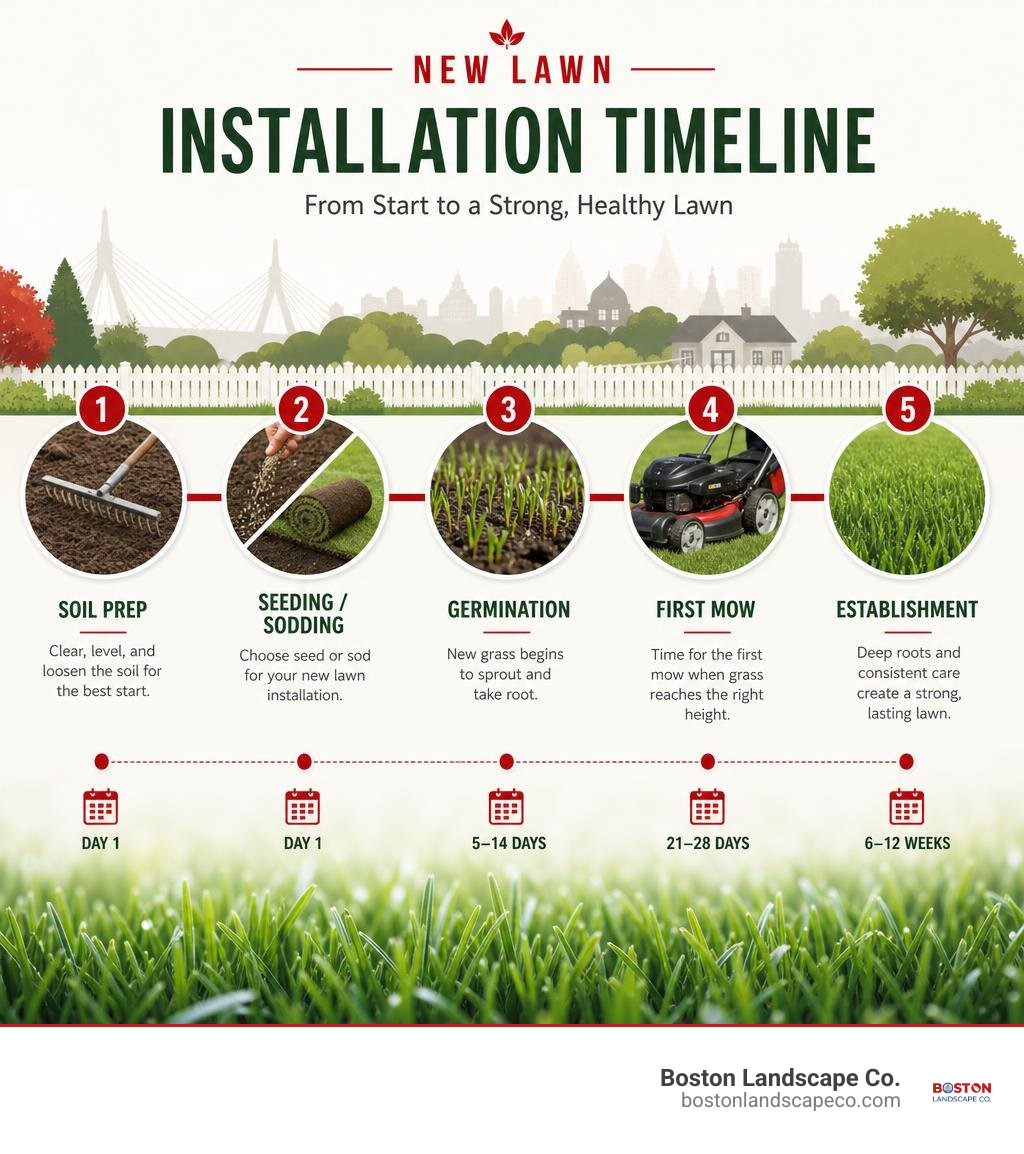
New lawn Boston MA terms to learn:
Optimal Timing and Grass Selection for Eastern Massachusetts
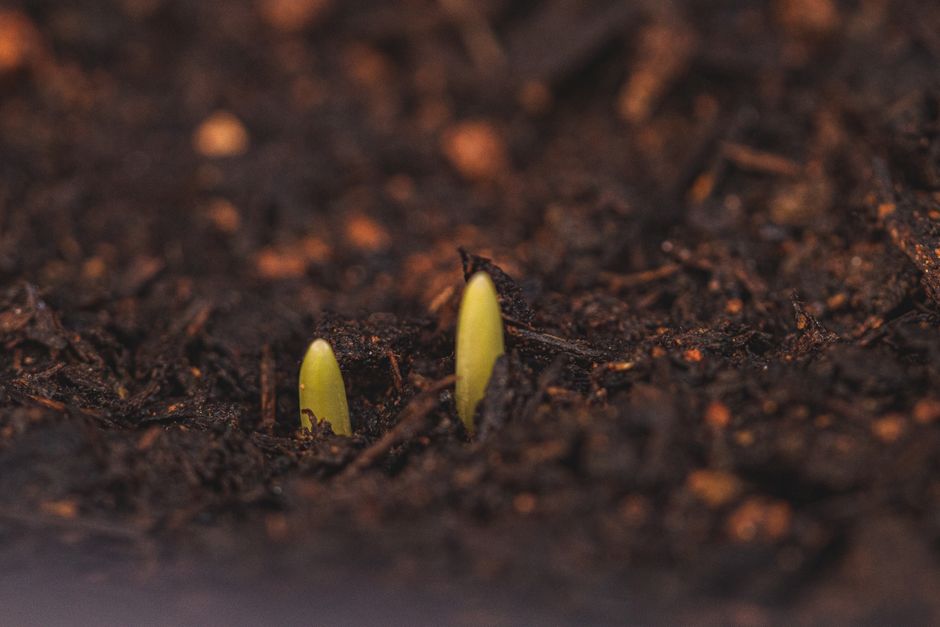
To establish a resilient, vibrant turf, we must work with species adapted to our cold winters and warm, humid summers. In Eastern Massachusetts, cool-season grasses are the gold standard. Selecting the right species, or more commonly, a balanced seed blend, ensures your yard can handle heavy foot traffic, summer drought, and seasonal shade.
The primary cool-season grasses we install include:
- Kentucky Bluegrass: Known for its lush, deep blue-green color and dense growth. It spreads via underground stems called rhizomes, allowing it to self-repair after heavy wear. It thrives in full sun but requires regular watering and nutrients to look its best.
- Tall Fescue: A bunch-type grass with deep root systems that penetrate far into the soil. This structural advantage makes it incredibly drought-resistant and resilient against summer heat stress. It is often blended with Kentucky Bluegrass for a highly durable lawn.
- Perennial Ryegrass: This species germinates exceptionally fast, often showing green shoots within a week. It offers excellent wear resistance and is frequently used in seed mixes to provide quick ground cover while slower species establish.
- Fine Fescues: Including creeping red, chewings, and hard fescues, these are the ultimate shade-tolerant grasses. They require very little water and fertilizer, making them ideal for low-maintenance areas and under mature tree canopies.
When planning your turf, local resources can help you understand neighborhood-specific conditions. For instance, reviewing guides like Lexington, MA Lawn Care | 6000+ 5-Star Reviews and Billerica, MA Lawn Care | 6000+ 5-Star Reviews provides excellent context on how these grass types perform in nearby suburban soils.
Optimal Timing for a New Lawn Boston MA
Timing is everything when installing a new lawn in Boston, MA. Cool-season grasses germinate and develop strong roots when daytime air temperatures hover between 65°F and 75°F, and soil temperatures are consistently between 55°F and 65°F.
The absolute best window for planting grass seed in Massachusetts is from the third week of August to the third week of September. During this late summer to early fall window, the soil is warm from the summer sun, weed pressure is significantly lower, and autumn rains provide consistent moisture. Planting during this time gives the young grass two full growing periods (fall and spring) to mature before facing the intense heat and drought of the following summer.
If you miss the fall window, the second-best time is in the spring, from mid-April to mid-May. While spring seeding can be successful, the young grass must compete with aggressive spring weeds and may struggle to establish deep roots before summer heat sets in. Seeding after the end of September is generally considered too late for new lawn establishments in Massachusetts, as the young seedlings will not have enough time to develop root systems strong enough to survive the winter freeze-thaw cycles.
For a professional, stress-free installation during these critical seasonal windows, you can learn more about our specialized Lawn Installations Boston MA options.
Soil Preparation for a New Lawn Boston MA
A beautiful lawn is only as good as the soil beneath it. Skipping proper site preparation is the number one reason new lawns fail by their second year. Eastern Massachusetts soils are notorious for presenting challenges such as compacted glacial till, heavy marine clay, and rocky shallow ground.
To set your new lawn up for long-term success, we follow a rigorous soil preparation protocol:
- Soil Testing: We highly recommend testing your soil through local services like the UMass Amherst Soil and Plant Nutrient Testing Laboratory. This test measures your soil’s pH and nutrient levels, telling us exactly what amendments are needed.
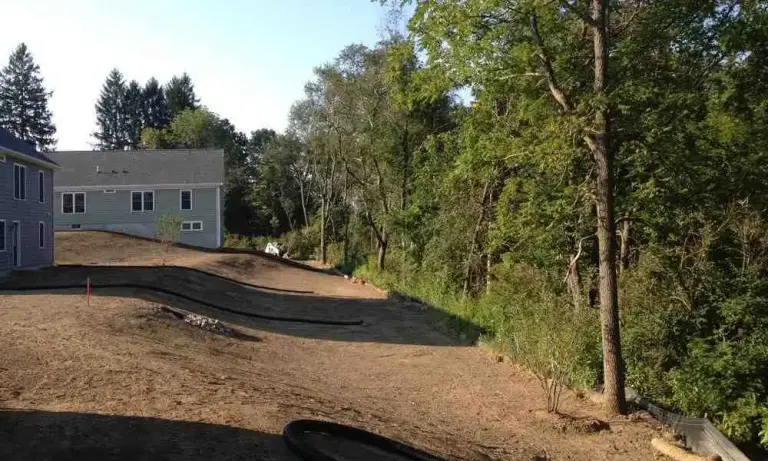
- Clearing and Grading: We remove all old vegetation, weeds, rocks, and debris. We then rough-grade the area, ensuring a 1% to 2% slope away from your home’s foundation to prevent water pooling and basement dampness.
- Adding Soil Amendments: Most local soils benefit from organic matter. We blend 2 to 4 inches of high-quality compost into the topsoil to improve drainage in clay soils and increase water retention in sandy soils, aiming for an organic matter content of 3% to 5%.
- pH Correction: Massachusetts soils tend to be naturally acidic. Based on your soil test, we apply lime (often 50 to 100+ lbs per 1,000 square feet) to bring the pH into the ideal 6.0 to 7.0 range, which maximizes nutrient absorption.
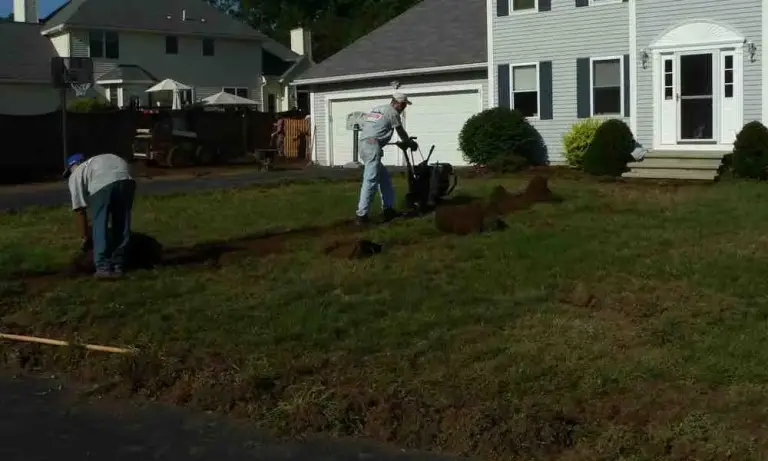
- Final Grading and Rolling: We fine-rake the surface to create a perfectly level, smooth seedbed, then use a light water-filled roller to firm the soil slightly without compacting it.
Proper prep ensures deep root penetration and healthy turf. Discover how our comprehensive Landscaping Boston services cover every detail from soil prep to final grading.
Choosing the Best Method for a New Lawn Boston MA
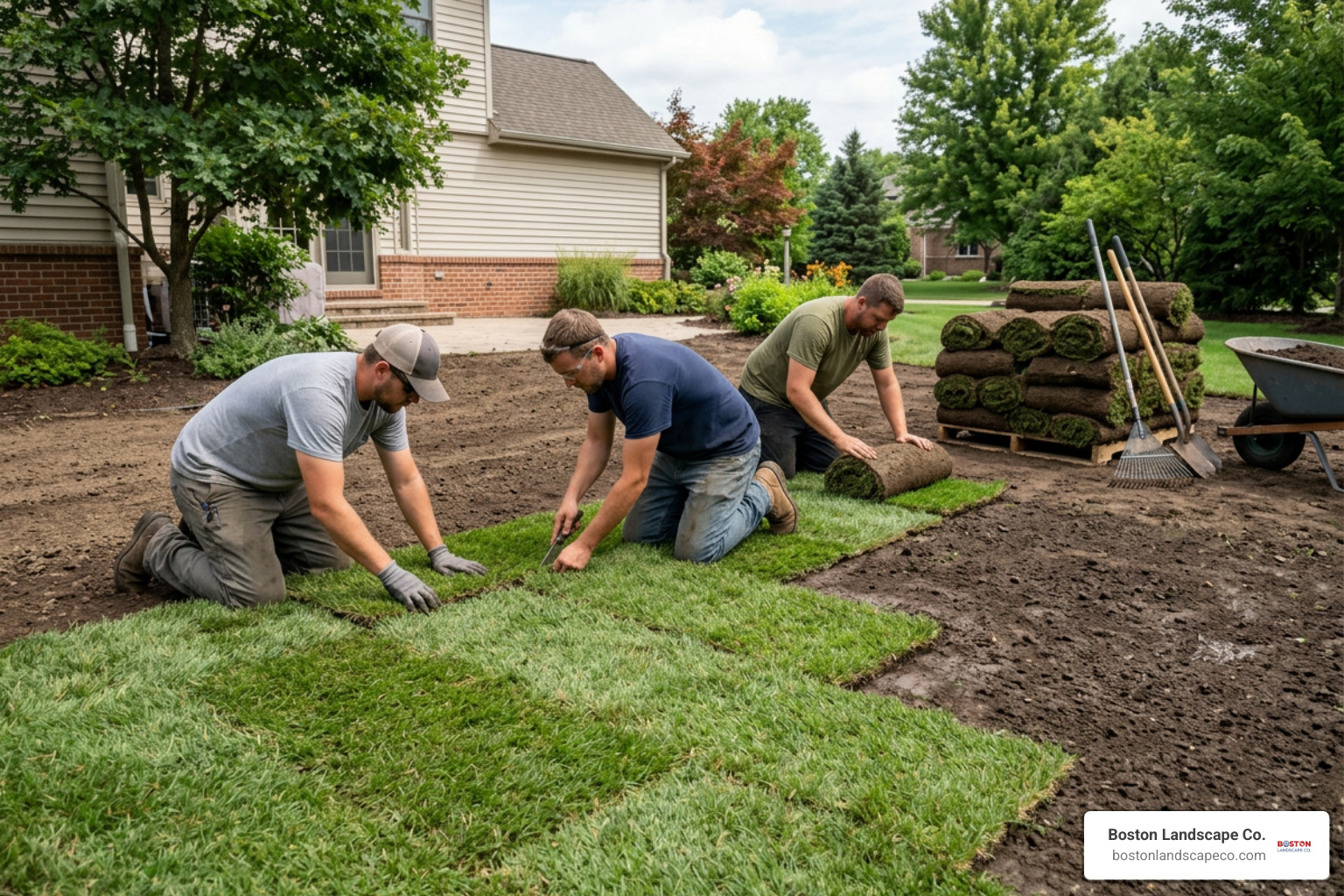
Homeowners and commercial property managers have three primary installation methods to choose from when establishing a natural lawn. Each method has distinct advantages depending on your budget, timeline, and site conditions.
To help you choose, let’s look at how these professional methods compare:
| Feature | Sod Installation | Hydroseeding | Traditional Seeding |
|---|---|---|---|
| Speed of Results | Instant green lawn | Germination in 5-10 days | Germination in 10-21 days |
| Erosion Control | Excellent (immediate) | Very Good (slurry binds soil) | Low (prone to washouts) |
| Weed Resistance | High (dense turf blocks weeds) | Moderate | Low (initially) |
| Root Establishment | Rapid (2-3 weeks) | Deep and highly resilient | Deep and highly resilient |
To dive deeper into the mechanics of hydraulic applications, read our detailed breakdown of The Pros and Cons of Hydroseeding Lawns.
Sod Installation for Instant Turf
Sodding is the process of transplanting mature, professionally grown turfgrass directly onto your prepared soil. It is the ultimate choice for property owners who want an instant, flawless green space without the wait.
The primary benefit of sod is immediate gratification and erosion control. If you have steep slopes or areas highly prone to runoff, sod acts as an instant stabilizing blanket. Because the turf is already dense and mature, it naturally blocks out weed seeds, resulting in a much cleaner lawn with fewer chemical treatments required in its first year.
To understand the typical investment required for this premium service, check out our guide on the Average Cost to Resod a Lawn.
Hydroseeding and Traditional Seeding
For larger properties where sodding might be cost-prohibitive, seeding is an excellent, highly successful alternative.
Hydroseeding involves mixing grass seed, water, fertilizer, and a protective wood- or paper-fiber mulch into a tank to create a thick slurry. This slurry is then sprayed evenly across the prepared soil. The green mulch dye ensures complete coverage, locks in consistent moisture, and binds the soil particles together to prevent erosion. It is highly cost-effective and ideal for covering large, uneven terrains quickly.
Traditional seeding involves spreading dry seed using precision broadcast spreaders, followed by a light raking and rolling to ensure excellent seed-to-soil contact. While it takes the longest to establish and is vulnerable to heavy rains, traditional seeding allows us to create highly customized seed blends tailored to the specific sun and shade patterns of your property.
Whether we are hydroseeding expansive Concord landscapes or performing traditional seeding on historic Burlington properties, matching the method to your land’s topography is key to a beautiful result.
Regulatory Compliance and Neighborhood Soil Challenges
Installing a new lawn in Boston, MA involves navigating local municipal codes, utility safety, and environmental regulations. Neglecting these rules can lead to costly fines or damage to your property.
- Dig Safe 811: Before any excavation, grading, or deep tilling begins, Massachusetts law requires calling Dig Safe at 811. This service must be contacted at least 72 hours in advance to mark all underground utility lines, including gas, electric, water, and telecommunications.
- Wetlands Protection Act: If your property is located near a river, stream, pond, or wetland area, your project falls under the jurisdiction of the local Conservation Commission. Under the Massachusetts Wetlands Protection Act, any land disturbance within 100 feet of a wetland boundary requires filing a Request for Determination of Applicability (RDA) or a Notice of Intent (NOI).
- Stormwater Management (MS4 Compliance): Boston and its surrounding suburbs enforce strict Municipal Separate Storm Sewer System (MS4) regulations. If your lawn renovation disturbs more than 1,000 square feet of soil, you must implement sediment barriers, such as silt fences or straw wattles, to prevent muddy runoff from entering local storm drains.
- Water Use Regulations: Many towns in our service area, including Lexington and Wilmington, enforce seasonal outdoor water restrictions during dry summer months. Installing an efficient, smart irrigation system can help you stay compliant while keeping your new turf alive.
For those managing properties in nearby areas, resources like Burlington, MA lawn care service starting at $19 - LawnStarter offer insight into local lawn maintenance standards. When tackling complex grading or environmental compliance, it is always best to work with licensed Landscape Contractors Boston who know how to navigate municipal permits and conservation rules seamlessly.
Boston Neighborhood Soil Variations
Understanding your specific neighborhood’s soil profile is essential for a successful lawn installation:
- Back Bay & Beacon Hill: These historic urban areas feature highly compacted soils, often sitting on top of historic fill and glacial till. Drainage is typically poor, requiring extensive aeration, organic compost blending, and specialized drainage systems.
- South Boston & East Boston: Coastal proximity means these neighborhoods often deal with heavy marine clay and sandy soils with high salt exposure. Turf installed here must be salt-tolerant and require heavy compost blending to improve soil structure.
- Concord & Bedford: Properties in these historic suburbs often feature rocky, shallow soils with low nutrient content. Successful lawn installation here requires meticulous stone removal and the addition of several inches of premium topsoil.
- Lexington & Billerica: These areas feature classic New England glacial till, which is highly prone to compaction. Deep core aeration and lime applications are vital to balance the naturally acidic pH of these suburban soils.
Natural Grass vs. Artificial Turf in New England
With our unpredictable New England weather, from freezing winters to humid summers, many property owners find themselves comparing natural grass to high-quality synthetic turf. Both options have distinct characteristics:
- Maintenance Requirements: Natural grass requires weekly mowing, seasonal fertilization, weed control, aeration, and regular watering. Artificial turf requires virtually no mowing or watering, needing only occasional brushing and rinsing to remove debris and pet waste.
- Year-Round Aesthetics: Natural grass goes dormant and turns brown during our cold winters. Artificial turf stays vibrant and green year-round, regardless of snow, ice, or summer drought.
- Environmental Considerations: While natural grass filters pollutants, cools the air, and supports local biodiversity, it requires water and chemical fertilizers. Artificial turf eliminates the need for fertilizers and pesticides, reducing chemical runoff into local waterways. However, synthetic turf does retain heat in direct summer sunlight and has a high upfront installation cost.
- Durability: For pet runs, high-traffic commercial courtyards, or backyard putting greens, artificial turf provides an incredibly durable, mud-free surface that stands up to heavy daily wear.
Post-Installation Care and Cost Considerations
Once your new lawn is installed, its survival depends entirely on proper post-installation care.
The Golden Rules of New Lawn Care:
- Watering: For new sod, water immediately and deeply, ensuring the soil underneath is thoroughly wet. Water daily (up to 20 minutes, 2-3 times a day in dry weather) for the first two weeks to keep the root zone consistently moist. For seeded or hydroseeded lawns, keep the top inch of soil damp but not muddy. Never let the seedbed dry out.
- First Mowing: Wait until your new grass reaches approximately 3 inches tall before its first cut. Ensure your mower blades are extremely sharp to avoid tearing the young roots, and never remove more than the top 1/3 of the grass blade height.
- Traffic Control: Keep all children, pets, and heavy equipment off the new lawn for at least 3 to 4 weeks to allow the delicate root systems to lock into the soil.
- Fertilization: Apply a high-quality starter fertilizer at the time of planting to provide essential phosphorus for rapid root development. Avoid standard high-nitrogen weed-and-feed fertilizers until the lawn is fully established.
When planning your budget, it is helpful to look at regional market trends. Please note that all prices mentioned below are average costs sourced from publicly available internet data and are not the actual prices of Boston Landscape Co.
To account for the high variability in soil prep, stone removal, and grading requirements in Eastern Massachusetts, professional lawn installation costs typically reflect a wide range. Based on general industry data:
- Sod Installation: While the national average for basic sod sits around $1.00 to $2.00 per square foot, a professional, full-service installation in our region, including extensive soil prep, grading, and post-care setup, typically ranges from $4.00 to $10.00 per square foot (with complex historic properties starting at 2x the standard rate and highly intricate urban sites reaching up to 5x that baseline).
- Seeding & Hydroseeding: Traditional seeding and hydroseeding are highly cost-effective options, with regional project averages generally ranging from $1.50 to $4.50 per square foot, depending on the size of the property and the depth of soil preparation required.
For a comprehensive breakdown of professional landscaping services and how to choose the right partner for your project, refer to our Buyer’s Guide: Best Lawn Installation Services for 2026.
Frequently Asked Questions about New Lawns
What is the best month to install a new lawn in Massachusetts?
The absolute best month is September (specifically from late August through mid-September). During this time, warm soil temperatures, cooler air, and consistent fall rain create the perfect environment for rapid root growth. The second-best window is May, which offers moderate temperatures but higher weed competition.
How much does it cost to install a new lawn in the Boston area?
Disclaimer: All prices mentioned are average costs sourced from publicly available internet data and are not the actual prices of Boston Landscape Co.
Because of our rocky soil and historic terrain, average professional installation costs in the Boston area range widely from $1.50 to $10.00+ per square foot. Hydroseeding and traditional seeding represent the lower end of this range, while premium, instant sod installation combined with extensive soil grading and compost blending represents the higher end of the spectrum.
Is artificial turf a viable option for Boston yards?
Yes, artificial turf is an excellent option for Boston properties, especially in highly shaded urban yards, dog runs, and commercial spaces. It withstands our harsh New England winters beautifully and eliminates the hassle of summer mud, though it does require a larger upfront investment than natural seeding.
Conclusion
Installing a new lawn in Boston, MA is a significant investment that completely transforms the look, feel, and value of your property. From selecting the perfect cool-season grass blend to navigating local wetlands regulations and preparing tough New England soil, success lies in the details.
At Boston Landscape Co., we bring over 30 years of local expertise to every project. Whether you are looking for instant, premium sod, cost-effective hydroseeding, or high-performance artificial turf, our team serves homeowners and businesses throughout Bedford, Billerica, Burlington, Chelmsford, Concord, Lexington, and Wilmington with dedicated, professional care.
Ready to transform your outdoor space? Let us handle the hard work and get your new lawn done right the first time.
- Call us today at: +781-438-6690
- Get a free, professional estimate:Request an Estimate Online
- Explore our services:Lawn Installation Services