
Waltham Snow and Ice Management: Understanding Local Ordinances
Waltham snow and ice management is governed by strict local ordinances that every property owner needs to know before the first snowflake falls.
Here’s a quick summary of what the rules require:
| Rule | Detail |
|---|---|
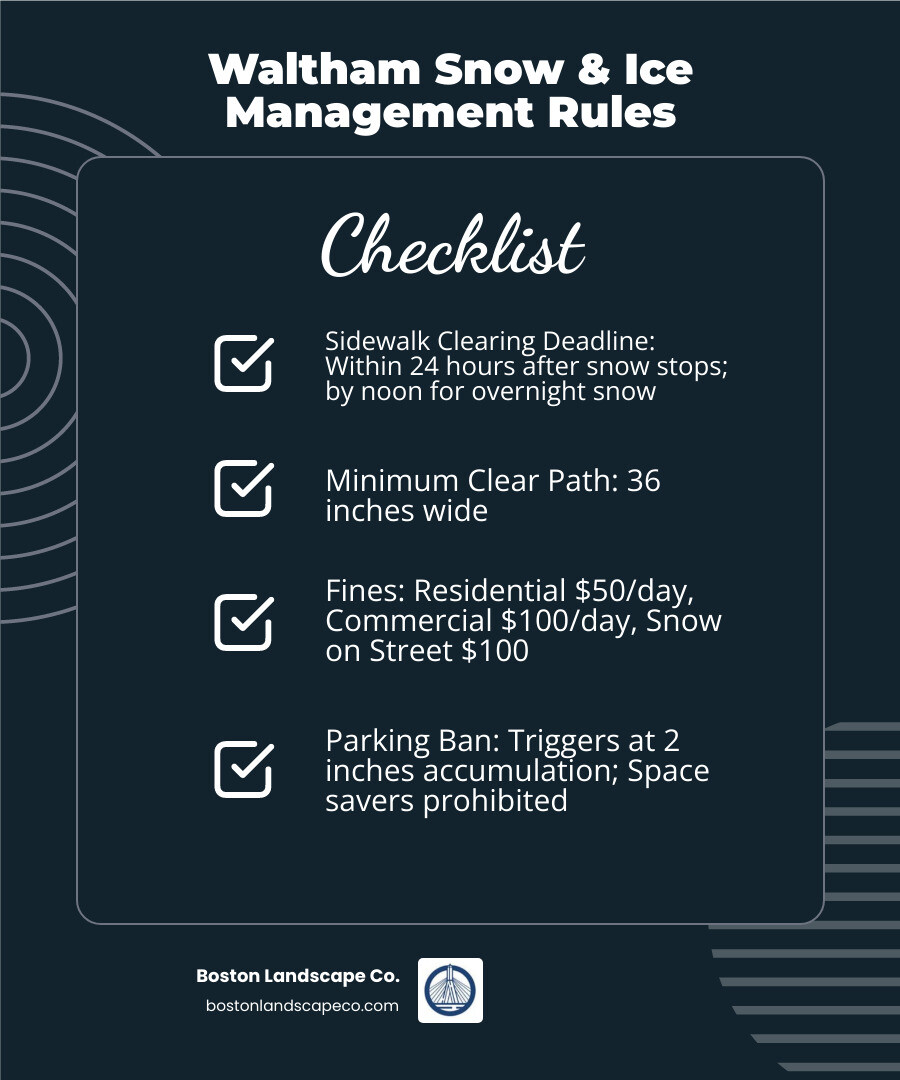
| Sidewalk clearing deadline | Within 24 hours after snow stops; by noon for overnight snow |
| Minimum clear path width | 36 inches |
| Ice treatment | Remove or treat with sand/salt if removal isn’t possible |
| Residential fine | $50 per violation per day |
| Commercial fine | $100 per violation per day |
| Snow deposited on street | $100 per incident |
| Parking ban trigger | 2 inches of snow accumulation |
| Space savers | Not permitted in Waltham |
Winter in Waltham is no joke. With over 150 lane miles of city roads to maintain, steep neighborhood hills, narrow streets, and heavy pedestrian traffic in the downtown core, snow and ice create real hazards fast. Whether you own a home or manage a commercial property, staying on top of snow and ice removal isn’t just about convenience – it’s a legal responsibility and a safety obligation.
Falling behind on snow removal can mean fines, liability exposure, and unsafe conditions for the people who live and work near your property. This guide covers everything you need to know: local ordinances, municipal operations, neighborhood-specific challenges, eco-friendly materials, and how to protect yourself legally.
I’m Steve Schumacher, owner of Boston Landscape Co. since 1991, and over more than three decades I’ve developed deep expertise in Waltham snow and ice management for both residential and commercial properties across the Greater Boston area. Let’s walk through exactly what you need to do to stay safe, compliant, and ahead of the storm.
When we talk about Waltham snow and ice management, we aren’t just talking about a suggestion; we are talking about the law. The City of Waltham has established clear rules under Chapter 12, Article II of the municipal code to ensure that the city remains walkable even during a Nor’easter.
The most critical rule for property owners is the 24-hour clearing window. Once the snow stops falling, the clock starts ticking. If the snow finishes falling during the night, the deadline is even tighter—you must have your sidewalks cleared by noon the following day. We always tell our clients that “noon is the new midnight” when it comes to overnight storms.
Waltham follows the authority granted by Massachusetts General Law Chapter 85, Section 5, which allows the city to mandate that owners of land abutting a sidewalk clear it of snow and ice. This isn’t just a Waltham quirk; it’s a standard practice across many of our service areas, though Waltham’s enforcement is notably diligent. You can find the full text of these rules in the Waltham Traffic Rules and Regulations.
For those who find themselves overwhelmed by these requirements, especially during back-to-back storms, seeking professional snow and ice removal services is often the most reliable way to stay compliant without losing your Saturday to a shovel.
Fines and Penalties for Non-Compliance
If you decide to sleep in or skip the shoveling, the City of Waltham may send you a “thank you” note in the form of a fine. For residential property owners, the penalty is $50 per violation, per day. If you manage a commercial property, that fine doubles to $100 per violation, per day.
One mistake we see all too often is people shoveling their driveway snow directly into the street. It seems logical—the plow will just take it away, right? Wrong. Waltham ordinances strictly prohibit depositing snow onto a public way. Doing so can result in a $100 fine per incident. The city takes this seriously because it creates “windrows” that can freeze into solid ice blocks, damaging plows and causing accidents for unsuspecting drivers.
Managing these risks is a core part of effective snow-and-ice-management/, where the goal is to keep the snow on the property and the fines out of your mailbox.
Sidewalk Standards for Waltham Snow and Ice Management
It isn’t enough to just scrape a narrow goat path through the snow. Waltham requires a minimum 36-inch wide clear path on all public sidewalks. This width is essential for ADA (Americans with Disabilities Act) compliance, ensuring that people using wheelchairs, parents with strollers, and the elderly can pass safely.
If the ice is so frozen that it’s “impracticable” to remove, the law requires you to treat it. This means applying sand, salt, or other de-icing materials to ensure the surface is no longer slippery. We always recommend a proactive approach—treating the pavement before the ice bonds—to make the eventual cleanup much easier. For many homeowners, residential-snow-shoveling/ is the best way to ensure these specific width and safety standards are met every time.
Municipal Operations and Parking Regulations

The Waltham Department of Public Works (DPW) is responsible for a massive operation, covering over 150 lane miles of city streets. When a storm hits, they don’t just wander around aimlessly; they follow a very specific hierarchy of needs.
The DPW prioritizes:
- Main Arteries: Routes like Main Street, Moody Street, and Totten Pond Road.
- Emergency Routes: Ensuring hospitals and fire stations are accessible.
- School Corridors: Making sure buses can run safely once classes resume.
- Hilly Neighborhoods: Addressing steep inclines that become death traps in icy conditions.
- Residential Side Streets: These are usually the last to be cleared.
It’s also important to note that the city’s schedule for other services can shift during winter weather. You should always check the Waltham Trash and Recycling Map to see if your pickup day has been delayed due to snow operations.
Snow Emergency Parking Bans and Towing
The most common question we get during a storm is, “Can I park on the street?” In Waltham, the answer is usually “no” once the snow starts piling up. A snow emergency parking ban is automatically triggered when there is an accumulation of 2 inches of snow.
Once this ban is in effect, any vehicle parked on a public way is subject to ticketing and towing. The towing fees alone start at $100, plus daily storage fees. The reason for this strictness is simple: the DPW needs the full width of the street to push snow back to the curbs. A single car left on the street can prevent an entire block from being properly plowed.
Waltham also has a very firm “No Space Savers” policy. Unlike some parts of Boston where people use lawn chairs or orange cones to claim a spot they shoveled, Waltham will remove these items immediately. If you leave it in the street, consider it gone. This policy is similar to the Snow & Ice Removal Policy – City of Woburn, emphasizing that public streets are for public use, not private reservation.
Reporting Issues via Waltham 311
If you notice a sidewalk that hasn’t been cleared 24 hours after a storm, or if a city plow missed your street, you can report it using the Waltham 311 system. This is the central hub for all non-emergency city services. Residents can file complaints via the 311 website or mobile app.
For business owners, staying on top of these complaints is vital. A single report to 311 can trigger a visit from a code enforcement officer. This is why many local businesses rely on commercial-snow-plowing-waltham-ma/ to ensure their storefronts and lots are cleared long before a neighbor feels the need to call the city.
Neighborhood Challenges and Professional Solutions
Waltham is a city of distinct neighborhoods, each with its own “personality” when it comes to snow. What works in the flat expanses of North Waltham won’t necessarily work in the tight streets of the South Side.
| Neighborhood | Primary Challenge | Strategy |
|---|---|---|
| South Side | Extremely narrow streets, limited snow storage | Snow hauling and relocation; smaller equipment. |
| The Highlands | Steep grades and older homes with shared driveways | Heavy de-icing; priority sanding; coordinated plowing. |
| Downtown | High pedestrian traffic and narrow storefronts | Rapid response; manual shoveling; zero-tolerance ice policy. |
| North Waltham | Large parking lots and wind exposure | Large-scale plowing; snow drifting management. |
In areas like the South Side, there is literally nowhere to put the snow. When we clear these areas, we often have to implement parking-lot-snow-best-practices/ which includes hauling snow off-site to a designated melting facility rather than letting it pile up and block sightlines.
Commercial vs. Residential Waltham Snow and Ice Management
The approach to Waltham snow and ice management changes significantly depending on the type of property.
For residential customers, the focus is on accessibility and convenience. We want you to be able to get your car out of the driveway and get to work on time. For commercial clients, the stakes are much higher. A commercial property manager is worried about tenant safety, customer access, and—most importantly—liability protection.
Commercial services often include 24/7 weather monitoring and “zero-tolerance” triggers, meaning we start clearing as soon as the first half-inch of snow hits the ground. This ensures that a business is ready for operation the moment the doors open. We provide specialized commercial-snow-removal-services/ that cater to these high-demand environments, using heavy-duty loaders and specialized sidewalk machines that a standard residential plow truck just can’t match.
Eco-Friendly De-Icing and Advanced Materials
In the old days, everyone just dumped rock salt everywhere. Today, we know better. Standard rock salt stops working effectively when temperatures drop below 15°F, and it can be brutal on your landscaping and concrete.
We utilize advanced materials like “Magic Salt” (rock salt treated with a proprietary liquid containing magnesium chloride and agricultural by-products). Magic Salt is effective down to -20°F and is much safer for the environment. It creates an “ice-shield” on the pavement, preventing snow from bonding to the surface in the first place.
We also use liquid brine pre-treatments. By spraying a brine solution on the ground before the storm starts, we can reduce the total amount of salt needed by up to 30%. This is not only better for the environment but also more cost-effective. These professional-grade materials are a step above what you’ll find at the local hardware store and are applied by crews who understand the Scientific data on grounds maintenance labor and application rates required for maximum safety.
Legal Liability and Risk Management in Massachusetts
In 2010, the Massachusetts Supreme Judicial Court changed the game for property owners in the case of Papadopoulos v. Target Corp. Before this ruling, owners weren’t always liable for “natural accumulations” of snow. Now, the law requires “reasonable care” for all accumulations of snow and ice.
This means if someone slips and falls on your property, you can’t just say, “Well, it was a big storm, what did you expect?” You must prove that you took reasonable steps to clear the hazard. For businesses, this is a massive risk. A single slip-and-fall lawsuit can cost tens of thousands of dollars in legal fees and settlements.
Understanding winter-liability-risks-for-businesses-snow-removal-and-legal-responsibility/ is the first step in protecting your assets. Documentation is key—we keep detailed logs of every time we visit a site, what materials were applied, and the weather conditions at the time.
The Importance of Ironclad Snow Contracts
A handshake deal with a guy who has a plow on his truck is a recipe for disaster. If he doesn’t show up, or if he damages your property, you have very little recourse. A formal snow clearing contract is essentially an insurance policy for your property.
There are three main types of contracts we offer:
- Per-Event: You pay a set price for each storm based on the amount of snow.
- Seasonal (Fixed-Rate): You pay one flat fee for the entire winter, regardless of how many times it snows. This is great for budgeting.
- Full-Service: An all-inclusive plan that covers plowing, shoveling, and unlimited de-icing.
A good commercial-snow-removal-contract/ should always include indemnification clauses, protecting you from liability if the contractor fails to perform their duties.
Frequently Asked Questions about Waltham Snow Removal
How long do I have to clear my sidewalk in Waltham?
You have 24 hours from the time the snow stops falling to clear your sidewalk. However, if the snow stops overnight, you are required by city ordinance to have it cleared by noon the following day. The path must be at least 36 inches wide to allow for safe passage of all pedestrians. If you find yourself unable to meet these windows, our snow-plowing-services/ can help keep you on the right side of the law.
Are “space savers” allowed in Waltham?
No. Unlike some other cities in the Greater Boston area, Waltham does not recognize or allow space savers. Items like trash cans, chairs, or cones placed in the street to reserve a parking spot will be removed by the city. The best way to ensure you have a spot is to utilize off-street parking or wait until the parking-lot-snow-plowing/ crews have cleared the public areas.
What are the average costs for professional snow removal?
Based on online data and general market trends in the Waltham area, professional snow removal costs can vary significantly.
- Residential Driveways: Typically range from $75 to $225 per storm.
- Commercial Lots: Can range from $300 to $1,500+ per storm depending on size and complexity.
- Seasonal Contracts: Often range from $500 for a small residential property to over $5,000 for large commercial sites.
Please note: These prices are average costs based on online internet data and are not the actual prices of Boston Landscape Co. Real-world costs can vary by 3x or more depending on the specific needs of the property, the severity of the winter, and the level of service required. For a detailed breakdown of what goes into these numbers, check out our guide on the cost-of-snow-removal/.
Conclusion
Staying ahead of the winter weather in Waltham requires more than just a sturdy shovel and a bag of salt. It requires an understanding of local laws, a plan for the city’s parking bans, and a strategy for managing the unique challenges of your specific neighborhood.
Whether you are a homeowner trying to avoid a $50 fine or a business owner looking to mitigate a $50,000 liability risk, professional snow management is the key to a stress-free winter. At Boston Landscape Co., we’ve been keeping Waltham moving since 1991. We take pride in our “no excuses” approach to service, ensuring that our clients are safe and compliant no matter what Mother Nature throws our way.
Don’t wait until the first blizzard is on the radar. Request a free estimate today and let us develop a custom snow and ice management plan for your property. Stay safe, stay warm, and let us handle the heavy lifting.
