
What Boston Businesses Pay for Commercial Snow Removal
Commercial snow removal cost Boston is one of the most searched topics by local property managers every fall — and for good reason. Getting caught off guard by winter pricing can blow your facilities budget fast.
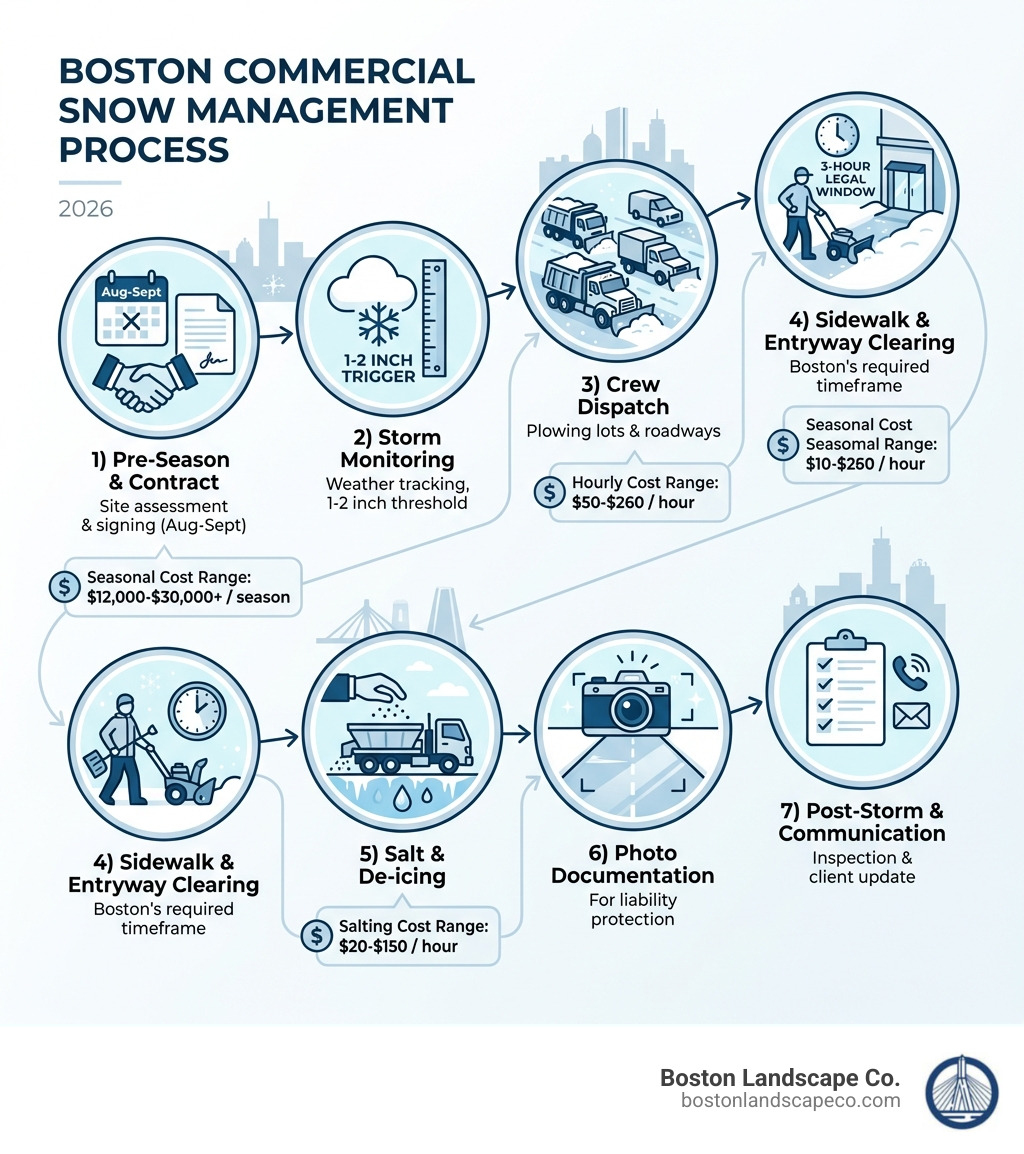
Here are the typical cost ranges you can expect (based on internet averages, not Boston Landscape Co.’s rates):
| Service Type | Typical Cost Range |
|---|---|
| Hourly commercial plowing | $50 – $260 per hour |
| Per-event (mid-size property) | $500 – $2,000 per event |
| Seasonal contract (mid-size) | $12,000 – $30,000+ per season |
| Parking lot (seasonal, 50 spaces) | ~$6,000 per season |
| Salt/de-icing application | $20 – $150 per hour |
| Sidewalk clearing (per visit) | Included or $50 – $200 add-on |
Please note: All prices listed in this article are average estimates based on publicly available online data. They do not reflect the actual pricing of Boston Landscape Co. Costs vary widely based on property size, service frequency, and complexity — the high end can easily reach 3× the average.
Boston averages 48.7 inches of snowfall per year. That is not a light winter city. For commercial properties, that means real operational risk — slip-and-fall liability, blocked access for customers and deliveries, and potential code violations if sidewalks aren’t cleared within Boston’s required 3-hour window after snowfall ends.
This guide breaks down exactly what drives those costs, what pricing models exist, and how to make sure you’re getting real value from your snow management budget.
I’m Steve Schumacher, owner-operator of Boston Landscape Co. since 1991, and over more than three decades I’ve helped commercial clients across Greater Boston navigate commercial snow removal cost Boston — from small retail lots to large multi-property portfolios. I’ll walk you through everything you need to know so there are no surprises when the first storm hits.
Commercial snow removal cost Boston: Average Rates and Estimates
When you start looking into professional help, you’ll find that “average” is a tricky word in Massachusetts. A light dusting in Reading is a different beast than a Nor’easter dumping two feet on a retail complex in Woburn.

Based on broader internet data, residential-style driveway plowing might start around $50 to $120 per visit, but commercial properties operate on a much larger scale. For a standard commercial lot, you might see “per push” rates ranging from $75 for a tiny office footprint to over $900 for expansive industrial sites. If you are looking for more general context, you can read more info about the cost of snow removal to see how residential and commercial needs differ.
Because every property is unique, we’ve put together a comparison table of internet-averaged costs based on property scale. These are not our rates, and high-complexity sites can cost 3× these amounts.
| Property Type | Est. Per-Visit Cost | Est. Seasonal Contract |
|---|---|---|
| Small Office (5-10 spaces) | $150 – $450 | $2,000 – $6,000 |
| Retail Strip (20-50 spaces) | $400 – $1,200 | $6,000 – $18,000 |
| Industrial/Medical (100+ spaces) | $1,000 – $3,000+ | $25,000 – $75,000+ |
Understanding Commercial Snow Removal Cost Boston Pricing Models
Choosing the right contract structure is just as important as the price itself. In the Greater Boston area, most contractors use one of four primary models:
- Hourly Rates: Typically ranging from $50 to $260 per hour depending on the equipment used (e.g., a standard pickup vs. a large front-end loader). This is common for “Time and Materials” contracts where you pay for the actual work performed.
- Per-Event/Per-Push: You pay a flat fee every time the plow hits the pavement. Most contracts have a “trigger” (usually 1 or 2 inches). If it snows 10 inches, the crew might “push” three times, and you’d pay for each visit.
- Per-Inch Pricing: This model uses tiers. For example, 1-3 inches might cost $300, while 3-6 inches costs $600. This is very popular in Boston because it accounts for the extra labor and fuel required to move heavy, deep snow. You can check historical snowfall data for your region to see how often these tiers might be triggered in towns like Lexington or Concord.
- Seasonal Contracts: This is the “insurance policy” of snow removal. You pay a fixed annual fee regardless of whether we get 20 inches or 80 inches. It offers the best budget predictability for property managers.
For a deeper dive into which model fits your business, see these details on commercial snow removal pricing.
Commercial Snow Removal Cost Boston for Parking Lots and Walkways
A parking lot is only half the battle. In an urban environment like Boston or Somerville, the sidewalks and entryways are often where the highest liability sits.
Most commercial contracts separate “plowing” (the big trucks in the lot) from “sidewalk crews” (the folks with blowers and shovels). Sidewalk work is labor-intensive and often billed at $25 to $75 per hour per worker, or as a flat add-on per visit.
Businesses with “Zero-Tolerance” policies—like hospitals in Burlington or 24-hour convenience stores—will pay a premium for constant monitoring and clearing to ensure there is never an accumulation of snow or ice. If you’re searching for local help, look for commercial-snow-plowing-services-near-me that offer comprehensive lot-to-door service.
Key Factors Influencing Your Winter Maintenance Budget
Why does one business in Stoneham pay $5,000 a year while their neighbor pays $15,000? It usually comes down to these variables:
- Property Size and Layout: It’s not just square footage; it’s where the snow goes. If your lot is tight and we have to haul snow off-site rather than piling it in a corner, costs can double or triple.
- Terrain Complexity: Steep inclines, narrow alleys, and lots of “islands” or light poles require slower, more careful work.
- Obstacles: A lot that stays full of cars overnight (like an apartment complex in Malden) takes much longer to plow than an empty office lot.
- Response Time: If you need your lot “black and wet” by 6:00 AM regardless of when the storm ends, you’ll pay for that priority dispatch.
- Liability and Safety: According to the Washington Post, there are approximately 11,500 snow shoveling injuries every year. For a business, a slip-and-fall lawsuit can cost infinitely more than a season of professional plowing. Investing in commercial-snow-removal-services is as much about risk management as it is about moving white stuff.
Additional Services: De-icing, Salting, and Roof Snow Removal
In New England, the snow is rarely the biggest problem—it’s the ice that follows.
De-icing and Salting
Most contractors charge for salt by the application or by the ton. Internet averages suggest $20 to $150 per hour for application labor, plus the cost of the material. For a large commercial lot, a single “salt run” can cost anywhere from $150 to $1,000+.
- Liquid De-icing: Many modern pros use brine (liquid salt) before a storm. This prevents snow from bonding to the pavement and can actually reduce your total salt usage.
- Eco-Friendly Options: If you have sensitive landscaping or “green” building requirements, expect to pay a 15-30% premium for calcium chloride or other specialized melters.
Roof Snow Removal
Don’t forget to look up! Heavy snow loads can cause structural damage, and melting snow creates ice dams that lead to interior leaks. Roof snow removal is specialized work involving harnesses and shovels. National averages range from $200 to $500 for small roofs, but commercial flat roofs or steep pitches can reach $3,000+ per visit. You can explore our full range of snow-and-ice-removal-services to see how we tackle both ground and roof challenges.
The Value of Seasonal Contracts and Professional Reliability
In a city where a single storm can drop 24 inches, reliability is everything. When you sign a commercial-snow-removal-contract, you aren’t just paying for a truck; you’re paying for a spot on a list.
Why Seasonal Contracts Win:
- Budget Predictability: You know exactly what your “winter nut” is in October. No more $5,000 surprises in February.
- Priority Service: When the whole city is buried, contractors take care of their contract clients first. “Will-call” customers often wait 24-48 hours for service.
- Liability Protection: A professional contract usually includes detailed logs of when the crew arrived, what they did, and how much salt they spread. This documentation is your first line of defense in a slip-and-fall claim.
- Comprehensive Care: For those managing multiple units, property-management-snow-removal ensures that every site—from Waltham to Winchester—is handled with the same standard of care.
Frequently Asked Questions about Commercial Snow Removal
How can Boston businesses reduce their snow removal expenses?
The best way to save is to plan early. Signing a contract in August or September often yields “early bird” discounts of 10-20%. You can also save by bundling services—many companies (like ours) offer better rates if you use them for both summer landscaping and winter snow management. Finally, designate “snow storage” areas on your property so you don’t have to pay for expensive off-site hauling.
What should be included in a commercial snow removal contract?
A solid contract should clearly define:
- The trigger depth (e.g., “we plow at 2 inches”).
- Response times (e.g., “cleared within 4 hours of storm end”).
- Scope of work (which walkways, which doors, where to pile snow).
- Insurance and Liability (ensure the contractor has high-limit commercial liability and workers’ comp).
- Pricing model (hourly, per-inch, or seasonal).
How does snowfall depth affect the total cost of service?
Depth changes everything. Moving 2 inches of fluffy snow is fast and easy. Moving 10 inches of “heart attack snow” (heavy, wet slush) takes specialized heavy equipment and more time. Most “per-inch” contracts have price jumps at 6, 12, and 18 inches to account for this exponential increase in labor and fuel.
Conclusion
Managing a business in the Greater Boston area is hard enough without worrying about the weather. From our bases in Stoneham and Billerica, we’ve spent decades watching the sky so our clients don’t have to. Whether you’re in the North Shore or the heart of the city, professional reliability is the only way to ensure your doors stay open when the flakes start falling.
Don’t wait until the first blizzard warning to find a partner. If you want to ensure your property stays safe and accessible all winter long, Request an estimate for commercial snow plowing today. We’ll help you find a plan that fits your budget and keeps your business moving, no matter what Mother Nature throws at us.