
Residential Lawn Care Services: 5 Powerful Benefits in 2025
The Value of Professional Lawn Care
When you drive through the nicest neighborhoods in Greater Boston, one thing stands out immediately: those gorgeous, lush lawns didn’t happen by accident. Residential lawn care services transform ordinary yards into neighborhood showcases through consistent, expert attention.
What exactly can you expect when you hire professionals? Typically, these services include regular mowing that keeps your grass at the optimal height, precision edging that creates those crisp boundaries between lawn and walkways, strategic fertilization that feeds your turf without burning it, targeted weed control that preserves your grass while eliminating unwanted plants, seasonal aeration that allows roots to breathe, and thorough cleanup that prevents debris from suffocating your lawn.
Most of our clients choose either weekly service during the peak growing months or bi-weekly options for more modest budgets. Depending on your property size and the specific services you need, visits typically range from $35-150 each time we care for your lawn.
| Core Residential Lawn Care Services | Typical Frequency | Average Cost Range* |
|---|---|---|
| Lawn Mowing & Edging | Weekly (growing season) | $35-105 per visit |
| Fertilization | 4-6 times annually | $40-120 per application |
| Weed Control | 2-4 times annually | $40-120 per application |
| Aeration | 1-2 times annually | $75-225 per service |
| Overseeding | 1 time annually | $90-270 per service |
| Seasonal Cleanup | Spring and Fall | $100-300 per service |
*Costs based on internet averages, not actual Boston Landscape Co. pricing. Actual costs may vary.
A beautiful lawn does far more than just boost your home’s curb appeal. It creates an inviting outdoor space where your kids can play, where you can entertain friends on summer evenings, and where you can simply relax after a long day. Beyond the aesthetic benefits, professional lawn care actually increases your property value – often by thousands of dollars – while providing environmental advantages like improved air quality, natural cooling, and erosion control.
Let’s be honest – between work commitments, family obligations, and trying to enjoy your precious free time, maintaining a consistent lawn care schedule is challenging for most homeowners. Add in the fact that quality equipment is expensive and requires maintenance, and that truly understanding soil science and turf management takes years of experience… well, it’s no wonder so many Boston-area homeowners turn to professionals.
Hi there – I’m Steve Schumacher, owner of Boston Landscape Co. Over my 30+ years caring for lawns throughout Greater Boston, I’ve learned that every property has its own unique needs. Our team doesn’t just mow grass – we develop customized care programs based on your specific soil conditions, grass varieties, and the microclimate of your property. New England weather throws plenty of challenges our way, but our experience means your lawn stays resilient through hot summers, harsh winters, and everything in between.
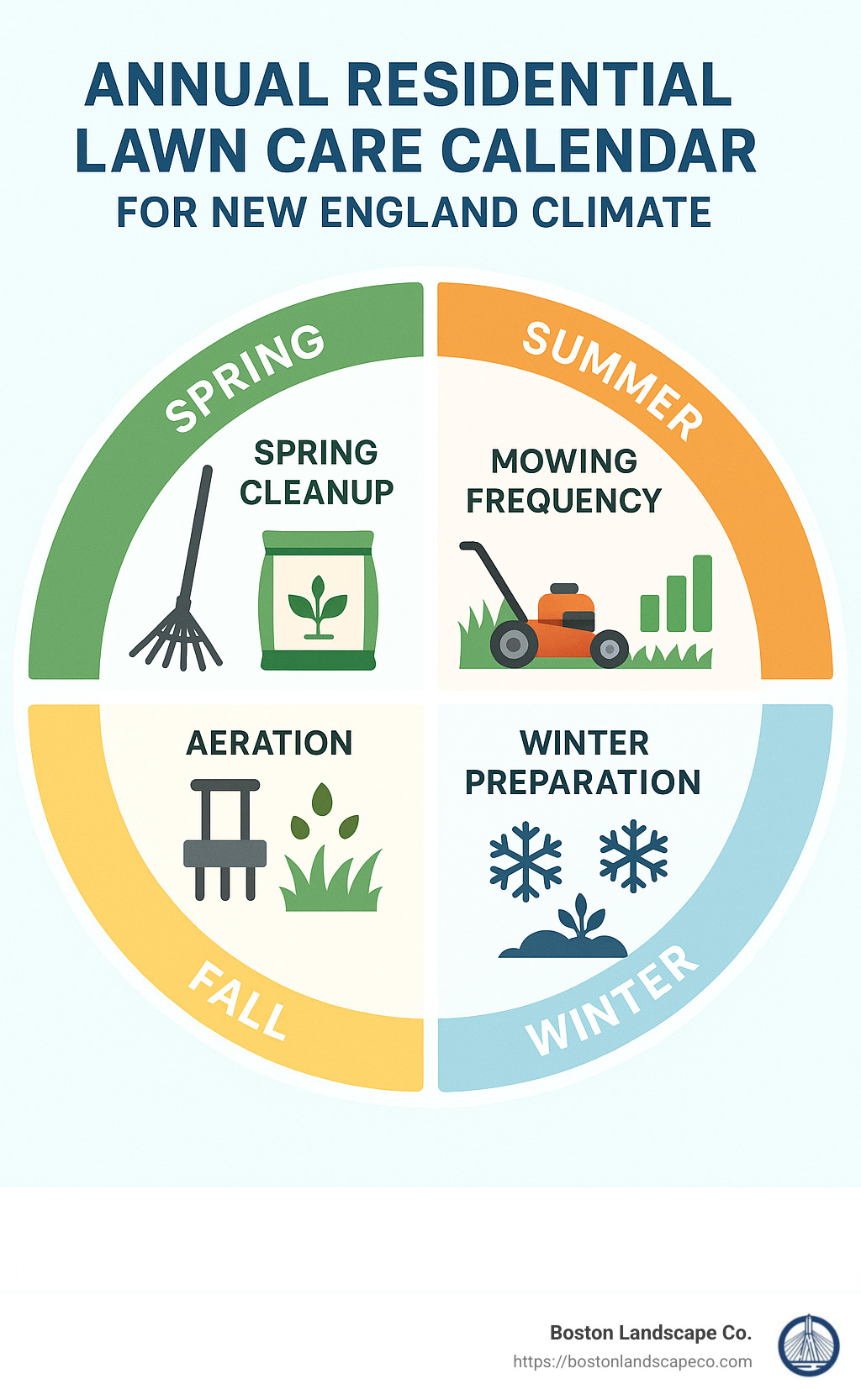
Looking to learn more about what professional lawn care entails? We’ve put together some helpful resources:
– what is full service lawn care
– what services do lawn care companies provide
– how much does full service lawn care cost
Understanding Residential Lawn Care Services
When it comes to creating that perfect green oasis around your home, residential lawn care services cover much more than just mowing. At Boston Landscape Co., we’ve spent decades perfecting our approach to lawn care in the unique and sometimes challenging Massachusetts climate.
The lush, healthy lawns you admire in Lexington, Winchester, and throughout the Boston suburbs don’t happen by accident – they’re the result of consistent, science-based care that adapts to our distinct New England seasons.
What Are Residential Lawn Care Services?
Residential lawn care services are professional treatments and maintenance routines designed to keep your home’s lawn healthy, vibrant, and weed-free throughout the year. Think of it as a comprehensive wellness program for your grass!
Full-service lawn care typically includes regular mowing and trimming, edging along walkways and garden beds, seasonal fertilization, weed control, aeration, overseeding, and pest management. All necessary equipment, products, and supplies are provided by us – no need to invest in expensive tools that sit unused in your garage most of the time.
You can choose between comprehensive maintenance packages or select individual services based on your lawn’s specific needs and your budget. As one delighted customer from Medford told us: “I love pulling into my property and seeing such a beautiful landscape! Everyone has been so nice and polite, and I enjoy having a company pay great attention to detail!”
Why Regular Maintenance Matters
Regular lawn maintenance delivers benefits far beyond just making the neighbors jealous:
Improved property value is perhaps the most tangible benefit – well-maintained lawns can increase home values by 5-15%, according to real estate experts. That’s a significant return on your lawn care investment!
Healthier turf develops when grass is consistently mowed at proper heights, promoting deeper root growth and creating a natural defense against both drought and pests.
Weed suppression happens naturally in thick, healthy lawns. As our specialists often say, “Our goal is to encourage as much healthy grass growth as possible, leaving no room for weeds to establish themselves.”
Safer outdoor spaces for your family and pets are another important benefit. Regular maintenance eliminates hiding spots for ticks and mosquitoes, while proper treatments keep harmful pests at bay.
Environmental benefits are substantial too – healthy lawns filter rainwater, prevent soil erosion, capture dust and pollutants, and produce oxygen. Your beautiful lawn is actually helping the planet!
A satisfied customer from Winchester recently noted: “The applicator was so very thorough with respect to spraying the weeds which we always appreciate!”
The Core Components of Residential Lawn Care Services
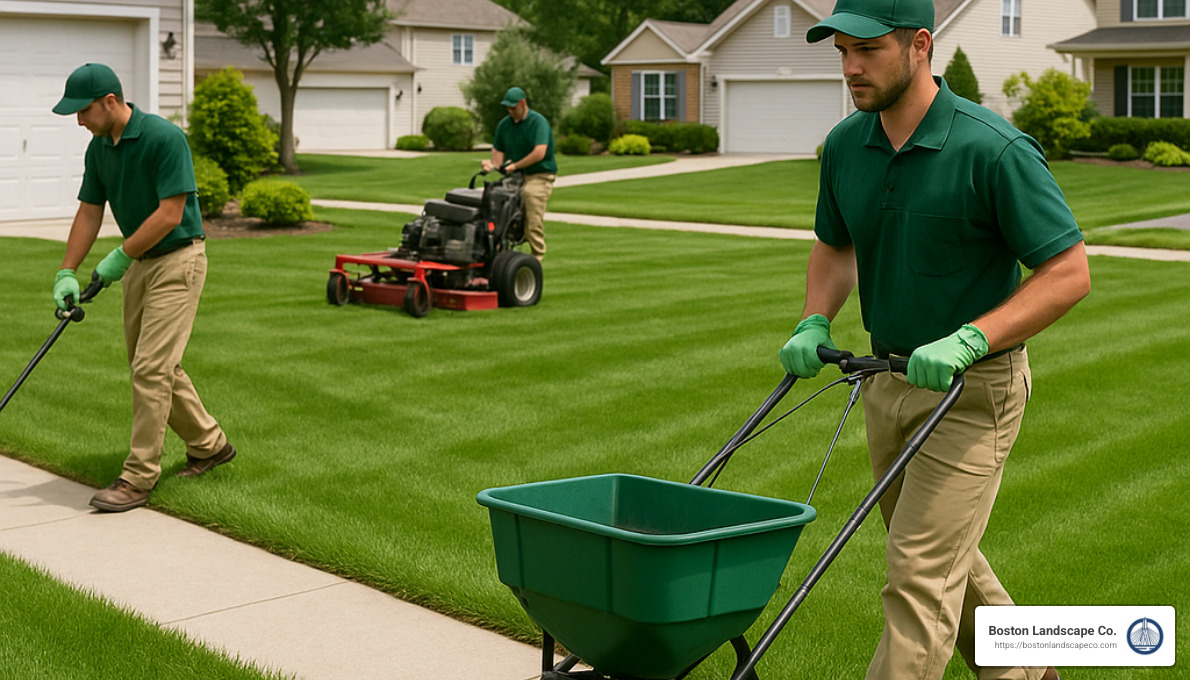
Regular Mowing and Trimming
Weekly mowing during the growing season forms the foundation of any effective lawn care program. For our Massachusetts cool-season grasses (like Kentucky bluegrass, perennial ryegrass, and fescues), we maintain cutting heights between 2.5-4 inches, adjusted seasonally for optimal health.
We never remove more than 1/3 of the grass blade at once (the golden “1/3 rule” of mowing), change mowing patterns to prevent ruts, and always use sharp blades for clean cuts that heal quickly. These practices might seem like small details, but they make an enormous difference in your lawn’s health and appearance over time.
Crisp Edging
That clean, defined border between your lawn and walkways, driveways, or garden beds doesn’t just look professionally manicured – it serves important functional purposes too. Proper edging prevents grass from invading gardens and hardscapes, creates better air circulation along borders, and dramatically improves your home’s curb appeal. It’s often the finishing touch that makes people stop and admire your property!
Seasonal Fertilization
Your lawn’s nutritional needs change with the seasons, which is why professional fertilization programs are carefully timed and formulated:
Spring applications provide balanced, slow-release nitrogen to promote steady growth as your lawn wakes up from winter dormancy.
Summer treatments focus on stress resistance with potassium to help withstand heat and drought – especially important during those brutal July and August stretches we sometimes experience in Massachusetts.
Fall applications are rich in phosphorus to strengthen root systems before winter, while late fall winterizing fertilizer helps your lawn store essential nutrients for a quick green-up when spring returns.
Pre-emergent Weed Applications
We take a proactive approach to weed management using targeted pre-emergent treatments that prevent weed seeds from germinating in the first place. When weeds do appear, we use selective post-emergent spot treatments rather than blanket applications, minimizing chemical use while maximizing effectiveness.
Our integrated approach includes cultural practices that naturally discourage weed growth – proper mowing height, adequate fertilization, and optimized watering all contribute to a lawn that naturally resists weeds through thick, healthy growth.
Aeration & Overseeding
Our New England soils tend to become compacted over time, especially in high-traffic areas. Core aeration removes small plugs of soil, allowing air, water, and nutrients to penetrate deeper into the root zone. When combined with overseeding, which introduces fresh, improved grass varieties, these services dramatically improve your lawn’s thickness and disease resistance.
Most lawns benefit from aeration every 1-2 years, with the best results seen when performed in late summer or early fall.
Grub & Mosquito Control
Nothing ruins a beautiful lawn faster than an underground grub infestation, which can destroy entire sections of turf before you even realize there’s a problem. Our preventive treatments target common lawn pests like grub worms, chinch bugs, and sod webworms before they cause visible damage.
We also offer mosquito control services to make your outdoor living spaces more enjoyable during our precious New England summers. As one Lexington client mentioned: “We’ve had problems with grubs for years until we started professional treatments. Now our lawn stays green all summer long.”
Looking for complete property care beyond just your lawn? Our Residential Landscapers handle everything from seasonal plantings to complete landscape renovations, while our Professional Lawn Care Services provide the specialized expertise your turf needs to thrive in our unique Massachusetts climate.
DIY vs. Professional Residential Lawn Care Services
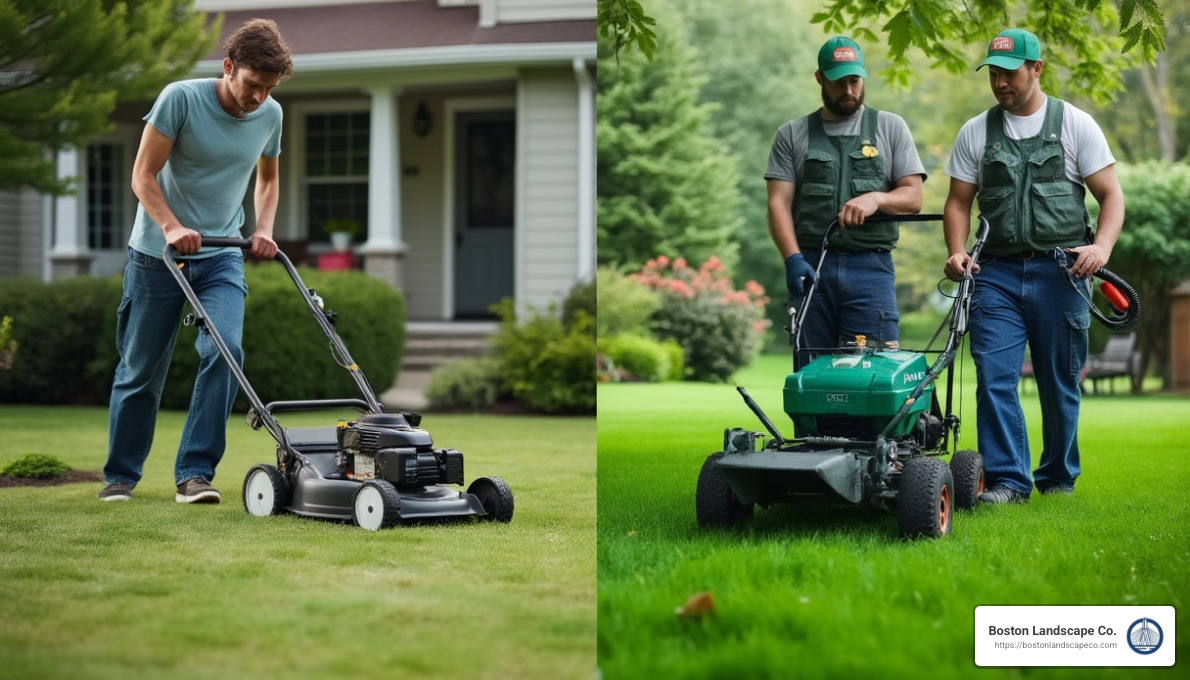
I’ve seen countless homeowners standing in their yards on beautiful Saturday mornings, debating whether to fire up the mower or call in the pros. It’s a decision that affects not just your wallet, but your weekends, your property value, and ultimately, the health of your lawn. Let’s walk through what you should consider before choosing your path.
Benefits of Hiring a Pro
When you hire professionals for your residential lawn care services, you’re getting far more than just someone to cut your grass. You’re investing in expertise that most homeowners simply don’t have time to develop.
Professional lawn technicians bring scientific knowledge about soil chemistry that transforms guesswork into precision. They understand how specific grass types respond to New England’s changing seasons and can spot early signs of disease or pest issues before they become visible to the untrained eye. As Marie from Burlington told us, “I tried the DIY approach for years with mixed results. The professionals brought a systematic approach that transformed my lawn within one season.”
The equipment difference is substantial too. While you might have a decent mower in your garage, professionals arrive with commercial-grade machines featuring regularly sharpened blades, calibrated spreaders for even fertilizer distribution, and specialized equipment for technical services like core aeration. They also have access to professional-strength products that typically aren’t available at your local garden center.
Perhaps the most valuable benefit is time. The average homeowner spends over 70 hours annually maintaining their lawn—that’s nearly two full work weeks! Professional residential lawn care services free up your weekends and ensure your lawn receives consistent care even when you’re traveling, swamped with work, or simply want to enjoy your outdoor space rather than maintain it.
Many companies also provide satisfaction guarantees. At Boston Landscape Co., we stand firmly behind our work with service warranties and will return to address any issues at no additional cost. This peace of mind, combined with proper insurance and liability protection, means you’re protected from unexpected problems.
When DIY Makes Sense
Despite the advantages of professional care, there are situations where the DIY approach might be right for you.
If your property has a small turf area under 2,000 square feet, the time commitment becomes much more manageable. Some homeowners genuinely enjoy lawn care as a weekend hobby and find satisfaction in learning proper techniques and seeing their efforts pay off. As one Lexington homeowner shared, “I actually look forward to my Sunday mornings in the yard—it’s my meditation time.”
Budget constraints can also make DIY appealing, especially for those willing to invest time instead of money. However, many homeowners underestimate the true cost of the DIY approach when accounting for equipment purchases, storage, maintenance, and the value of their time.
| DIY Lawn Care Costs* | Professional Service Costs* |
|---|---|
| Mower: $300-900 | Weekly Mowing: $1,400-4,200/season |
| Trimmer: $100-300 | Fertilization Program: $160-720/year |
| Spreader: $50-150 | Weed Control: $160-720/year |
| Fertilizer: $150-450/year | Aeration: $75-225/service |
| Weed Control: $100-300/year | Overseeding: $90-270/service |
| Annual Cost Range: $400-1,200+ | Annual Cost Range: $1,200-3,600+ |
*Costs based on internet averages, not actual Boston Landscape Co. pricing. DIY costs don’t include equipment maintenance, fuel, storage, or time value.
Customizing Service to Lawn & Climate
Whether you’re taking the DIY route or hiring professionals, customization is essential for a thriving lawn. This is where professional residential lawn care services truly shine.
Through professional soil testing, experts can determine your soil’s exact pH levels (ideally between 6.0-7.0 for most grasses), identify specific nutrient deficiencies, measure organic matter content, and assess soil structure and drainage characteristics. This scientific approach eliminates guesswork and ensures treatments address your lawn’s specific needs.
Different grass varieties have unique requirements, and professionals understand how to care for each type common in Massachusetts. Kentucky Bluegrass demands more nitrogen and regular watering, while Fine Fescues offer better drought and shade tolerance. Perennial Ryegrass establishes quickly but needs consistent maintenance, and Turf-type Tall Fescue has been gaining popularity for its resilience in our changing climate.
New England’s weather presents specific challenges that professionals are equipped to handle. From preventing snow mold in winter to managing variable spring conditions, navigating hot, sometimes humid summers, and tackling fall leaf management—local experts have seen it all and know how to respond.
Even within a single property, microclimates can vary dramatically. The shady north side of your home might need completely different care than your sun-drenched front yard. As Tom from Stoneham shared, “What I appreciate most is how they adjust their approach for different areas of my yard. The shady back gets different treatment than my sunny front lawn, and both look fantastic.”
For homeowners looking to lift their lawn care with customized, science-based approaches, our Professional Lawn Care Services provide Massachusetts-specific expertise that delivers results in our unique climate.
Core Treatments & Ideal Schedules for a Healthy Lawn
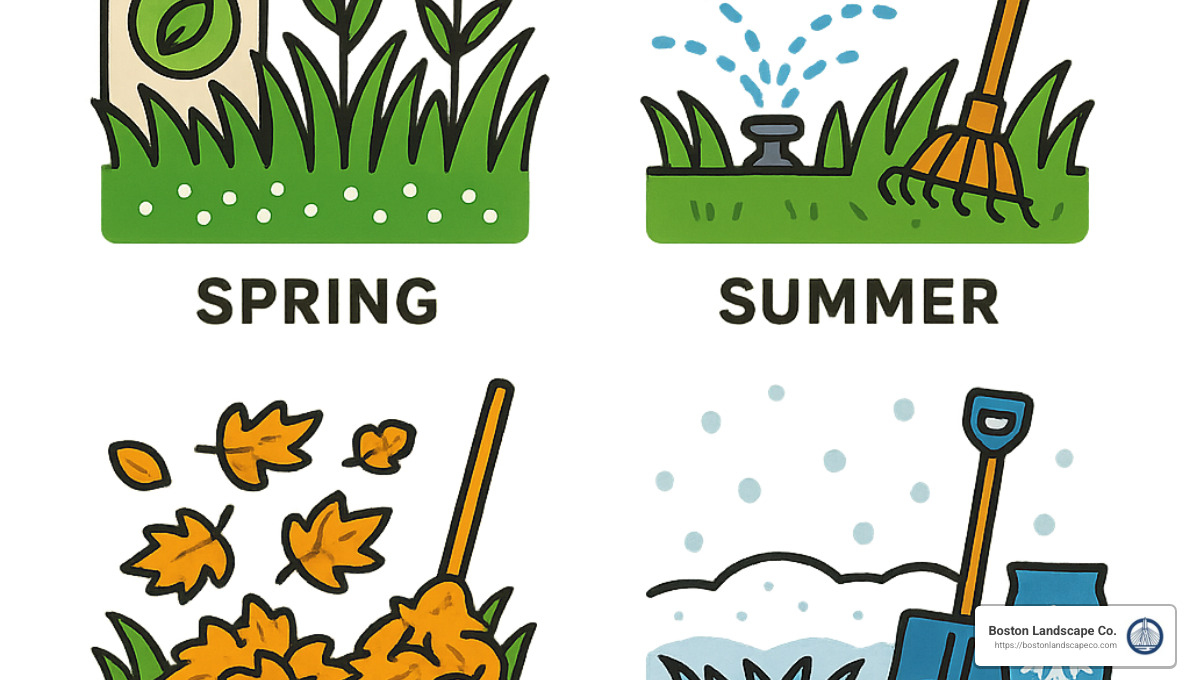
Creating that picture-perfect lawn isn’t just about occasional mowing—it’s about understanding the rhythm of your grass through the seasons. Here in Massachusetts, our unique climate demands a thoughtful approach to residential lawn care services that evolves throughout the year. Let me walk you through what your lawn needs and when it needs it.
Mowing & Edging Frequency
There’s an art to proper mowing that many homeowners miss. During the peak growing months (May-June and September), your lawn typically needs weekly attention. We follow what I like to call the “golden third rule”—never removing more than a third of the grass blade in a single cut. This prevents stress and encourages those deep, healthy roots we all want.
When summer heat hits, we actually raise our mowing height to 3-4 inches. It might seem counterintuitive, but taller grass shades the soil, retains moisture better, and stays greener through those hot spells. Then as fall approaches, we gradually lower the cutting height for the final mow of the season to about 2 inches.
One of our Medford clients recently told us, “The all-girls crew who mowed did an exceptional job. They went above and beyond with their carefulness and thoroughness.” That’s music to our ears, because we take pride in the details—like maintaining razor-sharp blades that create clean cuts, preventing disease and reducing water loss from ragged tears.
The finishing touch to any professional mowing is crisp edging. Those clean lines along driveways, sidewalks, and garden beds aren’t just for show (although they do look fantastic!). They prevent grass from invading your garden beds and create distinct visual borders that lift your entire landscape.
Fertilization & Weed Control
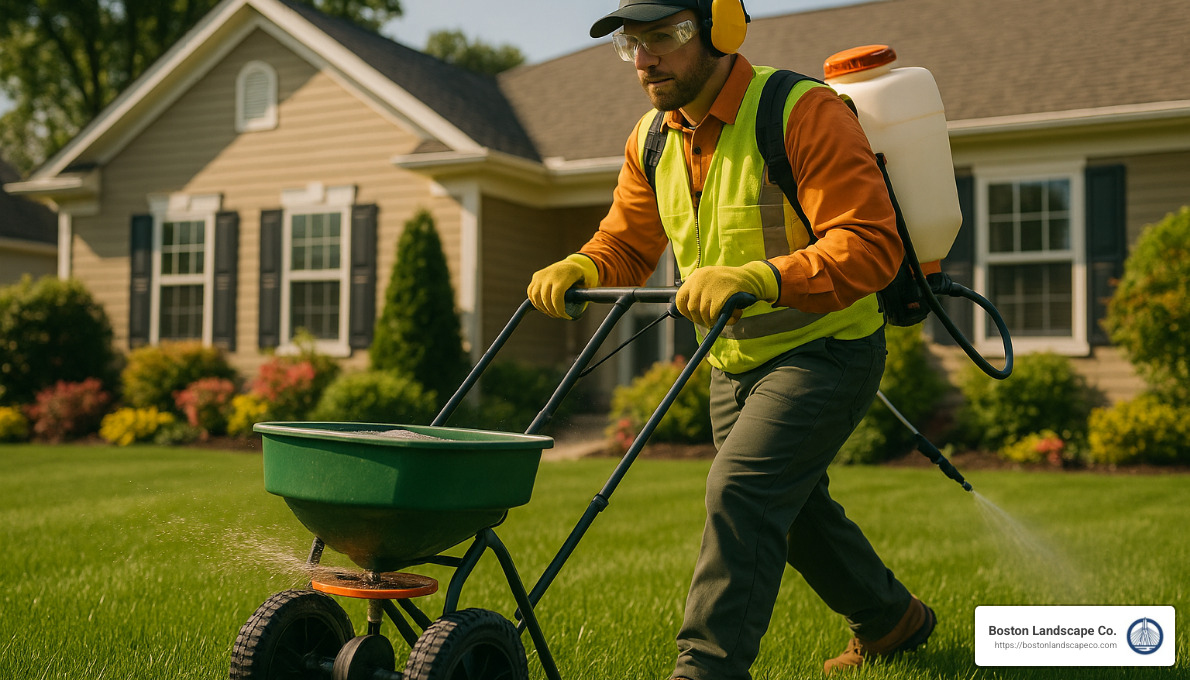
Feeding your lawn isn’t a one-and-done affair—it’s about providing the right nutrients at the right time. Here in Massachusetts, our cool-season grasses follow a natural rhythm that guides our fertilization schedule.
We start with a light, balanced feeding in early spring (April) to support that initial green-up without pushing excessive growth. By late spring (May-June), we’re applying slow-release nitrogen that supports steady growth and root development. When summer stress hits, we might apply a light feeding with extra potassium to help your lawn weather the heat.
Fall is actually the most critical feeding time—particularly that September application. This is when your grass is actively storing energy for winter and developing its root system. We follow up with a final winterizing application in November that helps your lawn store nutrients for a strong spring comeback.
What makes professional fertilization different? We’re not guessing. We use soil tests to customize fertilizer formulations to your lawn’s specific needs rather than applying one-size-fits-all products that might be wasting your money on nutrients you don’t need.
Weed control follows a similar strategic timeline. We apply pre-emergent treatments in early spring to prevent crabgrass and other annual weeds before they appear. Throughout the growing season, we target broadleaf weeds like dandelions and clover with spot treatments. Fall is another key time for weed control, as perennial weeds are actively storing nutrients for next year.
A client in Lexington shared, “After years of fighting dandelions myself, the professional approach of targeted treatments has finally given me the upper hand. My lawn is virtually weed-free for the first time.”
Most New England soils tend toward acidity, which is why we often recommend lime applications in fall. This helps neutralize soil pH, typically at a rate of 40-50 pounds per 1,000 square feet, making nutrients more available to your grass.
Aeration, Dethatching & Overseeding
Even the best-maintained lawns eventually face soil compaction from foot traffic, play areas, and natural settling. Core aeration—removing small plugs of soil throughout your lawn—creates pathways for air, water, and nutrients to reach the root zone. Most lawns benefit from annual aeration, while heavily trafficked areas might need twice-yearly treatment.
Early fall (September) is the sweet spot for aeration in our region. The grass is actively growing, but weed pressure is decreasing, giving your lawn the perfect opportunity to recover and strengthen.
Dethatching is another service that’s sometimes necessary, but not always. Thatch is that layer of dead grass and roots between your living grass and the soil. A thin layer (less than ½ inch) is actually beneficial, providing some natural insulation and reducing water evaporation. But when it builds up beyond that half-inch threshold, it can block water and nutrients from reaching the soil.
Overseeding goes hand-in-hand with aeration, and early fall is again the perfect timing. The soil is still warm from summer, but air temperatures are cooling—ideal conditions for seed germination. For Massachusetts lawns, we typically recommend a blend of turf-type tall fescue, Kentucky bluegrass, and perennial ryegrass, applied at 4-8 pounds per 1,000 square feet depending on how dense your existing lawn is.
A Winchester homeowner recently told us, “The combination of aeration and overseeding transformed my patchy lawn into a thick carpet within weeks. The professionals knew exactly which seed blend would work best in my partly shaded yard.”
Pest & Disease Management
Even healthy lawns can face threats from pests and diseases that are common in our region. Vigilant monitoring and timely intervention are key to preventing major damage.
Grubs are perhaps the most notorious lawn pests in Massachusetts. These larvae of Japanese beetles, June beetles, and European chafers feed on grass roots, causing large patches of lawn to die. We apply preventive treatments in late spring or early summer, before damage occurs. If you’re already seeing damage, curative treatments in late summer can help, but prevention is much more effective.
Chinch bugs tend to attack during hot, dry periods, creating yellowing patches that don’t respond to watering. Sod webworms—caterpillars that feed on grass blades at night—create small, irregular brown patches.
On the disease front, snow mold often appears after winter as circular patches where snow has lingered. A lower final mowing in fall and proper spring care can help prevent it. Brown patch thrives in hot, humid weather, while red thread is common in nitrogen-deficient lawns.
The advantage of professional pest management is early identification. Our trained technicians spot problems before they become severe and apply targeted treatments only when necessary, rather than blanket applications that might be unnecessary or harmful to beneficial insects. For more information on integrated pest management approaches, check out this scientific research on integrated pest management that explains how targeted treatments can be both effective and environmentally responsible.
Sustainable & Pet-Safe Options
Many of our clients share their lawns with children and four-legged family members, making safety a top priority. Others are concerned about environmental impact. We’re proud to offer options that address both concerns.
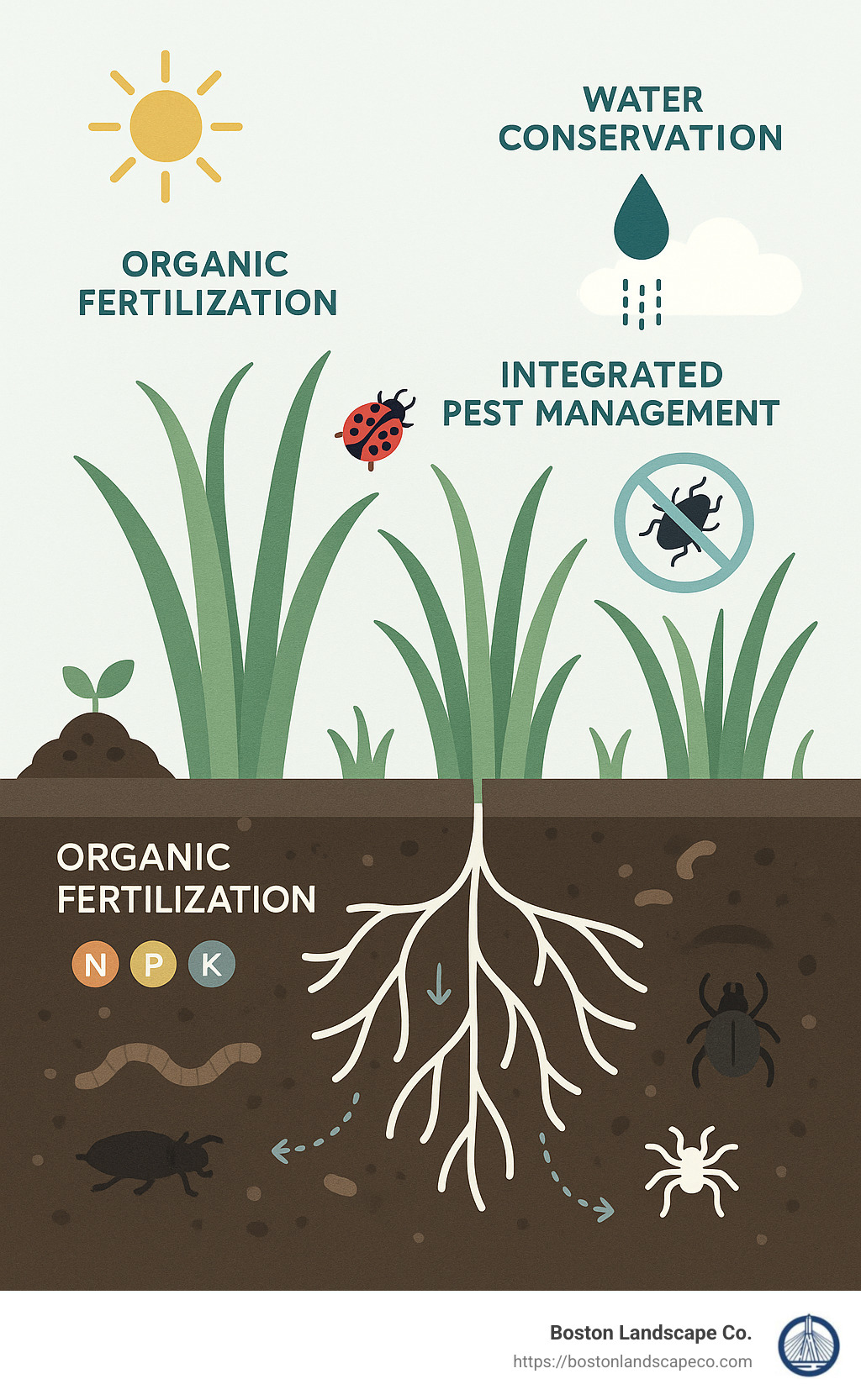
Organic fertilization programs use natural sources like composted manure, bone meal, and seaweed. These release nutrients slowly as soil microbes break them down, building soil health over time. While they typically require heavier application rates than synthetic options, many homeowners feel the benefits outweigh this consideration.
Our Integrated Pest Management (IPM) approach emphasizes prevention through proper cultural practices, monitors pest populations to determine when intervention is truly necessary, and uses the least toxic effective treatment. We spot-treat problems rather than making blanket applications, reducing the overall amount of product used.
We’re also investing in reduced-emission equipment options, including electric and battery-powered alternatives where practical, as well as modern four-cycle engines with lower emissions.
Water conservation is another sustainability focus, with smart irrigation controllers, rain sensors, and practices that encourage deep, infrequent watering to promote drought-resistant root systems.
A Burlington client with pets recently told us, “I was worried about lawn treatments with my dogs, but the pet-safe options have given me peace of mind while still delivering a beautiful lawn. The technicians always let me know when it’s safe to let the dogs back out.”
Choosing & Working With a Residential Lawn Care Provider
Finding the perfect lawn care partner isn’t just about getting the lowest price—it’s about finding a company that understands your vision and can bring it to life. Having helped thousands of Massachusetts homeowners transform their outdoor spaces, I’ve seen how the right partnership makes all the difference in achieving a lawn you’ll love.
What to Look For in a Company
When you’re inviting someone to care for your little piece of the earth, you want to be confident in their expertise and reliability. The best residential lawn care services providers distinguish themselves in several important ways.
Credentials speak volumes about a company’s commitment to professionalism. Look for valid state pesticide licenses, certifications from organizations like the National Association of Landscape Professionals, and proper insurance coverage. These aren’t just pieces of paper—they represent a dedication to doing things right.
Experience and reputation tell you how a company performs in the real world. A company that’s been beautifying local lawns for years has weathered different challenges and refined their approach. Check online reviews (aim for 4+ stars), ask to see before/after photos of actual client properties, and don’t hesitate to request references from current customers.
One of our longtime Winchester clients put it perfectly: “What impressed me most was how thoroughly they explained their approach before starting. They tested my soil, identified specific issues, and created a custom plan—not just a generic program.”
The best lawn care providers offer customized programs rather than one-size-fits-all solutions. They’ll conduct soil testing before recommending treatments, practice Integrated Pest Management to minimize chemical use, and maintain clear communication throughout your relationship.
Transparency should extend to every aspect of your service agreement. Look for clear, detailed written estimates, straightforward explanations of what each service includes, and no hidden fees or surprise charges. A company worth trusting will be upfront about their policies, guarantees, and exactly what you can expect.
Understanding Pricing & Packages
Lawn care is an investment in your property, and understanding pricing helps you budget appropriately while ensuring you’re getting good value. Pricing varies based on property size, service frequency, and program components.
Most homeowners in Massachusetts can expect these general price ranges for residential lawn care services:
- Basic Mowing: $35-105 per visit
- Full-Service Seasonal Packages: $1,200-3,600+ annually
- Fertilization Programs: $160-720 annually (4-6 applications)
- Weed Control: $160-720 annually (2-4 applications)
- Core Aeration: $75-225 per service
- Overseeding: $90-270 per service
These costs reflect internet averages, not actual Boston Landscape Co. pricing. Actual costs may vary significantly based on property size, conditions, and service specifications.
Most companies, including Boston Landscape Co., offer tiered service packages to meet different needs and budgets. Basic packages typically include regular mowing and trimming only. Standard packages add fertilization and weed control to the mix. Premium options provide comprehensive care including all seasonal treatments. And for unique properties, custom programs can be custom to specific challenges and goals.
Smart homeowners can find several ways to maximize value, including pre-paying for the season (many companies offer discounts), signing multi-year contracts, bundling services, or even coordinating with neighbors for group discounts when multiple homes on a street sign up.
Before signing any agreement, ask important questions: Are there extra charges for tall grass or difficult terrain? What happens if a scheduled service is rained out? Is there a satisfaction guarantee? Are there cancellation fees or contract requirements? Clear answers now prevent surprises later.
Guarantees, Tech & Ease of Scheduling
Modern lawn care has evolved beyond just showing up with a mower. Today’s leading companies leverage technology and strong service guarantees to improve your experience.
Service guarantees provide peace of mind that your investment is protected. Reputable companies typically offer satisfaction guarantees on service quality, return visits at no charge if results aren’t satisfactory, and specific “green-up” guarantees for fertilization programs. These guarantees reflect a company’s confidence in their work—and their commitment to your satisfaction.
Technology integration has transformed how we interact with service providers. Look for companies offering online customer portals where you can view your service history and upcoming visits, digital payment options for convenience, GPS-tracked service vehicles for accurate arrival estimates, and mobile apps for easy communication.
A Billerica customer recently told me: “I love that I get a text when the crew is on the way, and another one with a service summary and photo when they’re done. It makes managing the service so much easier.”
Scheduling flexibility is another hallmark of customer-focused providers. Quality companies provide clear communication about service windows, notification systems for upcoming visits, easy rescheduling processes, and transparent rain date policies. This flexibility acknowledges that your time is valuable and that lawn care should fit into your life—not disrupt it.
Preparing Your Lawn for a Service Visit
A little preparation before your lawn care team arrives can help ensure they deliver the best possible results. Think of it as a partnership where both sides contribute to the outcome.
For mowing services, remove toys, furniture, and other obstacles from the lawn before the crew arrives. Secure pets in a safe area away from the service zone, and make sure gates are open uped if needed. It’s also helpful to flag irrigation heads or other hidden features that might be damaged by equipment.
Before treatment applications, water your lawn 1-2 days before service if conditions have been dry. Avoid mowing 1-2 days before or after treatments to maximize effectiveness. Keep pets and children off treated areas for the recommended time period (your provider should specify this), and communicate any specific concerns directly to your technician.
For aeration and overseeding visits, mark sprinkler heads and shallow buried utilities to prevent damage. Water thoroughly 1-2 days before service to soften the soil for better core removal. Avoid applying herbicides within 4 weeks before seeding, as they can prevent germination. And be prepared to adjust your irrigation afterward to keep new seed moist.
Between-Visit Care Tips
Even with professional residential lawn care services, some simple homeowner maintenance between visits helps maximize results and protect your investment.
Proper watering is perhaps the most important thing you can do between professional visits. Water deeply (aiming for moisture 6-8 inches down) rather than frequently to encourage deep root development. Early morning (5-9 AM) is the ideal time to water, reducing evaporation and disease risk. A simple rain gauge can help you adjust based on natural rainfall, and during drought restrictions, focus on keeping the lawn alive rather than lush.
If you’re mowing between professional visits, maintain the same height the pros use (typically 3-4 inches for Massachusetts lawns). Remember the golden rule: never remove more than 1/3 of the blade height in a single cutting. Keep your mower blades sharp for clean cuts that heal quickly, and alternate mowing patterns to prevent ruts and soil compaction.
Developing a habit of monitoring for issues can catch problems before they become serious. Watch for brown spots or discoloration that might indicate disease or pest activity. Note any unusual insect presence, especially in concentrated areas. Document concerns with photos to share with your provider, and communicate promptly about any problems you notice.
A Reading homeowner shared this wisdom: “Communication is key. When I noticed some brown patches developing between visits, I sent photos to my lawn care provider. They identified it as the beginning of a fungal issue and were able to treat it before it spread.”
The best residential lawn care services create a partnership between professional expertise and homeowner attention. With both sides engaged, your lawn will thrive season after season, creating an outdoor space your whole family can enjoy.
Looking for more guidance on selecting the right provider? Our Lawn Maintenance Service Agreement page explains what to expect in a professional contract, while our Lawn Maintenance Service Cost resource provides deeper insight into pricing factors.
Frequently Asked Questions about Residential Lawn Care
How often should I aerate my lawn?
In our Massachusetts climate, most lawns thrive with annual core aeration, preferably in early fall when grass is actively growing and has time to recover before winter. If your property has heavy clay soil, sees lots of foot traffic from kids and pets, or was built within the last 5-7 years, you might benefit from twice-yearly aeration.
Core aeration isn’t just poking holes—it’s actually removing small plugs of soil that allow your lawn to breathe. This process creates pathways for air, water, and nutrients to reach deeper into the root zone where they’re needed most. The result? Reduced compaction, stronger roots, and natural thatch breakdown.
“When we first moved to our Lexington home, the soil was like concrete from the construction equipment,” shares one of our long-time clients. “After two seasons of spring and fall aeration, the difference was remarkable—the grass was thicker, greener, and finally looked established.”
For severely compacted lawns, we typically recommend the double approach (spring and fall) for the first couple of years. Once your soil structure improves, you can usually scale back to just the annual fall service.
Are there truly pet-safe weed killers?
As pet owners ourselves, we understand the concern about keeping your furry family members safe while maintaining a beautiful lawn. The good news is yes—there are definitely weed control options that can be used safely around pets when applied correctly.
At Boston Landscape Co., we offer several pet-friendly approaches:
Organic herbicides derived from natural ingredients like citrus oil, vinegar, and plant-based compounds break down quickly and leave minimal residue. While they may require more frequent application, they provide peace of mind for many pet owners.
Targeted spot treatments allow us to address problem weeds individually rather than broadcasting chemicals across your entire lawn. This dramatically reduces the amount of product used.
Cultural practices like proper mowing height, regular overseeding, and appropriate fertilization naturally discourage weeds by promoting thick, healthy turf that outcompetes unwanted plants.
Even with traditional products, the key is following proper reentry intervals—keeping pets off treated areas until products have completely dried, typically 24-48 hours. We always provide clear instructions about when it’s safe for your pets to return to the lawn.
“Communication is everything,” notes our lawn care manager. “Let us know about your pets—their habits, favorite spots, and any health concerns—so we can tailor our approach to keep them safe while still giving you effective results.”
What happens if I skip a month of mowing?
Life gets busy—we get it! But missing several weeks of mowing can create a cascade of problems for your lawn that go beyond just looking unkempt.
When grass grows too tall before cutting, removing more than one-third of the blade height (the golden rule of mowing) becomes unavoidable. This sudden removal of significant leaf surface stresses the plant, potentially reducing root development and making your lawn more susceptible to disease and drought.
Excessive clippings left from cutting tall grass can contribute to thatch buildup—that layer of dead plant material between the soil and living grass. While a thin layer of thatch is beneficial, too much can block water and nutrients from reaching the soil.
Perhaps most problematic is weed proliferation. Many common lawn weeds can flower and set seed within just 2-3 weeks. Miss a month of mowing, and you might be dealing with the consequences for seasons to come as those weed seeds germinate.
From a practical standpoint, overgrown lawns are simply harder to mow properly. The mower may struggle, leaving an uneven cut or even causing the engine to stall. Most lawn services (including ours) charge extra for cutting severely overgrown grass, typically anything over 10 inches tall.
If you know you’ll miss regular mowing due to vacation or other circumstances, consider arranging temporary service or asking a neighbor for help. If your lawn does become overgrown, the best approach is gradual height reduction over several mowings rather than shocking the grass with one dramatic cut.
How do I know if my lawn needs lime?
New England’s naturally acidic soils often benefit from lime applications, but determining exactly when and how much to apply requires some investigation. Think of lime as a soil sweetener—it raises the pH from acidic toward neutral, creating conditions where grass thrives and many weeds struggle.
The most reliable indicator is a professional soil test showing pH below 6.0 (grass prefers a pH between 6.0-7.0). However, there are visual clues that might suggest your lawn could benefit from lime:
Poor response to fertilization despite regular applications might indicate that nutrients are being locked up in acidic soil and unavailable to grass roots.
Acid-loving weeds like sorrel, plantain, and moss tend to thrive in low-pH conditions. Their abundance can signal that your soil is too acidic for optimal grass growth.
Yellowing grass that doesn’t respond to nitrogen fertilizer could be suffering from nutrient deficiencies caused by acidic soil conditions.
At Boston Landscape Co., we include soil testing as part of our comprehensive lawn assessment to ensure any lime applications are precisely calibrated to your specific needs. Most Massachusetts lawns benefit from application rates between 40-50 pounds per 1,000 square feet, typically applied in fall when freeze-thaw cycles naturally work the lime deeper into the soil profile.
“We had been applying standard fertilizer for years with mediocre results,” recalls a Winchester client. “After testing showed our soil pH was 5.2, we applied lime in the fall. The following spring, our lawn responded to fertilizer like never before—the difference was remarkable.”
When is the best time to overseed my lawn?
For Massachusetts lawns, early fall—specifically late August through September—provides the perfect window for overseeding. This timing capitalizes on nature’s ideal conditions for seed germination and establishment.
Soil temperatures remain warm from summer sun, promoting quick germination, while cooling air temperatures reduce heat stress on delicate seedlings. Fall also brings naturally reliable moisture from dew and seasonal rains, reducing the need for supplemental irrigation. Perhaps most importantly, many annual weeds are beginning to die off, reducing competition for your new grass seedlings.
Spring (April to early May) offers the second-best opportunity, though increased weed competition and the looming summer heat make establishment more challenging. We generally avoid summer overseeding entirely due to extreme heat stress and extraordinary watering requirements.
For truly impressive results, we recommend combining overseeding with core aeration. Those thousands of small holes create perfect seed-to-soil contact—essentially giving each seed its own protected microenvironment for germination. This combination typically improves germination rates by 30-50% compared to simply broadcasting seed over existing turf.
“The change of my lawn after fall aeration and overseeding was nothing short of amazing,” shares a satisfied Melrose homeowner. “Areas that had been thin for years filled in completely by spring, and the new grass varieties we introduced have made the lawn more resistant to drought and disease.”
Conclusion
I’ve worked with hundreds of Massachusetts homeowners over the years, and one thing I’ve learned is that a beautiful lawn doesn’t happen by accident. It’s the result of consistent care, proper timing, and a little bit of lawn wisdom passed down through generations of landscape professionals.
As one of our veteran team members likes to say, “Routine lawn maintenance is more cost-effective than a full lawn replacement.” That simple truth has saved our clients thousands of dollars over the years. Think of your lawn like your car—regular oil changes cost far less than a new engine!
Your lawn is more than just grass—it’s where your kids play catch, where you host summer barbecues, and where you unwind after a long day. At Boston Landscape Co., we see ourselves as partners in creating those perfect outdoor moments. When your lawn looks its best, you feel a sense of pride every time you pull into your driveway.
We’ve seen how New England’s unique climate challenges even the most dedicated DIY homeowners. That patch of Kentucky bluegrass that thrives in Lexington might struggle in the sandy soils of Winchester. The fertilizer timing that works perfectly in Burlington might need adjustment in Medford. This local knowledge is something we’ve developed over decades of caring for Massachusetts lawns through blizzards, droughts, and everything in between.
Residential lawn care services shouldn’t be one-size-fits-all. That’s why we begin every new client relationship with a thorough assessment of your property’s unique characteristics. Is that shady corner struggling? Do you have high-traffic areas that need special attention? Are there specific environmental concerns you want us to address? We listen first, then craft a solution that fits your specific needs and budget.
Many of our clients start with basic mowing services and gradually add other treatments as they see the results. Others jump right into a comprehensive program to transform their property quickly. Whatever approach makes sense for your situation, we’re here to guide you through the options without pressure or upselling.
Our communication-focused approach means you’ll never wonder what’s happening with your lawn. From pre-visit notifications to post-service summaries, we keep you in the loop every step of the way. And if you ever have questions or concerns, we’re just a phone call or email away.
Ready to experience the difference professional care can make? Request an estimate today, and let’s start creating the outdoor space you’ve always wanted. Whether you need a complete lawn renovation or just some regular maintenance to keep things looking sharp, we’ve got you covered.
Beautiful lawns are grown over time, not overnight. With Boston Landscape Co. as your partner, you can enjoy all the benefits of a showcase lawn without the stress, guesswork, and weekend hours spent pushing a mower. Instead, you can spend that time actually enjoying your outdoor space with the people who matter most.
