
When Surface Water Becomes a Problem: What You Need to Know
A channel drainage system is a linear drain installed at ground level to intercept and redirect surface water runoff away from driveways, patios, and other hardscaped areas before it causes flooding or structural damage.
Here’s what a channel drainage system does at a glance:
| Feature | Detail |
|---|---|
| What it is | A long, narrow drain (also called a trench drain) set into the ground surface |
| How it works | A slotted or grated opening captures sheet flow and directs water to an outlet pipe |
| Where it’s used | Driveways, patios, parking lots, pool decks, sports courts, loading docks |
| Key benefit | Prevents pooling, flooding, mildew, concrete staining, and structural damage |
| Who needs it | Homeowners and commercial property managers with impervious hardscaped surfaces |
Heavy rainfall in the Greater Boston area is not something to take lightly. When water has nowhere to go on a sealed driveway or patio, it pools, seeps under foundations, and causes costly damage over time. A properly installed channel drainage system solves this by giving that water a clear, controlled path off your property.
I’m Steve Schumacher, owner of Boston Landscape Co., and with over 30 years of hands-on experience in landscape contracting and hardscape drainage across Stoneham and the Greater Boston region, I’ve seen how the right channel drainage system protects properties from the kind of water damage that’s far more expensive to fix than to prevent. Let’s walk through everything you need to know to make the right choice for your property.
Understanding the Channel Drainage System
When we talk about Effective Channel Drainage, we are referring to a specialized type of Residential Landscape Drainage designed to handle “sheet flow.” Sheet flow occurs when rain hits an impervious surface—like your asphalt driveway in Reading or a paver patio in Lexington—and moves across it in a uniform thin layer.
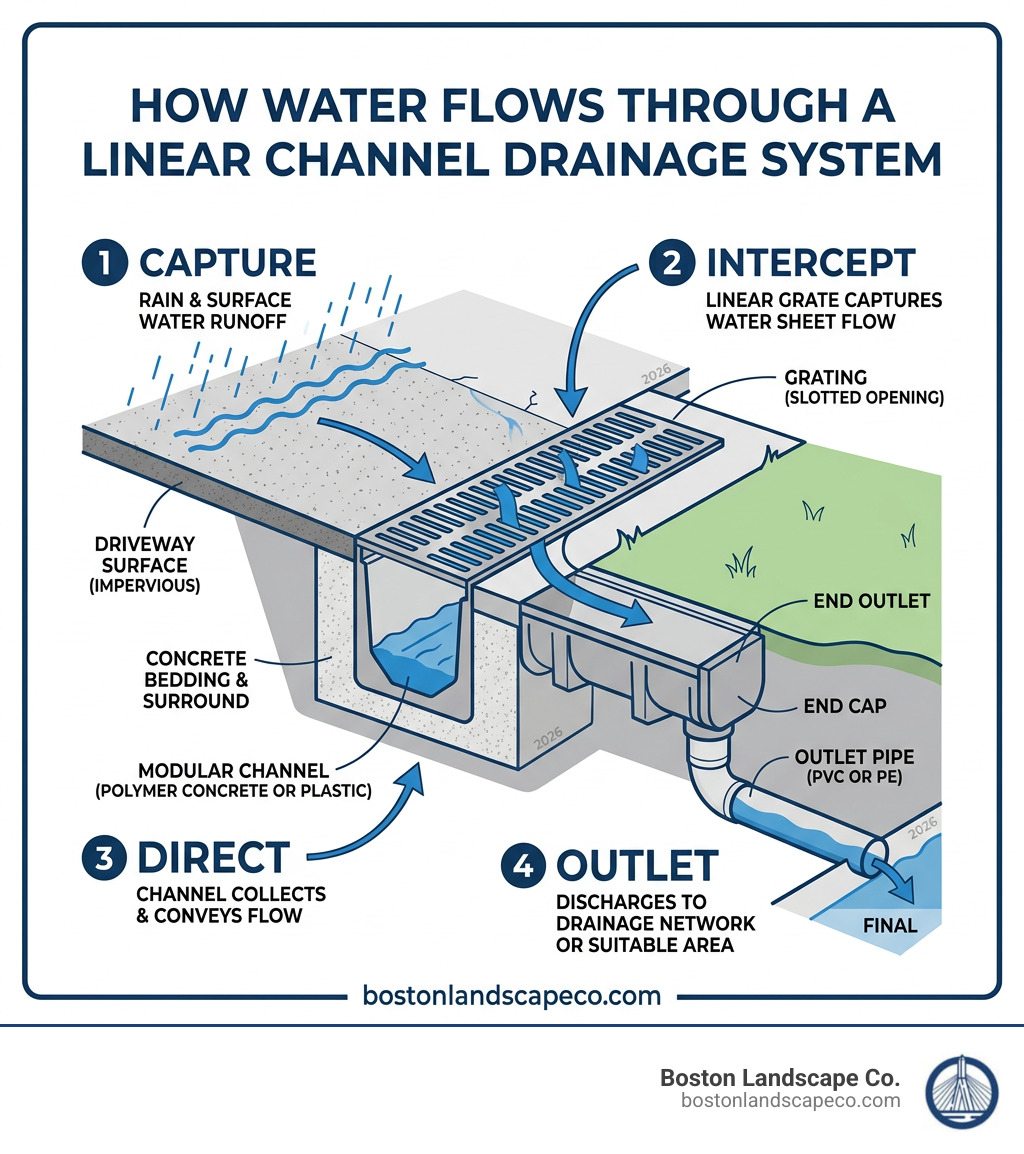
A channel drainage system (often called a trench drain) uses a linear design to act as a perimeter defense. Unlike a single point drain (like a catch basin) that requires the entire area to be sloped toward one small hole, a channel drain creates a long “interception line.” This makes it much more efficient for protecting garage entries or the edge of a pool deck. These systems consist of modular components: the collection trough (the channel itself), the grate, and various accessories like end caps and outlets.
How a Channel Drainage System Works
The physics behind these systems is quite simple: gravity is our best friend. The channel drainage system is set into a trench, usually encased in concrete for stability. As water flows across the hardscape, it hits the grate. The grate intercepts the water, allowing it to drop into the smooth collection channel below.
Once inside the channel, the water is directed toward an outlet. In many advanced systems, such as the NDS Dura Slope, the channel actually has a built-in 0.7% slope to keep water moving even on perfectly level ground. The water then exits through an outlet pipe—often connected to a larger Storm Water Drainage network or a downstream release point away from the home’s foundation.
Shallow vs. Deep Profile Channels
Choosing the right profile is a critical step in our design process.
- Shallow Profile Channels: These usually have a depth of around 2 5/8 to 4 1/2 inches. We use these in areas where excavation depth is limited—perhaps due to existing utilities, shallow bedrock common in parts of North Shore MA, or when installing within the thickness of a standard paver.
- Deep Profile Channels: These can range from 4 3/4 inches to over 7 inches deep. A Deep Profile Channel offers significantly higher water flow capacity. They are ideal for high-volume runoff areas or where we have plenty of room to dig.
Most professional systems allow for customization, with sections that can be cut in 4-inch increments to fit the exact dimensions of your walkway or driveway apron.
Selecting the Right Materials and Load Ratings

Material selection isn’t just about looks; it’s about structural survival. In the Greater Boston area, our drainage systems must withstand heavy snowplows, road salt, and extreme freeze-thaw cycles.
Common materials for the channel body include HDPE (High-Density Polyethylene) and PVC, which are often treated with UV inhibitors to prevent cracking and fading. For the grates, options range from reinforced plastic to stainless steel and ductile iron.
Load Classes for Residential and Commercial Use
The National Concrete Masonry Association and international standards (EN 1433) categorize drains by their “load class.” This tells us exactly how much weight the system can support before failing.
| Load Class | Typical Application | Rating |
|---|---|---|
| Class A | Pedestrian traffic, patios, and bike paths | ~3,372 lbs |
| Class B | Residential driveways and parking lots | ~28,100 lbs |
| Class C | Commercial parking lots and light delivery trucks | ~56,200 lbs |
| Class D-F | Industrial areas, loading docks, and airports | Heavy Machinery |
For most of our residential projects in Winchester or Wellesley, a Class B rating is sufficient for cars and light trucks. However, if you have a commercial property in Woburn with heavy delivery traffic, we look toward the Polylok Heavy Duty or ductile iron options that meet H-20 wheel load ratings (approximately 32,000 lbs per axle).
Grate Materials and Aesthetics
While functionality is king, we know you want your property to look great.
- Plastic Grates: Available in colors like Portland Grey, sand, and black to match pavers or concrete.
- Stainless Steel: Provides a modern, sleek look and superior corrosion resistance, perfect for pool areas.
- Ductile Iron: The “tough guy” of the group. Used for high-traffic areas where durability is the only priority.
- Heel-Proof Designs: Essential for public walkways and commercial entries to prevent high heels or small objects from getting stuck.
Installation and Maintenance Best Practices
A channel drainage system is only as good as its installation. If the trench isn’t dug correctly or the slope is off, you’ll just end up with a long, expensive puddle. At Boston Landscape Co., we follow strict protocols to ensure Hardscape Drainage Solutions last for decades.
Step-by-Step Installation of a Channel Drainage System
- Excavation: We dig a trench that is wider and deeper than the channel to allow for a sturdy bedding material, usually concrete or compacted gravel.
- Assembly: Modular sections are connected using male-to-female interlocking joints. For systems like the NDS 8 in. Pro Series, we use PVC glue on accessories to ensure a watertight seal.
- Anchoring: To prevent the lightweight plastic channels from “floating” when concrete is poured around them, we use rebar clips or anchoring kits to stake them firmly into the ground.
- Leveling and Sloping: We ensure a minimum 0.7% to 1% slope toward the outlet.
- Concrete Pour: For vehicle-rated areas, the channel must be encased in a concrete “envelope” to distribute the weight of tires away from the plastic walls of the drain.
- Finishing: The final surface (pavers, asphalt, or concrete) should sit about 1/8 inch above the grate to ensure water actually falls into the drain.
Essential Maintenance for a Channel Drainage System
Don’t “set it and forget it.” To keep your system running at peak performance:
- Debris Removal: Lift the grates twice a year (spring and fall) to scoop out sediment and leaves.
- Leaf Guards: Use internal leaf guards or strainers to prevent clogs from reaching your underground pipes.
- Pressure Washing: Occasionally flush the system with a garden hose or low-pressure washer to clear out fine silt.
- Inspect Joints: Check for any signs of shifting or cracking, especially after a harsh Massachusetts winter.
Comparing Channel Drains to Traditional Solutions
We often get asked if a channel drainage system is better than a traditional French drain. The answer depends on the source of your water.
- French Drains: Use perforated pipes buried in a gravel trench. They are designed to manage groundwater (water soaking into the soil).
- Channel Drains: Are designed to manage surface water (water running on top of the ground).
While a French drain is great for a soggy lawn in Concord, a channel drain is the superior choice for a flooding driveway in Waltham. Compared to old-fashioned poured-in-place concrete trenches, modern modular systems are faster to install, more cost-effective, and much easier to maintain. You can even Calculate your drainage install using modern mobile tools to ensure the capacity matches your specific roof and driveway runoff.
Cost Considerations and Project Budgeting
When planning your budget, it is important to remember that every site is unique. Based on general online data, the average cost for a professional drainage installation can range significantly.
For a basic residential setup, you might see costs between $150 and $300 per linear foot. However, for complex commercial projects involving deep excavation, heavy-duty ductile iron, and extensive concrete work, prices can easily reach $900 or more per linear foot.
Note: These figures are based on national averages and internet research. They do not reflect the specific pricing of Boston Landscape Co. Factors such as soil type, utility locations, and material choice will cause real-world prices to vary widely.
Frequently Asked Questions about Channel Drains
Can channel drains be customized for bends and corners?
Yes! While the channels come in straight sections (often 4 feet long), they can be customized. We use miter saws to cut angles for custom corners, or we utilize 90-degree joiners and “tee” sections provided by the manufacturer. For a secure fit, we often use PVC glue and then encase the joint in concrete to ensure it stays put.
What is the difference between a trench drain and a French drain?
The main difference is the “intake.” A trench drain (channel drain) has a visible grate on the surface to catch water before it sinks in. A French drain is buried under gravel and “sucks” water out of the saturated soil through small holes in a pipe. Think of a channel drain as a gutter for your ground, and a French drain as a sponge for your soil.
How do I calculate the required capacity for my project?
We look at three things: the surface area (square footage of the driveway/patio), the rainfall intensity (how hard it pours in Boston), and the “runoff coefficient” (how much water bounces off the surface vs. soaking in). For example, an 8 in. Pro Series Deep Profile can handle up to 579 GPM (gallons per minute) at a 1% slope, which is enough for even the most massive residential estates.
Conclusion
Investing in a high-quality channel drainage system is one of the smartest moves you can make for your property’s longevity. Whether you are dealing with a sloped driveway in Stoneham or a commercial parking lot in Medford, redirecting surface water is essential for preventing erosion and protecting your hardscape investment.
At Boston Landscape Co., we take pride in solving the toughest drainage challenges across the Greater Boston area. From initial site analysis to the final concrete pour, our team ensures your property stays dry and your foundations stay safe.
Ready to stop the flooding? More info about hardscape drainage solutions is just a click away, or reach out to us for a professional consultation on your next project.
