
Tree Assessment Services: 5 Powerful, Essential Picks for 2025
Why Professional Tree Assessment Services Are Essential for Property Safety
Tree assessment services are professional evaluations that determine the health, structural integrity, and safety risks of trees on your property. These comprehensive inspections help prevent costly property damage, ensure legal compliance, and protect your investment in mature trees.
Quick Overview of Tree Assessment Services:
- Level 1 (Visual): Basic ground-level inspection for obvious hazards ($150-$300)
- Level 2 (Basic): Detailed inspection with simple tools like probes ($300-$600)
- Level 3 (Advanced): In-depth analysis using sonic tomography and climbing ($600-$1,500+)
- Frequency: Every 1-3 years, or after storms and construction
- Who performs them: ISA-certified arborists with TRAQ credentials
*Average costs based on internet data; actual fees vary and are not quotes from Boston Landscape Co.
The stakes are higher than many property owners realize. As one arborist noted: “Tree hazards are structural defects that may result in a partial or total failure causing personal injury or property damage.” Even healthy trees can become hazardous when they interfere with structures, utilities, or obstruct visibility.
Common warning signs that trigger professional assessments include:
- Extreme leaning or tilting
- Dead or dying branches
- Fungal growth at the base
- Recent root damage from construction
- Visible cavities or decay
Regular assessments aren’t just about safety – they’re smart business. Well-maintained mature trees can account for a significant portion of your property’s market value and curb appeal. Professional evaluations help you make informed decisions about pruning, treatment, or removal before minor issues become major expenses.
I’m Steve Schumacher, owner-operator of Boston Landscape Co since 1991, and I’ve seen how tree assessment services can prevent costly damage while preserving valuable mature trees. My three decades in the landscaping industry have taught me that proactive tree care, including regular professional assessments, is always more cost-effective than reactive emergency removal.
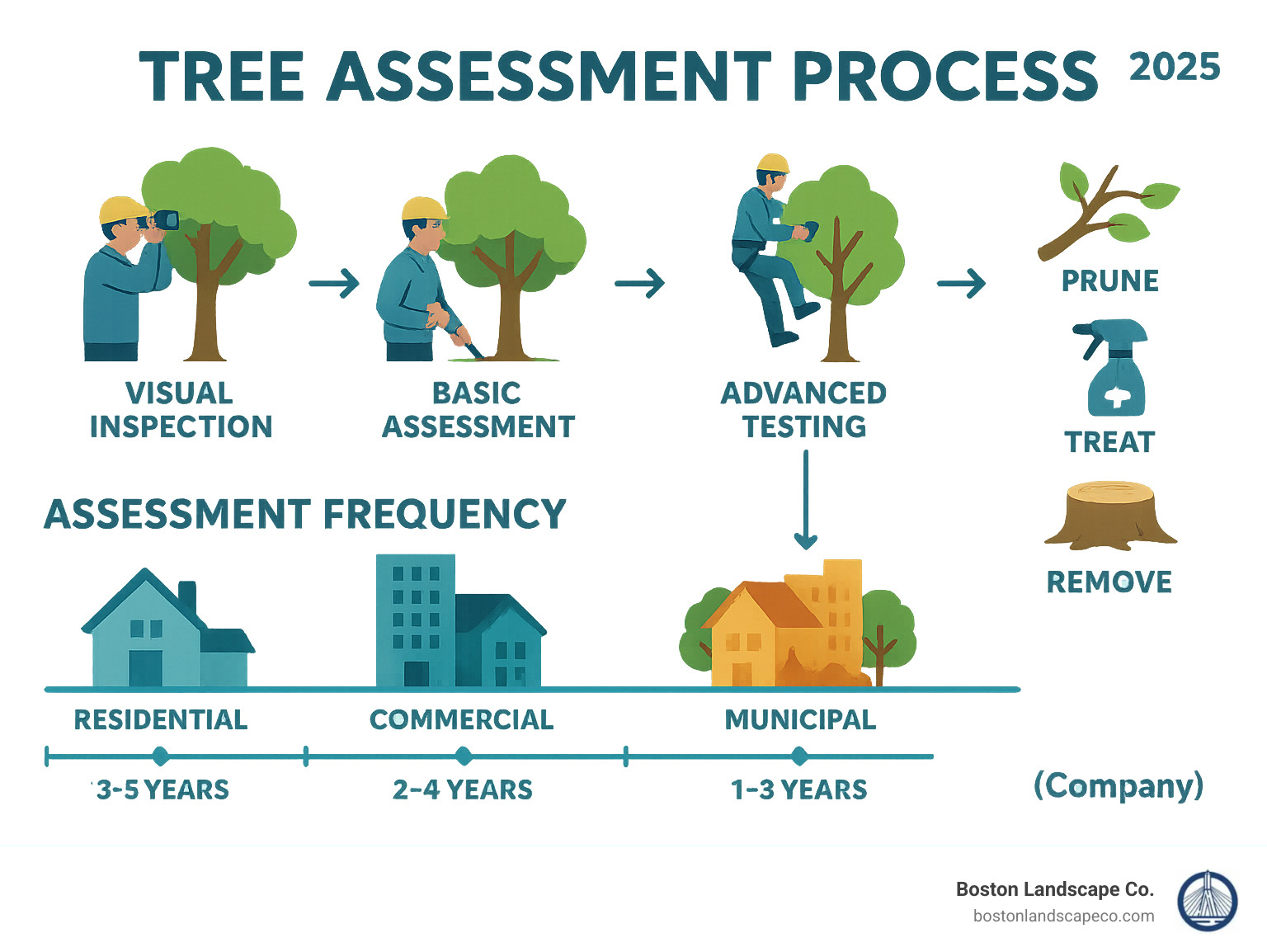
What Is a Tree Assessment and Why It Matters
A tree assessment is a systematic evaluation of a tree’s condition, focusing on structural integrity, health status, and potential risks to people or property. These evaluations go far beyond what most property owners can identify during casual observation.
The urban canopy in our Massachusetts service areas represents millions of dollars in property value. Research shows that mature trees can increase property values by 10-15%, making professional assessment a wise investment in protecting these assets.
Beyond financial considerations, tree assessments address legal liability. As property owners, we have a legal obligation to periodically inspect our trees for unsafe conditions and correct them.
Understanding Tree Assessment Services
When it comes to keeping your property safe and your trees healthy, tree assessment services offer much more than a quick glance at your oak or maple. These professional evaluations follow strict standards set by the International Society of Arboriculture (ISA), ensuring you get consistent, reliable results no matter which certified arborist you choose.
Professional assessments combine expertise in tree biology, structural mechanics, and risk analysis to give you defensible opinions about your trees’ condition. The approach differs depending on what you’re trying to accomplish. Risk assessments zero in on structural problems that could lead to tree failure, while health evaluations focus on diseases, pests, and environmental stresses.
Only ISA-certified arborists with Tree Risk Assessment Qualification (TRAQ) credentials should perform official risk assessments. These professionals have specialized training in inspection techniques and risk categorization outlined in the ISA Tree Risk Assessment Qualification handbook.
Levels of Tree Assessment Services
The industry recognizes three distinct levels of assessment, each designed for different situations and budgets.
Level 1 assessments are like a quick health screening. Arborists can evaluate large areas efficiently, often from vehicles or walkways, focusing on obviously hazardous trees that need immediate attention. This rapid screening works perfectly for municipal inventories or quick storm damage assessment.
Level 2 assessments represent the sweet spot for most property owners. Your arborist will walk around each tree, using simple tools like rubber mallets and probes to detect problems you can’t see from the surface. They’ll examine the root zone, trunk, and crown for signs of decay, cavities, or mechanical damage.
Level 3 assessments bring out high-tech equipment for complex situations or valuable trees. Think sonic tomography to visualize internal wood condition, resistograph drilling to measure wood density, or specialized climbing inspections. These advanced evaluations generate detailed reports suitable for legal proceedings or insurance claims.
Signs Your Tree Needs Professional Assessment
Structural red flags include a leaning trunk (especially if the lean seems recent), large dead branches in the crown, cavities or hollows in the trunk, and cracks or splits in major limbs. Root damage from construction or soil disturbance also warrants immediate attention.
Health warning signs include fungal growth at the base or on the trunk, extensive dieback in the crown, unusual leaf discoloration, or premature leaf drop. Don’t ignore evidence of pest infestation or disease – early intervention usually costs far less than tree removal.
Environmental factors can trigger assessment needs too. Recent severe weather damage, construction activity within the root zone, drainage changes, or chemical spills near the tree all create stress that may not show up immediately.
Tree Risk Assessment vs. Arborist Report
Choosing between these two services depends on what you’re trying to accomplish and who needs the information.
| Aspect | Tree Risk Assessment | Arborist Report |
|---|---|---|
| Purpose | Identify immediate safety hazards | Comprehensive tree management guidance |
| Length | 1-3 pages | 5-20+ pages |
| Cost Range* | $200-$600 | $500-$2,000+ |
| Audience | Property owners, insurance | Municipalities, developers, legal proceedings |
| Detail Level | Focused on defects and mitigation | Detailed analysis with management recommendations |
| Timeline | 1-2 days | 1-2 weeks |
*Average costs based on internet data; actual fees vary and are not quotes from Boston Landscape Co.
Risk assessments get straight to the point about safety concerns and what you need to do about them. Arborist reports dive deep into comprehensive analysis, management recommendations, and long-term planning. The choice often comes down to your immediate needs and timeline.
Top Tree Assessment Services to Consider in 2024
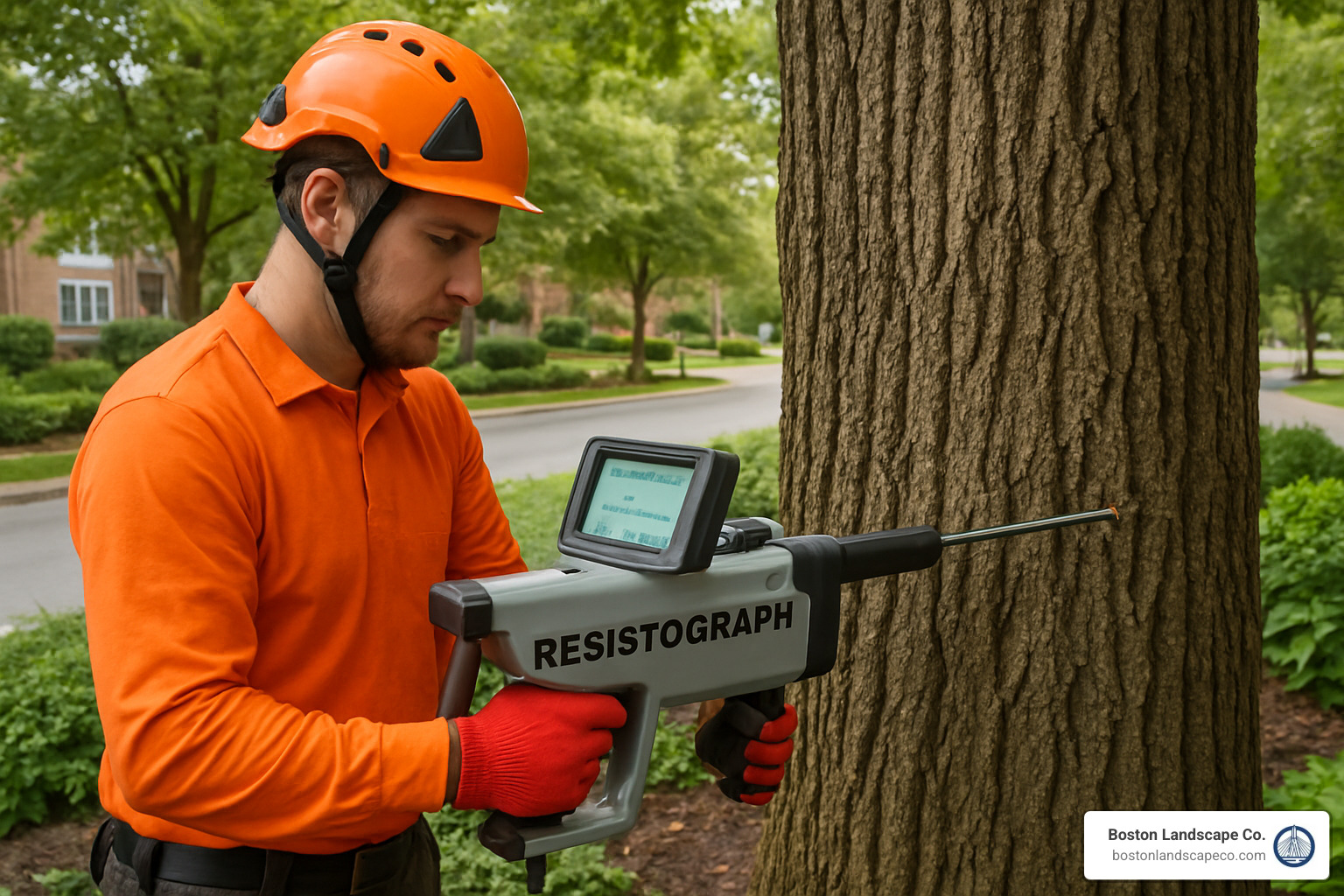
The world of tree assessment services has evolved significantly with advances in diagnostic technology and standardized methods. Here’s what’s worth considering based on your specific needs:
Tree Risk Assessment (Advanced) — For Safety-Critical Sites
When you’ve got trees near your house, power lines, or anywhere people spend time, an advanced risk assessment is your best insurance policy. These comprehensive safety analyses by TRAQ-certified arborists consider load factors like wind exposure patterns, ice and snow loading potential, and soil drainage conditions.
The arborist will assess your target zones – what’s at risk if the tree fails and how often people or property are exposed to that risk. What makes these assessments valuable is the mitigation guidance you receive. Maybe your oak needs strategic pruning to reduce wind load, or a cabling system could provide extra support.
Modern advanced assessments often use sonic tomography – sound waves that create images of the wood inside your tree without drilling holes. This technology can spot decay or hollow areas that look perfectly fine from the outside.
Comprehensive Tree Health Inspection — For Long-Term Care
If you’re thinking beyond just safety concerns, a health-focused inspection evaluates your trees as living investments that need proper care to thrive for decades.
The inspection covers nutrient testing of your soil, since Massachusetts soils often lack what trees need to stay strong and healthy. The arborist will also conduct a thorough pest and disease scan, looking for problems that might not be obvious yet but could become serious without treatment.
These assessments provide multi-year care planning instead of just fixing today’s problems. You get a roadmap for keeping your trees healthy long-term, including fertilization schedules, preventive treatments, or timing recommendations for pruning.
Pre-Construction Tree Surveys — For Developers & Municipalities
Planning construction work? A pre-construction survey can save you thousands in tree replacement costs and potential legal issues. These surveys create complete inventory mapping of existing trees, including species identification and condition assessment. More importantly, they establish root protection zones – areas around each tree that must stay undisturbed during construction.
Modern surveys integrate with CAD and GIS systems, creating precise digital maps that architects and contractors can use during planning. The survey identifies which trees can realistically be preserved, which need special protection measures, and which should be removed before construction begins.
Independent Consulting & Forensic Assessments — For Insurance & Legal Needs
Sometimes you need a completely unbiased professional opinion – maybe for an insurance claim, property dispute, or legal proceedings. Independent consulting arborists don’t perform tree work, which keeps their assessments completely objective. They can provide expert witness testimony if needed and create detailed reports that insurance companies and courts accept as credible evidence.
Forensic assessments dive deep into what happened and why, documenting everything with detailed photography and often using drone mapping to capture site conditions comprehensively.
Cost & Frequency: What to Expect
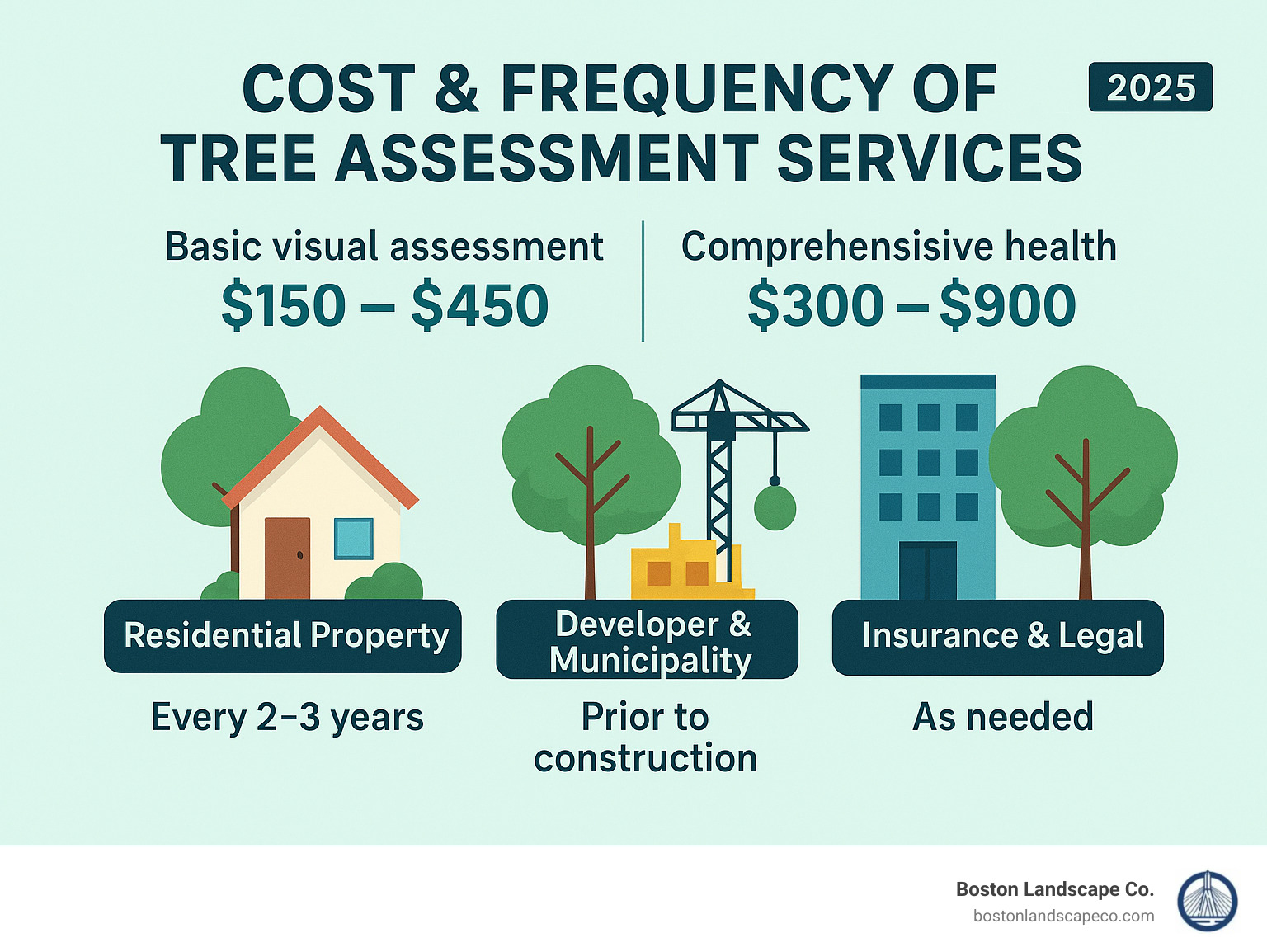
Tree assessment services range widely in cost, but understanding what drives these prices helps you budget smartly and avoid overpaying.
*Average costs based on internet data; actual fees vary and are not quotes from Boston Landscape Co.
Basic visual assessments typically run $150-$450 per property, making them an affordable starting point for most homeowners. Comprehensive health inspections cost $300-$900, depending on how many trees need evaluation and what diagnostic work is required.
Advanced risk assessments with high-tech equipment like sonic tomography can run $600-$1,500 or more. Yes, that sounds steep, but consider this: removing a large damaged tree often costs $2,000-$5,000, not counting potential property damage.
Pre-construction surveys for developers range $800-$2,400 and up, scaling with property size and complexity. Independent forensic assessments for legal or insurance purposes typically cost $1,000-$3,000 or more, reflecting the detailed analysis and expert testimony these situations require.
Several factors affect your final bill. Property size and tree count obviously matter, while site accessibility plays a role too. The complexity of problems found during assessment can increase costs, and geographic location affects pricing as labor costs vary across different areas.
How Often Should You Schedule Tree Assessment Services
Annual visual inspections make sense for everyone with mature trees. You can often handle these yourself, walking around your property each spring to spot obvious changes.
Professional assessments every two years work well for most residential and commercial properties. This frequency catches developing problems before they become emergencies while keeping costs reasonable.
Some situations trigger immediate assessment needs. Severe storms top this list – high winds, ice storms, or heavy snow can damage trees in ways that aren’t immediately obvious. Construction activity near trees also warrants professional evaluation, as root damage often shows up months later.
High-risk situations may require annual professional assessment. Trees hanging over your house, near power lines, or in areas where people gather frequently deserve extra attention.
How Assessments Save Money & Prevent Damage
Tree assessment services typically pay for themselves through prevention and early intervention. Preventive pruning costs a fraction of emergency tree removal. Removing a few problematic branches might cost $300-$600, while removing an entire failed tree often runs $2,000-$5,000 or more.
Informed decision-making helps you spend your tree care budget wisely. Instead of guessing which trees need attention, assessments prioritize interventions based on actual risk and tree condition.
Property value preservation might be the biggest long-term benefit. Mature trees can add 10-15% to property values, but only if they’re healthy and safe. The cost of regular assessments is typically far less than the value lost when beautiful mature trees must be removed due to neglect.
At Boston Landscape Co., we’ve seen how small investments in professional assessment prevent major headaches later. For more information about integrating tree assessments into your overall landscape maintenance plan, check out our comprehensive tree care services.
Choosing the Right Tree Assessment Partner
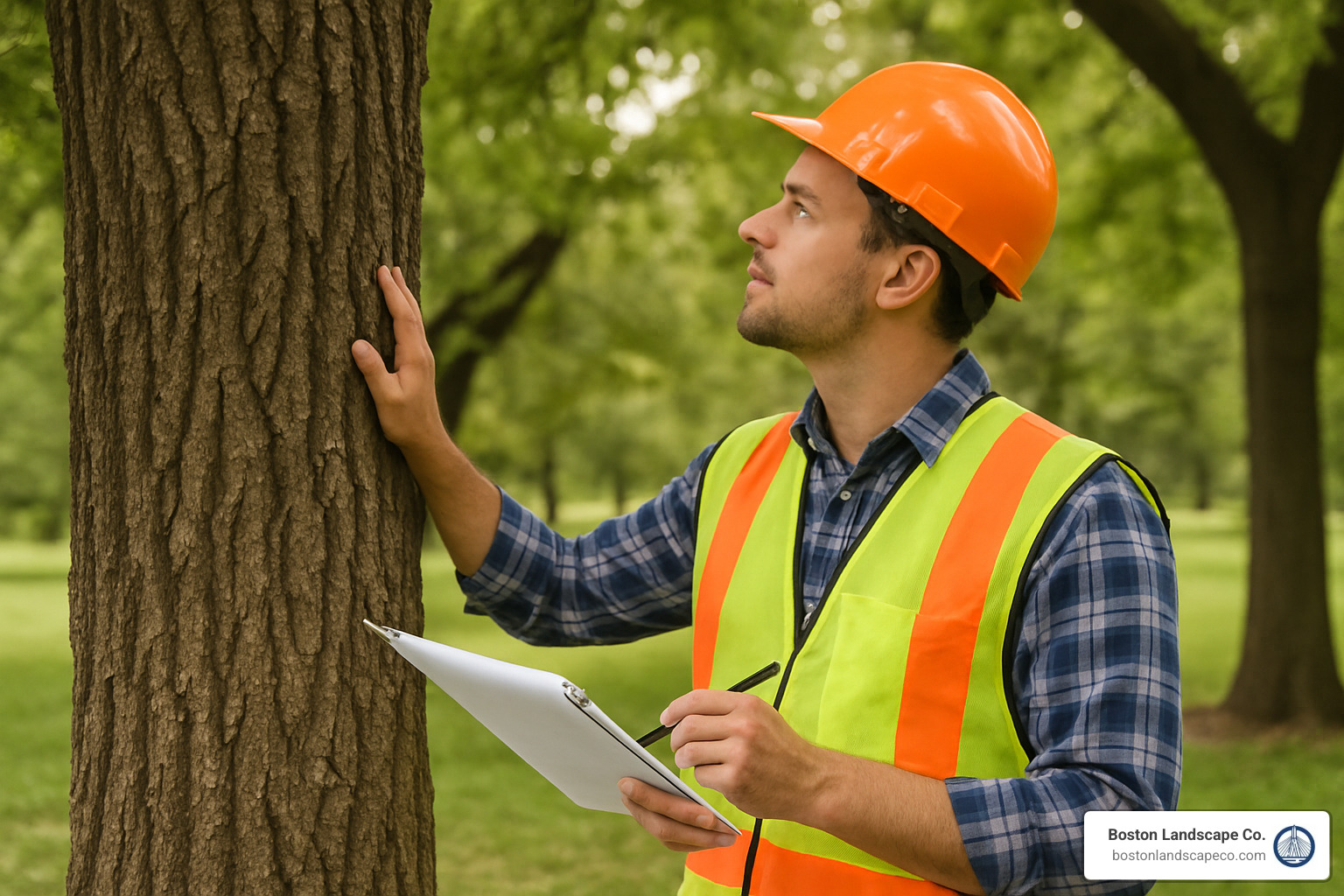
Finding the right professional for tree assessment services requires knowing what to look for. The best arborists combine solid credentials with clear communication and genuine care for both trees and clients.
The foundation starts with proper credentials. You want an ISA Certified Arborist who has earned certification through rigorous testing and maintains it through continuing education. For risk assessments specifically, look for TRAQ (Tree Risk Assessment Qualification) certification.
Insurance matters more than most people realize. A qualified professional should carry comprehensive liability insurance with coverage typically ranging from $1-5 million, plus workers’ compensation. Don’t be shy about asking for certificates of insurance.
The best arborists today use advanced diagnostic equipment like sonic tomography and resistograph testing. Some professionals now use drone technology for aerial inspections of tall trees, providing safer and more comprehensive evaluations.
What really sets great professionals apart is their reporting quality. You should receive detailed written reports with clear photographs and specific recommendations, not just a quick verbal summary.
Questions to Ask Before Hiring
Start with qualification verification – ask to see their ISA certification and TRAQ credentials. Ask about their diagnostic toolset and methodology. A professional who only does visual inspections may miss internal decay that specialized equipment would detect.
Find out their typical turnaround time for reports and ask about follow-up support. Will they answer questions about their report? Can they coordinate with tree care professionals for recommended treatments?
Don’t forget to ask for references from similar projects. A residential specialist might not be the best choice for complex commercial assessments.
Tailoring Services for Homeowners vs. Commercial Clients
Homeowners typically need straightforward assessments focused on immediate safety concerns and practical solutions. The best residential arborists explain findings in everyday language, focusing on cost-effective treatments that fit family budgets.
Commercial and municipal clients require more comprehensive documentation and formal reporting. These assessments often need to satisfy insurance requirements, support legal proceedings, or comply with local regulations.
At Boston Landscape Co, we’ve built relationships with certified arborists throughout the greater Boston area who understand these different needs. We often coordinate tree assessment services with our broader landscape maintenance programs, ensuring that assessment recommendations integrate smoothly with ongoing property care.
Frequently Asked Questions about Tree Assessment Services
How do tree assessment services prevent property damage?
Tree assessment services work like a health checkup for your trees – they catch problems before they become expensive disasters. When a certified arborist examines your trees, they’re looking for structural weaknesses, disease, and other issues that could lead to branch failure or complete tree collapse.
A small crack in a tree trunk might not look like much today, but after a winter of ice storms, that crack could cause the entire tree to split and fall onto your house. Professional assessments identify these vulnerabilities while there’s still time to address them through strategic pruning or soil treatments.
The financial benefits are substantial. Research consistently shows that preventive tree care saves property owners thousands of dollars compared to emergency removal services or property damage repairs.
Are advanced diagnostic tools safe for my tree?
Modern diagnostic equipment is specifically designed to gather crucial information while minimizing any impact on tree health.
Sonic tomography is completely non-invasive – it works like an ultrasound for trees, using sound waves to create detailed images of the internal wood structure without any physical contact whatsoever.
Resistograph drilling does create tiny holes, but we’re talking about holes that are only about 1/8 inch in diameter. These heal quickly and cause no more stress to the tree than a small insect boring would.
All these advanced tools are used by trained professionals who understand exactly how to minimize any potential impact. The tiny amount of stress these tools might cause is far outweighed by the safety benefits of understanding your tree’s true condition.
Can I perform a basic tree assessment myself?
You absolutely can and should keep an eye on your trees throughout the year! Regular visual inspections by property owners are actually an important part of good tree stewardship.
As a property owner, you can watch for obvious warning signs like dead branches hanging in the crown, new fungal growth around the base, or changes in leaf color and timing.
But certified arborists understand tree biology, structural mechanics, and species-specific characteristics that affect how different trees respond to various stresses. They can spot subtle early warning signs that might not be apparent to even the most observant property owner until problems become serious.
Your role as a property owner is to stay alert and call in the professionals when you notice changes or have concerns.
Conclusion
Taking care of your trees isn’t just about keeping them looking nice – it’s about protecting your property, your family, and your investment. Tree assessment services give you the knowledge you need to make smart decisions about the trees that add so much value to your landscape.
Think of professional tree assessment as an insurance policy that actually pays you back. The few hundred dollars you spend on regular evaluations can save you thousands in emergency tree removal, property damage, or liability issues down the road. Plus, healthy, well-maintained trees can boost your property value by 10-15%.
The beauty of modern tree assessment services is that there’s an option for every situation and budget. Whether you need a quick visual check after a storm or a comprehensive health analysis for that magnificent oak in your front yard, certified arborists have the tools and expertise to give you clear, actionable answers.
At Boston Landscape Co, we’ve been helping property owners throughout the greater Boston area since 1991. While we focus on landscape design and maintenance rather than tree assessment itself, we work closely with certified arborists who provide these specialized services to our clients.
This partnership approach works beautifully because tree health doesn’t exist in a vacuum – it’s connected to soil conditions, drainage, pest management, and overall landscape health. When assessment recommendations call for soil improvements or integrated pest management, we can seamlessly coordinate those services as part of your broader landscape care plan.
The Massachusetts climate keeps us on our toes with everything from nor’easters to summer storms. Regular professional assessment isn’t just smart planning – it’s essential risk management. The peace of mind that comes from knowing your trees are healthy and safe is worth every penny.
Don’t wait until you’re worried about a tree to establish a relationship with qualified professionals. The best time to find a certified arborist is before you need one urgently.
Ready to learn more about how tree assessment fits into comprehensive property care? Check out our tree care services page to see how we coordinate with certified arborists to keep your entire landscape healthy and beautiful.
Remember: Average costs mentioned throughout this article are based on aggregated internet data and are not quotes from Boston Landscape Co. Actual assessment fees vary based on your property’s unique characteristics and local market conditions.
