
Irrigation System Installation: 10 Powerful Ways to Boost Value
The Hidden Cost of Neglecting Proper Irrigation
Irrigation system installation is the process of setting up a network of pipes, valves, sprinklers, and controllers that automatically water your landscape. For commercial property managers seeking professional solutions, here’s what you need to know:
| Key Element | Details |
|---|---|
| Average Cost | $3,000-$12,000 for typical commercial properties |
| Installation Time | 1-3 days for professional installation |
| Return on Investment | Up to 86% ROI through water savings and property value increase |
| Water Savings | Can reduce landscape water use by up to 50% |
| System Lifespan | 15-20 years with proper maintenance |
Did you know that residential outdoor water use in the United States accounts for nearly 9 billion gallons of water each day, mostly for landscape irrigation? Even more concerning, up to 50% of this water is wasted through inefficient watering practices and poorly designed systems.
A professionally installed irrigation system transforms this scenario completely. Beyond the lush, vibrant landscape it creates, a well-designed system delivers precisely the right amount of water exactly where it’s needed. This targeted approach not only promotes healthier plant growth but also significantly reduces water waste and utility costs.
For commercial properties, the benefits extend even further. Professional irrigation ensures consistent curb appeal that attracts customers and tenants while freeing up maintenance staff from the time-consuming task of manual watering. Additionally, modern smart irrigation controllers can adjust watering schedules based on weather conditions, soil moisture, and seasonal needs—maximizing efficiency and minimizing waste.
I’m Steve Schumacher, and with over three decades in the landscaping industry, I’ve overseen countless irrigation system installations that have transformed dry, struggling landscapes into thriving outdoor environments for commercial clients throughout the Boston area.
Key terms for irrigation system installation:
– how are irrigation systems installed
– watering and irrigation systems
Irrigation Systems 101: Types & Benefits
When it comes to irrigation system installation, understanding the different types available is crucial for making an informed decision. Each system has its unique benefits and applications depending on your property’s specific needs.

How Each System Works
Have you ever wondered what happens beneath the surface when you press that irrigation controller button? Let me walk you through it.
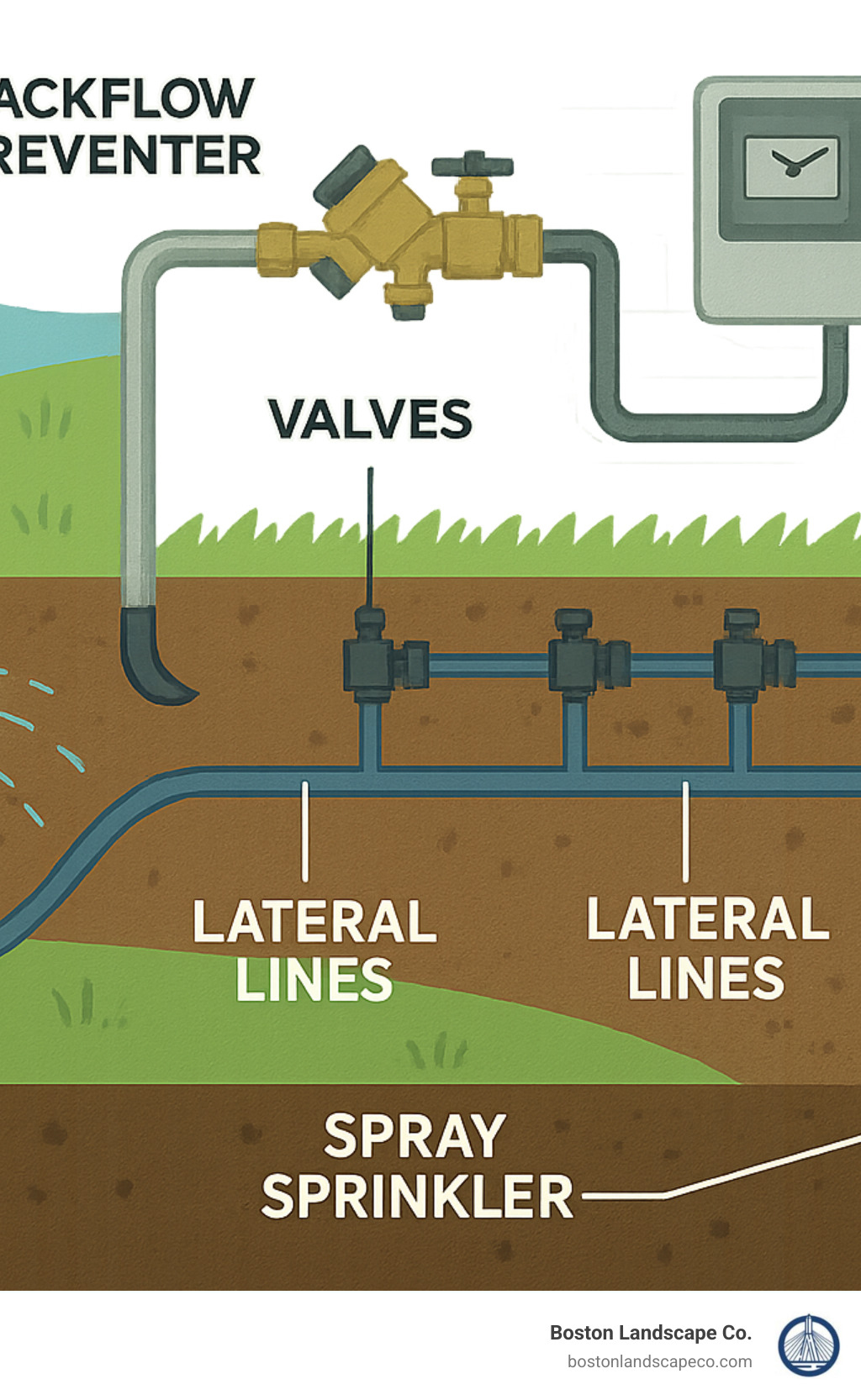
In-Ground Sprinkler Systems create that professional look we all admire. These permanent systems feature underground pipes with pop-up sprinkler heads that only appear when it’s showtime. Water travels from your main water source through a backflow preventer (keeping your drinking water safe), into zone valves, and finally out through the sprinkler heads. These systems typically operate at pressures between 30-65 PSI and are designed with head-to-head coverage—meaning each sprinkler’s water reaches the next sprinkler—ensuring your landscape gets uniform watering with no dry patches.
Above-Ground Systems offer a more budget-friendly approach without the digging. Using hoses and portable sprinklers, they’re perfect for temporary needs or smaller commercial areas. While you’ll see them (unlike their underground cousins), they provide flexibility when permanent solutions aren’t required.
Drip Irrigation works like a gentle, patient gardener. Operating at lower pressure (25-30 PSI), these systems deliver water directly to plant roots through small tubes with emitters. Rather than measuring water in minutes, drip systems work in gallons per hour—typically 0.5 GPH for clay soils up to 2 GPH for thirsty sandy soils. They’re incredibly efficient since water goes exactly where plants need it.
Rotary Sprinklers are the marathon runners of irrigation. They rotate while distributing water in circular patterns, covering distances of 15-30 feet or more. When you need to water larger turf areas efficiently, these higher-pressure workhorses get the job done.
Micro-Spray Systems create a gentle mist that’s perfect for your more delicate landscape residents. Operating at lower pressures, they provide precise watering for flowers, smaller plants, and areas where a softer touch matters.
Bubblers are exactly what they sound like—they create a “bubbling” fountain of water directly at the base of individual plants, trees, or shrubs. This provides deep, targeted watering without the waste of runoff or evaporation.
Why Install One?
The benefits of professional irrigation system installation go far beyond just saving you from dragging hoses around.
Your time is valuable, and automatic irrigation systems respect that. By eliminating manual watering, you’ll free up hundreds of maintenance hours annually for a typical commercial property. Imagine what your staff could accomplish with all that extra time!
Plants, like people, thrive on consistency. With proper irrigation, your landscape receives the right amount of water at the right times, encouraging deeper root growth and creating more resilient plants. This translates to fewer replacements and reduced maintenance costs over the years.
Modern irrigation isn’t about drowning your landscape—it’s about precision. Today’s systems deliver exactly the right amount of water based on specific plant needs, soil conditions, and even weather patterns. This targeted approach means healthier plants and less waste.
When it comes to smart investments, irrigation delivers impressive returns. A well-installed system provides an average ROI of 86%, according to industry data. This comes through reduced water bills, lower labor costs, and increased property value—a win on multiple fronts.
First impressions matter in business, and nothing speaks to professionalism like consistently lush, vibrant landscaping. Your property’s curb appeal creates immediate positive impressions for clients, customers, and tenants before they ever step inside.
In today’s environmentally-conscious world, water conservation matters. Smart controllers and efficient design can reduce landscape water usage by up to 50% compared to manual watering methods, helping your business meet sustainability goals while lowering utility costs.
At Boston Landscape Co., we’ve witnessed countless property changes throughout Boston, Bedford, Burlington, and surrounding Massachusetts communities. The difference between manually watered landscapes and those with professional irrigation systems isn’t subtle—it’s immediately visible to everyone who passes by.
More info about watering options
Pre-Installation Blueprint: Design, Costs & Permits
Before breaking ground on your irrigation system installation, a little planning goes a long way. Think of this preparation phase as the foundation for your system’s success—it determines not just how well your system works, but how much it’ll cost you down the road.
Design Considerations
When we sit down with commercial clients in the Boston area, we start by looking at what makes your property unique. Your yard size naturally affects everything—a quarter-acre commercial landscape might run $2,500-$7,500 for a basic setup, while a full acre property could approach $10,000-$30,000.
Your soil tells us an important story too. Sandy soil? It drains quickly, so we’ll need more frequent watering with higher flow rates—typically 2 GPH emitters spaced closer together. Clay soil holds moisture longer but needs gentler application to prevent wasteful runoff.
Those beautiful rolling hills on your property? They present unique challenges. We’ll need to incorporate pressure-compensating emitters and check valves to prevent water from draining to the lowest points. Sometimes we’ll create separate zones entirely for sloped areas.
Water pressure and flow are the unsung heroes of irrigation. Most commercial systems need 40-70 PSI of pressure and 10-13 GPM flow rate. We always test these metrics before finalizing any design—it’s like checking your car’s engine before a cross-country trip.
Dividing your property into irrigation zones isn’t just smart—it’s essential. Different plants have different needs, and zones let us customize watering schedules accordingly. Each additional zone typically adds $500-$1,000 to the installation, but the water savings often pay for themselves.
From basic timers to weather-responsive smart controllers, your control system choice impacts both immediate costs and long-term savings. Think of smart controllers as the difference between a flip phone and a smartphone—both make calls, but one does so much more.
Cost Breakdown
Based on industry averages (not specific to Boston Landscape Co.), here’s what you might expect to invest:
| Component | Average Cost Range |
|---|---|
| Professional Design | $300-$3,000 |
| Materials (pipes, fittings, valves) | $1,000-$5,000 |
| Sprinkler Heads | $2-$35 each (×dozens or hundreds) |
| Controllers | $170-$1,500+ |
| Labor | $50-$150 per hour |
| Permits | $50-$200 |
| Backflow Prevention | $150-$500 |
| Trenching | $4-$12 per foot |
For commercial properties, total system costs typically range from $3,000 to $30,000+, depending on size and complexity.
DIY vs. Professional Installation Comparison
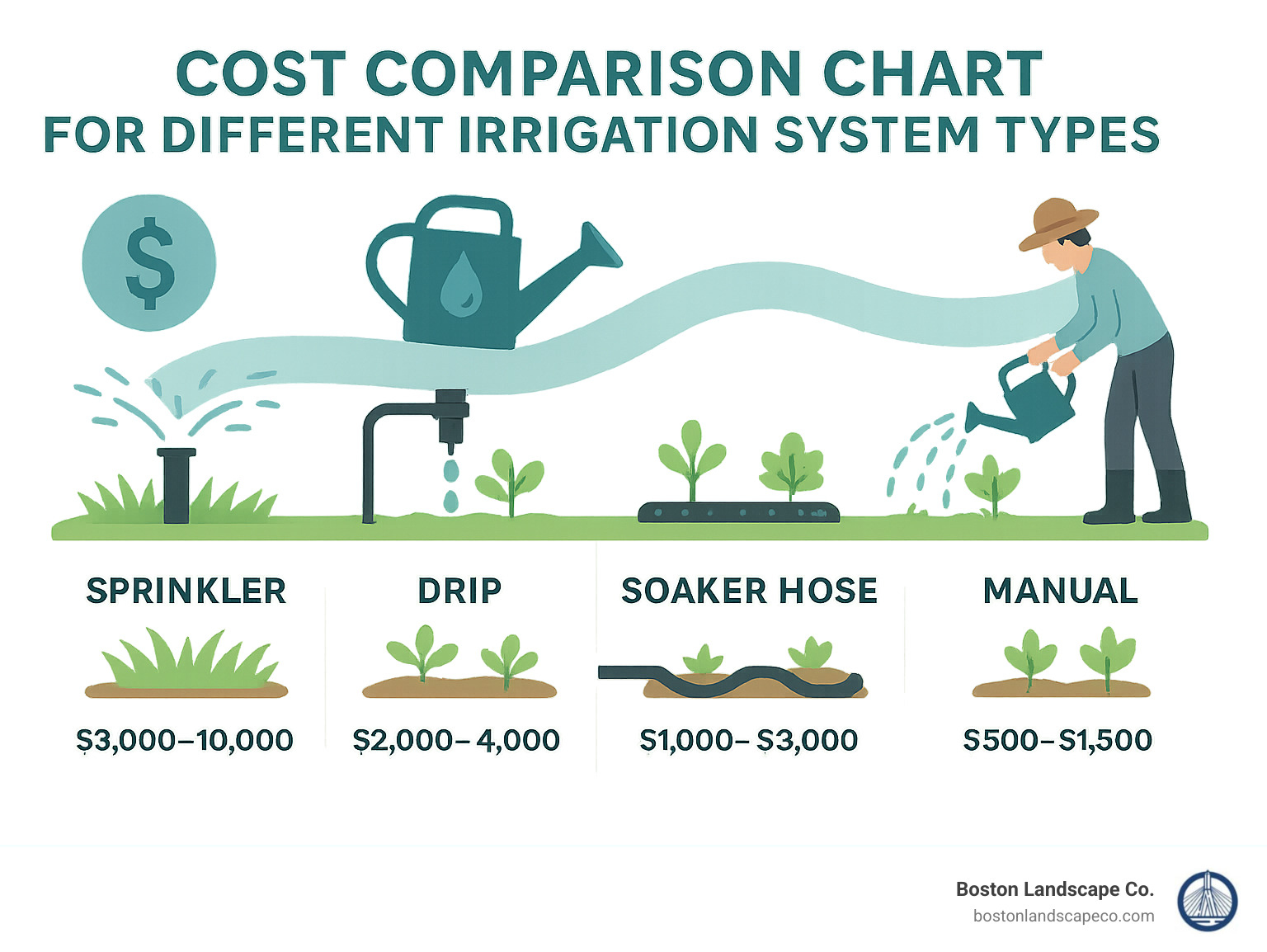
The DIY route might seem tempting at first glance. Materials alone might run $500-$4,500, compared to $3,000-$30,000+ for professional installation. But here’s where the numbers don’t tell the whole story.
A DIY approach typically takes 16-40+ hours spread over 1-2 weeks of part-time work, while professionals can complete the job in 1-7 days. DIYers need to juggle plumbing, electrical, and landscape knowledge, plus rent or purchase specialized tools. Professionals bring certified expertise, all necessary equipment, and custom-engineered designs specifically for your property.
Perhaps most importantly, professional installation typically includes 1-5 years of warranty coverage on both parts and labor, while DIY installations offer limited or no warranties. We’ll also handle all those pesky permits for you!
Budgeting Tips
Want to make the most of your irrigation system installation budget? Consider scheduling during the off-season (late fall through early spring) when many companies, including Boston Landscape Co., offer better rates.
If you’re working with budget constraints, focus on high-impact zones first. Your property’s front entrance and client-facing landscapes deserve priority treatment—they’re what make those crucial first impressions.
When selecting components, the cheapest options often become the most expensive over time. Those budget sprinkler heads might save you money today, but they’ll likely need replacement in just a few years. Mid-range components typically deliver the best long-term value.
Finally, think ahead. Having your system designed with expansion capability can save considerable money if you plan to develop additional areas in the future—it’s like buying a house with room to grow.
Permit & Regulation Checklist
Before we start digging, we need to check several regulatory boxes:
Most Massachusetts municipalities require permits for commercial irrigation system installation, typically costing $50-$200. Commercial properties must also install approved backflow preventers to protect the public water supply, with annual testing running $75-$150.
Be aware of local water-use bylaws—many communities restrict watering days, times, and total usage. Modern smart controllers can be programmed to comply with these regulations automatically.
Always call 811 before any digging begins to have underground utilities marked—this isn’t just a good idea, it’s the law. And if your property falls under HOA or property management regulations, we’ll help you secure all necessary approvals.
At Boston Landscape Co., we handle all permitting and compliance issues as part of our comprehensive irrigation system installation service for commercial clients throughout our service areas, including Lexington, Medford, Malden, and beyond.
How Are Irrigation Systems Installed?
Irrigation System Installation: Step-by-Step Guide
The journey from a dry, thirsty landscape to a lush, efficiently watered property involves several critical phases. Let me walk you through how we bring irrigation system installation to life at Boston Landscape Co.
Step 1 – Site Layout & Irrigation System Installation Plan
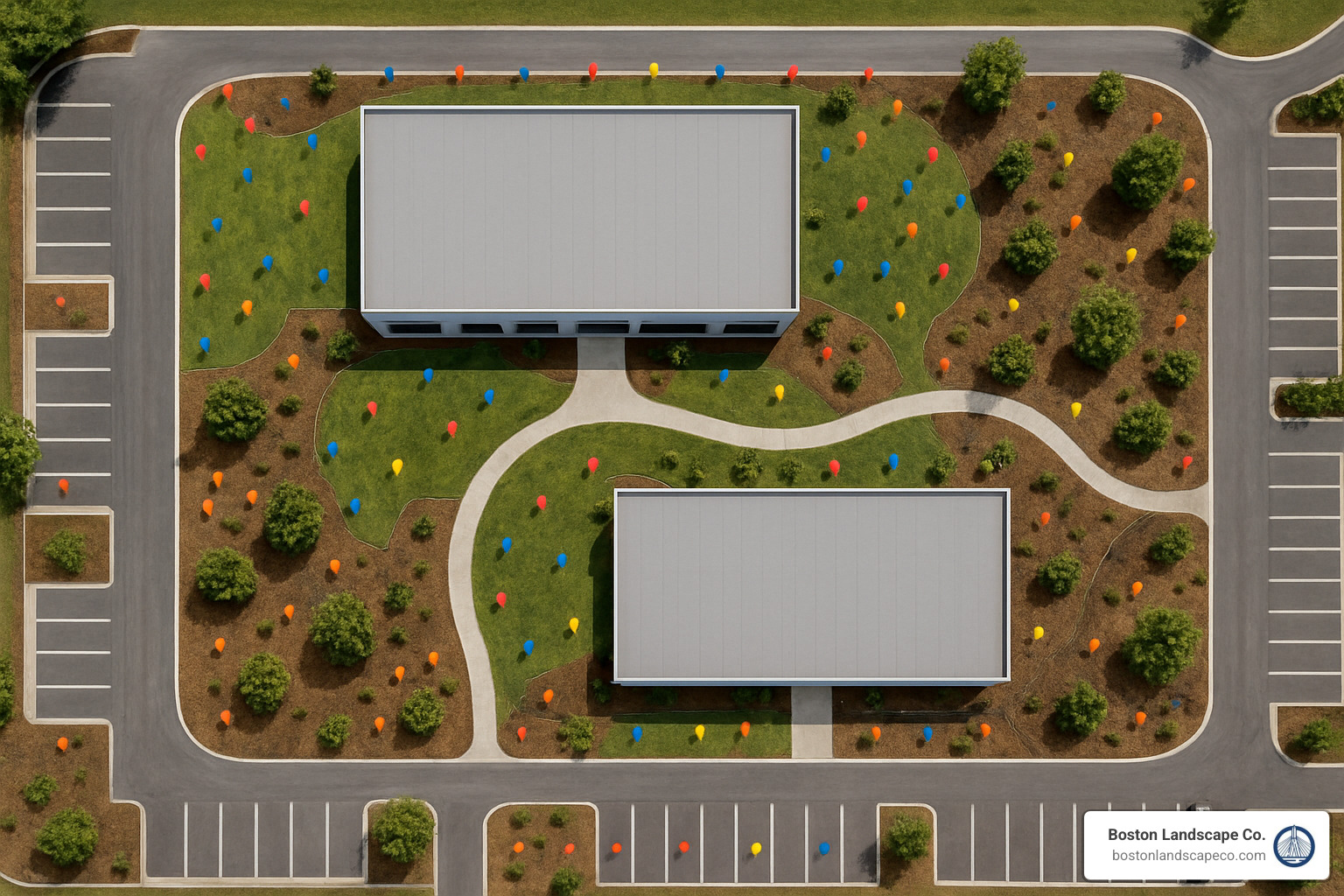
Every great irrigation system begins with thoughtful planning. We start by creating a detailed scale drawing of your commercial property, carefully marking buildings, walkways, parking areas, and all landscaped zones. Think of this as the blueprint for your property’s hydration system.
Next, we assess your water source by measuring both static pressure (when water isn’t flowing) and working pressure (during flow). Most commercial systems perform best between 40-65 PSI with flow rates of 10-13 GPM or higher. This step is crucial—like checking your car’s engine before a cross-country trip.
With colored flags or paint, we mark the future home of each valve, sprinkler head, and controller. This visual roadmap guides our installation team and helps you envision the completed system. We calculate optimal head placement using the “head-to-head coverage” principle, ensuring water from one sprinkler reaches adjacent sprinklers for that perfect, uniform distribution.
For larger commercial properties, we employ sophisticated design software that helps us balance water efficiency with optimal coverage. It’s like having a chess grandmaster plan several moves ahead—every pipe, valve, and sprinkler is positioned with purpose.
Step 2 – DIY Irrigation System Installation Toolkit
While our professionals handle all aspects of your irrigation system installation, understanding the specialized equipment involved gives you appreciation for the craft behind the process.
Professional installations require a specialized arsenal: trenching machines that carefully dig channels 6-12 inches deep, pipe pullers that minimize landscape disruption, and horizontal boring tools that snake pipes under walkways without demolition. We use precision poly pipe cutters that make clean cuts without creating system-clogging debris.
We also employ professional-grade pressure gauges and flow meters to ensure each zone receives the perfect amount of water. For commercial installations, having the right equipment isn’t just convenient—it’s essential for creating a system that will water faithfully for decades to come.
If you’re curious about simpler tools used in irrigation work, a simple pipe cutter gives you an idea of just one small piece of the equipment puzzle.
Step 3 – In-Ground Assembly & Connections
Now comes the change of your landscape. We begin by carefully digging trenches 6-12 inches deep (depending on local frost depth requirements) using equipment that minimizes disruption to your existing landscape.
For the piping network, we use Schedule-40 PVC for main lines (typically ¾”, 1″, or 1¼” diameter) and flexible polyethylene for lateral lines. Each connection is properly sealed and pressure-tested—think of it as creating a leak-proof vascular system for your landscape.
The heart of your system is the valve manifold assembly. We install professional-grade valves in protective boxes with gravel bases for proper drainage. Each manifold includes pressure regulators, filters, and the all-important backflow prevention device that keeps your drinking water safe.
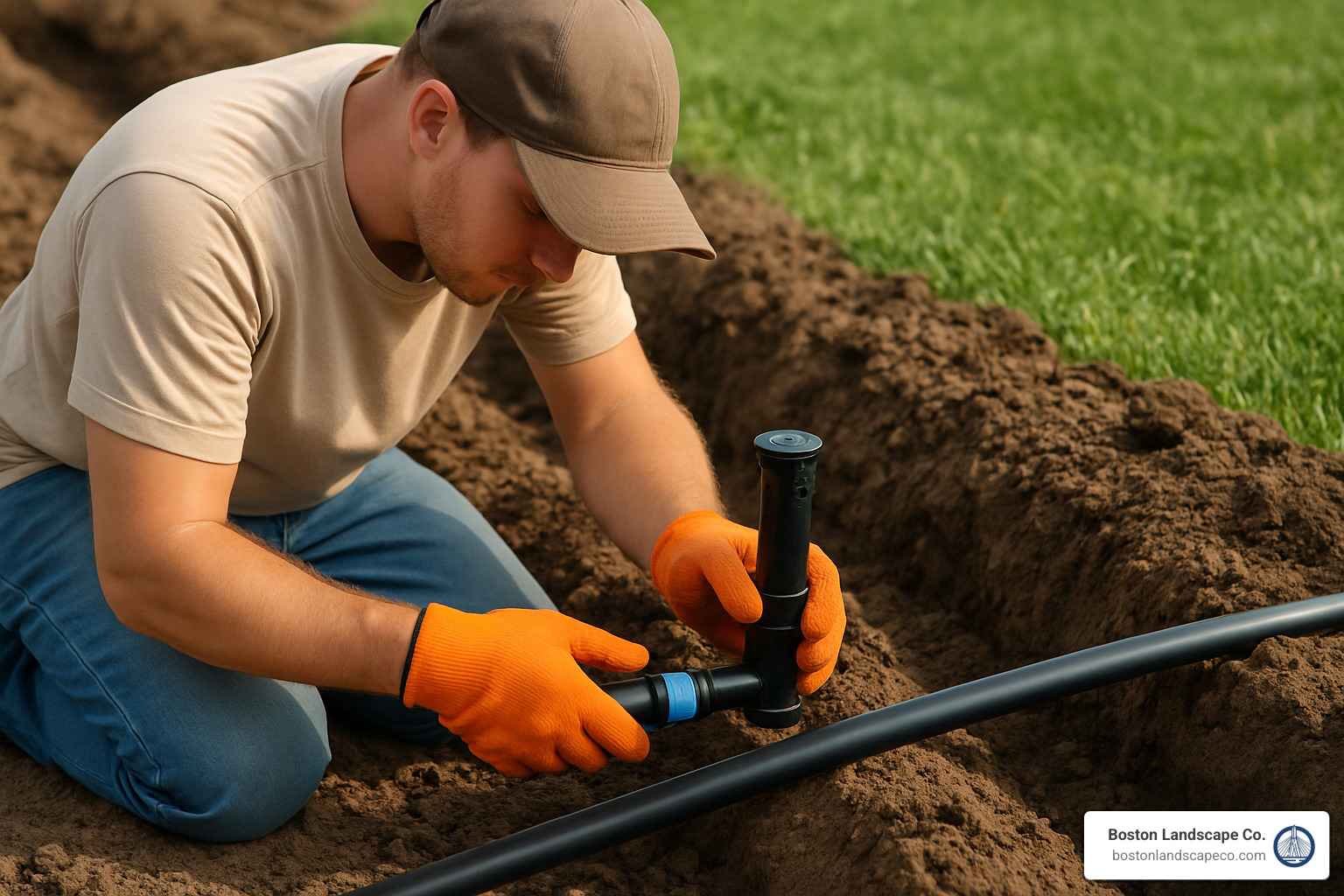
For sprinkler head installation, we use “funny pipe” or swing pipe connections. These flexible connectors allow for precise head placement while providing enough give to prevent breakage from foot traffic or maintenance equipment. Each head is installed flush with the grade level, ensuring safe mowing and preventing tripping hazards.
Before we attach the final sprinkler heads, we thoroughly flush all lines to remove any debris that might clog those precisely engineered nozzles.
Step 4 – Zone Wiring, Controller Setup & Testing
This is where your irrigation system installation becomes truly intelligent. We run 24-volt multi-strand irrigation wire alongside the main line, using waterproof connectors at each valve. For commercial systems, we typically use direct-burial wire with additional protective conduit—think of it as the nervous system that coordinates all watering activities.
The controller—the brain of your system—is mounted in an accessible, protected location. For commercial properties, this is typically indoors or in a weatherproof cabinet outdoors. We then connect rain sensors, soil moisture sensors, and/or weather stations to prevent unnecessary watering during rainfall or when soil conditions are already optimal.
Each zone is programmed based on specific needs: plant water requirements, soil type, sun exposure, seasonal changes, and local water restrictions. This customized approach ensures your landscape receives precisely what it needs, when it needs it.
We then conduct comprehensive testing of each zone, adjusting sprinkler head arc, radius, and spray pattern for optimal coverage. Finally, we provide detailed instructions on controller operation and basic maintenance, empowering you to get the most from your new system.
Step 5 – DIY vs. Professional Irrigation System Installation
For commercial properties, professional installation offers compelling advantages. While a DIY approach might take 1-2 weeks of part-time work, our professional teams typically complete installations in just 1-3 days. Our certified technicians bring specialized training and hydraulically engineered designs that maximize efficiency.
Professional installations come with warranties (typically 1-5 years on parts and labor), proper permitting handled by us, and ongoing support options. Perhaps most importantly, professionally designed systems are optimized for water efficiency, reducing waste and lowering utility bills.
At Boston Landscape Co., our irrigation system installation teams serve commercial clients throughout Boston, Stoneham, Billerica, and surrounding Massachusetts communities. We pride ourselves on creating professional-grade systems designed for decades of reliable operation—keeping your landscape lush while conserving one of our most precious resources.
Lifetime Care: Maintenance, Smart Tech & ROI
A properly installed irrigation system is a long-term investment that requires ongoing care to maximize its performance and lifespan.
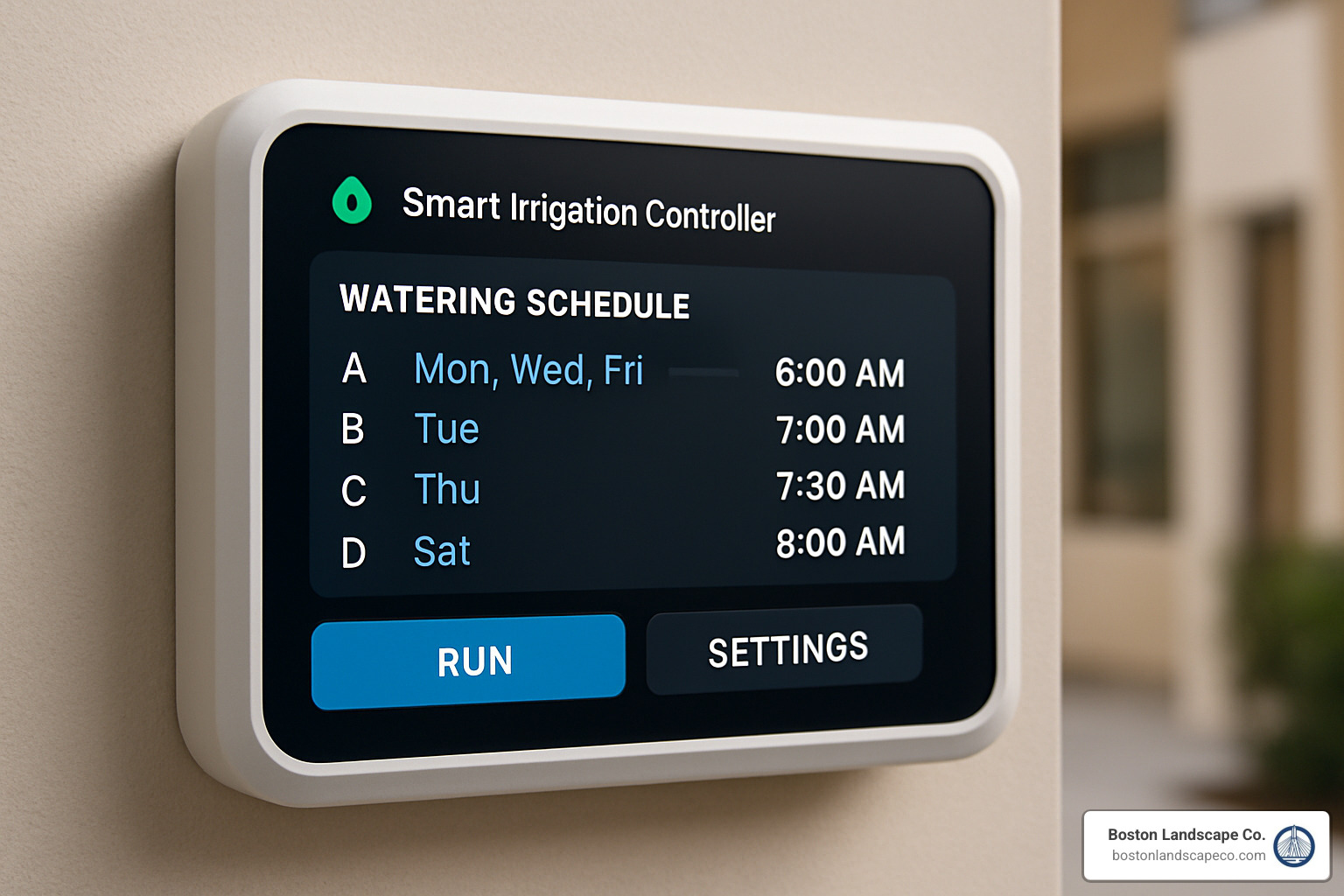
Let’s talk about what happens after your irrigation system installation is complete. Think of your new system like a car – it’ll serve you faithfully for years, but only with proper care and occasional check-ups.
Regular Maintenance Requirements
Your irrigation system needs seasonal attention to keep it running at peak efficiency. In the spring, your system needs a professional wake-up call after its winter hibernation. This spring start-up includes gradually restoring water pressure, inspecting all valves and heads, and reprogramming the controller for spring conditions. Don’t forget the backflow testing and certification – it’s not just recommended, it’s typically required by law. Based on industry averages (not specific to Boston Landscape Co.), this service typically runs between $75-$225.
As summer heats up, your system might need mid-season adjustments. Plants grow, weather patterns shift, and suddenly that perfectly aligned sprinkler is watering the sidewalk instead of your flowers. A professional tune-up ($50-$150 per visit) ensures everything stays on target.
Once a year, consider investing in a comprehensive system audit ($100-$300). This deep dive checks for leaks, tests pressure throughout the system, and ensures water is being distributed evenly across your landscape. It’s like an annual physical for your irrigation – catching small issues before they become expensive problems.
Then there’s winterization – an absolute must in Massachusetts where freezing temperatures can crack pipes and destroy components. A proper blow-out using compressed air, along with controller shutdown and backflow protection, typically costs between $75-$225 but saves thousands in potential repair costs. Trust me, I’ve seen the aftermath of systems that weren’t properly winterized – it’s not pretty!
Smart Irrigation Technology
Modern irrigation technology has come a long way from simple timers. Today’s smart controllers are the brain of your system, making real-time decisions about when and how much to water based on actual conditions.
Weather-based controllers are particularly impressive. They pull data from local weather stations, factor in historical evapotranspiration rates, and adjust watering schedules automatically. That downpour that happened while you were at work? Your smart controller already canceled today’s watering cycle. These intelligent systems typically reduce water consumption by 20-50% compared to traditional timers – that’s real money saved on your utility bills.
Soil moisture sensors take this precision even further. Placed directly in the root zone of your landscape, these sensors measure exactly how much moisture is available to your plants. Why water on Tuesday just because it’s Tuesday if your soil is still perfectly moist from Sunday’s rain? With moisture sensors, your system waters based on what your plants actually need, not just what day it is.
For larger commercial properties, flow monitoring capabilities provide peace of mind. These systems detect leaks in real-time, automatically shut down affected zones, and send instant alerts to your phone. Some clients tell me this feature alone has saved them thousands in potential water damage and wasted water costs.
Speaking of phones, most modern systems offer mobile control through user-friendly apps. Adjust your watering schedule from your desk, receive instant alerts about system issues, and track your water usage patterns – all from the palm of your hand. As the Rachio smart controller company notes, their users typically see water savings of 30-50% after installation.
Return on Investment
When clients ask me about the value of their irrigation system installation, I’m always confident in the numbers. With proper maintenance, a quality commercial system will serve your property for 15-20 years or more. Many components last even longer, with only occasional updates needed.
The financial benefits are substantial. Water savings alone typically reduce utility bills by 30-50%, while automated watering eliminates labor costs associated with manual irrigation. I’ve had clients tell me their maintenance staff now focuses on more valuable tasks instead of dragging hoses around the property.
There’s also the hidden savings in plant replacement. Consistent, appropriate watering significantly reduces plant stress and mortality rates. When plants aren’t cycling through drought and flood conditions, they establish stronger root systems and show greater resilience to pests and disease.
For most commercial properties, the system pays for itself within 3-5 years. After that breakeven point, it’s all return on investment through ongoing savings and improved property value.
Upgrading to Smart Irrigation
If you already have an irrigation system but it’s showing its age, upgrading to smart technology offers compelling benefits without the cost of a complete reinstallation.
Swapping an old timer for a smart controller is relatively simple and delivers immediate water savings. Adding flow sensors helps detect leaks before they cause damage, while converting spray zones to drip irrigation in planting beds can reduce water use by up to 60% in those areas.
These targeted upgrades often deliver the biggest bang for your buck, bringing older systems up to modern efficiency standards without breaking the bank.
Water-Saving Best Practices
Want to maximize efficiency? Schedule your irrigation between 4-9 AM when evaporation is minimal and wind is typically calm. Early morning watering also reduces disease pressure in many plants compared to evening watering.
Consider programming your controller for cycle-and-soak watering, which breaks irrigation into shorter, multiple cycles. This approach prevents runoff and allows water to penetrate deeply into the soil, encouraging deeper root growth.
Don’t forget to adjust your watering schedule seasonally. Your landscape needs much less water in spring and fall than during the heat of summer. And please, turn the system off completely during dormant winter months!
A layer of mulch (2-3 inches) in planting beds dramatically reduces evaporation and can cut irrigation needs by up to 30%. It’s a simple step that compounds your water savings.
Finally, make it a habit to walk your property monthly during the growing season to check for leaks, broken heads, and misaligned sprayers. Even the best systems need occasional adjustments as plants grow and landscapes evolve.
With these practices and regular professional maintenance, your irrigation system installation will remain a valuable asset for your commercial property for decades to come, delivering lush landscapes while conserving one of our most precious resources.
Avoiding Pitfalls & Maximizing Savings
Let’s face it—even the best-laid plans can go awry when it comes to irrigation system installation. After seeing hundreds of systems installed throughout Boston and surrounding areas, I’ve noticed patterns in what makes some thrive while others struggle. Understanding these common challenges can save you thousands in the long run.
Common Installation Errors
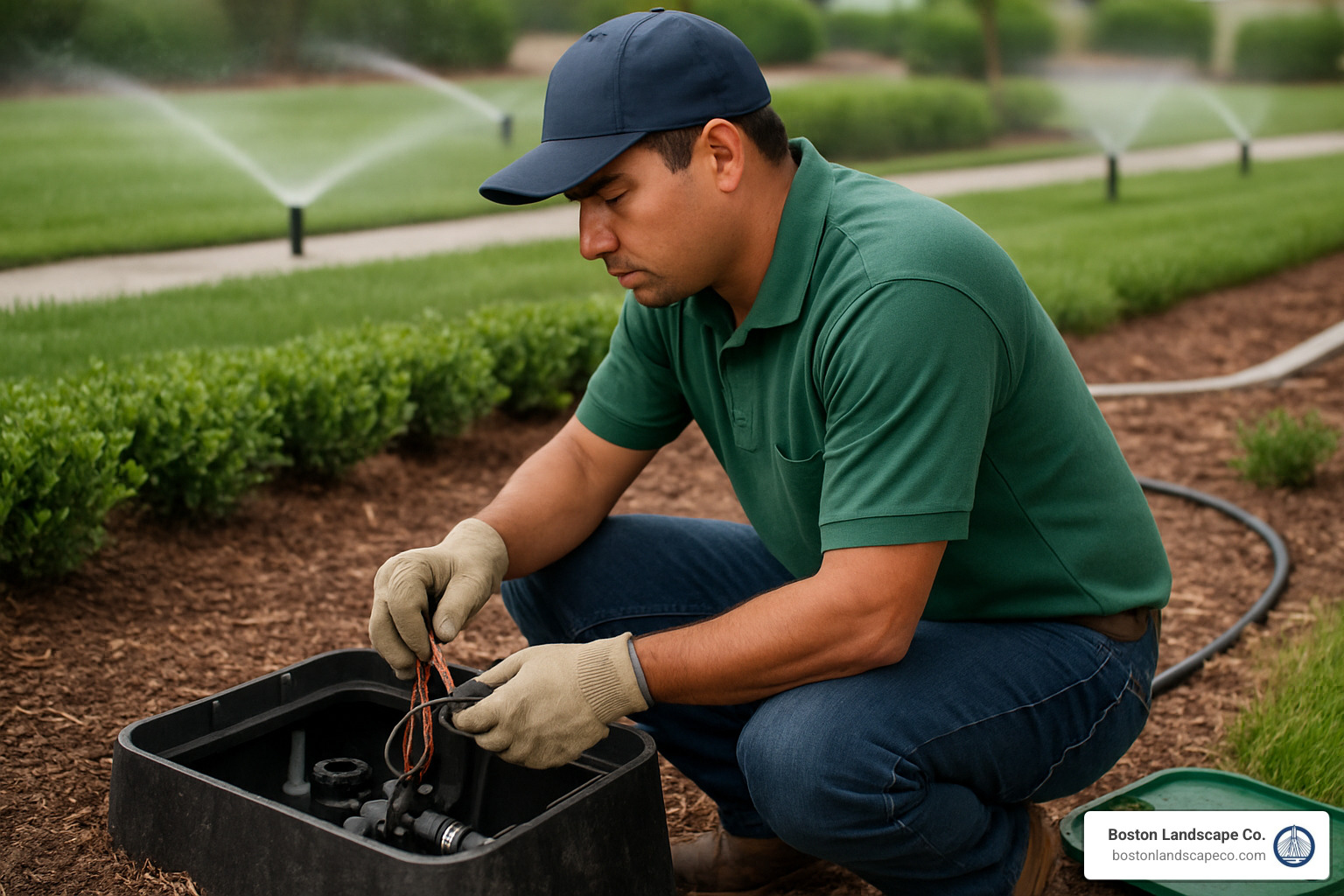
You know that sinking feeling when something doesn’t work quite right after installation? It’s usually traceable to one of these common missteps.
The most frequent mistake I see is improper head mixing—combining different sprinkler types in the same zone. It’s like trying to fill a bathtub and a shot glass with the same water pressure! Rotors and spray heads have completely different precipitation rates, leaving you with soggy spots in some areas and bone-dry patches in others.
Shallow trenching is another culprit that comes back to haunt property owners. When pipes aren’t buried at least 6 inches deep, they’re vulnerable to all sorts of damage. I’ve seen countless systems compromised by routine aeration, frost heave during winter, and even everyday landscape maintenance equipment. That shortcut during installation becomes an expensive repair down the road.
Many installers also rush past the critical system flushing step. All that cutting and gluing of pipes creates debris that must be cleared before attaching sprinkler heads. Skip this step, and you’ll be dealing with clogged nozzles from day one, wondering why your brand-new system isn’t performing properly.
Pressure problems plague many systems too. Each component has specific pressure requirements—too high, and you’ll damage components and create mist that blows away; too low, and you’ll get inadequate coverage. Without proper regulation, you’re essentially setting your system up for failure.
Finally, there’s the matter of overlooking local codes. Massachusetts municipalities have specific requirements for backflow prevention and often require permits for commercial installations. Skipping these steps might save a few dollars upfront, but can result in hefty fines or even having to shut down your system entirely.
Money-Saving Strategies
Smart property owners know that saving on irrigation system installation isn’t just about finding the lowest initial price—it’s about maximizing long-term value.
Consider scheduling your installation during the off-season (fall or early spring). Not only will irrigation companies have more availability, but they’re often willing to offer better pricing during these slower periods. At Boston Landscape Co., we see this pattern year after year.
If budget constraints are a reality (and when aren’t they?), think about zone prioritization. Focus first on high-visibility areas and plants that are particularly vulnerable to drought. Your irrigation system can grow in phases as your budget allows.
Don’t skimp on efficiency upgrades that quickly pay for themselves. Pressure-regulating spray heads reduce wasteful misting. Check valves prevent water from draining out of low-lying heads when the system shuts off. High-efficiency nozzles deliver more uniform coverage with less water. These components might cost a bit more upfront, but the water savings add up quickly.
Many commercial property owners miss out on valuable rebate programs offered by water utilities. These programs can significantly offset the cost of water-efficient components. It’s worth a quick call to your local provider to see what’s available.
Regular preventive maintenance is perhaps the most overlooked money-saver. Small issues caught early prevent expensive emergency repairs later. Annual service contracts typically provide the best value and ensure your system runs efficiently year after year.
For larger commercial properties, exploring water reuse integration can dramatically cut water bills. Systems that capture rainwater or HVAC condensate for irrigation use are becoming increasingly popular and cost-effective.
Cost-Benefit Analysis
When evaluating options for your irrigation system installation, looking beyond the initial price tag reveals the true value of various components.
Smart controllers might seem expensive at $300-$1,500+, but they typically deliver 20-50% water savings and pay for themselves within 1-2 years. Similarly, high-efficiency nozzles at $5-$15 each reduce water use by about 30% with a return on investment in just 1-3 years.
Pressure regulation components ($200-$600) not only reduce system wear but also save 10-15% on water usage, typically paying for themselves in 2-3 years. Drip irrigation for planted areas ($1,000-$3,000) can cut water use by 30-60% in those zones with a 2-4 year payback period. Even simple rain sensors ($150-$500) prevent wasteful watering during or after rainfall, recouping their cost within 1-2 years.
At Boston Landscape Co., we help commercial clients throughout Bedford, Carlisle, Concord, Lexington and beyond make informed decisions that balance immediate budget concerns with long-term benefits. After all, the most expensive irrigation system isn’t necessarily the one with the highest price tag—it’s the one that wastes water and requires constant repairs.
Frequently Asked Questions about Irrigation System Installation
How long does a typical installation take?
When folks ask me about timing for irrigation system installation, I always tell them it depends on a few key factors. For most commercial properties, our professional team completes the job in 1-7 days. A modest quarter-acre property might be finished in just a single day, while larger estates can take up to a week.
The timeline really comes down to your property’s unique characteristics: its size, how complex the system needs to be, what your soil is like, and even what Mother Nature decides to throw our way during installation. At Boston Landscape Co., we’re big believers in clear communication—we provide detailed timelines during the proposal phase and work closely with property managers to minimize any disruption to your daily operations.
What’s the difference between drip and sprinkler systems?
This is one of my favorite questions because the difference is so fundamental to good irrigation design. Think of it this way: sprinkler systems are like rainfall, watering from above, while drip irrigation delivers water directly to the root zone where plants need it most.
Drip irrigation is incredibly efficient (90-95% of water reaches the plants) because it minimizes evaporation and runoff. It’s measured in gallons per hour (GPH) and runs at lower pressure (25-30 PSI). You’ll barely notice it’s there since the lines can be hidden under mulch. It’s perfect for planting beds, shrubs, trees, and container plants.
Sprinkler systems, on the other hand, create that classic overhead spray pattern. They’re moderately efficient (70-80%) and ideal for lawns and large turf areas. They require more pressure (30-65 PSI) and their application rate is measured in inches per hour.
For most commercial properties, we recommend a thoughtful hybrid approach—using sprinklers for turf areas and drip irrigation for planting beds and tree wells. This combination gives you the best of both worlds.
Do I need to winterize in Massachusetts?
Absolutely. I can’t stress this enough for Massachusetts property owners. Our freezing winter temperatures make winterization not just recommended—it’s essential.
Without proper winterization, water trapped in your irrigation system can freeze and expand, causing pipes, valves, backflow preventers, and sprinkler bodies to crack. I’ve seen repair bills from freeze damage easily hit $1,000-$3,000, which is a painful expense that’s completely avoidable.
Professional winterization involves shutting off the water supply, using compressed air to blow all water out of the system, insulating above-ground components, and setting controllers to “rain” or “off” mode for winter. Based on industry averages (not specific to Boston Landscape Co.), commercial properties typically pay $75-$225 for winterization, depending on system size and complexity.
At Boston Landscape Co., we provide comprehensive winterization services throughout the Boston area, including Malden, Reading, Somerville, and Stoneham. It’s one of those services that pays for itself many times over.
How can I tell if my existing system is water-efficient?
Walking your property during an irrigation cycle can reveal a lot about your system’s efficiency. Look for these telltale signs of inefficiency:
If you see dry patches right next to soggy areas, that’s a clear sign of uneven coverage. Water running off onto sidewalks or parking areas suggests your system is applying water faster than the soil can absorb it. Fine mist coming from your sprinklers? That means pressure is too high, and you’re losing water to evaporation before it even hits the ground.
The controller itself can be another clue—basic timers without smart features typically waste 15-30% more water than weather-based models. And perhaps the most obvious sign: if your system runs during or right after rainfall, you’re definitely wasting water.
We offer professional irrigation audits that precisely measure your system’s efficiency and identify specific opportunities for upgrades that will save both water and money in the long run.
What ongoing maintenance will my system require?
Think of your irrigation system like a car—regular maintenance keeps it running smoothly and extends its lifespan. For commercial properties, this means seasonal attention: spring start-up (March-April), a mid-season check (June-July), and winterization (October-November).
Annually, you’ll need backflow testing (which is actually required by law in most municipalities), a system efficiency audit, and controller program updates to match seasonal needs.
Then there’s the as-needed maintenance: replacing or adjusting sprinkler heads that get damaged, repairing occasional leaks, rebuilding or replacing valves, and troubleshooting wiring issues that might arise.
At Boston Landscape Co., we’ve developed comprehensive maintenance programs for commercial properties throughout our service areas. Our goal is to ensure your irrigation system installation continues to perform efficiently year after year, protecting your investment and keeping your landscape looking its best while minimizing water usage.
Conclusion
There’s something truly magical about watching a parched, struggling landscape transform into a vibrant, thriving oasis. That’s the power of a professional irrigation system installation – it’s not just about convenience, but about creating lasting beauty while being environmentally responsible.
Throughout this guide, we’ve walked through everything from system types and design considerations to installation steps and long-term maintenance. What becomes clear is that proper irrigation isn’t a luxury for commercial properties – it’s an essential investment that pays dividends in multiple ways.
The numbers tell a compelling story. With water savings of up to 50%, labor reductions that free up your maintenance staff, and property value increases that attract and retain tenants, a well-designed irrigation system typically pays for itself within 3-5 years. After that, it’s all return on investment.
But perhaps the most valuable benefit isn’t measured in dollars. It’s the peace of mind knowing your landscape is receiving exactly what it needs, even when you’re not there to oversee it. It’s the pride that comes from maintaining a property that stands out for its beauty and sustainability.
At Boston Landscape Co., we’ve spent over three decades perfecting the art and science of irrigation system installation for commercial properties throughout Boston and surrounding communities. Our approach combines technical expertise with a genuine understanding of what makes Massachusetts landscapes thrive:
- We design each system with your specific property in mind – considering soil conditions, plant types, sun exposure, and water availability
- We use only professional-grade components installed with precision and care
- We integrate smart technology that adjusts to weather conditions and maximizes efficiency
- We provide ongoing support to ensure your system continues performing season after season
The journey from dry, lackluster landscaping to a lush, vibrant property doesn’t happen by accident. It’s the result of thoughtful planning, expert installation, and proper maintenance – all things we’re passionate about providing.
Ready to see how a professional irrigation system could transform your commercial property? We’d love to show you the possibilities. Contact Boston Landscape Co. today for a consultation and find what a difference professional irrigation system installation can make for your landscape.
irrigation system installation services
