
Install Irrigation System: Flawless 1-3 Day Setup
Why Your Lawn Deserves a Professional Irrigation System
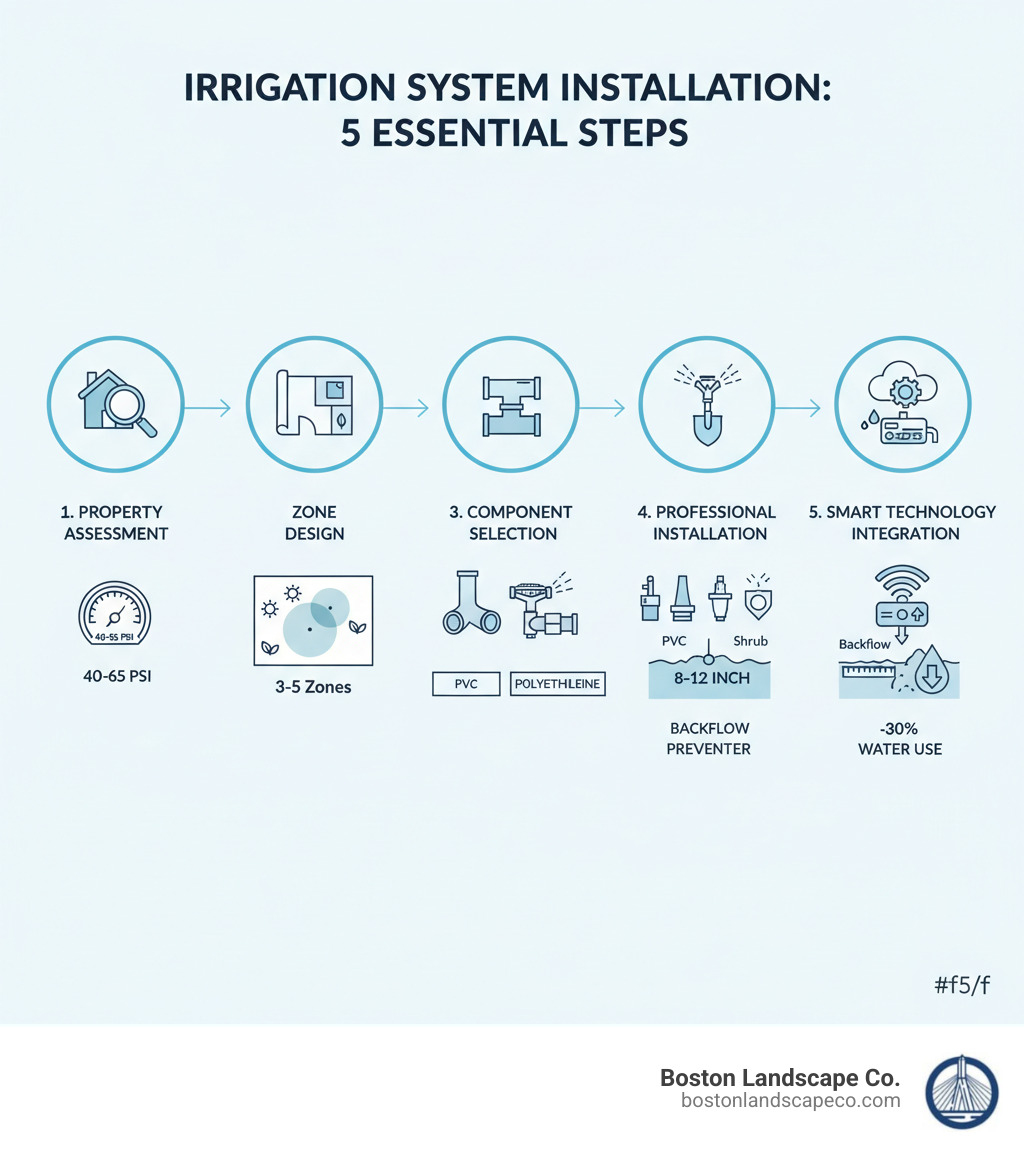
To install irrigation system correctly requires careful planning, the right components, and expert execution. A professional installation includes:
- Property assessment – Mapping zones, measuring water pressure (40-65 PSI required), and testing soil.
- System design – Creating 3-5 zones for a typical quarter-acre property with head-to-head coverage.
- Component installation – Burying pipes 8-12 inches deep and installing backflow preventers.
- Smart technology integration – Adding weather-based controllers that can reduce water use by 30%.
- Testing and adjustment – Ensuring complete coverage and optimal pressure.
Average costs range from $2,500 to $15,000+ depending on property size and complexity (these are national averages, not Boston Landscape Co. pricing).
If you’ve spent summers dragging hoses or watching brown patches appear, you understand the frustration. In the U.S., nearly 9 billion gallons of water are used for residential irrigation daily, and experts estimate that up to 50% is wasted due to inefficient methods. A professional irrigation system solves this by delivering the right amount of water, at the right time, only where it’s needed.
The difference between a system that saves you money and one that creates headaches is expertise. From determining water pressure to selecting pipes suited for Massachusetts’ freeze-thaw cycles, technical details matter. Poor planning leads to dry spots, wasted water, and costly repairs-issues that plague many DIY installations.
A professionally installed system increases property value (homeowners often recover about 83% of the cost upon resale), saves water with smart technology, and eliminates the chore of manual watering. As Steve Schumacher, owner-operator of Boston Landscape Co. since 1991, I’ve seen how a well-designed system transforms a struggling lawn. Our team helps Greater Boston property owners install irrigation system solutions built for New England’s unique climate challenges.
Terms related to install irrigation system:
The Foundation of a Flawless System: Planning and Design
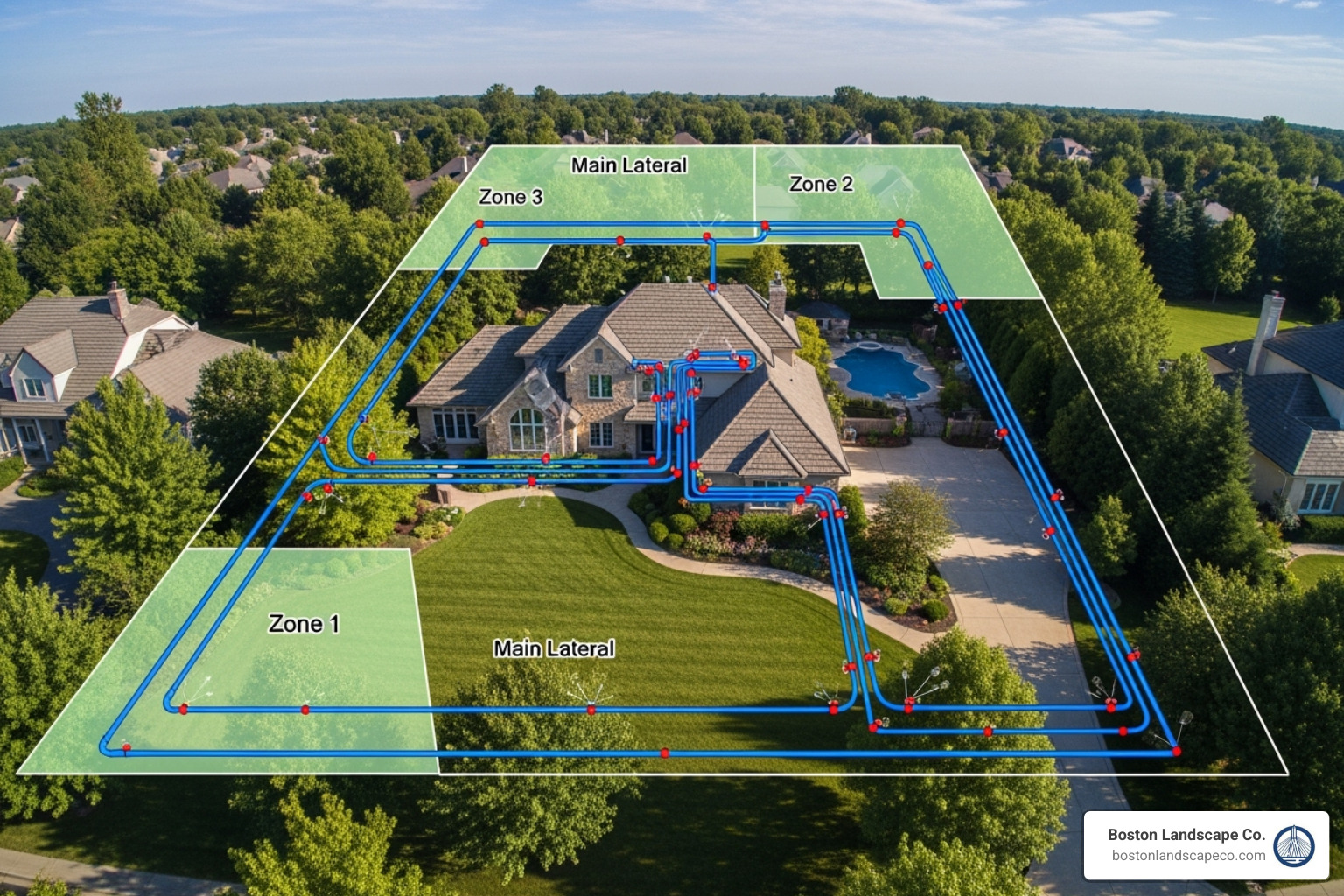
A successful irrigation system begins long before the first trench is dug. Proper planning is the most important factor in ensuring water efficiency and complete lawn coverage. This phase involves a detailed assessment of your property’s unique characteristics, something a professional handles with precision.
Here in Massachusetts, early spring-as the ground thaws-is the ideal time for this crucial planning stage. The bare landscape allows us to accurately map your property and understand its needs. A poorly designed system wastes water and money. Our designers create a detailed property map, accounting for every tree, flowerbed, and patch of grass, while also assessing local watering ordinances. This ensures every component is perfectly placed for optimal performance, potentially saving hundreds of gallons of water daily.
Why Creating Different Watering Zones is Crucial
Different parts of your landscape have different needs. Creating separate watering zones is crucial for an efficient system. Think of zones as distinct neighborhoods in your yard.
- Sun and shade patterns are key. A sunny patch dries out faster than a shaded area under a tree, so they need different watering schedules.
- Soil type matters. Sandy soil drains quickly and needs more frequent, shorter watering cycles, while clay soil holds water longer and requires less frequent, deeper watering.
- Plant-specific water needs vary. Thirsty annuals require more water than drought-tolerant perennials. We ensure each plant type gets precisely what it needs.
For lawns, we plan for head-to-head coverage, where spray from each sprinkler head reaches the next. This industry best practice creates 100% overlap, eliminating the dry spots common in DIY systems. A standard quarter-acre property typically requires 3-5 zones for optimal efficiency and flexibility.
How to Determine Water Pressure and Pipe Sizing
Before selecting sprinkler heads, we must analyze your water supply-a technical step where most DIY projects go wrong.
First, we perform a water pressure test to measure your static water pressure in Pounds Per Square Inch (PSI). An irrigation system needs 40 to 65 PSI to work correctly. If pressure is too low, a booster pump may be needed; if it’s too high, a pressure regulator is installed to prevent damage.
Next, we calculate the flow rate in Gallons Per Minute (GPM). This determines how many sprinkler heads can run at once in a single zone. With PSI and GPM data, we select the correct pipe diameter. Using larger pipes for main lines minimizes friction loss-the natural pressure drop as water moves through the system-ensuring consistent pressure to every sprinkler head.
Getting these foundational calculations right is critical for the system to function correctly. Skipping this step is why many DIY systems fail to perform as expected.
More info about our landscaping design process
Understanding the Core Components and Installation Process
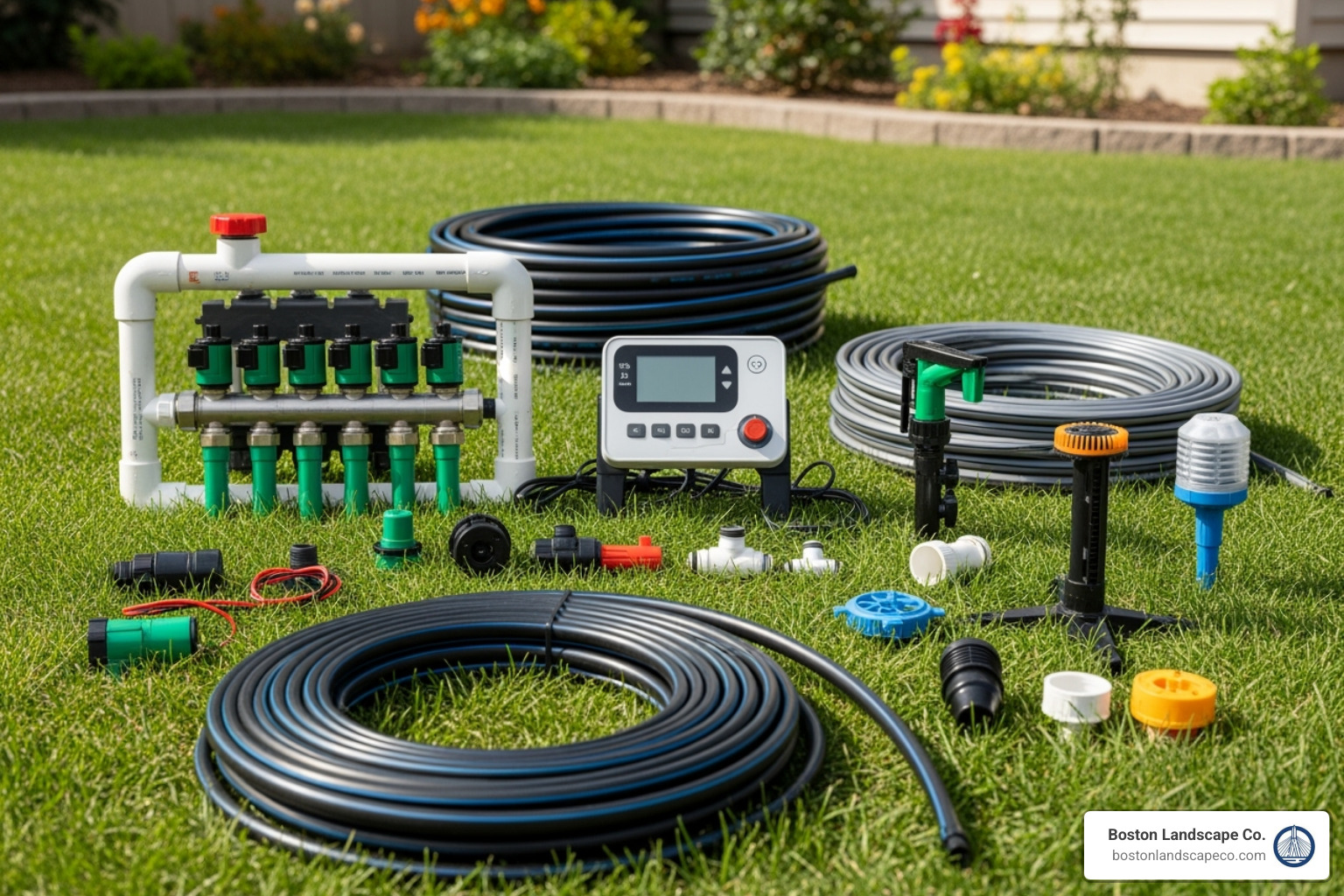
An irrigation system is a network of specialized parts working in harmony. Understanding these components reveals the quality that goes into a professional installation. Key parts include pipes, valves, sprinkler heads, a backflow preventer, and a smart controller that serves as the system’s brain. Every component we select is chosen for durability and efficiency, especially for Massachusetts’ varied climate.
Comparing PVC vs. Polyethylene Pipes
| Feature | PVC (Polyvinyl Chloride) Pipe | Polyethylene (Poly) Pipe |
|---|---|---|
| Rigidity | Rigid, strong, and durable. | Flexible, easier to curve around obstacles. |
| Best Use | Ideal for main water lines due to strength. | Commonly used for lateral lines running to sprinkler heads. |
| Climate | Standard for most climates. | Excellent for cold climates like Massachusetts due to freeze resistance. |
| Connections | Joined with primer and solvent cement. | Joined with mechanical clamps and fittings. |
We primarily use two pipe types: PVC (Polyvinyl Chloride) and Polyethylene (Poly) pipe. PVC’s rigidity makes it the workhorse for main water lines that are constantly under pressure. Poly pipe, however, offers flexibility, which is crucial for navigating around tree roots and rocks. Its greatest advantage in Massachusetts is its freeze resistance. Poly pipe can expand and contract during our harsh winters without bursting, preventing costly springtime repairs.
Our trenches are typically dug 8 to 12 inches deep to protect pipes from damage. Before connecting any sprinklers, we flush the entire system to clear out dirt and debris, preventing clogs and ensuring clean, efficient operation from day one.
The Importance of a Professional Backflow Preventer Installation
One of the most critical safety components is the backflow preventer. Its vital job is to prevent contaminated water from your irrigation system from flowing backward into your home’s drinking water supply. A sudden drop in municipal water pressure could create a siphon effect, pulling lawn chemicals back into your potable water.
Backflow prevention is required by most local building codes throughout Massachusetts as a public health measure. During every install irrigation system project, we integrate a correctly sized backflow preventer. Professional installation ensures compliance with all local regulations. Based on national averages from online data (these are not Boston Landscape Co. prices), backflow preventers typically add $250 to $800 to a project’s cost-a small investment for protecting your family’s health.
We also select the right sprinkler heads for each zone. Rotor heads are for large lawn areas, spray heads cover smaller or irregular spaces, and drip emitters deliver water directly to the roots of individual plants. We ensure head-to-head coverage for lawns and never mix different head types within the same zone, as this causes pressure imbalances and inefficient watering.
The Smart Choice: Water-Efficiency and Modern Technology
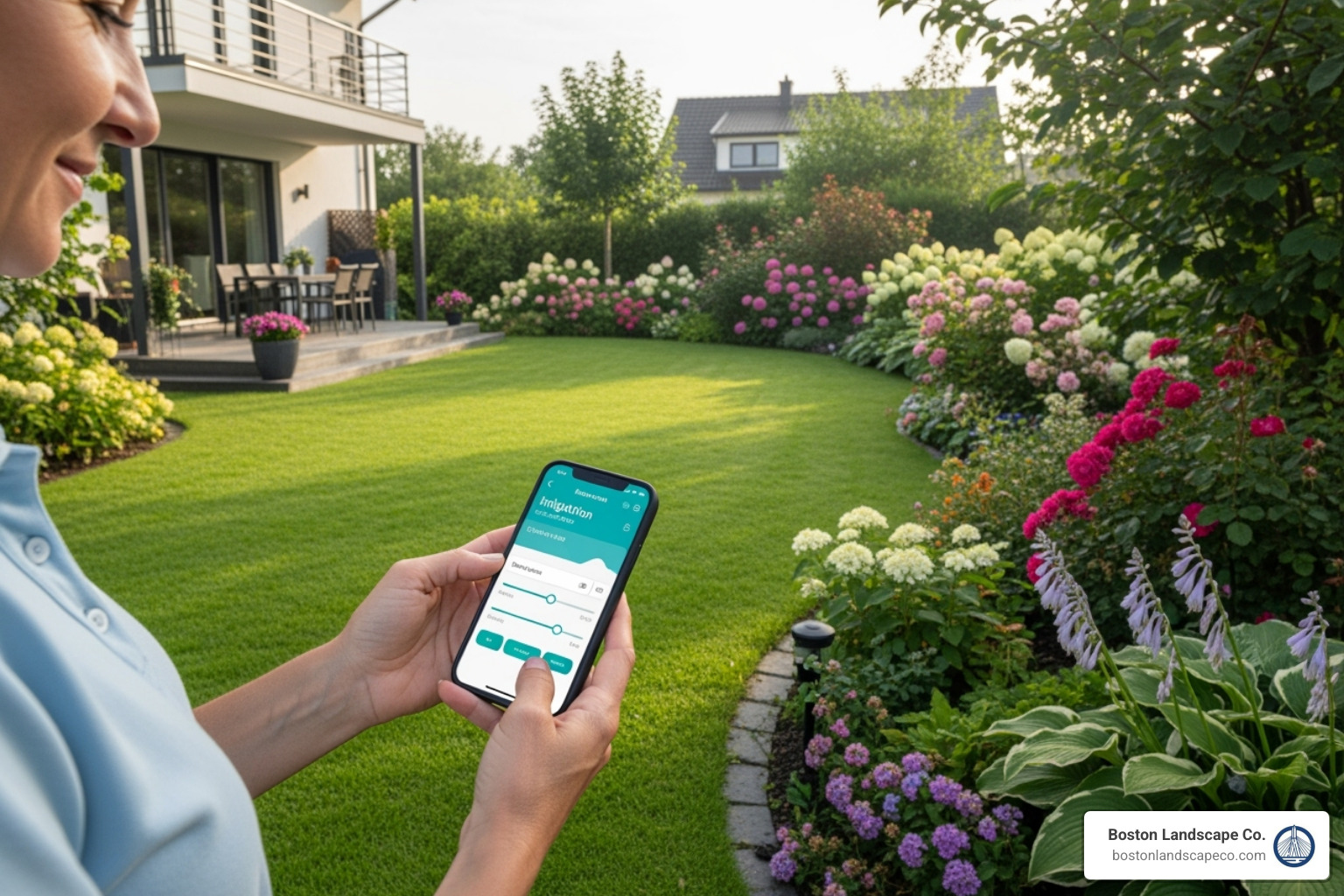
The irrigation systems we install irrigation system today are intelligent networks that think, adapt, and conserve. According to the EPA, as much as 50% of water used for irrigation is wasted. Smart systems are engineered to solve this problem, which is critical during the scorching July and August weeks in Massachusetts. The difference between a standard timer and a smart controller can be hundreds of gallons of water saved per day.
The Benefits of Smart Controllers and Sensors
Forget rushing home to turn off sprinklers in the rain. Smart controllers make irrigation effortless and efficient.
Many feature Wi-Fi connectivity, allowing you to adjust schedules from your smartphone anywhere, anytime. But their real brilliance is automation. These controllers use local weather data-tracking temperature, rainfall, and humidity-to make intelligent watering decisions. They give your lawn exactly what it needs, and no more. EPA’s research on smart controllers shows they can reduce water use by 30% or more, which translates directly into lower bills.
The system gets even smarter with sensors:
- Rain sensors are a simple, effective addition (costing $25 to $75 based on national averages) that automatically shut off your system when it rains.
- Soil moisture sensors ($30 to $350 nationally) are buried in the root zone and measure actual moisture levels, ensuring the system only runs when the soil is truly dry.
- Flow sensors ($100 to $350 based on internet data) monitor water flow, detecting leaks or breaks early and sending an alert to your phone before they cause major damage and waste thousands of gallons.
Homeowners with smart irrigation systems often report water bill savings of $50 to $100 per month during peak summer watering season. While a smart Wi-Fi controller costs more upfront-typically $100 to $300 based on national averages-the long-term savings and convenience make it one of the best investments for your property.
The Investment: DIY vs. Professional to Install Irrigation System
The decision to install irrigation system often comes down to cost. While a DIY approach seems cheaper, a professional installation is an investment in quality, efficiency, and peace of mind. Before you rent a trencher this spring, it’s important to understand the full scope of the project.
Breaking Down the Average Costs to Install Irrigation System
When considering the cost to install irrigation system, factors like property size, complexity, and number of zones impact the price. Please note: The following figures are based on national averages from online data and do not represent a quote from our company.
For a standard residential property, costs can range from $2,500 for a basic system to over $15,000 for a large, complex installation with premium smart technology. For properties an acre or larger, costs can climb beyond $10,000, with per-acre pricing often between $6,000 to $20,000.
Labor typically accounts for about 60% of the total project cost, with professional installers charging between $50 and $150 per hour. Trenching is another significant expense, and in our region, rocky soil-a common feature in Massachusetts-can increase digging costs. Don’t forget permit fees (typically $35 to $200) and the required backflow preventer (adding another $250 to $800 to the project).
The Hidden Costs of DIY and the Value of a Professional Guarantee
While saving on labor with a DIY installation is tempting, the reality can be a frustrating and expensive endeavor. Many homeowners start a project in April and are still troubleshooting leaks in July.
Consider the time commitment-a typical DIY installation can consume 20 to 40 hours of intense physical labor. Without professional expertise, you risk incorrect system design, leading to dry spots, wasted water, and higher bills. Leaks and repairs from improper connections are common, wasting water and damaging your landscape. Furthermore, digging without calling 811 to locate utilities is extremely dangerous and can lead to thousands in repair costs.
Local regulations often require permits and licensed professionals to install irrigation system components like backflow preventers. Non-compliance can result in fines and mandatory rework, erasing any potential savings.
A professional installation from Boston Landscape Co. provides expertise, efficiency, and a warranty on parts and labor. We know how to handle Massachusetts’ rocky soil and specific municipal codes. A professionally installed system also increases your home’s value, with homeowners seeing a strong ROI of typically 83% of their investment upon resale. It’s a smart investment in your property that pays dividends in time saved, water conserved, and value added.
More info about our residential landscaping services
Frequently Asked Questions about Irrigation Installation
We understand you have questions about what it takes to install irrigation system on your property. Here are answers to the most common ones we hear from homeowners across Greater Boston.
How long does a professional installation take?
While a DIY project can consume multiple weekends, a professional crew can typically install irrigation system on a standard residential property in just 1 to 3 days. Our experienced team works efficiently to minimize disruption to your lawn and your life, so you can enjoy your new landscape much sooner.
What maintenance is required after installation?
Proper maintenance is key to your system’s longevity. The two most important services for our climate are spring startup and fall winterization.
- Annual Spring Startup: In early spring, after the threat of frost has passed, we reactivate your system, check for damage, adjust sprinkler heads, and program your controller for the season. Based on national averages, this service typically costs between $75-$250.
- Professional Winterization: This is mandatory in Massachusetts. Before the first hard freeze, we use a powerful air compressor to blow all water out of the pipes, preventing them from freezing and bursting. This “blow-out” service is the best insurance for your investment. Based on internet data, winterization costs between $60-$200 annually.
Overall, annual maintenance keeps your system running smoothly for decades. Typical repairs, if needed, run around $130-$450 based on national averages.
Will an irrigation system increase my water bill?
This is a fair question. While your bill will reflect the water being used, a professionally installed smart system is almost always more efficient than manual watering. If you currently water sporadically, you may see an increase of $50-$100 monthly during peak summer periods.
However, watering with a hose is often inconsistent and wasteful, leading to runoff in some areas and dry patches in others. A professionally designed system delivers water precisely where and when it’s needed, often in the early morning to minimize evaporation. When paired with smart technology, these systems can reduce water usage by up to 30% compared to manual methods. The result is a healthier lawn that uses water far more efficiently, making your bills more manageable and predictable.
Conclusion
Choosing to install irrigation system is an investment in the long-term health and beauty of your property. When the summer heat settles over Massachusetts, you can relax knowing your lawn is getting exactly what it needs, without you lifting a finger.
The process may seem complex, but a professionally installed system transforms a time-consuming chore into an automated task. You’re not just buying sprinklers; you’re buying back your weekends and investing in a landscape that will thrive for years.
At Boston Landscape Co., we’ve been helping homeowners across the Greater Boston area install irrigation system solutions since 1991. We know this region’s rocky soil, freeze-thaw cycles, and the specific needs of New England landscapes. Every system we design is custom-built for your property to ensure maximum efficiency and complete coverage.
When you work with our experienced team, you get peace of mind. We handle the permits, ensure code compliance, integrate smart technology that saves water and money, and back our work with a solid warranty. The result is a flawless installation that increases your property value while reducing your environmental impact.
Ready to achieve the perfect lawn with zero effort? Request a consultation for your irrigation system installation.
