
What You Need to Know About Holly Tree Maintenance
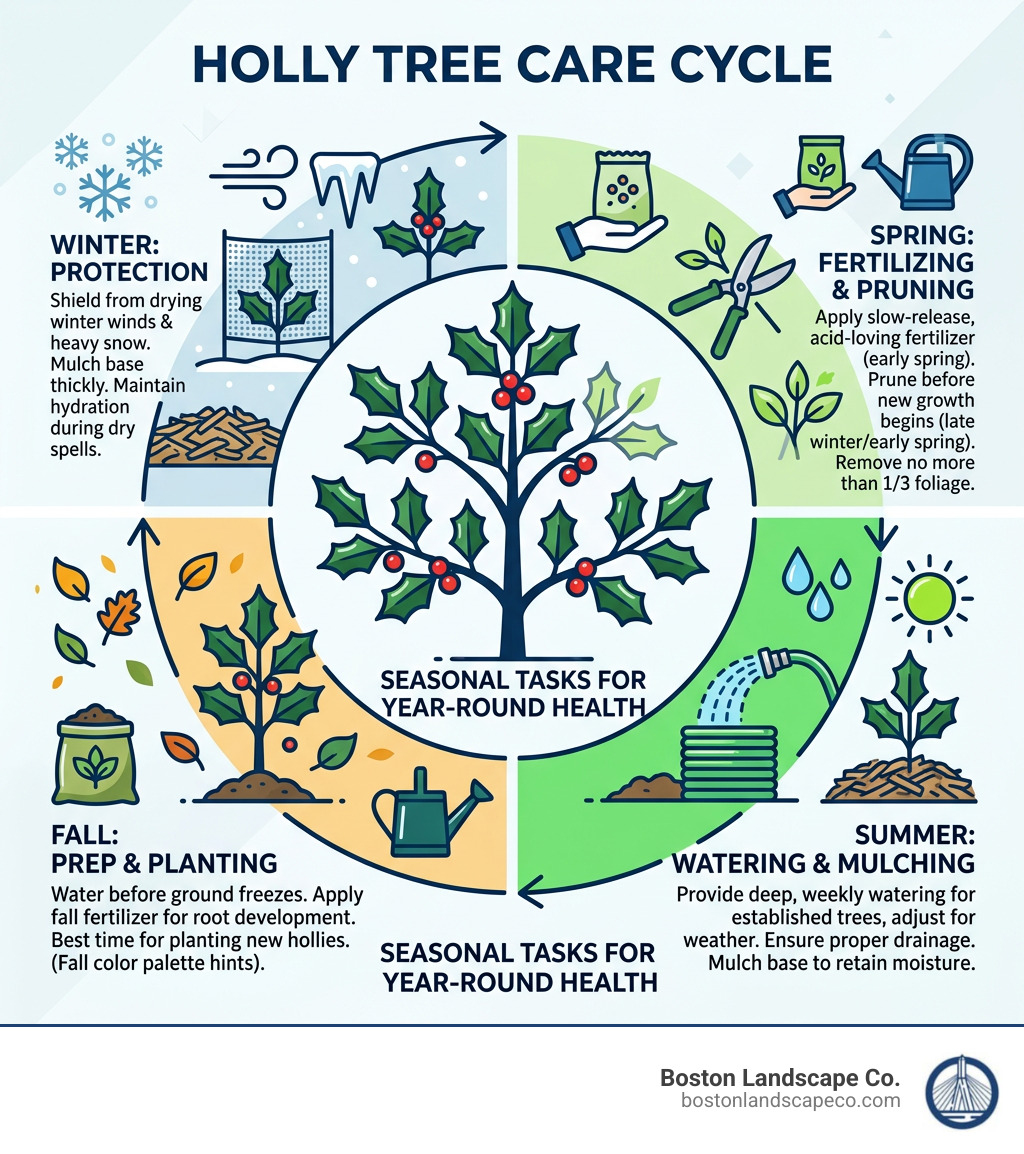
Holly tree maintenance is straightforward when you know the basics. Here’s a quick overview:
- Sunlight: Full sun to partial shade (at least 4-6 hours daily)
- Soil: Slightly acidic, well-drained (pH 4.2-6.4)
- Watering: Deep watering weekly for new trees; adjust for weather and season
- Fertilizing: Slow-release, acid-loving fertilizer in early spring and late fall
- Pruning: Late winter or early spring, removing no more than one-third of foliage
- Berries: Plant one male holly for every 2-3 female plants
- Winter care: Mulch the base, water before ground freezes, shield from drying winds
Holly trees are one of the most rewarding plants you can add to a New England landscape. Their glossy evergreen foliage, bright red berries, and year-round structure make them a standout in any yard — from a small foundation planting in Stoneham to a sweeping estate border on the North Shore.
But like any plant, they have preferences. Get the conditions right, and hollies are remarkably low-maintenance. Get them wrong — waterlogged soil, poor pruning timing, or a missing male pollinator — and you’ll be left with yellow leaves and no berries.
This guide covers everything you need to keep your hollies healthy and looking their best, season after season.
I’m Steve Schumacher, owner of Boston Landscape Co., and with over 30 years of hands-on landscaping experience in the Greater Boston area, holly tree maintenance is something I’ve dealt with on properties of every shape and size. I’ll walk you through exactly what works in our regional climate so you can avoid the most common mistakes.
Understanding Holly Varieties and Characteristics
Before we dive into the nitty-gritty of holly tree maintenance, it helps to know exactly what kind of holly is growing in your yard. The genus Ilex contains over 400 species, ranging from 60-foot towering trees to 12-inch creeping shrubs. In our service areas—from the historic properties of Concord to the suburban yards of Billerica—we see a few specific varieties most often.
One of the most unique things about hollies is that they are “dioecious.” This is a fancy botanical term meaning individual plants are either male or female. If you want those iconic red berries for your winter landscape, you need a female plant and a male plant nearby to handle the heavy lifting of pollination.
| Holly Variety | Leaf Type | Berry Color | Growth Rate | Mature Height |
|---|---|---|---|---|
| American Holly (I. opaca) | Spiny, dull green | Bright Red | 6-12 inches/year | 15-50 feet |
| English Holly (I. aquifolium) | Spiny, glossy | Red (usually) | 6-24 inches/year | 15-40 feet |
| Japanese Holly (I. crenata) | Small, boxwood-like | Black | 6-12 inches/year | 3-10 feet |
| Winterberry (I. verticillata) | Smooth, deciduous | Vibrant Red | 12-24 inches/year | 3-15 feet |
Most garden hollies have a slow to medium growth rate, typically putting on 6 to 24 inches per year. While some species can technically reach 50 feet if left unpruned for a century, most varieties we use in residential landscaping are bred to stay much more manageable. For more details on choosing the right specimen for your space, check out this Holly Tree Care Guide.
Essential Holly Tree Maintenance: Sunlight, Soil, and Planting
Success starts with the right spot. If you plant a holly in a “wet feet” area (soil that stays soggy), it won’t matter how much you fertilize it; the roots will eventually rot.
Ideal Growing Conditions
Hollies are surprisingly hardy, but they have a “sweet spot” for optimal health:
- Sunlight: They love full sun to partial shade. While they can tolerate light shade, you’ll get the best berry production and densest foliage in full sun (at least 6-8 hours).
- Soil Type: Hollies are “acid-loving” plants. They prefer a soil pH between 4.2 and 6.4. If your soil is too alkaline, the tree can’t absorb iron, leading to yellowing leaves.
- Temperature: Consistent soil temperatures between 45°F and 48°F are ideal for root vigor. In our neck of the woods—places like Lexington and Winchester—we have to be mindful of winter winds that can desiccate the foliage.
If you’re planning a new addition to your landscape, we recommend following these steps for planting, which are consistent with professional residential landscaping services:
- Timing: Plant in the spring or early autumn when temperatures are mild.
- The Hole: Dig a hole twice as wide as the root ball but no deeper.
- Preparation: If you have heavy clay soil (common in some parts of the North Shore), rake the sides of the hole to help the roots penetrate the soil more easily.
- Placement: Set the plant so the top of the root ball is level with or slightly higher than the surrounding soil.
- Backfill: Use the native soil, tamping down lightly to remove air pockets.
- Mulch: Apply a 2-3 inch layer of organic mulch around the base, but keep it a few inches away from the trunk to prevent rot and pest issues.
For a deeper dive into the biology of these plants, the Holly Bushes: Planting, Growing, and Pruning Hollies guide is a fantastic resource.
Watering and Fertilizing for Vibrant Growth
Once your holly is in the ground, the first year is the most critical for holly tree maintenance.
Watering Schedule
Hollies are most productive when they receive between 32 and 56 inches of annual precipitation. In Massachusetts, we usually get a decent amount of rain, but supplemental watering is often necessary during our dry summer stretches.
- New Trees: Water deeply once or twice a week (about 1 inch of water) for the first year. Check the soil about 2 inches down; if it feels dry, it’s time to water.
- Established Trees: Once established, hollies are fairly drought-tolerant, but they still benefit from deep watering during heatwaves.
- Winter Prep: This is a “pro tip” for New Englanders: water your hollies deeply in late fall before the ground freezes. Evergreen leaves continue to lose moisture all winter, and if the ground is frozen solid and dry, the tree can’t replenish that moisture, leading to “winter burn.”
Fertilizing Basics
Hollies aren’t heavy feeders, but the right nutrients make a world of difference.
- What to use: Look for a balanced, slow-release fertilizer formulated for acid-loving plants (like a 4-6-4 or 10-10-10 ratio).
- When to apply: The best times are early spring (before new growth starts) and late fall.
- How to apply: Spread the fertilizer evenly around the “drip line”—the area directly under the outer circumference of the branches—where the active roots are located.
For more technical insights on soil nutrient assimilation, Growing and Caring for Holly Plants provides excellent arborist-level data.
Pruning and Shaping for Long-Term Health
Pruning is where many homeowners get nervous, but hollies are actually very forgiving. Whether you have a formal hedge in Bedford or a specimen tree in Carlisle, regular trimming keeps the plant dense and healthy.

Proper pruning improves air circulation and allows sunlight to reach the inner branches, which prevents the “hollow center” look and discourages fungal diseases. If you have a large property with extensive hedging, you might find our estate landscaping services helpful for keeping everything in top shape.
Seasonal Holly Tree Maintenance: Pruning for Shape and Health
- The Best Time: Late winter or very early spring is the “goldilocks” window. The plant is still dormant, but growth is just around the corner. Avoid pruning in late autumn, as this can stimulate new growth that will be killed by the first hard frost.
- The 1/3 Rule: Never remove more than one-third of the foliage in a single year. If a tree is severely overgrown, it’s better to prune it back in stages over two or three years.
- Technique: Always use sharp, clean bypass pruners. Make your cuts just above a leaf node or a bud.
- Shaping: For American Hollies, maintain a strong “central leader” (the main upward trunk). If you want a bushier look, you can cut back the central leader by about a third to encourage lateral growth.
- Japanese Holly Hedges: These can be sheared more formally, similar to boxwoods, to create tight, geometric shapes.
Managing Pests, Diseases, and Winter Protection
While hollies are generally “tough as nails,” they aren’t invincible. In our local climate, we keep an eye out for a few specific troublemakers.
Common Pests and Diseases
- Holly Leaf Miner: If you see yellow or brown “trails” inside the leaves, you likely have leaf miners. The best organic fix? Pick off and destroy affected leaves.
- Scale and Aphids: These tiny insects suck the sap from leaves. You might notice a sticky residue (honeydew) or even black sooty mold. Insecticidal soaps or neem oil usually do the trick.
- Phytophthora Root Rot: This is the result of poor drainage. Symptoms include wilting and dieback. Prevention is the only real cure—make sure your soil drains well!
Winter Protection
New England winters can be brutal. Between the salt on the roads in Woburn and the biting winds in Burlington, your hollies might need a little extra love.
- Windbreaks: For young or sensitive hollies, a burlap screen can protect them from desiccating winter winds.
- Anti-Desiccant Sprays: These “waxy” sprays help seal moisture into the leaves. They are very effective but must be applied when temperatures are above 40°F.
- Salt Awareness: If your hollies are near a sidewalk or driveway, be careful with de-icing salts, which can burn the roots and foliage.
For a comprehensive look at Integrated Pest Management (IPM), Holly Care: A Guide to Growing and Maintaining Holly offers great preventative strategies.
Ensuring Berry Production and Troubleshooting
The most common question we get is: “Why doesn’t my holly have berries?”
The Berry Formula
Dioecious nature we mentioned? To get berries, you generally need:
- A Female Plant: Only females produce fruit.
- A Male Plant: Needed for pollination.
- Proximity: The male should be within 100 feet of the female. One male can typically pollinate up to three females.
Note: There are a few “self-fertile” cultivars available now, like ‘Nellie R. Stevens’, but even these produce more berries if a male is nearby.
Troubleshooting Common Holly Tree Maintenance Issues
- Yellowing Leaves (Chlorosis): This is usually a sign of iron deficiency. Check your soil pH. If the pH is too high, the iron is “locked” in the soil. Adding elemental sulfur or an acidified fertilizer can help.
- Leaf Drop: Some leaf drop is normal in the spring as the tree makes room for new growth. However, massive leaf drop in summer usually points to drought stress.
- No Berries: Beyond the male/female issue, late spring frosts can kill the tiny flowers before they turn into berries. Also, heavy pruning in late spring can accidentally remove the developing fruit.
Frequently Asked Questions about Holly Tree Maintenance
Why are my holly leaves turning yellow?
The most common culprits are high soil pH (alkaline soil), poor drainage leading to root rot, or a simple nitrogen deficiency. A soil test is the best way to determine the exact cause.
Do I need two holly trees to get berries?
In 90% of cases, yes. You need a male and a female of the same or compatible species. If you only have room for one, look for a “self-fertile” variety or a “two-in-one” planting where a male and female are grown in the same pot.
When is the best time to prune my holly bushes?
Late winter or early spring is best. This allows you to enjoy the berries all winter long and gives the plant plenty of time to recover before the summer heat hits.
Conclusion
At Boston Landscape Co., we take pride in helping our neighbors in Stoneham, Billerica, and throughout the North Shore create landscapes that thrive year-round. Holly tree maintenance doesn’t have to be a chore—with the right soil, a bit of mulch, and a partner for pollination, these trees will provide beauty for decades.
If your hollies are looking a bit “prickly” or you’re ready to overhaul your property maintenance routine, we’re here to help. Professional maintenance for a residential property can range anywhere from $150 to $1,500 depending on the size of the trees and the scope of the work. Disclaimer: These prices are based on national averages and internet data; actual costs vary significantly based on property size, tree health, and specific local conditions.
Ready to give your landscape the professional touch it deserves? Request a free estimate for your holly tree care today and let’s keep your North Shore greenery happy and healthy!
