
commercial repair and maintenance work: 7 Proven Expert Tips 2025
The Essential Guide to Commercial Property Upkeep
Commercial repair and maintenance work encompasses all activities required to keep commercial buildings functioning properly and looking their best. For property managers and business owners, understanding these services is crucial for preserving asset value and ensuring tenant satisfaction.
What is commercial repair and maintenance work?
- Definition: Regular upkeep, inspections, repairs, and improvements to commercial buildings and their systems
- Scope: Includes HVAC, plumbing, electrical, landscaping, structural elements, and more
- Purpose: Prevents costly failures, ensures safety, maintains compliance, and preserves property value
- Approach: Can be preventive (scheduled) or reactive (as-needed)
Commercial properties face unique maintenance challenges due to higher traffic volumes, complex building systems, and stricter regulatory requirements. According to industry data, general maintenance and repair workers earn a median annual wage of $48,620, reflecting the skilled nature of this essential work.
Regular maintenance is not just about fixing what’s broken. As one facility manager noted in our research, “Routine maintenance and repairs help reduce costs overall, as large overhauls and repairs for damages are costlier than maintaining existing systems to prevent damage or the need for replacement.”
The difference between proactive and reactive maintenance approaches can significantly impact your bottom line. Proactive maintenance programs typically reduce emergency repairs by 70-80% and extend equipment lifespan by 30-40%, making them the preferred strategy for cost-conscious property managers.
I’m Steve Schumacher, owner-operator of Boston Landscape Co since 1991, and I’ve witnessed how effective commercial repair and maintenance work transforms properties from liability-prone challenges to valuable, efficient assets that tenants love.
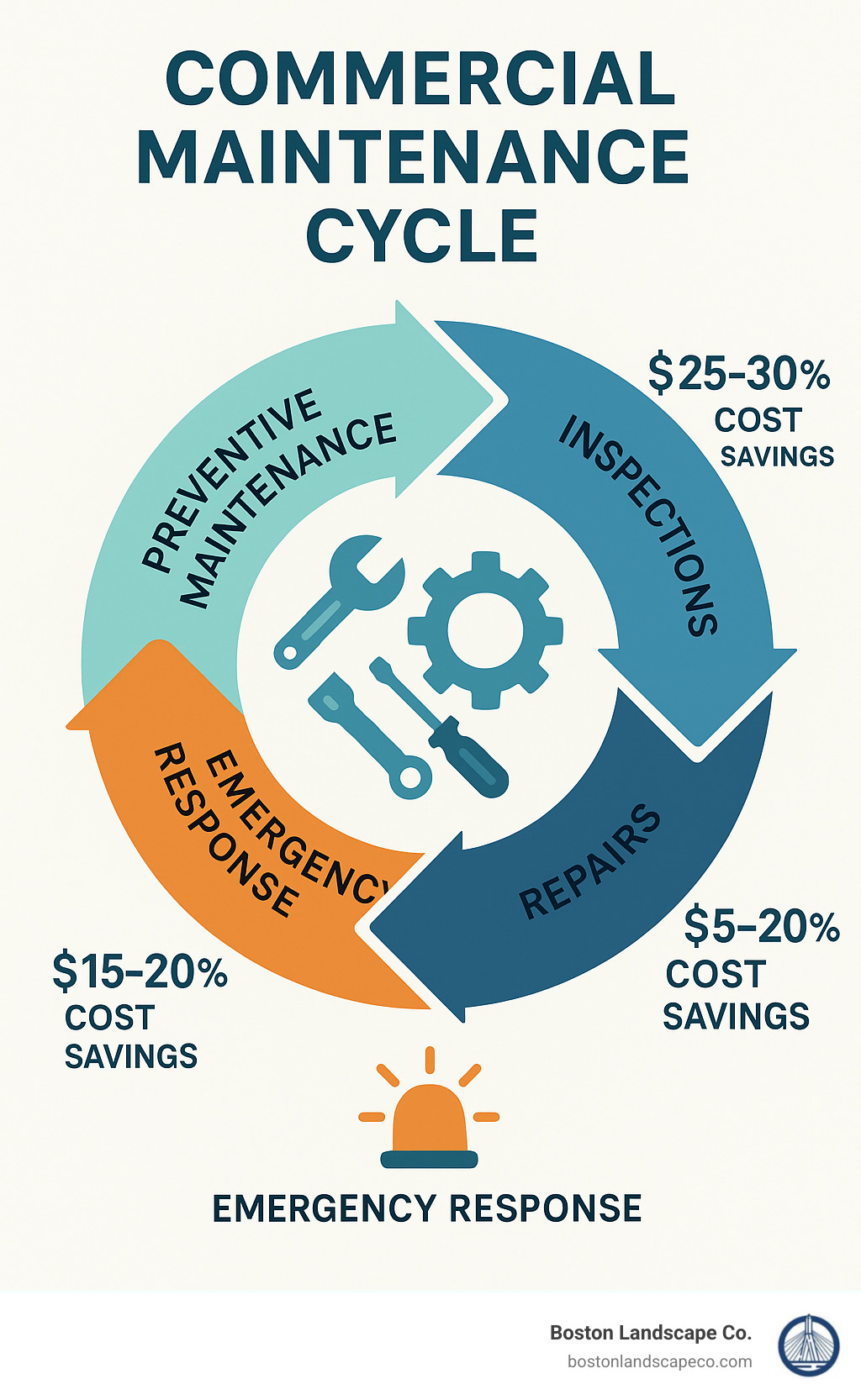
Simple commercial repair and maintenance work glossary:
– building maintenance agency
– building maintenance near me
– building repair
Commercial Repair and Maintenance Work: Definition & Scope
When you walk into a gleaming office building with perfectly functioning elevators, comfortable temperatures, and spotless common areas, you’re experiencing the results of effective commercial repair and maintenance work. This isn’t just about fixing broken light fixtures or unclogging toilets—it’s a comprehensive approach to keeping commercial properties running smoothly day after day.
What is commercial repair and maintenance work?
Commercial repair and maintenance work is the heartbeat of any well-run commercial property. It’s the ongoing care that keeps buildings not just standing, but thriving. This includes everything from those Monday morning inspections to Friday afternoon system tune-ups.
“I like to think of commercial maintenance as preventive medicine for buildings,” says Jane Martinez, a facility director with 15 years in the field. “We’re not just treating symptoms—we’re creating wellness plans that keep the whole building healthy year-round.”
At its core, this work involves regular inspections that catch small issues before they become building-wide headaches. It includes preventive maintenance that extends equipment life, immediate repairs when systems fail, and optimization work that ensures everything runs efficiently. Perhaps most importantly, it includes compliance checks that keep buildings safe and legal.
The scope is truly comprehensive—covering everything from the roof that keeps the rain out to the complex HVAC systems that keep everyone comfortable. It includes electrical systems powering your business, plumbing systems keeping water flowing, safety systems protecting everyone inside, interior finishes making spaces functional and beautiful, exterior grounds creating first impressions, and any specialized equipment your business relies on.
How commercial differs from residential maintenance
The jump from residential to commercial repair and maintenance work is like moving from taking care of a bicycle to maintaining a commercial airliner—the principles might be similar, but the scale and stakes are dramatically different.
Commercial buildings face challenges that homes simply don’t. They endure thousands of footsteps daily, with doors opening and closing hundreds of times. Building systems run longer hours under heavier loads. As one maintenance supervisor told me, “In residential, you might change a furnace filter twice a year. In our office tower, we’re replacing filters monthly and still fighting to keep systems clean.”
Code complexity makes commercial maintenance particularly challenging. While your home renovation might need a simple permit, commercial work must steer complex building codes, ADA accessibility requirements, and stringent safety regulations. This often means maintenance teams need specialized certifications just to perform routine tasks.
The equipment itself is different too. Commercial buildings use industrial-grade systems designed for continuous operation—these require specialized knowledge to maintain properly. And while you can schedule a home repair during normal hours, commercial work often happens nights and weekends to avoid disrupting business operations.
Documentation requirements add another layer of complexity. Commercial properties must maintain detailed maintenance records for insurance purposes, liability protection, and regulatory compliance—creating paperwork demands that homeowners never face.
Why regular maintenance matters for commercial properties
Regular commercial repair and maintenance work isn’t just nice to have—it’s essential for property success. The benefits touch every aspect of property management:
Preventing costly downtime might be the most immediate benefit. When a critical system fails in a commercial building, the costs pile up quickly—not just for repairs, but from business interruption and lost productivity. A well-maintained cooling system keeps running through the hottest summer days, while a neglected one tends to fail precisely when you need it most.
Preserving asset value is where maintenance truly shines. Well-maintained properties simply hold their value better and command higher rents. The math is compelling: for every dollar invested in preventive maintenance, property owners typically see $3-5 returned through asset preservation.
Safety improvement might be the most important benefit. Regular maintenance identifies potential hazards before they cause injuries. With maintenance workers already facing higher-than-average injury rates, proper protocols aren’t just good practice—they’re essential protection.
Legal risk reduction comes naturally with good maintenance. Well-maintained properties face fewer liability claims related to preventable incidents like slip-and-falls or system failures. One property manager noted, “Our insurance premiums dropped 15% after implementing our comprehensive maintenance program.”
Tenant satisfaction improves dramatically with responsive maintenance. When systems work reliably and issues are addressed promptly, tenants notice—and they’re more likely to renew their leases. In competitive markets, maintenance quality can be the difference between full occupancy and costly vacancies.
Energy efficiency provides ongoing financial returns. Regular tuning of building systems typically reduces energy consumption by 5-20%, according to Energy Star data. In large commercial buildings, these savings can amount to thousands of dollars monthly.
At Boston Landscape Co., we’ve witnessed how thoughtful maintenance transforms properties throughout Greater Boston. From office complexes in Billerica to retail centers in Wellesley, our comprehensive building repair services help properties stay in peak condition year-round.
Expert Roundup: Common Services, Duties & Skills
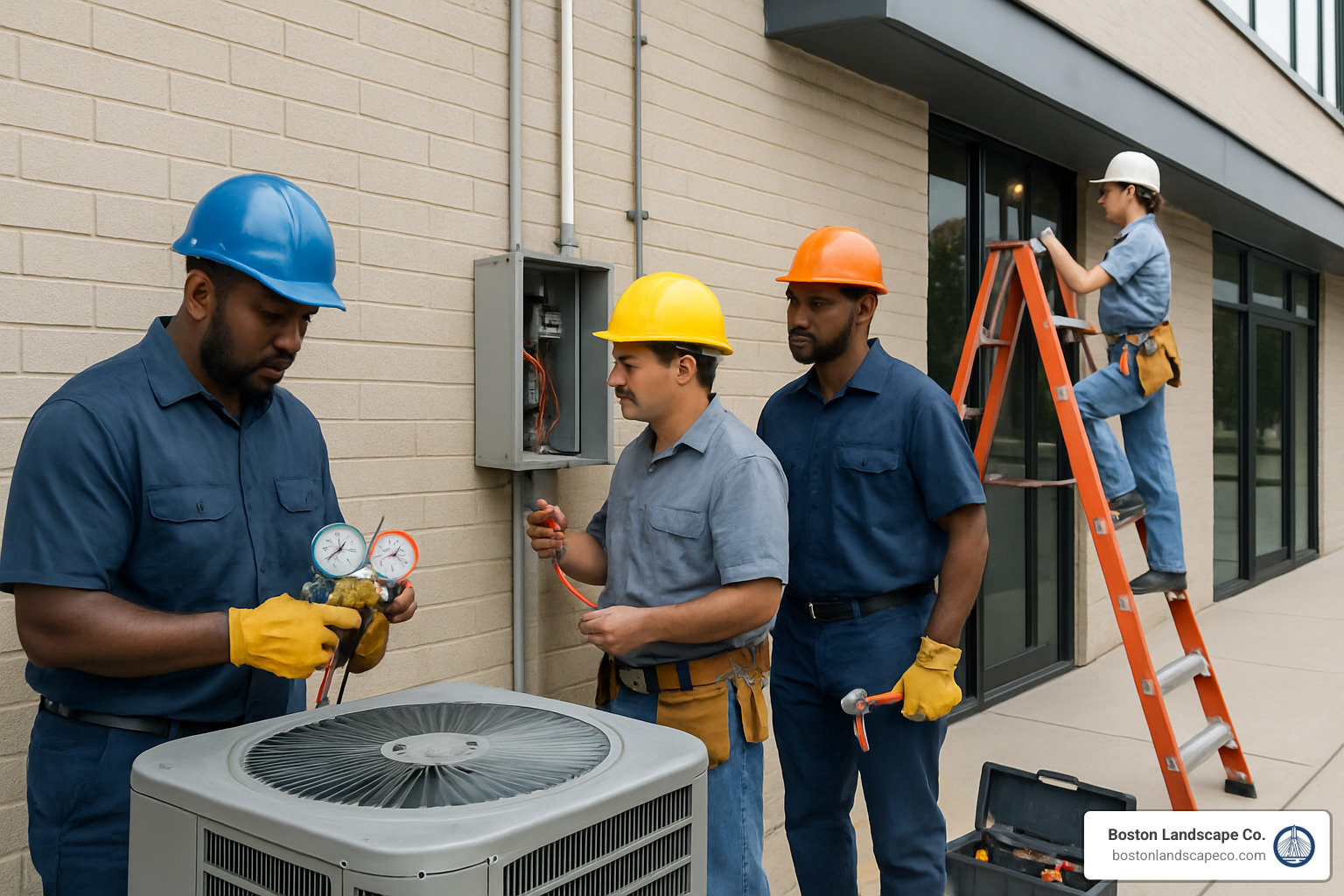
Behind every well-maintained commercial property stands a diverse team of skilled professionals. I’ve had the pleasure of talking with experts across various trades to bring you insights on what makes commercial repair and maintenance work tick in today’s demanding business environment.
HVAC & air quality essentials
When the summer heat waves hit Boston or winter winds howl, your HVAC system becomes the unsung hero of tenant comfort. John Martinez, a veteran HVAC technician who’s seen it all in his 15 years servicing commercial buildings, shared something that stuck with me:
“You know what I find most days when I’m called for an ’emergency’ repair? Dirty filters and neglected coils. The most expensive service call is the one that could have been prevented with basic maintenance.”
Regular HVAC maintenance isn’t just about comfort—it’s about dollars and cents. Quarterly filter replacements (or monthly in dusty environments), annual coil cleaning, and consistent belt checks can prevent those midnight emergency calls that wreck your budget. Since the pandemic, we’ve seen a dramatic shift toward higher-quality filtration, with MERV-13 filters and UV germicidal systems becoming the new normal rather than the exception.
The energy savings alone make HVAC maintenance worth every penny. A well-maintained system typically uses 15-20% less energy than a neglected one, according to Department of Energy data. For a 50,000 square foot commercial building, that could mean thousands of dollars saved annually.
Plumbing and restroom repairs
“A dripping faucet in your home is annoying. The same leak in a commercial restroom is throwing money down the drain,” says Sarah Johnson, a master plumber who specializes in commercial properties.
Commercial plumbing takes a beating few residential systems ever experience. A single running toilet in a busy office building can waste 200 gallons daily—multiply that across multiple fixtures, and you’re looking at serious water bills. Smart commercial repair and maintenance work includes regular leak checks, drain cleaning to prevent embarrassing backups, and water heater maintenance.
The trend toward water conservation has changed commercial plumbing maintenance significantly. Low-flow fixtures and sensor-operated faucets now dominate commercial spaces, and while they save water, they require different maintenance approaches than traditional fixtures.
Beyond the pipes, commercial restroom maintenance extends to partition hardware, door closers, and accessibility features. ADA compliance isn’t optional—it’s essential both legally and for creating inclusive spaces for everyone who uses your building.
Electrical & lighting maintenance
Michael Chen, a licensed commercial electrician with a focus on energy efficiency, puts it bluntly: “Electrical maintenance isn’t just about keeping the lights on—it’s about safety, efficiency, and reliability.”
The backbone of good electrical maintenance includes annual infrared scanning of electrical panels (to catch hotspots before they become fire hazards), regular testing of emergency lighting, and thorough checks of electrical connections. One of the most visible aspects—lighting—has been revolutionized by LED technology.
Commercial repair and maintenance work in the electrical field has shifted dramatically toward LED retrofits, which typically reduce energy consumption by 40-60% while extending maintenance intervals. Modern LED fixtures can last 50,000+ hours compared to just 10,000 for fluorescents, meaning fewer disruptions for bulb changes and less waste headed to landfills.
For business owners watching their carbon footprint and their bottom line, lighting upgrades offer one of the fastest returns on investment, often paying for themselves within 2-3 years through energy savings alone.
Exterior & grounds care
First impressions happen before anyone steps through your door. At Boston Landscape Co., we understand that exterior maintenance creates that crucial first impression of any commercial property.
Proper grounds maintenance goes far beyond mowing and plowing. It includes thoughtful landscape design and upkeep, irrigation system adjustments, parking lot maintenance, and building envelope inspections. Our teams are trained to spot potential building issues while performing their regular landscape duties—like noticing a developing drainage problem before it damages your foundation.
Winter brings special challenges in New England. As one of our long-time property manager clients told me, “A single slip-and-fall lawsuit can cost more than an entire season of snow management.” Professional service isn’t just about convenience—it’s risk management at its most basic level.
Our Commercial Landscape Maintenance services are designed holistically, keeping your property looking its best while protecting your investment and ensuring safety for everyone who visits.
Interior finishes & carpentry
The interior condition of your commercial space directly impacts both tenant satisfaction and property value. Carlos Mendez, a commercial carpenter who specializes in tenant improvements, explains the unique challenges of commercial spaces:
“Office buildings, retail spaces, and healthcare facilities take a beating most homes never experience. Regular maintenance of interior elements isn’t just about aesthetics—it prevents more costly repairs and maintains your professional image.”
Commercial repair and maintenance work for interiors includes timely drywall repairs, regular door hardware maintenance, ceiling tile replacement, and floor care custom to your specific surfaces. Commercial spaces need more durable materials than residential properties—what works in a home often fails quickly in a busy commercial environment.
Some industries face specialized requirements. Healthcare facilities need materials that support infection control protocols, while restaurants must meet health department standards. A good maintenance partner understands these specialized needs and adapts accordingly.
Technology & CMMS skills every pro needs
Today’s maintenance professionals need to be as comfortable with apps as they are with wrenches. Computerized Maintenance Management Systems (CMMS) have transformed how commercial repair and maintenance work is planned and tracked.
“The days of maintenance schedules on clipboards are long gone,” says David Wilson, a facility management technology consultant. “Today’s systems use real-time data to predict failures before they happen, saving thousands in emergency repairs and downtime.”
Modern maintenance professionals need skills that weren’t part of the job description a decade ago: CMMS usage for tracking work orders, mobile app proficiency for field documentation, basic data analysis to spot maintenance trends, and familiarity with building automation systems that control everything from lighting to security.
IoT sensors are increasingly common in commercial buildings, monitoring everything from water leaks to equipment vibration patterns. This technology enables truly predictive maintenance based on actual conditions rather than arbitrary schedules.
At Boston Landscape Co., we’ve acceptd these technological advances to improve our Property Maintenance Services, using digital tools to ensure nothing falls through the cracks and communication remains seamless with our clients.
The best maintenance professionals today combine traditional hands-on skills with technological savvy, creating a powerful combination that keeps commercial properties running smoothly while controlling costs. Whether you need comprehensive maintenance or specialized services, finding partners who understand the full scope of commercial repair and maintenance work is essential to protecting your property investment.
Proactive vs Reactive Maintenance: Strategies, Costs & ROI
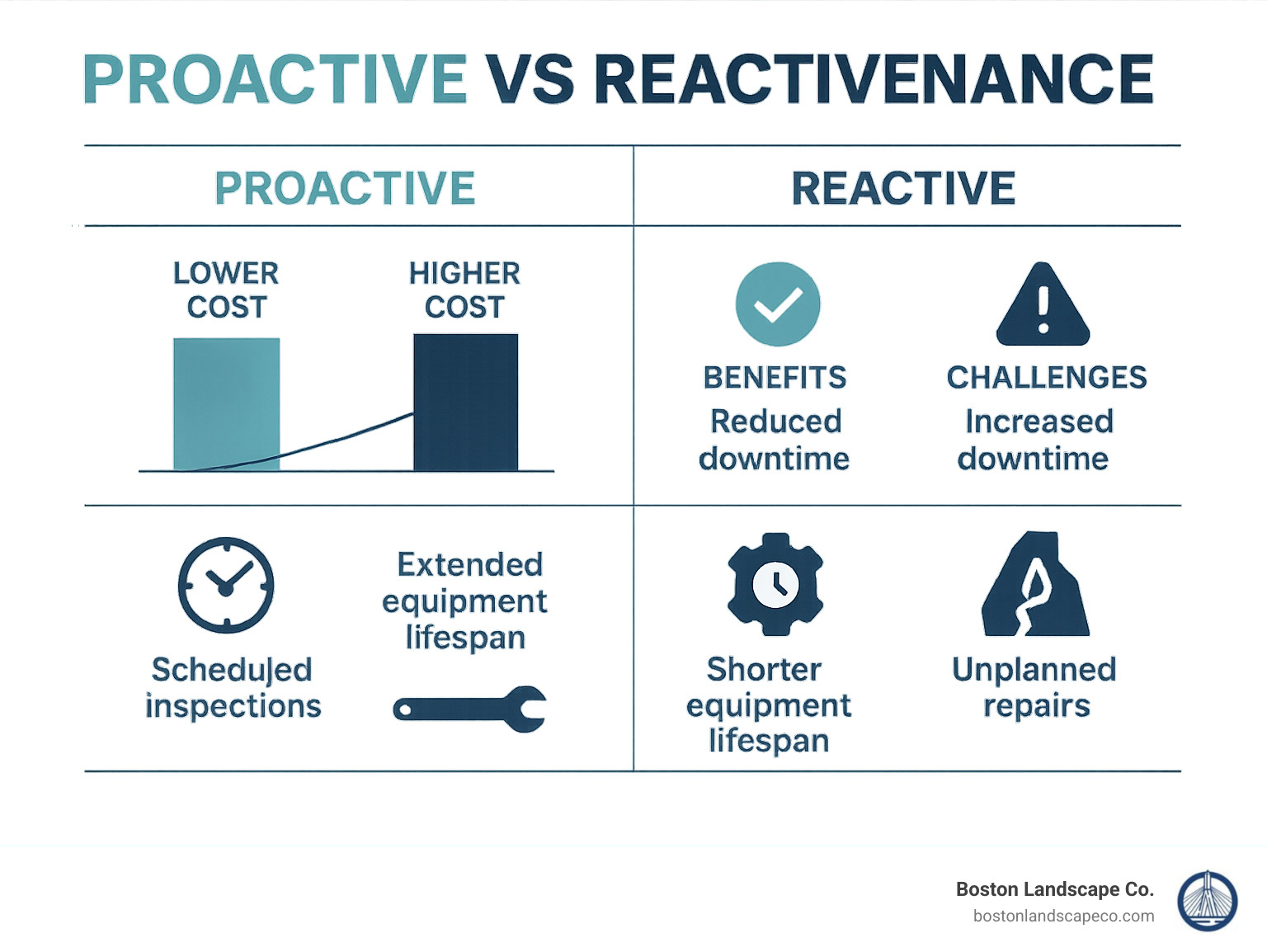
When it comes to commercial repair and maintenance work, one of the most important strategic decisions is choosing between proactive and reactive approaches. This choice dramatically impacts your budget, property condition, and long-term costs – often in ways that aren’t immediately obvious.
Benefits of proactive commercial repair and maintenance work
Think of proactive maintenance as preventive healthcare for your building. Just as regular check-ups help catch health issues before they become serious, scheduled maintenance prevents small problems from becoming expensive disasters.
“I’ve managed properties both ways, and the difference is night and day,” shares James Peterson, a commercial property manager with 25 years of experience. “Buildings with proactive maintenance programs not only cost less to operate long-term but also maintain their value better and generate fewer tenant complaints.”
The numbers back up James’s experience. Buildings that implement comprehensive preventive maintenance see 70-80% fewer emergency repairs. That HVAC system that might last 7-10 years with minimal care? With proper maintenance, it could serve your building reliably for 20+ years – effectively doubling its useful life.
Your energy bills will thank you too. Well-maintained equipment simply runs more efficiently, reducing energy consumption by 5-20%. For large commercial properties, these savings add up quickly.
Perhaps the most underrated benefit is budget predictability. When maintenance is planned and scheduled, costs become predictable and can be properly budgeted. No more sudden financial surprises that throw your quarterly numbers into chaos.
Your tenants will notice the difference as well. Fewer system failures mean fewer disruptions to their operations, creating a more comfortable, reliable environment. This translates directly to higher tenant satisfaction and better retention rates – a win-win for everyone involved.
Safety improvements shouldn’t be overlooked either. Regular inspections catch potential hazards before they cause injuries or violations, reducing your liability exposure and ensuring regulatory compliance.
When reactive fixes make sense
Despite the clear advantages of being proactive, sometimes a reactive approach makes practical sense. Not every situation calls for preventive maintenance.
For equipment already nearing the end of its useful life and scheduled for replacement, extensive preventive maintenance might not be the best use of your budget. Similarly, for non-critical systems where failure wouldn’t significantly impact operations or safety, a run-to-failure approach could be economically justifiable.
Budget constraints sometimes force tough decisions too. Organizations facing severe short-term financial limitations might temporarily defer some preventive maintenance, though this strategy often leads to higher costs down the road.
Some building components also have unpredictable failure patterns that don’t respond well to preventive approaches, making reactive maintenance the more practical choice.
However, maintenance technician Frank Rodriguez offers this word of caution: “Even when you’re planning to replace equipment soon, basic maintenance is still important. I’ve seen businesses try to squeeze an extra year out of an old system without maintenance, only to have it fail during a critical period, costing far more in emergency repairs and business disruption than the maintenance would have.”
Average price ranges & budgeting tips*
Understanding typical costs helps with budgeting and evaluating service proposals. Here’s what you might expect to pay for common commercial repair and maintenance work:
Labor rates vary widely based on specialization. General maintenance technicians typically charge $35-$150 per hour, while specialized professionals (HVAC, electrical, plumbing) command $75-$225 hourly. When emergencies strike after hours, those rates jump significantly to $110-$340 per hour.
Service contracts offer more predictable pricing. Basic preventive maintenance might cost $0.50-$2.00 per square foot annually, while comprehensive maintenance (including repairs) ranges from $1.50-$6.00 per square foot. Specialized systems like data centers demand even more attention, with annual costs between $3.00-$12.00 per square foot.
When individual repairs are needed, costs can vary tremendously. Commercial HVAC repairs typically run $400-$3,000, plumbing repairs $150-$1,800, electrical repairs $200-$2,400, and roof repairs $300-$3,600. Emergency service calls start around $250 and can easily reach $900.
*These are internet-based averages and not Boston Landscape Co. rates. Actual costs vary based on building size, system complexity, location, and other factors.
Facility maintenance expert Lisa Chen offers this practical budgeting advice: “As a rule of thumb, commercial buildings should budget 2-4% of their replacement value annually for maintenance. For a $10 million building, that’s $200,000-$400,000 per year. Buildings that consistently underspend this amount typically face larger capital expenditures down the road.”
At Boston Landscape Co., we help clients develop comprehensive maintenance strategies that balance short-term budget constraints with long-term property preservation goals. Our approach ensures you get the most value from your maintenance investment while avoiding the costly pitfalls of deferred maintenance.
Safety, Compliance, Sustainability & Tech Trends
The world of commercial repair and maintenance work extends far beyond fixing what’s broken. Today’s maintenance professionals steer a complex landscape of safety regulations, sustainability initiatives, and emerging technologies—all while keeping buildings running smoothly.
Legal requirements & documentation
“If you think paperwork is the boring part of maintenance, try explaining to an inspector why you don’t have records,” jokes Robert Thompson, a safety compliance consultant with 20 years in the field.
The truth is, proper documentation isn’t just bureaucratic busywork—it’s your protection and proof of responsible management. Commercial repair and maintenance work must comply with a web of regulations that grows more complex each year.
Building codes establish minimum standards for everything from structural elements to electrical systems, but they’re just the starting point. OSHA requirements impact how maintenance teams perform their work, setting standards for ladder safety, electrical practices, and hazard communication. One maintenance director told us, “We keep OSHA guidelines posted in our workshop and review them in monthly safety meetings—it’s saved us from countless potential incidents.”
Fire safety regulations demand regular testing of alarms, sprinklers, and emergency lighting. The ADA requires ongoing attention to accessibility features like door clearances and restroom fixtures. Environmental rules govern everything from refrigerant handling to wastewater disposal.
“The documentation burden can feel overwhelming,” Thompson acknowledges, “but with digital tools, it’s become more manageable.” Smart maintenance teams maintain detailed records of all inspections, repairs, permits, certifications, and training. These records aren’t just for compliance—they provide valuable insights for planning future maintenance activities.
For comprehensive guidance on maintenance-related OSHA regulations, visit thorough guidelines that break down requirements by building system and maintenance activity.
Building codes vary by location, but resources like up to code provide searchable databases of current requirements. The investment in understanding these regulations pays dividends in reduced liability and smoother operations.
Sustainability & energy efficiency in maintenance
Sustainability has transformed from a nice-to-have feature to a core business strategy in property management. Today’s tenants and clients increasingly expect green practices, and smart maintenance teams are delivering both environmental and financial benefits.
“The myth that sustainability costs more is finally being dispelled,” says Maria Sanchez, an environmental consultant who works with commercial properties. “In maintenance, green approaches often reduce costs while improving building performance.”
Energy-efficient equipment choices deliver ongoing savings with every utility bill. A building that upgrades to variable frequency drives on HVAC motors might see energy use drop by 30-50%. Smart maintenance teams track these savings to demonstrate ROI and justify future improvements.
Water conservation has become another focus area in commercial repair and maintenance work. Beyond installing low-flow fixtures, maintenance teams are implementing leak detection programs and smart irrigation controls. “A single leaking toilet can waste 200 gallons daily,” Sanchez notes. “Finding and fixing leaks quickly is one of the simplest ways to reduce both water bills and potential water damage.”
Green cleaning practices improve indoor air quality while reducing chemical exposure for occupants and staff. Many maintenance teams have found that environmentally friendly products work just as effectively as their traditional counterparts while creating healthier indoor environments.
Waste reduction initiatives include recycling programs for maintenance materials, reusing components when possible, and proper disposal of hazardous items. Some forward-thinking properties are even implementing circular economy principles, where one building’s waste becomes another’s resource.
For buildings pursuing or maintaining LEED certification, maintenance practices play a crucial role. Regular recommissioning of building systems ensures they continue to perform at designed efficiency levels—a process that typically reduces energy consumption by 10-15%.
Emerging technologies driving the future
Technology is revolutionizing commercial repair and maintenance work, enabling approaches that were science fiction just a decade ago. “Smart buildings aren’t just about fancy lobbies and touchscreens,” says technology integration specialist David Chen. “The real change is happening behind the scenes in how we maintain these increasingly complex structures.”
IoT sensors now monitor everything from temperature and humidity to equipment vibration and energy use. These tiny devices provide continuous streams of real-time data, alerting maintenance teams to potential issues before they cause failures. One property manager shared how vibration sensors on an air handler motor detected unusual patterns two weeks before it would have failed, allowing for a scheduled replacement during off-hours instead of an emergency repair.
Predictive analytics represents perhaps the most significant shift in maintenance thinking. AI algorithms analyze sensor data to forecast when equipment is likely to fail, allowing truly condition-based maintenance rather than arbitrary schedules. “We’re moving from changing filters every three months because the calendar says so, to changing them when airflow data indicates they’re actually restricting performance,” Chen explains.
Augmented reality tools are changing how technicians approach complex repairs. With AR headsets, maintenance staff can access repair manuals, view cutaway diagrams of equipment, or receive real-time guidance from remote experts. This technology is particularly valuable for specialized systems where in-house expertise might be limited.
Drones and robots are improving safety by inspecting hard-to-reach areas like roofs, tall facades, or confined spaces. These unmanned systems capture detailed images and data without putting human inspectors at risk. One shopping center reported saving over $5,000 annually just by using drones for quarterly roof inspections instead of hiring lift equipment.
Digital twins—virtual replicas of buildings and their systems—enable better planning and optimization. Maintenance teams can test different scenarios, predict the impact of changes, and visualize complex systems in ways physical inspection can’t match.
Mobile CMMS applications have transformed workflow management, allowing maintenance staff to receive work orders, access equipment history, and document repairs from anywhere in the building. This mobility improves response times and ensures more accurate record-keeping.
At Boston Landscape Co., we stay current with these technological trends to integrate our exterior maintenance services seamlessly with your overall building management systems. Whether you’re implementing a new CMMS or exploring IoT sensors for irrigation systems, we can adapt our services to complement your technology strategy.
Choosing Providers, Scheduling & Emergency Response
Finding the right partner for commercial repair and maintenance work is like choosing a doctor for your building. Make the right choice, and your property stays healthy and valuable. Choose poorly, and you might face costly headaches and unhappy tenants.
How to pick the right commercial repair and maintenance work partner
Patricia Morgan has managed commercial properties for over 25 years, and she’s seen it all when it comes to maintenance providers.
“Don’t choose maintenance providers based solely on price,” she warns with a knowing smile. “The cheapest bid often becomes the most expensive option when you factor in poor quality work, callbacks, and premature system failures. Look for experience, proper licensing, strong references, and a systematic approach to maintenance.”
When evaluating who should care for your commercial property, think beyond the bottom line. Proper licensing and insurance should be non-negotiable – verify that any provider carries adequate general liability and workers’ compensation coverage. You’ll sleep better knowing you’re protected.
Look for companies with specific experience in your property type. The needs of a medical facility differ dramatically from those of a retail center or office building. A provider who understands your specific challenges will deliver more value.
Consider whether you want a jack-of-all-trades or specialists for each system. Multi-trade providers can offer convenience and better coordination, eliminating the “not my department” problem that happens when multiple companies are involved.
“Always check references thoroughly,” Morgan emphasizes. “Ask other property managers about reliability, quality of work, communication, and how the provider handles unexpected issues. A provider’s response to problems often tells you more than their performance when everything goes smoothly.”
At Boston Landscape Co., we’ve built our reputation on being responsive and reliable across Greater Boston. From Billerica to Wellesley, our clients know we understand New England’s unique maintenance challenges – from winter storm preparation to summer irrigation needs.
Best practices for scheduling & task management
Facility manager Michael Rodriguez takes a systematic approach to maintenance scheduling that balances prevention with practicality.
“The key to successful maintenance scheduling is having a system, not just a calendar,” he explains. “We use a combination of manufacturer recommendations, historical data, and seasonal considerations to develop our maintenance calendar, then adjust based on building usage patterns and tenant needs.”
Smart scheduling starts with seasonal planning. Schedule roof inspections in spring and fall when weather conditions allow for thorough assessment. Complete HVAC maintenance before heating and cooling seasons hit their peak. Plan exterior work during favorable weather windows to ensure quality results.
Being considerate of your tenants pays dividends in satisfaction and retention. Coordinate with tenants to schedule disruptive maintenance during off-hours when possible, and always provide advance notice for work that might affect their operations. Your tenants will appreciate being kept in the loop.
Efficiency comes from thoughtful planning. Bundle related tasks to minimize disruption and improve productivity. When you’ve already got the lift equipment out for lighting maintenance, it makes sense to replace ceiling tiles and handle high dusting at the same time.
“We conduct thorough property walks monthly, focusing on different systems each time,” Rodriguez shares. “These proactive inspections catch small issues before they become major problems and help us refine our maintenance schedules based on actual building conditions.”
Don’t forget to track compliance requirements. Code-required inspections for fire systems, elevators, and backflow preventers must follow regulatory timelines – missing these can result in fines or increased liability.
Handling emergencies & minimizing downtime
Even with perfect maintenance, emergencies happen. A burst pipe doesn’t check your calendar before flooding your lobby at 2 AM on a Sunday.
Emergency response expert James Wilson puts it plainly: “The time to plan for emergencies is before they happen. Every commercial property should have clear protocols for different types of emergencies—water leaks, power outages, HVAC failures, security breaches—with defined responsibilities and communication channels.”
Creating an effective emergency response system starts with 24/7 availability. Establish clear procedures for after-hours emergencies, including on-call schedules and escalation protocols. When a tenant calls about water pouring through their ceiling, they need help immediately, not Monday morning.
Smart property managers maintain a critical parts inventory for emergency repairs. Having basic supplies on hand – from common plumbing parts to circuit breakers – can mean the difference between a minor inconvenience and a major shutdown.
Vendor agreements with guaranteed response times for emergencies provide peace of mind. When you’re facing a crisis, the last thing you want is to be calling around for someone – anyone – who can help right away.
“Regular emergency drills and tabletop exercises help identify gaps in your response plans before real emergencies occur,” Wilson advises. “Include both maintenance staff and tenant representatives in these exercises to ensure everyone understands their roles.”
At Boston Landscape Co., we take emergency response seriously, especially when it comes to weather events. Our 24/7 snow and ice management services keep properties safe and accessible during winter storms, and we respond quickly to storm damage throughout the year. When Mother Nature throws her worst at New England, our clients know we’ve got their backs.
Finding a maintenance partner who combines everyday excellence with emergency readiness is invaluable. Visit our Property Maintenance Companies page to learn more about our comprehensive approach to commercial property care.
Frequently Asked Questions about Commercial Repair and Maintenance Work
What qualifications should a commercial maintenance technician have?
Finding qualified maintenance professionals can feel like searching for unicorns – they need to be part technical expert, part detective, and part customer service representative.
The best commercial maintenance technicians bring a well-rounded mix of formal training and real-world experience to the table. At minimum, they should have relevant technical certifications in their specialty area, whether that’s HVAC (look for EPA refrigerant handling or NATE certification), electrical (journeyman or master electrician licenses), or plumbing credentials.
“The best maintenance technicians combine technical knowledge with detective skills,” explains Carlos Mendez, a maintenance supervisor with over a decade of experience. “They’re good at finding the root cause of problems, not just treating symptoms.”
Beyond paper qualifications, safety training is absolutely essential. OSHA certification ensures technicians understand critical protocols for fall protection, electrical safety, and handling hazardous materials – areas where cutting corners can lead to serious consequences.
Most property managers find that 3-5 years of hands-on experience in commercial settings is the sweet spot. There’s simply no substitute for the problem-solving abilities that come from facing diverse maintenance challenges across different building types.
Don’t overlook the importance of soft skills either. The technician who brilliantly fixes your HVAC system but leaves tenants frustrated due to poor communication might create more problems than they solve. Look for professionals who communicate clearly, manage their time effectively, and understand that they represent your property when interacting with occupants.
For properties with sophisticated systems, additional credentials like Building Operator Certification (BOC) or Facilities Management Professional (FMP) certification can be valuable indicators of advanced knowledge and commitment to the profession.
How often should a commercial property schedule preventive maintenance?
If you’ve ever wondered why some commercial buildings seem to run smoothly year after year while others lurch from one crisis to the next, the difference often comes down to maintenance scheduling.
“While standard frequencies provide a starting point, they should be adjusted based on your specific building conditions, usage patterns, and equipment age,” advises Sarah Johnson, a facility manager with 15 years of experience. “Older systems typically require more frequent attention than newer ones.”
For HVAC systems, which represent some of the most expensive equipment in your building, monthly filter inspections are a must, with comprehensive tune-ups scheduled twice yearly – ideally before heating and cooling seasons begin. Catching a minor issue during a spring checkup can prevent a major breakdown during July’s heatwave.
Plumbing maintenance follows a similar logic, with quarterly visual inspections of accessible plumbing to catch small leaks before they cause water damage. Annual backflow preventer testing isn’t just good practice – it’s often legally required to protect public water supplies.
Your building’s electrical systems keep everything running, making annual infrared scanning of panels essential to identify potential hotspots before they cause fires. Monthly testing of emergency lighting ensures safety systems will function when needed most.
The building envelope deserves close attention too, with semi-annual roof inspections (plus additional checks after major storms) helping to prevent water intrusion that could damage interior finishes and lead to mold growth.
For safety systems, monthly emergency exit inspections and regular testing of fire alarms and sprinklers aren’t optional – they’re critical life safety measures often mandated by code.
Finally, don’t overlook grounds and exterior maintenance, where Boston Landscape Co. excels. Regular attention to landscaping, parking lots, and exterior lighting not only maintains curb appeal but also prevents safety hazards and more costly repairs down the road.
Does proactive maintenance really save money long-term?
The short answer? Absolutely. But don’t just take our word for it – the numbers tell a compelling story.
Study after study confirms that preventive maintenance delivers remarkable returns on investment. Department of Energy research shows that proactive maintenance typically reduces energy costs by 5-20% compared to reactive approaches. Equipment maintained on a regular schedule generally lasts 30-40% longer than equipment that only receives attention when it breaks down.
The financial equation is straightforward: For every $1 invested in preventive maintenance, businesses save approximately $3-5 in repair costs and avoided downtime. Buildings with comprehensive preventive maintenance programs experience 70-80% fewer unexpected breakdowns – eliminating those panic-inducing emergency repair calls that always seem to come at the worst possible times.
Real-world examples make these statistics concrete. One 100,000-square-foot office building invested an additional $25,000 annually in preventive maintenance and documented $83,000 in savings within just two years through reduced emergency repairs and improved energy efficiency.
A retail chain that analyzed maintenance costs across 50 locations found that stores with consistent preventive maintenance spent 32% less on total maintenance over a five-year period compared to locations that primarily relied on reactive fixes.
“The financial benefits extend far beyond direct repair costs,” notes maintenance director Michael Chen. “They include energy savings, extended equipment life, reduced business interruption, and improved occupant comfort and productivity. When all these factors are considered, the return on investment becomes even more compelling.”
For commercial property owners in Greater Boston, these benefits are particularly significant given our region’s extreme seasonal temperature swings and aging building stock. At Boston Landscape Co., we’ve helped numerous clients develop integrated maintenance programs that protect their investments while reducing long-term costs – creating properties that not only look better but also perform better financially year after year.
Conclusion
Commercial repair and maintenance work isn’t just another expense on your balance sheet—it’s one of the smartest investments you can make in your property’s future. Throughout this guide, we’ve seen how thoughtful maintenance strategies protect your bottom line while creating spaces that tenants and visitors truly appreciate.
I’ve been in this business long enough to see the dramatic difference between buildings that receive consistent care and those that don’t. The contrast becomes obvious within just a few years, affecting everything from energy bills to tenant retention rates.
The maintenance professionals we spoke with all emphasized a few crucial points worth remembering:
First, the numbers don’t lie—proactive maintenance simply makes financial sense. For every dollar you invest in preventing problems, you’ll save several more in emergency repairs, extended equipment life, and improved energy efficiency. One property manager told me she reduced overall maintenance costs by 37% within three years of switching to a preventive approach.
Second, breaking down silos between maintenance disciplines creates powerful results. When your HVAC team talks to your plumbers and your landscapers communicate with your electricians, small issues get caught before they cascade into major headaches. This integrated approach is something we pride ourselves on at Boston Landscape Co.
Third, technology is changing maintenance in exciting ways. Those IoT sensors monitoring your building systems might seem like a luxury today, but they’re quickly becoming as essential as your maintenance staff’s toolbox. They catch problems human eyes can’t see until it’s too late.
Fourth, green maintenance practices aren’t just good for the planet—they’re great for your operating budget. LED lighting retrofits, water-conserving fixtures, and smart irrigation systems typically pay for themselves many times over during their lifespan.
Finally, never underestimate the power of good documentation. Those maintenance logs might seem tedious, but they become invaluable when facing compliance questions, planning capital improvements, or bringing new staff up to speed.
As one of our long-time clients recently told me, “The buildings that stand the test of time aren’t always the ones with the fanciest lobbies—they’re the ones where someone cared enough to maintain them properly, season after season, year after year.”
At Boston Landscape Co., we bring that level of care to properties throughout Greater Boston. Our approach to exterior maintenance complements your interior systems care, creating a seamless experience for property managers who have enough on their plates already.
Whether you need seasonal landscape maintenance in Lexington, snow management in Woburn, hardscape repairs in Waltham, or drainage solutions in Burlington, our team brings local expertise and genuine care to every property we touch.
Ready to see how our Commercial Property Landscape Maintenance services can improve your property’s value and curb appeal? Reach out today, and we’ll develop a maintenance plan custom to your specific needs and budget constraints.
Boston Landscape Co. proudly delivers integrated solutions for New England properties, bringing over three decades of local expertise to every commercial property we serve. We understand the unique challenges of maintaining properties in our region—because we’ve been doing it successfully since 1991.
