
Snow and ice control: Pro Tips 2025
Why Professional Snow and Ice Control Matters for Property Safety
Snow and ice control is the systematic process of keeping roads, parking lots, and walkways safe during winter. It combines mechanical removal like plowing with chemical applications like salting. Key aspects include:
- Mechanical Removal: Physically clearing snow with plows, blowers, and shovels.
- Chemical Applications: Using de-icers like salt to melt ice or anti-icing agents to prevent it from bonding to surfaces.
- Priority Systems: Clearing emergency routes and main roads before residential streets.
- Property Owner Duties: Clearing sidewalks and keeping snow off public streets.
Winter weather poses serious risks. Unsafe conditions can lead to injuries, business closures, and liability issues. Notably, parking lots and walkways account for 20 to 40% of all salt used in cities, often at rates three times higher than on roads. Effective management isn’t just reactive plowing; it’s a modern approach using weather monitoring, strategic material application, and proper equipment to ensure safety while minimizing environmental impact.
I’m Steve Schumacher, and for over 30 years, I’ve managed winter operations at Boston Landscape Co., helping property owners in the Greater Boston area maintain safe spaces. Understanding professional snow management is key to protecting your property and the people who use it.
Must-know Snow and ice control terms:
The Core Methods of Modern Snow and Ice Control
When winter blankets our properties, a strategic approach to snow and ice control is paramount. We combine various methods and technologies to ensure safety and accessibility, tackling everything from light dustings to major blizzards.
Mechanical Removal: Plowing, Blowing, and Shoveling
The first line of defense is mechanical removal, which involves physically moving snow. We deploy a range of specialized equipment to get the job done efficiently. Our arsenal includes powerful snow plows to clear large areas quickly, including advanced sectional plows that contour to the road surface for a cleaner scrape.
For sidewalks, pathways, and tighter spaces, we use agile solutions like compact utility vehicles (UTVs) with plow or blower attachments, skid-steers, and dedicated sidewalk plows. When choosing equipment, we consider pushing power, visibility, maneuverability, and attachment options. For areas where heavy machinery can’t go, or for fine detailing, traditional shoveling is essential, often followed by snow hauling to remove large volumes of snow from the property entirely.
Whether its a vast commercial parking lot or a winding residential driveway, our goal is to clear snow thoroughly and quickly. You can learn more about our approach on our Commercial Snow Plowing Boston MA page.
Chemical Applications: A Closer Look at De-Icers
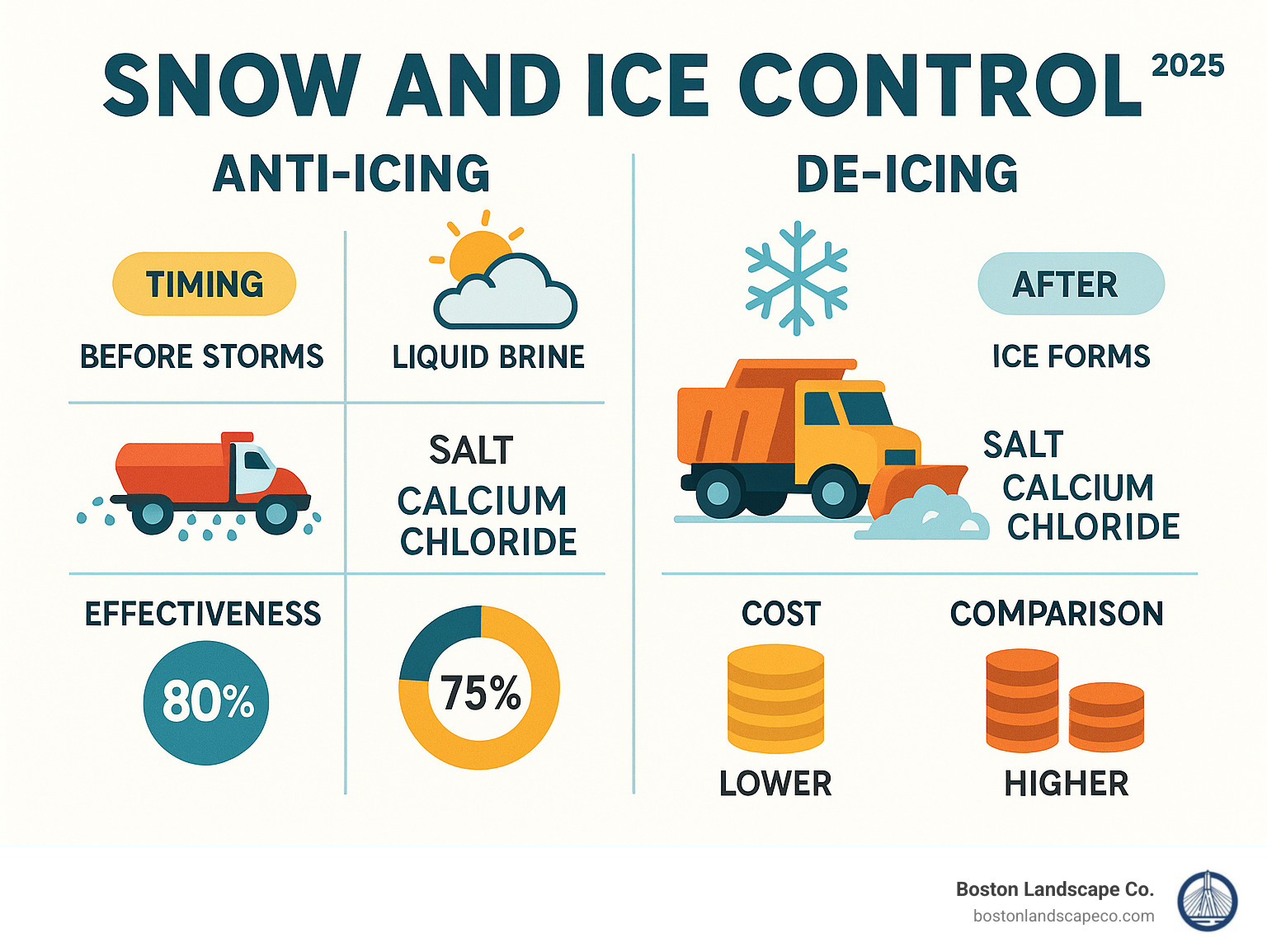
Beyond mechanical removal, chemical applications are crucial for effective snow and ice control. We use two primary strategies: anti-icing and de-icing.
Anti-icing is a proactive measure where we apply a liquid or solid de-icer before a storm. This prevents snow and ice from bonding to the pavement, making plowing much easier.
De-icing is applied after snow or ice has accumulated to melt it and restore surfaces to a safe, clear state.
We use a variety of de-icing materials, each with unique properties:
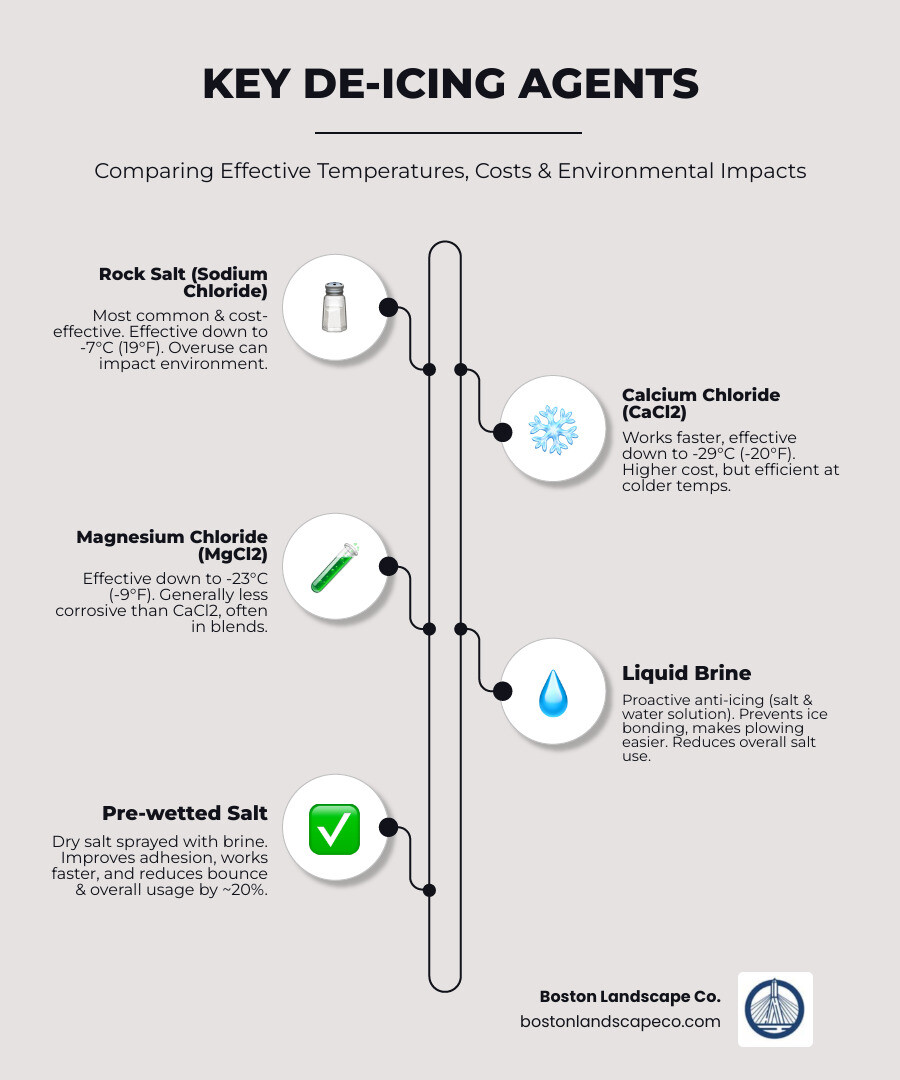
- Rock Salt (Sodium Chloride): The most common and cost-effective de-icer, effective down to about -7 C (19 F).
- Calcium Chloride (CaCl2): Works faster and at much colder temperatures, down to -29 C (-20 F), but is more expensive.
- Magnesium Chloride (MgCl2): Effective down to -23 C (-9 F) and is generally less corrosive than other chlorides.
- Liquid Brine: A solution of salt and water used for anti-icing. Pre-wetting dry salt with brine can reduce overall salt usage by about 20% on parking lots.
- Pre-wetted Salt: Dry salt sprayed with a liquid brine as it’s spread, helping it stick to the surface and work faster.
Application rates are critical and depend on pavement temperature and snow depth. Our team is trained to apply the right material at the right rate for optimal results.
The Evolution of Snow Management Technology
The snow and ice control industry has seen remarkable technological advancements, turning a brute-force operation into a sophisticated science. These innovations allow us to be more efficient, responsive, and environmentally responsible.
GPS tracking in our fleet allows us to monitor vehicle locations in real-time, optimizing routes and ensuring timely service. Automated spreader controls and ground-speed controllers are game-changers, automatically adjusting the amount of de-icer spread based on vehicle speed. This precision dramatically reduces material waste, with studies showing salt usage can be cut by up to 47% compared to manual spreaders.
Advanced weather monitoring and pavement sensors provide crucial real-time data on air and ground temperatures and precipitation forecasts. This information helps us make informed decisions about when to start anti-icing, which materials to use, and how much to apply.
By adopting these new technologies, we improve the effectiveness of our snow and ice control services and contribute to minimizing environmental impacts and improving operational efficiency, as detailed in the Operational Guidelines for Snow Removal and Ice Control.
Public vs. Private Snow Management: Priorities and Responsibilities
Understanding who handles snow and ice control can be confusing. Municipalities, property owners, and private contractors each have distinct roles, all working to keep communities safe.
How Municipalities Prioritize Snow Clearing
Municipalities use a tiered priority system to manage snow on public roads, focusing on safety, emergency services, and public transit.
- Priority 1 Streets: These are major arterial roads and emergency routes. The goal is typically to achieve bare pavement conditions quickly. For example, some cities aim to clear these routes within 36 hours of a storm’s end.
- Priority 2 Streets: These include collector roads and major bus routes, which are also typically plowed to bare pavement, though on a slightly longer timeline.
- Priority 3 Streets: These are residential streets. The service level is often to maintain a compacted snow surface rather than bare pavement. Plowing may only begin after significant accumulation (e.g., 10-20 cm) and can take several days to complete.
Snow accumulation triggers and windrow policies also vary. A windrow is the ridge of snow left by a plow. In some towns, residents are responsible for clearing windrows at their driveway entrance. You can often find a detailed snow and ice service levels map on municipal websites to understand local priorities.
The City of Longmont, for example, maintains 340 miles of roadway but only plows 140 miles as part of its program, emphasizing that plowing all streets would be prohibitively expensive.
Your Role: Responsibilities for Property Owners
While cities handle public roads, property owners are crucial for maintaining safety on their land and adjacent public spaces.
The most common responsibility is sidewalk clearing. Many municipalities require residents to clear snow and ice from adjacent sidewalks within 24 to 48 hours after snowfall stops, as outlined in local ordinances like the Municipal code. Failure to do so can result in fines.
Other duties include clearing a safe area around fire hydrants and maintaining private driveways. It’s important to never push snow from your property onto public streets, as this creates hazards.
For commercial property owners, these responsibilities extend to parking lots and walkways. Ensuring these areas are clear is vital for reducing liability and ensuring business continuity. This is where professional services become invaluable. You can explore our full range of services on our Snow Removal page.
Minimizing Environmental Impact: Sustainable Snow and Ice Control
Effective snow and ice control is essential, but it comes with an environmental cost. After three decades in this business, I’ve seen the industry evolve to tackle this challenge with more sustainable practices.
The Environmental Cost of Over-Salting
A sobering reality: parking lots and walkways account for 20 to 40% of all salt used in cities, despite covering less ground than roads. Application rates are often three times higher than on highways. This excess salt finds its way into our environment.
Chloride contamination is the biggest issue. Dissolved salt travels into groundwater, streams, and lakes, harming aquatic life and contaminating drinking water supplies. Salt also damages roadside vegetation, accelerates concrete degradation on sidewalks and foundations, and causes vehicle corrosion.
Best Practices for Eco-Friendly De-Icing
Fortunately, we have proven strategies for effective snow and ice control that reduce environmental impact without compromising safety. These smart practices also save money.
- Calibrated Equipment: We regularly calibrate spreaders to ensure precise material delivery, preventing over-salting.
- Pre-wetting Salt: Spraying dry salt with liquid brine helps it stick to surfaces and work faster. This simple technique can reduce salt usage by approximately 20% on parking lots.
- Direct Liquid Application (DLA): This cutting-edge anti-icing technique applies liquid de-icers with high precision, preventing ice from forming in the first place.
- Reduced Application Rates: We use weather data and pavement temperatures to apply the minimum effective amount of material. Anti-icing alone can reduce salt use by 25 to 75%, and ground-speed controllers can cut usage by up to 47%.
- Proper Snow Storage: We haul snow to designated areas where meltwater can be managed, preventing contaminated runoff into storm drains.
- Operator Training: Our team receives continuous education on best practices, guided by resources like the Winter Parking Lot and Sidewalk Maintenance Manual.
By combining these methods, we achieve excellent results while protecting the environment we all share.
Hiring a Professional: What to Look for in a Snow Removal Contractor
When winter storms hit, the right snow and ice control partner is the difference between smooth operations and costly disruptions. Hiring a professional isn’t just about convenience—it’s about protecting your investment, keeping people safe, and ensuring your business stays open.
A reliable contractor brings expertise that goes beyond just pushing snow. We understand the science of de-icing, the importance of timing, and how to balance safety with environmental responsibility. Crucially, we carry the insurance that protects you from the significant risks of winter weather management.
Learn more about the advantages on our Winter Preparedness: Why Your Business Needs Professional Snow Removal page.
Understanding Commercial Snow Removal Contracts and Costs
Navigating snow removal contracts requires understanding different pricing models and what drives costs in the snow and ice control industry.
- Per-Push/Per-Event Pricing: You are charged a set fee each time the property is serviced, often triggered by a specific snow accumulation.
- Per-Inch Contracts: Costs are tied to snowfall amounts, with rates increasing for higher accumulations. This model reflects the work required but can make budgeting difficult.
- Seasonal Flat-Rate Contracts: A fixed price for the entire winter season offers the most budget certainty, which is ideal for areas with predictably heavy snowfall like New England.
Please note that pricing ranges vary widely based on internet data and are not actual costs for Boston Landscape Co. Average commercial snow plowing can range from $50 to $160 per hour, though complex properties may see seasonal rates from $900 to over $2,700 per event.
Costs are impacted by overhead like liability insurance, employee wages, fuel, and equipment maintenance. Job complexity, such as property size, tight spaces requiring handwork, and the need for snow hauling, also plays a crucial role.
Key Questions to Ask a Potential Contractor
Choosing the right partner requires asking the right questions upfront.
- Equipment and Capabilities: Do they have a diverse, well-maintained fleet suitable for your property, including backup units?
- Staff Training: Are crews trained in safe operation, efficient plowing, and responsible de-icing? Industry certifications are a plus.
- Emergency Response Plan: How do they handle unexpected storms? What are their communication protocols?
- Proof of Insurance: This is non-negotiable. Verify they carry adequate liability coverage to protect you from slip-and-fall claims and property damage.
- Client References: Ask for references from similar properties to gauge their reliability and service quality.
- Storm Monitoring: Do they use advanced weather forecasting and other technologies to make proactive decisions?
At Boston Landscape Co., we are prepared to address all these critical considerations. Explore our services on our Commercial Snow Plowing Services Near Me page.
Frequently Asked Questions about Snow and Ice Control
Over my three decades in the snow and ice control business, I’ve fielded countless questions from property owners. Here are answers to the most common ones we hear in Greater Boston.
Why are parking lots and private roads a major focus for salt reduction?
This surprises people, but private surfaces are environmental heavyweights for salt use. Parking lots and walkways account for 20 to 40% of all salt used in cities. The reason is that application rates on these surfaces are often 3 times higher than on public roads.
On a highway, traffic helps grind salt into the pavement. In a parking lot with less traffic, contractors may over-apply salt to compensate. Furthermore, the pressure to avoid slip-and-fall lawsuits drives many to achieve a “bare pavement” look, leading to excessive salt use. That’s why we focus on calibrated equipment and proper application techniques—it’s safer and better for the environment.
Why don’t plows clear snow down to the bare pavement on every street?
This is a common question from residents. The short answer is that bare pavement is a premium service level reserved for the most critical routes. Municipalities operate on a priority system to manage costs and resources effectively. Priority 1 streets (major arterials, emergency routes) get the full bare pavement treatment.
Extending that service to every residential street would be prohibitively expensive and environmentally taxing due to the heavy chemical use required. Instead, many cities aim for “passable roadways” on residential streets, meaning a safe, compacted snow surface that is drivable but not completely clear.
What is a “windrow” and who is responsible for clearing it?
A windrow is the ridge of snow pushed to the side by a plow. You’ll find them along roadsides and, most notably, at the end of your driveway after the street has been cleared.
In most municipalities, property owners are responsible for clearing windrows at their driveway entrances. Local rules vary, but it’s a common part of winter property ownership. The key is to never push that snow back into the street, as it creates a hazard for drivers and often violates local ordinances. Instead, move the snow to another spot on your property.
Conclusion
When winter weather arrives, effective snow and ice control is your first line of defense. It’s not just about clearing snow—it’s about understanding the science of ice, choosing the right materials, and having a plan that keeps people safe while protecting your property and the environment. The key takeaway is that proactive planning always beats reactive scrambling.
For property owners, the stakes are high. A slip-and-fall lawsuit can be devastating, and business closures due to inaccessible lots hurt your bottom line. Modern snow and ice control uses technology like GPS tracking and automated spreaders to deliver precise, efficient service, using less salt while achieving better results.
Understanding the difference between municipal priorities and your own responsibilities helps set realistic expectations for the winter season.
At Boston Landscape Co., we’ve been navigating New England winters for over three decades. Our approach combines cutting-edge equipment with proven experience. What sets a professional service apart is the expertise to read weather patterns, the training to apply materials efficiently, and the commitment to show up when conditions are at their worst. We’re out there making sure your property stays safe and accessible.
Don’t wait for the first storm warning. The best time to plan your snow and ice control strategy is now.
Ensure your property is safe and accessible all winter with professional snow and ice management
